
Wat is een paralegal (en waarom zijn ze onmisbaar)?
Wat doet een paralegal precies? En waarin verschilt een paralegal van een advocaat of juridisch adviseur? Dat is een praktische keuze die direct impact heeft op uw kosten, snelheid en interne legal, commerciële en finance workload. Of u nu een bedrijf runt, sales of procurement aanstuurt, of juridische zaken intern beheert is dit van belang. Begrijpen wat een paralegal doet (of niet doet), kan u tijd, structuur en besparingen opbrengen.
Toch kennen veel organisaties vooral één route: “we hebben een advocaat nodig voor dit juridisch werk”. Dit is niet altijd nodig. Er is een belangrijke rol die vaak wordt onderschat: de paralegal. Daarom horen we in de praktijk steeds dezelfde vragen terug: wat doet een paralegal precies? Welke taken mag een paralegal oppakken? Hoe verschilt dit van een advocaat? En wanneer is een paralegal eigenlijk de slimste keuze? In dit artikel leggen we dat helder uit, inclusief concrete voorbeelden, zodat u sneller de juiste beslissing kunt nemen.

Wat we zullen behandelen:
- Wat een paralegal is,
- De rol van paralegals in zakelijke en juridische activiteiten,
- Praktijkvoorbeelden van de voordelen van paralegale diensten voor zakelijke en juridische belanghebbenden,
- Veelvoorkomende uitdagingen wanneer bedrijven paralegale ondersteuning over het hoofd zien, en
- Waarom paralegals cruciaal zijn in moderne bedrijfsomgevingen.
Wat is een paralegal?
De rol van paralegals in zakelijke en juridische teams
De eenvoudigste manier om uit te leggen wat een paralegal doet, is door te kijken naar de rollen die zij combineren. In de praktijk brengen paralegals vaardigheden samen van administratief medewerkers, junior en middenkader juridisch adviseurs en boekhoudkundig medewerkers. De verschillende rollen zijn als volgt.
- Administratieve ondersteuning: Paralegals zorgen ervoor dat documenten en bedrijfsgegevens nauwkeurig en toegankelijk zijn. Hierbij gaat het om bedrijfsadministratie, volmachten en UBO-registraties. Zij vormen hierdoor een perfecte aanvulling op het juridische team en zijn verantwoordelijk voor het beheer en onderhoud van deze documenten. Voor meer informatie over UBO verwijzen wij naar ons artikel “Ultimate Beneficial Ownership (UBO) uitgelegd – Wat is het en hoe creëer je een proces dat werkt” hier.
- Juridisch secretaresse: Een juridisch secretaresse organiseert dossiers, stelt correspondentie en juridische documenten op, plant vergaderingen en coördineert archivering. Paralegals bouwen hierop voort met diepgaandere juridische kennis en meer autonomie.
- Junior juridisch adviseur: De rol omvat het opstellen en proeflezen van contracten, uitvoeren van juridisch onderzoek, uitrollen van sjablonen en signaleren van risico’s. Zo kan een junior juridisch adviseur vrijwel alle taken van het juridische team uitvoeren.
- Boekhoudkundig assistent: Paralegals ondersteunen financiële en compliance functies die raakvlakken hebben met juridisch werk, zoals het bijhouden van betalingsverplichtingen, bewaken van contractdeadlines, ondersteunen van boekhouding en beheren van compliance-taken die audits beïnvloeden.
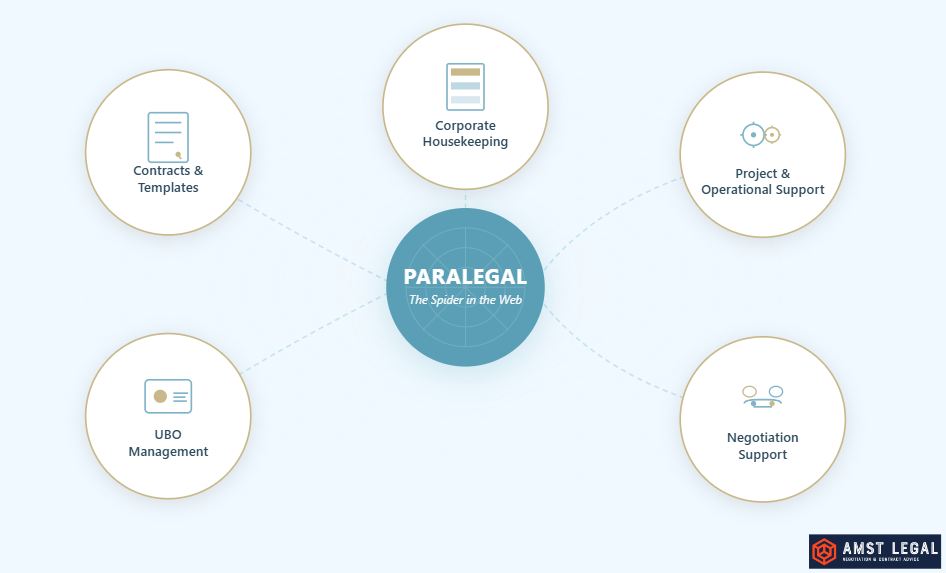
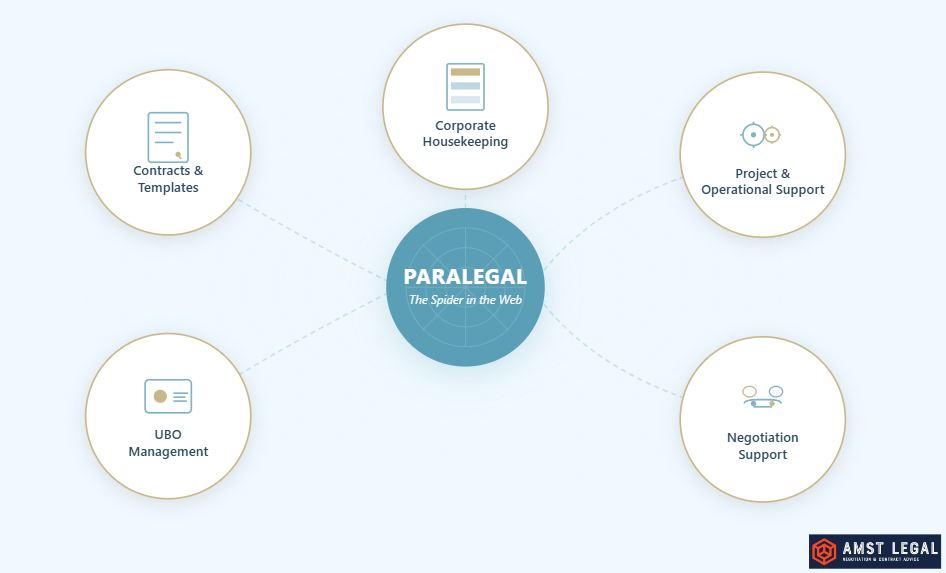
De echte waarde van een paralegal ligt in hoe deze functies samenkomen. Paralegals zien zichzelf als de ‘spin in het web’, coördineren tussen afdelingen en zorgen voor structuur en efficiëntie. Zo vervullen zij een centrale rol in het verbinden van juridische, commerciële en financiële processen.
Paralegal diensten in Europa
In Europa zijn paralegal diensten buiten juridische kringen minder zichtbaar, maar hun belang neemt toe. Veel verschillende belanghebbenden kunnen profiteren van een paralegal in het team, wat we hieronder nader zullen toelichten. Hoewel zij een cruciale rol spelen, hebben wetgevers in Nederland en Zweden geen algemene definitie of gemeenschappelijke beschrijving van de rol vastgesteld. In het Verenigd Koninkrijk definieert de National Association of Licensed Paralegals (NALP) een paralegal echter als:
“Een persoon die is opgeleid en getraind om juridische taken uit te voeren, maar die geen gekwalificeerde advocaat of procureur is.”
De NALP definieert de rol van paralegals op een manier die ook past bij Nederland en Zweden, aangezien zij advocaten en juridisch adviseurs bijstaan bij juridische taken. De rol kan echter breder zijn dan dat en de meeste paralegals in Nederland en Zweden hebben een hogere opleiding genoten.
Zie de website van de NALP en verdere informatie hier.
Onderwijs in Nederland en Zweden
In de meeste Europese landen is ‘paralegal’ geen beschermde titel, wat betekent dat professionals via verschillende routes het vakgebied kunnen betreden. Toch hebben de meesten een juridische opleiding gevolgd die hen toerust voor functies bij bedrijven en advocatenkantoren.
In Nederland is het gebruikelijk om rechten te studeren op verschillende niveaus, van hogeschool tot universiteit. Elke route biedt verschillende niveaus van juridische kennis en praktische vaardigheden, maar alle kunnen leiden tot functies als juridisch medewerker. Zoals we bij veel bedrijven hebben gezien, zijn deze functies een uitstekende springplank om carrière te maken en door te groeien naar andere functies binnen het bedrijf.
In Zweden zijn veelvoorkomende trajecten onder meer beginnen als juristassistent na de middelbare school, een tweejarige hogere beroepsopleiding met stages volgen, of rechten studeren aan de universiteit en tegelijkertijd werkervaring opdoen.
Daardoor beschikken zowel Nederlandse als Zweedse paralegals over een combinatie van academische opleiding en praktische vaardigheden, waardoor ze flexibel inzetbaar zijn voor verkoopteams, inkoopmanagers en bedrijfsjuristen.
Paralegal-diensten in de VS
In de VS is ‘paralegal’ een bekend beroep en wordt er sinds eind jaren zestig, toen ze werden erkend door de American Bar Association (ABA), een formele opleiding gegeven. De huidige definitie van een paralegal volgens de ABA luidt als volgt:
“Een paralegal is een persoon die door opleiding, training of werkervaring gekwalificeerd is en in dienst is van of wordt ingehuurd door een advocaat, advocatenkantoor, bedrijf, overheidsinstantie of andere entiteit en diespecifiek gedelegeerde inhoudelijke juridische werkzaamheden verricht waarvoor een advocaat verantwoordelijk is”.
Zie de website van de ABA hier en meer informatie over de historische achtergrond hier.
Met andere woorden, een paralegal in de VS houdt zich bezig met juridische zaken die door de verantwoordelijke advocaat zijn gedelegeerd. Hoewel er in de VS geen landelijke regelgeving bestaat, stelt Californië specifieke eisen aan paralegals.
Zie de website van de American Association for Paralegal Education hier en de website van de National Federation of Paralegal Associations hier voor meer informatie.
Wat paralegals bijdragen aan zakelijke en juridische teams
Waarom paralegals essentieel zijn
Paralegals bieden veel meer dan een administratief medewerker dankzij hun bachelordiploma in de rechten. Door gebruik te maken van paralegalservices krijgt u gestructureerde juridische ondersteuning, waarmee de kloof wordt overbrugd tussen routinematige documentatie en hoogwaardig juridisch werk. Daarom werken veel paralegals bij advocatenkantoren of in-house juridische teams.
Houd paralegals dus in gedachten wanneer u een advocaat of juridisch adviseur overweegt. Er zijn twee belangrijke redenen om dat te doen. Ten eerste vermindert het de juridische kosten, bijvoorbeeld door de paralegal uw adviseur te laten assisteren of voorbereidend werk uit te voeren dat geen advocaat vereist. Ten tweede stroomlijnt het gebruik van een paralegal processen zoals verkoop, inkoop en compliance. Hierdoor ontstaan mogelijkheden voor hogere inkomsten, terwijl u juridisch beschermd blijft.
Wat u kunt verwachten van paralegal diensten
Om een nog duidelijker beeld te krijgen van hoe paralegaldiensten kunnen bijdragen aan het dagelijkse werk van uw bedrijf of advocatenkantoor, gaan we dieper in op de details. Over het algemeen zijn de beperkingen van wat paralegals juridisch gezien kunnen doen vaag. Dit komt door het gebrek aan regelgeving. Natuurlijk zijn bepaalde taken uitsluitend voorbehouden aan advocaten. Dat betekent echter niet dat paralegals niet kunnen helpen bij het begin van een traject. Ook kunnen zij aan het einde een snelle controle uitvoeren. Kortom nemen zij doorgaans het tijdrovende voorbereidende werk uit handen van advocaten of juridisch adviseurs. De verantwoordelijkheden van paralegals omvatten daarbij een reeks documenten die aan de basis liggen van elk bedrijf.
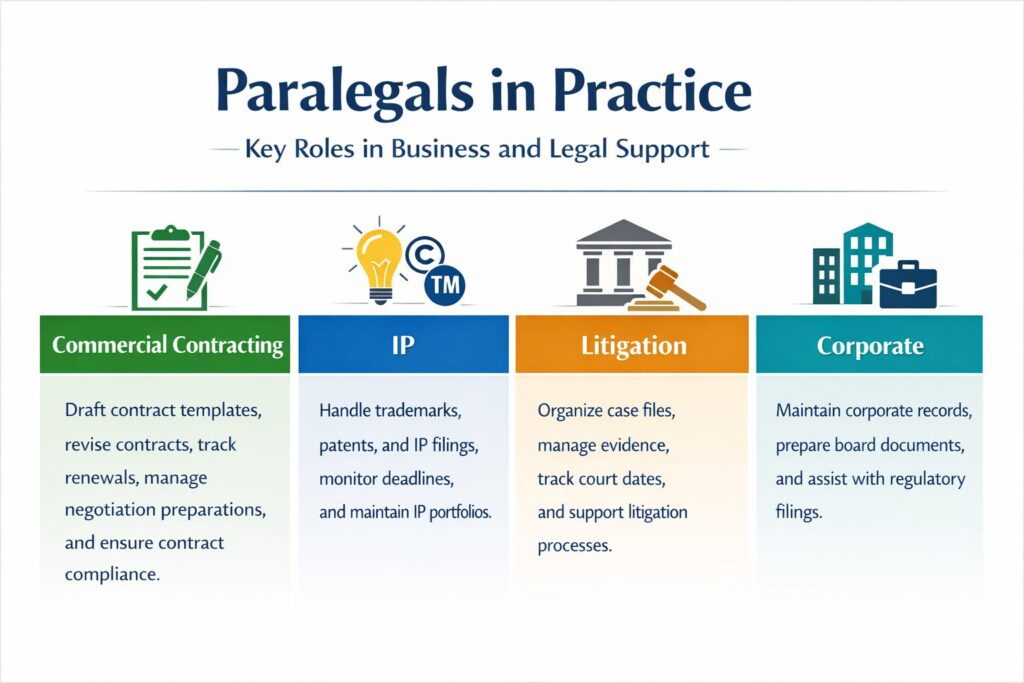
Paralegale diensten worden uitgevoerd door opgeleide professionals die gedelegeerde juridische taken uitvoeren, zoals contracten onderhandelen en voorbereiden, compliance werkzaamheden en bijhouden en structureren van bedrijfsdocumentatie.
8 voorbeelden waar paralegals kunnen worden ingezet
Om een paar dingen te noemen die deel uitmaken van het werk van paralegals, omvat dit normaal gesproken:
- het maken van lijsten van bijvoorbeeld debiteuren en crediteuren, belanghebbenden, concurrenten enz.
- het structureren en proeflezen van contracten en documenten zoals bestelformulieren, geheimhoudingsverklaringen, volmachten, arbeidscontracten, algemene voorwaarden, routinematige leveranciers- of klantovereenkomsten enz.
- het voorbereiden, opstellen en archiveren van juridische en bedrijfsdocumenten (d.w.z. bedrijfsadministratie en UBO)
- het sorteren en beoordelen van bewijsmateriaal voor cliënten,
- het uitvoeren van juridisch onderzoek naar relevante onderwerpen,
- het opstellen van contract sjablonen en instructies en/of informatie voor cliënten,
- het uitrollen van nieuwe bestelformulieren, algemene voorwaarden, sjablonen en informatie naar cliënten,
- het assisteren bij compliance-kwesties (zoals gegevensprivacy, gegevensbescherming, handelscontrole, enz.).
Hoewel advocaten of juridisch adviseurs uiteindelijk natuurlijk een aantal van deze documenten moeten controleren, kunnen paralegals de eerste controle uitvoeren. Op die manier kunnen ze een brug slaan tussen de verschillende contractprocessen van een bedrijf. Tegelijkertijd zorgt dit voor structuur en kunnen advocaten of juridisch adviseurs zich concentreren op complexe kwesties. Dit biedt mogelijkheden en gestroomlijnde, maar toch kostenbesparende processen. Kortom, paralegals zijn een geweldige aanvulling voor juridische teams bij bedrijven van verschillende grootte.
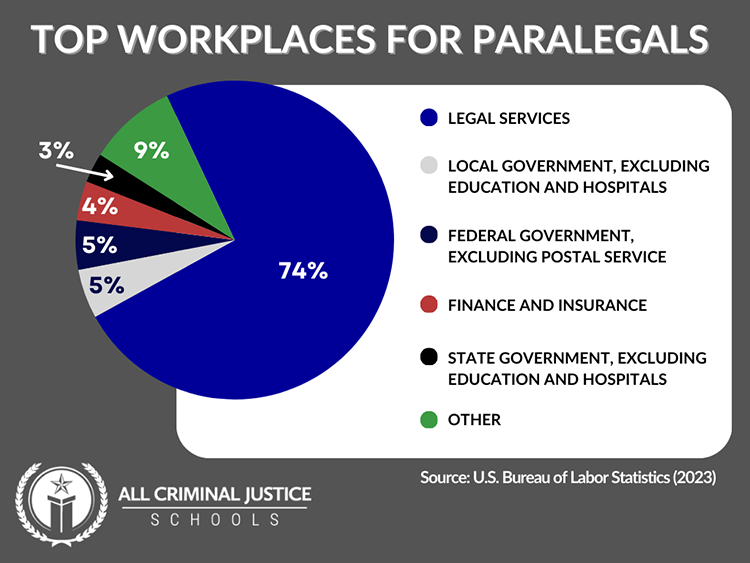
Voorbeelden van sectoren van (Amerikaanse) paralegals. Externe bron (zie link hier).
Voordelen van het inhuren van een paralegal
Praktische voordelen
We hebben besproken wat een paralegal is en voorbeelden gegeven van wat u van hun diensten kunt verwachten. Nu gaan we concreet aangeven hoe uw bedrijf of advocatenkantoor kan profiteren van het inhuren van zo’n juridisch professional. Om de verschillende voordelen te benadrukken, gaan we hierna dieper op deze punten in. Impact op het bedrijf: snelheid, duidelijkheid, kosten- en procesefficiëntie.
Bedrijven hebben vaak moeite om een evenwicht te vinden tussen commerciële snelheid en risicobeheer. Door gebruik te maken van paralegaldiensten en deze te integreren in de bedrijfsvoering, kan deze kloof worden overbrugd. Dit maakt snellere contractcycli mogelijk. Daarnaast zorgt het voor betere communicatie tussen afdelingen en lagere totale juridische kosten. Hierdoor hoeven verkoop- en inkoopteams niet langer te wachten tot routinematige juridische taken zijn uitgevoerd door een dure senior adviseur.
In plaats daarvan ontvangen zij tijdige en betaalbare ondersteuning van een paralegal. Zo blijft het bedrijf operationeel, zonder te bezuinigen op actuele juridische aspecten en compliance.
Enkele voorbeelden van voordelen in het bedrijfsleven
In het bedrijfsleven vermindert deze aanpak:
- gemiste nalevingsdeadlines die de financiering vertragen,
- vertragingen bij transacties die de verkoopcycli frustreren en
- inconsistente voorwaarden die het risico voor leveranciers vergroten.
Dit gestructureerde proces vermindert de kans op latere geschillen en stroomlijnt processen, aangezien voorwaarden consistent worden toegepast en correct worden gedocumenteerd. Juridisch adviseurs kunnen zich concentreren op complexe vragen, nieuwe mogelijkheden en gestroomlijnde, maar toch kostenbesparende processen.
Naast het inhuren van een paralegal kunnen bedrijven hun contractprocessen aanzienlijk vereenvoudigen door onze tips voor 10 manieren om uw contractprocessen te verbeteren toe te passen. Bekijk hieronder enkele van onze gepubliceerde artikelen over dit onderwerp:
- hier om te weten waarom u zich moet richten op het verbeteren van uw contractsjablonen,
- hier voor tips over het beheren van uw contractsjablonen,
- hier om de voordelen te zien van een sterke samenwerking tussen de juridische afdeling en andere afdelingen, en
- hier om te leren waarom het cruciaal is om uw juridisch adviseur leiding te laten geven aan het verbeteren van contractsjablonen.
Bovendien zijn de voordelen van paralegale diensten niet beperkt tot verbeterde bedrijfsprocessen en resultaten. Het is ook gunstig in termen van juridische impact en ondersteuning voor de verantwoordelijke juridisch adviseur. .
Juridische impact: verbeterde structuur, betere schaalbaarheid Vanuit juridisch oogpunt verminderen paralegale diensten allereerst de kans op fouten en geschillen, doordat zij zich richten op de details van documentatie en contracten. Daardoor blijven dossiers volledig en consistent, wat ervoor zorgt dat bedrijven met vertrouwen kunnen opschalen. Met name bij uitbreiding naar nieuwe markten of bijvoorbeeld tijdens de voorbereiding van een overname, leidt goed bijgehouden documentatie tot een lager risico. Tegelijkertijd positioneert het bedrijf zich als een professionele en betrouwbare partner. Bovendien kunnen juridische adviseurs zich focussen op complexe contracten, omdat zij worden ontlast van routinematig werk. Zo ontstaat een ideale basis voor juridische én zakelijke resultaten.
Image source: Forbes Outsourcing Paralegal Work: Why Remote Paralegals Are The Future Of Legal
Praktische uitdagingen bij het ontbreken van paralegale ondersteuning
Wanneer paralegale ondersteuning ontbreekt, worden bedrijven in de praktijk vaak geconfronteerd met vermijdbare knelpunten. Zo kan bijvoorbeeld de goedkeuring van contracten vertraging oplopen, omdat niemand de concepten structureert of deadlines bewaakt. Daarnaast kunnen bedrijfsaangelegenheden, zoals jaarlijkse aandeelhoudersbesluiten, eenvoudig over het hoofd worden gezien. Dit leidt vervolgens tot nalevingsrisico’s en onnodige vertragingen. In veel gevallen grijpen verkoopteams terug op verouderde sjablonen of brengen zij ad-hocwijzigingen aan. Hierdoor ontstaan inconsistenties en juridische kwetsbaarheden. Uiteindelijk verhoogt dit gebrek aan structuur de kosten op de lange termijn.
Kansen bij een goede aanpak
Daarentegen profiteren bedrijven aanzienlijk wanneer zij paralegale diensten structureel in hun workflow integreren. Niet alleen winnen zij aan snelheid, maar ook aan betrouwbaarheid. Hierdoor doorlopen contracten sneller de beoordelingscycli, aangezien steeds met de juiste versie wordt gewerkt. Daarnaast worden handtekeningen zorgvuldig bijgehouden en worden belangrijke voorwaarden uitsluitend gemarkeerd voor input van advocaten of bedrijfsjuristen wanneer dat nodig is. Bovendien blijven bedrijfsdocumenten actueel, waardoor audits, nalevingscontroles en verzoeken van investeerders direct kunnen worden afgehandeld.
Als resultaat ontstaat een soepelere samenwerking tussen zakelijke en juridische belanghebbenden. Zo weten inkoopmanagers dat de voorwaarden consistent zijn, en vertrouwen CFO’s erop dat de documenten in orde zijn. Tegelijkertijd krijgen oprichters het vertrouwen dat hun bedrijf juridisch voorbereid is op groei of omzetstijging.
Belangrijkste conclusies
- Paralegals bieden essentiële juridische ondersteuning die bedrijven van elke omvang tijd en kosten bespaart.
- Bedrijven zonder paralegal ondersteuning worden geconfronteerd met knelpunten, inconsistente contracten en compliance-risico’s.
- Door paralegal diensten te integreren met algemene juridische diensten ontstaan er soepelere processen voor verkoop-, inkoop- en juridische teams.
- Paralegal diensten zijn gunstig voor bedrijven in elke branche en voor advocatenkantoren.
- Bedrijven die investeren in paralegale ondersteuning winnen aan efficiëntie, duidelijkheid en juridische paraatheid voor groei en omzetstijging.
Conclusie en volgende stappen
Paralegale diensten zijn niet langer optioneel voor groeiende bedrijven. Allereerst bieden ze een praktische oplossing om kosten te verlagen, compliance te verbeteren en ervoor te zorgen dat contracten zonder vertraging door de pijpleiding lopen. Daarnaast vormen ze een geweldige investering om uw interne juridische adviseurs van de juiste ondersteuning te voorzien. Of uw bedrijf nu tech-deals sluit, relaties met leveranciers beheert of zich voorbereidt op een investering, blijven paralegals de gestructureerde juridische ondersteuning bieden die u nodig hebt. Zo verzekert u zich van efficiëntie en betrouwbaarheid op alle juridische vlakken.
Bij AMST Legal combineren we senior juridisch advies met deskundige paralegale diensten, waardoor we onze klanten de juiste mix van strategie en uitvoering kunnen bieden. Ons werk omvat zowel individuele projecten als tijdelijke overeenkomsten met een vast aantal uren per week, waardoor u kunt rekenen op flexibiliteit en betrouwbaarheid. Wij bieden flexibele paralegale diensten en senior juridisch advies in Stockholm, Zweden en Amsterdam, Nederland.
Bezoek amstlegal.com voor meer informatie of boek vandaag nog een consult hier of stuur een e-mail naar info@amstlegal.com.
Om hierover meer te lezen, zie de volgende artikelen:

Peak Workload – How to Improve Contract Processes and Set Q4 Priorities
Also notice an enormous peak of contracts that need to be signed before the end of the year? This year will be no different. After starting as a lawyer in 2004, I constantly noticed this peak at the end of the year. After asking my fellow lawyers & negotiators, this seems to be a constant for most corporate & commercial contracting professionals. As teams enter the final stretch of Q4, the pressure to improve contract processes grows rapidly. Sales, procurement, legal, partnerships and finance all face a peak contract workload while internal availability drops and deadlines accelerate. This combination often produces stress, bottlenecks and unclear priorities. However, when organizations take a structured approach to Q4 planning and align on meaningful priorities early, they reduce friction and accelerate execution without sacrificing legal quality or commercial accuracy. This article explains how business and legal teams can set the right Q4 priorities, streamline internal coordination and manage contracts intelligently during the busiest period of the year.
With 19 December 2025 expected to be the final practical day for executing agreements, it’s more important than ever to focus on the contracts that drive strategic impact. At the same time, managing dormant deals, clearing roadblocks early and preparing the groundwork for Q1 2026 can significantly reduce last-minute stress and ensure a seamless transition into the new year.
This guide breaks down 9 practical, high-impact actions that will help you align your teams, accelerate deal cycles, and finish the year strong without sacrificing quality or burning out your workforce.
What We Will Cover
- How to set clear, realistic Q4 priorities across sales, procurement, legal, and leadership
- How to improve contract processes during peak contract workload
- How to reduce bottlenecks and eliminate low-value cycles
- How to balance speed with legal and commercial safeguards
- How to prepare for the new year while keeping Q4 delivery on track
Context and Importance of the Topic
Why Q4 Creates Pressure for Commercial and Legal Teams
Peak contract workload typically builds in November and December and slows down the Friday before Christmas. This is because companies push to finalize revenue, secure procurement budgets, and complete partnership renewals before year-end. Sales teams try to close deals to meet quotas, while procurement aims to finalize vendor agreements before budgets expire. Meanwhile, legal teams face a surge in review requests with shorter turnaround expectations, fewer available decision-makers, and a higher volume of non-standard negotiations. This combination magnifies misalignment and exposes the weaknesses of unclear processes.
Practical Challenges When Q4 Is Not Managed Properly
Teams that lack clear priorities face an immediate productivity drop. Sales focuses on high-value customer deals, procurement targets last-minute supplier contracts, and partnerships try to finalize distributor or reseller agreements—yet all three funnel into a single legal team with limited capacity. Without alignment, low-impact work gets equal attention, dormant deals drain time, and review queues grow faster than they shrink. These issues slow contracting cycles, frustrate counterparties, and risk missing revenue or budget deadlines.
Opportunities When Q4 Priority Setting Is Done Well
When organizations define clear Q4 priorities, they improve contract processes across multiple dimensions. Legal gains predictability, commercial teams gain transparency, and leadership gets a clear view of revenue or procurement impact. Prioritized work also reduces rework, shortens negotiations, and channels resources to the contracts that matter most—reducing calendar stress and improving year-end decision-making. As a result, teams close more impactful deals without sacrificing quality or compliance.
How This Fits Into the Broader Contract or Business Framework
Key Documents, Processes, and Phases to Consider
Year-end contracting typically spans three categories: customer-facing sales agreements, procurement/vendor contracts, and partnership arrangements such as distributors, resellers, or strategic alliances. Each flows through a predictable contracting process: intake, triage, drafting, negotiation, approval, and signature. During Q4 peaks, organizations should reassess intake channels, approval chains, fallback positions, signature authority, and final documentation workflows. When these elements are reasonably defined, teams move faster and reduce unnecessary escalations.
Connecting Processes Across Functions
Contracting cannot sit within a single department, especially during Q4. Sales needs structured negotiation paths for pricing, service levels, and timelines. Procurement requires clarity on commercial terms, supplier evaluation, and risk ownership. Partnerships depend on a balanced approach to exclusivity, territories, and performance commitments. Legal sits at the center of all three, translating business intent into enforceable language while protecting the organization. Improving contract processes requires connecting these groups so that information flows freely and issues surface early.
Balancing Flexibility With Risk Management
Speed increases during peak contract workload, but so does risk exposure. To maintain flexibility without losing safeguards, teams can agree on pre-approved fallback clauses, risk thresholds, and decision rules. For example, a customer deal with standard terms may bypass legal review, while a supplier contract above a certain financial threshold requires legal approval. Clear rules reduce cycle time, protect the business, and avoid last-minute escalations to leadership.
Take These Nine Actions to Successfully Close Out the Year
Now, let’s go into the practical examples and specific actions you can take at the end of the year. This will take preparation and buy in from the other teams, so focus on cooperation and communication with other teams. Avoid the top down approach where possible (see our article about this here). The end of the year can be a stressful period so it is all about creating understanding with the other teams and focusing on helping each other where possible to reach the best result. While trying to avoid the top down approach, do ensure that you have champions to reach your results in all layers in the organization. This means involving the leadership and senior management, as well as involving all team members of the commercial team. In our commercial contracting “world” this means Sales, IT, Tech, Procurement and other Commercial Business Teams entering into purchase, vendor and supplier contracts.
1. Align Your Teams on What Matters Most
Before diving into individual contracts, bring your cross-functional teams together including Legal, Sales, Procurement, Operations, and Finance. A lack of alignment is the fastest path to missed opportunities and duplicated effort. See also the article from the leading university MIT ‘3 ways to keep your team together in critical times’ here.
How to do it:
- Hold a short, focused Q4 planning session with key stakeholders.
- Map out each active deal and assign priorities.
- Identify blockers early (approvals, redlines, internal dependencies).
- Consolidate everything into a shared, accessible priority list.
Why does this work? When everyone knows the plan—and their role in it—you replace chaos with coordinated progress.
2. Lock in the Q4 Deals That Really Count
Once priorities are aligned, spotlight the agreements that are critical to your company’s year-end financials or strategic objectives.
Recommended actions:
- Assign dedicated team members to shepherd these deals across the finish line.
- Keep internal and external stakeholders informed with regular updates.
- Use approved tracking tools consistently to avoid miscommunication.
Ask yourself: Which deals materially impact revenue, partnerships, or strategic positioning? Based on your answer to this, it might make it easier to know what to focus on.
3. Give High-Value Deals the Time They Deserve
Large or strategically important agreements often involve more complex negotiations and require input from senior leadership.
Best practices:
- Conduct weekly status syncs with deal teams.
- Flag potential risks early and build backup plans.
- Pre-schedule time with executives for final reviews and approvals.
Why this matters:
These contracts deliver the greatest impact—and often require the most care.
4. Close Smaller Deals Quickly to Build Momentum
Not every deal needs heavy negotiation. Smaller, straightforward agreements can be finalized quickly when approached with intention. As also confirmed in numerous studies and by Harvard University (see this link explaining why celebrating small wins matters).
Your playbook:
- Set a target date in early December to close these low-effort deals.
- Automate workflows (signing, approvals, templates) wherever possible.
The benefit:
Quick wins free your team to focus on more complex negotiations later in the month.
5. Tackle Dormant Deals Before They Drain Time
Dormant contracts—ones you’ve chased without progress—tend to clutter your pipeline.
How to manage them:
- Evaluate whether each deal can realistically close in Q4.
- If not, document the status and move it into your 2026 pipeline.
Pro tip:
Clearing out stalled deals improves focus and removes unnecessary noise.
6. Communicate Proactively With Customers or Vendors
Strong, consistent communication prevents last-minute surprises and keeps deals on track. This sounds so logic that we should not even mention it, but in most companies that we have been involved in, we see that it is very common that people are only waiting for an answer. We understand that this happens as there are hundreds of contracts to be managed, but this waiting game will often lead to last-mite stress and very high peaks just before the start of a holiday period.
What to do:
- Align on closing timelines and expectations.
- Follow up consistently (but respectfully).
- Confirm customer-specific requirements, e.g., signing protocols, timing, legal or compliance approvals.
Why it helps:
Transparency builds trust and keeps your pipeline moving smoothly.
7. Empower Your Team With the Right Tools and Instructions
Your team can only move as fast as your internal systems allow.
Set them up for success by:
- Storing contracts in the correct internal locations for compliance and visibility.
- Tracking negotiation, approval, and signature steps in your official tools.
- Reminding everyone of approval thresholds, escalation paths, and policy requirements.
Outcome:
Streamlined workflows prevent confusion and reduce turnaround times.
8. Review Your Processes—Not Just the Contracts
A successful year-end close isn’t just about finishing agreements. It’s about ensuring your internal process supports fast, compliant execution.
Questions to consider:
- Are approval chains clear and respected?
- Are compliance checks documented?
- Who is available for year-end signatures?
Why it matters:
Even the best-negotiated deal can stall if your internal process is slow or unclear.
9. Only Prepare Q1 2026 Deals When Your Q4 Is Under Control
If your team has extra capacity, now is the perfect time to set up Q1 for success—but only after critical Q4 work is complete.
Suggested early prep:
- Refresh templates and fallback clauses.
- Schedule early-January alignment sessions.
- Resolve known issues that could delay Q1 negotiations.
Key reminder: Year-end focus should stay firmly on finishing 2025 strong.
Practical Examples and Use Cases
Example 1 — Supporting a Tech Company Facing End-of-Year Customer Renewals and New Enterprise Deals
When we supported a fast-growing SaaS company preparing for a demanding Q4, their sales and legal teams were overwhelmed by simultaneous enterprise renewals and a pipeline of new mid-market deals. The primary issue was that everything looked urgent, which meant nothing received the right level of attention. We helped the team improve contract processes by creating a structured triage model that classified contracts into three streams: high-value enterprise deals with leadership involvement, medium-tier customer contracts that required legal review, and standard renewals that could move forward through automated templates. By focusing first on high-impact agreements, removing low-value distractions, and coordinating weekly alignment sessions between sales, finance, and legal, the company accelerated closures and reduced unnecessary negotiation cycles during their peak contract workload.
Example 2 — Helping a High-Fashion Brand Fix Procurement Contracts Across IT, Tech, Software, and Professional Services
A luxury fashion house engaged us when their procurement team was struggling to finalize multiple IT, software, and professional services agreements before budgets expired. The issue wasn’t legal complexity—it was a lack of clear priorities and inconsistent intake. Teams were spending time on small tactical contracts while strategic supplier agreements sat idle. We first helped procurement and legal jointly define Q4 priorities, identifying which vendors materially impacted operations or budget planning. Then we aligned internal stakeholders—procurement, IT, security, finance, and legal—through short weekly checkpoints focused exclusively on those priority contracts. We also cleaned up dormant deals and moved non-essential negotiations to Q1. As a result, the company stabilized its supplier pipeline, reduced negotiation drag, and avoided year-end spending pressure.
Example 3 — Training a Fintech Provider to Improve Contract Processes Through Templates, Policies, and Hands-On Guidance
A fintech services company asked us to improve their contracting efficiency during peak contract workload, but the real underlying problem was inconsistent knowledge across teams. Sales, operations, and product all used different contract versions, and only legal understood the approval thresholds and fallback positions. To improve contract processes sustainably, we conducted targeted training sessions on the correct templates, escalation rules, risk thresholds, and standard negotiation positions. We also introduced a “first-level review” checklist so business teams could handle straightforward issues themselves before involving legal. This freed the legal department to focus on high-value negotiations while enabling commercial teams to move faster with low-risk contracts. By year-end, the company saw a measurable reduction in turnaround time and far fewer last-minute escalations.
Benefits of Doing This Well
Business Impact: Speed, Clarity, Efficiency
Improved contract processes reduce cycle time, minimize distractions, and ensure that commercial teams focus on high-value opportunities. Prioritization improves forecasting accuracy and helps leadership plan revenue, cost, and budget decisions more reliably. The organization closes more meaningful contracts with less friction and greater transparency.
Legal Impact: Lower Disputes, Better Scalability
When priorities are clear and workflows are consistent, legal teams experience fewer urgent escalations and less rework. Contracts become more consistent, negotiation positions become clearer, and documentation improves. This reduces future disputes and enables legal teams to scale their support more effectively across the business.
Key Takeaways
- Improve contract processes early to handle peak contract workload confidently
- Set clear Q4 priorities across sales, procurement, legal, partnerships, and finance
- Remove dormant deals and focus resources where the business impact is highest
- Strengthen communication channels to prevent late-stage surprises
- Prepare the early Q1 pipeline only once critical Q4 contracts are secured
Conclusion & Call to Action
As year-end approaches, the difference between a controlled contracting function and a chaotic one often comes down to clarity, preparation, and alignment. Organizations that improve contract processes early manage peak contract workload more effectively and protect both commercial and legal outcomes. If your team needs support with contract prioritization, negotiation, or process improvement, AMST Legal can help you close Q4 efficiently while setting up a strong foundation for the new year.
Visit amstlegal.com to book a consultation with Robby Reggers via our appointment page.

Introducing Paralegal Services – What is a paralegal and why do you need one?
What exactly does a paralegal do? How are paralegals different from lawyers or legal counsels? If you run a business, lead a sales or procurement team, or manage in-house legal operations, understanding the answer can save you both time and money. In the legal profession, there are many different roles. Most people are only familiar with lawyers and legal counsels. However, there is an additional role that everyone should know about. It is an important profession that is often misunderstood: paralegals.
Although the role is gaining in popularity, there are many misconceptions or questions what they do exactly and which paralegal jobs are most popular. Common questions we also hear are: “Shouldn’t we refer to the role as paralegal legal assistant or paralegal assistant”? Also: “Should I hire a paralegal or lawyer for this” or “Where can a paralegal help me here”. As we often see and hear a need for them, we wrote this article to answer these questions. We will also cover the difference is between a paralegal vs lawyer or legal counsel. Hopefully, this will clear any confusion you might have about what paralegals are and what they can do.
“Paralegal services involve trained professionals who handle delegated legal tasks such as contracts, compliance and corporate records, allowing lawyers and business teams to focus on strategy.”
What we will cover
- What a paralegal is,
- The role of paralegals in business and legal operations
- Real-world examples of the benefits of paralegal services for business and legal stakeholders,
- Common challenges when companies overlook paralegal support, and
- Why paralegals are critical in modern business environments.
What is a paralegal?
The role of Paralegals in Business and Legal Teams
The easiest way to explain what a paralegal does is to describe the roles they combine. In practice, paralegal services merge elements of several professions and skills of administrative assistants, junior / mid level legal counsels and accounting assistants. Thus, the different roles are usually as follows:
- Administrative assistance: ensuring documents or corporate records like Corporate Housekeeping, Powers of Attorney and UBO filings are accurate and accessible. We have seen that paralegals are perfect additions to the legal team to be the person responsible for these documents. For further information about UBO, see our article “Ultimate Beneficial Ownership (UBO) Explained – What is it and How to Create a Process That Works” here).
- Legal secretary: A legal secretary focuses on organizing case files, preparing correspondence, formatting legal documents, scheduling meetings, and coordinating filings for lawyers or partners in a law firm.. Paralegals build on this role with deeper legal knowledge and greater autonomy.
- Junior legal counsel: in our practice, this means drafting contracts, proof-reading agreements, conducting legal research, rolling out templates (like order forms and terms and conditions) and flagging potential risks for lawyers to address. Generally speaking, junior legal counsel can basically do all tasks that the other legal counsels in the legal team are responsible for.
- Accounting assistant: Many paralegals also support the financial and compliance functions that intersect with legal work. This may include tracking payment obligations, monitoring contract deadlines, supporting bookkeeping related to legal spend, and managing compliance tasks that influence financial reporting or audit preparation.
However, the true value of a paralegal lies in how these functions come together. Paralegals often describe themselves as “the spider in the web,” coordinating across departments to create structure and efficiency. This image captures their central role in connecting legal, commercial, and financial processes.
Paralegal Services in Europe
In Europe, paralegal services are less visible outside legal circles, but their importance is growing. Many different stakeholders can benefit with a paralegal on the team, which we will elaborate on in the following. Although they do play a crucial role, lawmakers in the Netherlands and Sweden have not established a general definition or common description of the role. In the United Kingdom however, the National Association of Licensed Paralegals (NALP) define a paralegal as:
“A person who is educated and trained to perform legal tasks but who is not a qualified solicitor or barrister.”
NALP defines the role of paralegals in a way that also fits the Netherlands and Sweden, as they do assist lawyers and legal counsel with legal tasks. However, the role can be broader than that and most paralegals in the Netherlands and Sweden have higher education backgrounds.
See NALP’s website and further information here.
Education in the Netherlands and Sweden
In most European countries, “paralegal” is not a protected title, which means professionals can enter the field through different routes. Still, most have legal training that equips them for corporate and law firm roles.
In the Netherlands, it is common to study law at various level, from college to university. Each route provides varying levels of legal knowledge and practical skills, but all can lead to roles as juridisch medewerker (legal assistant). As we have seen in many corporates, these roles are a great stepping stone to advance in their career and grow to other roles in the company.
In Sweden, common paths include starting as a juristassistent after upper secondary school, completing a two-year higher vocational program with internships, or studying law at university while gaining work experience.
As a result, both Dutch and Swedish paralegals bring a mix of academic training and practical skills, making them adaptable resources for sales teams, procurement managers, and in-house counsel.
Paralegal Services in the USA
In the US, “paralegal” is a well-known profession and formal training has been on-going since late 1960s when they were acknowledged by the American Bar Association (ABA). The contemporary definition of a paralegal according to the ABA is as follows:
“A paralegal is a person, qualified by education, training, or work experience who is employed or retained by a lawyer, law office, corporation, governmental agency or other entity and who performs specifically delegated substantive legal work for which a lawyer is responsible”.
See the ABA’s website here and further information of the historical background here.
In other words, a paralegal in the US is working with law matters delegated by the responsible lawyer. Although the U.S. lacks nationwide regulation, California sets specific requirements for paralegals.
See the American Association for Paralegal Education’s website here and the National Federation of Paralegal Associations’ website here for more information.
What Paralegal Services contribute with to Business and Legal teams
Why Paralegals are Essential
They provide much more than what an administrative assistant can due to the bachelor degree of law obtained. Taking advantage of paralegal services leads to structured legal support that bridges the gap between routine documentation and high-level legal support. That is why it is very common to see many of them working at law firms or legal teams (inhouse legal). So, when considering hiring a lawyer or legal counsel, keep paralegals in mind too.
Why you should keep paralegals services in mind when considering legal resources, there are two main reasons. Firstly, it strains legal fees. Either by having the paralegal assist your legal counsel, relieving them of costly work or by letting the paralegal do preparatory legal work that does not require a legal counsel or lawyer. Secondly, using a paralegal streamlines processes (with sales, procurement, compliance etc.) which creates possibility for higher revenue while staying legally protected.
What to Expect from Paralegal Services
To create an even clearer picture of how paralegal services can contribute to your company’s or law firm’s day-to-day work, let us dive into the specifics. Generally, the limitations of what paralegals can do are vague from a legal point of view due to the lack of regulation. Naturally, certain tasks are only possible for lawyers to do, but that does not mean that they cannot assist in the beginning or do a quick check towards the end.
In sum, they typically handle the time-consuming preparatory work for lawyers or legal counsels. Responsibilities for paralegals cover a range of documents that sit at the foundation of every business.
8 examples Where to Use Paralegals
To name a few things that is part of the work of paralegals, it normally includes:
- making lists of e.g., debtors and creditors, stakeholders, competitors etc,
- structuring and proof-reading contracts and documents like order forms, NDA’s, power of attorney’s, employment contracts, terms and conditions, routine supplier or customer agreements etc,
- preparing, drafting and filing legal and corporate documents (i.e. corporate housekeeping and UBO),
- sorting and value evidence for clients,
- conducting legal research on relevant topics,
- drafting contract templates and client instructions and/or information,
- rolling out new order forms, terms and conditions, templates and information to clients,
- assisting in compliance matters (like data privacy, data protection, trade control etc).
While lawyers or legal counsel naturally should review some of these documents in the end, paralegals can do the initial check. By doing this, they can provide a bridge between the different contract processes of a company, At the same time, this brings structure and lets the lawyer or legal counsel focus on complex questions. This opens possibilities and streamlined yet cost-reduced processes. In short, paralegals are a great complement for legal teams at companies of varying sizes.
Advantages of hiring a paralegal
Practical Benefits
We have discussed what a paralegal is and examples of what can be expected from their services, but now we will pinpoint exactly how your business or law firm can benefit from hiring such a legal professional. To highlight the various benefits, we will delve into this below.
Business impact: speed, clarity, cost- and process efficiency
Companies often struggle to balance commercial speed with risk management. Taking advantage of paralegal services and integrating that into company operations benefit by bridging this gap. This enables faster contract cycles, better communication between departments and lower overall legal costs. In turn, sales and procurement teams no longer have to wait for routine legal tasks to be completed by an expensive senior counsel. Instead, they receive timely cheaper support from a paralegal that keeps business moving, without sparing on up-to-date legal aspects and compliance.
A Few Examples of Advantages in Business
In business, this approach reduces:
- missed compliance deadlines that slow funding,
- deal delays that frustrate sales cycles and
- inconsistent terms that increase supplier risk.
This structured process reduces likelihood of later disputes and streamlined processes since terms are consistently applied and properly documented.ior legal counsel focus on complex questions, opening possibilities and streamlined yet cost-reduced processes.
In addition to hiring a paralegal, businesses can heavily reduce their contract processes by applying our tips of 10 ways to improve your contract processes. Access some of our published articles on this topic below:
- here to know why you should focus on improving your contract templates,
- here to get tips on how to manage your contract templates,
- here to see the benefits of strong collaboration between legal and other departments, and
- here to learn why it is crucial to let your legal counsel lead the work of improving contract templates.
Furthermore, the benefits of paralegal services are not limited to improved business processes and results. It is also beneficial in terms of legal impact and aid for the legal counsel in charge.
Legal impact: improved structure, better scalability
From a legal perspective, paralegal services reduce the likelihood of errors and disputes as they go into the detail of the documentation and contracts. In turn, records are complete and consistent which helps companies scale up with confidence. When expanding into new markets or preparing for acquisition, well-maintained documentation reduces risk and positions the company as a professional, trustworthy partner. At the same time, when routine legal work is relieved from the legal counsel, they can focus on the legally complex contracts. Allowing this creates the ideal situation for successful legal and business outcomes.
Practical Challenges when Paralegal Support is Missing
Without a paralegal, companies frequently face avoidable bottlenecks. For example, contract approvals may stall because no one organizes the drafts or tracks deadlines. Corporate housekeeping tasks such as annual shareholder resolutions can be overlooked, creating compliance risks and delay. In many cases, sales teams resort to reusing outdated templates or making ad hoc edits, which leads to inconsistencies and legal vulnerabilities. This lack of structure increases costs in the long run.
Opportunities when handled well
When businesses integrate paralegal services into their workflow, they gain both speed and reliability. Contracts move faster through review cycles, because then the right version is used, signatures are tracked, and key terms are flagged for lawyer/in-house counsel input only when necessary. In addition, corporate records remain current, so audits, compliance checks, or investor requests can be answered immediately.
The result is a smoother collaboration between business and legal stakeholders. Procurement managers know that terms are consistent, CFOs trust that filings are in order, and founders gain the confidence that their company is legally prepared for growth or sales increase.
Key takeaways
- Paralegals provide essential legal support that saves time and cost for businesses of all sizes.
- Companies without paralegal support face bottlenecks, inconsistent contracts, and compliance risks.
- Integrating paralegal services with general-counsel services creates smoother processes for sales, procurement, and legal teams.
- Paralegal services are beneficial for companies within any industry and law firms.
- Businesses that invest in paralegal support gain efficiency, clarity, and legal readiness for growth and sales increase.
Conclusion & next steps
Paralegal services are no longer optional for growing businesses. They are a practical solution to reduce costs, improve compliance, and ensure contracts move through the pipeline without delay. At the same time, they are a great investment to ensure proper assistance to your in-house counsel. Whether your company is closing tech deals, managing supplier relationships, or preparing for an investment, paralegals provide the structured legal support you need.
At AMST Legal, we combine senior legal counsel with skilled paralegal services, offering clients the right mix of strategy and execution. Our work spans individual projects as well as interim arrangements with set hours each week, giving you flexibility and reliability. We offer flexible paralegal services and senior legal counsel services in Stockholm, Sweden and Amsterdam, the Netherlands.
👉 Visit amstlegal.com to learn more or book a consultation today here or email lowa@amstlegal.com.