

Introducing Paralegal Services – What is a paralegal and why do you need one?
What exactly does a paralegal do? How are paralegals different from lawyers or legal counsels? If you run a business, lead a sales or procurement team, or manage in-house legal operations, understanding the answer can save you both time and money. In the legal profession, there are many different roles. Most people are only familiar with lawyers and legal counsels. However, there is an additional role that everyone should know about. It is an important profession that is often misunderstood: paralegals.
Although the role is gaining in popularity, there are many misconceptions or questions what they do exactly and which paralegal jobs are most popular. Common questions we also hear are: “Shouldn’t we refer to the role as paralegal legal assistant or paralegal assistant”? Also: “Should I hire a paralegal or lawyer for this” or “Where can a paralegal help me here”. As we often see and hear a need for them, we wrote this article to answer these questions. We will also cover the difference is between a paralegal vs lawyer or legal counsel. Hopefully, this will clear any confusion you might have about what paralegals are and what they can do.
“Paralegal services involve trained professionals who handle delegated legal tasks such as contracts, compliance and corporate records, allowing lawyers and business teams to focus on strategy.”
What we will cover
- What a paralegal is,
- The role of paralegals in business and legal operations
- Real-world examples of the benefits of paralegal services for business and legal stakeholders,
- Common challenges when companies overlook paralegal support, and
- Why paralegals are critical in modern business environments.
What is a paralegal?
The role of Paralegals in Business and Legal Teams
The easiest way to explain what a paralegal does is to describe the roles they combine. In practice, paralegal services merge elements of several professions and skills of administrative assistants, junior / mid level legal counsels and accounting assistants. Thus, the different roles are usually as follows:
- Administrative assistance: ensuring documents or corporate records like Corporate Housekeeping, Powers of Attorney and UBO filings are accurate and accessible. We have seen that paralegals are perfect additions to the legal team to be the person responsible for these documents. For further information about UBO, see our article “Ultimate Beneficial Ownership (UBO) Explained – What is it and How to Create a Process That Works” here).
- Legal secretary: A legal secretary focuses on organizing case files, preparing correspondence, formatting legal documents, scheduling meetings, and coordinating filings for lawyers or partners in a law firm.. Paralegals build on this role with deeper legal knowledge and greater autonomy.
- Junior legal counsel: in our practice, this means drafting contracts, proof-reading agreements, conducting legal research, rolling out templates (like order forms and terms and conditions) and flagging potential risks for lawyers to address. Generally speaking, junior legal counsel can basically do all tasks that the other legal counsels in the legal team are responsible for.
- Accounting assistant: Many paralegals also support the financial and compliance functions that intersect with legal work. This may include tracking payment obligations, monitoring contract deadlines, supporting bookkeeping related to legal spend, and managing compliance tasks that influence financial reporting or audit preparation.
However, the true value of a paralegal lies in how these functions come together. Paralegals often describe themselves as “the spider in the web,” coordinating across departments to create structure and efficiency. This image captures their central role in connecting legal, commercial, and financial processes.
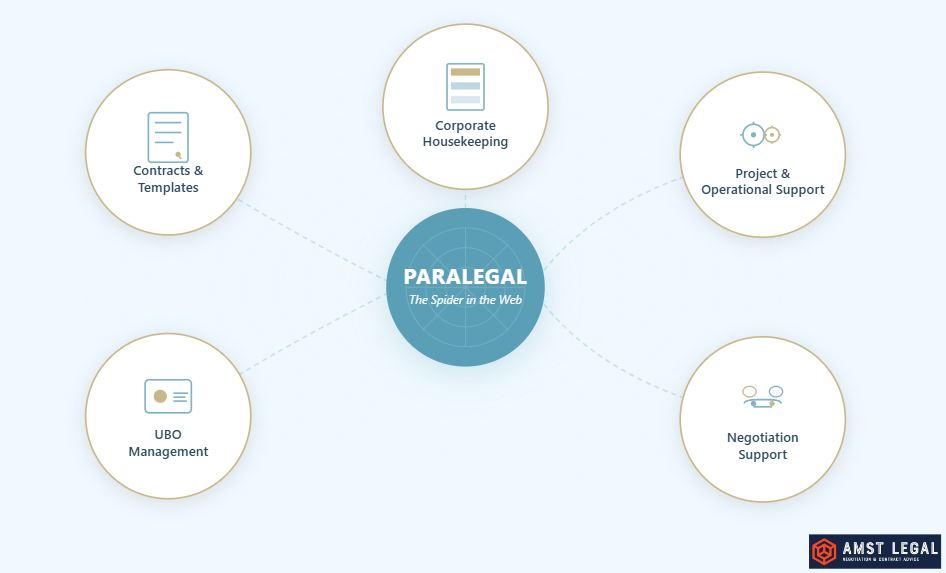
Paralegal Services in Europe
In Europe, paralegal services are less visible outside legal circles, but their importance is growing. Many different stakeholders can benefit with a paralegal on the team, which we will elaborate on in the following. Although they do play a crucial role, lawmakers in the Netherlands and Sweden have not established a general definition or common description of the role. In the United Kingdom however, the National Association of Licensed Paralegals (NALP) define a paralegal as:
“A person who is educated and trained to perform legal tasks but who is not a qualified solicitor or barrister.”
NALP defines the role of paralegals in a way that also fits the Netherlands and Sweden, as they do assist lawyers and legal counsel with legal tasks. However, the role can be broader than that and most paralegals in the Netherlands and Sweden have higher education backgrounds.
See NALP’s website and further information here.
Education in the Netherlands and Sweden
In most European countries, “paralegal” is not a protected title, which means professionals can enter the field through different routes. Still, most have legal training that equips them for corporate and law firm roles.
In the Netherlands, it is common to study law at various level, from college to university. Each route provides varying levels of legal knowledge and practical skills, but all can lead to roles as juridisch medewerker (legal assistant). As we have seen in many corporates, these roles are a great stepping stone to advance in their career and grow to other roles in the company.
In Sweden, common paths include starting as a juristassistent after upper secondary school, completing a two-year higher vocational program with internships, or studying law at university while gaining work experience.
As a result, both Dutch and Swedish paralegals bring a mix of academic training and practical skills, making them adaptable resources for sales teams, procurement managers, and in-house counsel.
Paralegal Services in the USA
In the US, “paralegal” is a well-known profession and formal training has been on-going since late 1960s when they were acknowledged by the American Bar Association (ABA). The contemporary definition of a paralegal according to the ABA is as follows:
“A paralegal is a person, qualified by education, training, or work experience who is employed or retained by a lawyer, law office, corporation, governmental agency or other entity and who performs specifically delegated substantive legal work for which a lawyer is responsible”.
See the ABA’s website here and further information of the historical background here.
In other words, a paralegal in the US is working with law matters delegated by the responsible lawyer. Although the U.S. lacks nationwide regulation, California sets specific requirements for paralegals.
See the American Association for Paralegal Education’s website here and the National Federation of Paralegal Associations’ website here for more information.
What Paralegal Services contribute with to Business and Legal teams
Why Paralegals are Essential
They provide much more than what an administrative assistant can due to the bachelor degree of law obtained. Taking advantage of paralegal services leads to structured legal support that bridges the gap between routine documentation and high-level legal support. That is why it is very common to see many of them working at law firms or legal teams (inhouse legal). So, when considering hiring a lawyer or legal counsel, keep paralegals in mind too.
Why you should keep paralegals services in mind when considering legal resources, there are two main reasons. Firstly, it strains legal fees. Either by having the paralegal assist your legal counsel, relieving them of costly work or by letting the paralegal do preparatory legal work that does not require a legal counsel or lawyer. Secondly, using a paralegal streamlines processes (with sales, procurement, compliance etc.) which creates possibility for higher revenue while staying legally protected.
What to Expect from Paralegal Services
To create an even clearer picture of how paralegal services can contribute to your company’s or law firm’s day-to-day work, let us dive into the specifics. Generally, the limitations of what paralegals can do are vague from a legal point of view due to the lack of regulation. Naturally, certain tasks are only possible for lawyers to do, but that does not mean that they cannot assist in the beginning or do a quick check towards the end.
In sum, they typically handle the time-consuming preparatory work for lawyers or legal counsels. Responsibilities for paralegals cover a range of documents that sit at the foundation of every business.
8 examples Where to Use Paralegals
To name a few things that is part of the work of paralegals, it normally includes:
- making lists of e.g., debtors and creditors, stakeholders, competitors etc,
- structuring and proof-reading contracts and documents like order forms, NDA’s, power of attorney’s, employment contracts, terms and conditions, routine supplier or customer agreements etc,
- preparing, drafting and filing legal and corporate documents (i.e. corporate housekeeping and UBO),
- sorting and value evidence for clients,
- conducting legal research on relevant topics,
- drafting contract templates and client instructions and/or information,
- rolling out new order forms, terms and conditions, templates and information to clients,
- assisting in compliance matters (like data privacy, data protection, trade control etc).
While lawyers or legal counsel naturally should review some of these documents in the end, paralegals can do the initial check. By doing this, they can provide a bridge between the different contract processes of a company, At the same time, this brings structure and lets the lawyer or legal counsel focus on complex questions. This opens possibilities and streamlined yet cost-reduced processes. In short, paralegals are a great complement for legal teams at companies of varying sizes.
Advantages of hiring a paralegal
Practical Benefits
We have discussed what a paralegal is and examples of what can be expected from their services, but now we will pinpoint exactly how your business or law firm can benefit from hiring such a legal professional. To highlight the various benefits, we will delve into this below.
Business impact: speed, clarity, cost- and process efficiency
Companies often struggle to balance commercial speed with risk management. Taking advantage of paralegal services and integrating that into company operations benefit by bridging this gap. This enables faster contract cycles, better communication between departments and lower overall legal costs. In turn, sales and procurement teams no longer have to wait for routine legal tasks to be completed by an expensive senior counsel. Instead, they receive timely cheaper support from a paralegal that keeps business moving, without sparing on up-to-date legal aspects and compliance.
A Few Examples of Advantages in Business
In business, this approach reduces:
- missed compliance deadlines that slow funding,
- deal delays that frustrate sales cycles and
- inconsistent terms that increase supplier risk.
This structured process reduces likelihood of later disputes and streamlined processes since terms are consistently applied and properly documented.ior legal counsel focus on complex questions, opening possibilities and streamlined yet cost-reduced processes.
In addition to hiring a paralegal, businesses can heavily reduce their contract processes by applying our tips of 10 ways to improve your contract processes. Access some of our published articles on this topic below:
- here to know why you should focus on improving your contract templates,
- here to get tips on how to manage your contract templates,
- here to see the benefits of strong collaboration between legal and other departments, and
- here to learn why it is crucial to let your legal counsel lead the work of improving contract templates.
Furthermore, the benefits of paralegal services are not limited to improved business processes and results. It is also beneficial in terms of legal impact and aid for the legal counsel in charge.
Legal impact: improved structure, better scalability
From a legal perspective, paralegal services reduce the likelihood of errors and disputes as they go into the detail of the documentation and contracts. In turn, records are complete and consistent which helps companies scale up with confidence. When expanding into new markets or preparing for acquisition, well-maintained documentation reduces risk and positions the company as a professional, trustworthy partner. At the same time, when routine legal work is relieved from the legal counsel, they can focus on the legally complex contracts. Allowing this creates the ideal situation for successful legal and business outcomes.
Practical Challenges when Paralegal Support is Missing
Without a paralegal, companies frequently face avoidable bottlenecks. For example, contract approvals may stall because no one organizes the drafts or tracks deadlines. Corporate housekeeping tasks such as annual shareholder resolutions can be overlooked, creating compliance risks and delay. In many cases, sales teams resort to reusing outdated templates or making ad hoc edits, which leads to inconsistencies and legal vulnerabilities. This lack of structure increases costs in the long run.
Opportunities when handled well
When businesses integrate paralegal services into their workflow, they gain both speed and reliability. Contracts move faster through review cycles, because then the right version is used, signatures are tracked, and key terms are flagged for lawyer/in-house counsel input only when necessary. In addition, corporate records remain current, so audits, compliance checks, or investor requests can be answered immediately.
The result is a smoother collaboration between business and legal stakeholders. Procurement managers know that terms are consistent, CFOs trust that filings are in order, and founders gain the confidence that their company is legally prepared for growth or sales increase.
Key takeaways
- Paralegals provide essential legal support that saves time and cost for businesses of all sizes.
- Companies without paralegal support face bottlenecks, inconsistent contracts, and compliance risks.
- Integrating paralegal services with general-counsel services creates smoother processes for sales, procurement, and legal teams.
- Paralegal services are beneficial for companies within any industry and law firms.
- Businesses that invest in paralegal support gain efficiency, clarity, and legal readiness for growth and sales increase.
Conclusion & next steps
Paralegal services are no longer optional for growing businesses. They are a practical solution to reduce costs, improve compliance, and ensure contracts move through the pipeline without delay. At the same time, they are a great investment to ensure proper assistance to your in-house counsel. Whether your company is closing tech deals, managing supplier relationships, or preparing for an investment, paralegals provide the structured legal support you need.
At AMST Legal, we combine senior legal counsel with skilled paralegal services, offering clients the right mix of strategy and execution. Our work spans individual projects as well as interim arrangements with set hours each week, giving you flexibility and reliability. We offer flexible paralegal services and senior legal counsel services in Stockholm, Sweden and Amsterdam, the Netherlands.
👉 Visit amstlegal.com to learn more or book a consultation today here or email lowa@amstlegal.com.