
Tip 5: Review the content of Your Templates
Introduction
This is a follow up on the previous tip 4 to make a full list of all your contract templates. If you want to read that part, follow this link here: https://amstlegal.com/tip-4-make-an-inventory-of-your-contract-templates/. Staying on the same track, we at AMST Legal strongly advise to regularly perform a detailed review of your contract templates. That is part of our tip 5 of the article series “How to Improve Contract Templates”.
Keep reading to learn more about this appraoch.
Review the contents of your templates
Leaning back on the previous tip 3, which builds on cross-departemental collaboration, legal should review the templates – of course together with business – to make sure that the templates are all legally up to date and still work for all products/services that you are offering and cover all business risks. That require knowledge of the content of your templates though. The solution to that is to review your contract templates on a regularly basis.
What the review can show you
Think back to when the company started. In the beginning, the company might used certain contract templates without legal alignment, i.e. templates made by the commercial team or online templates. Another scenario is that the company has changed considerably. Thus, your company’s current needs might not be reflected in the contract templates.
Due to this review you might also find out that you can potentially:
- combine templates to limit the amount of different templates,
- remove templates that are not used, or
- make new templates,
Doing this can further improve the scalability & productivity of your company.
Pro-tip
Certain large corporates that I have worked with even ask an external law firm every two years to do a full review of their templates. That concerns e.g. General Terms & Conditions and Master Ordering Agreement. This ensures that their templates are up to date. It can also show how they generally can improve the templates for the business and their customers.
Conclusion
If you make sure to keep an eye on your templates you can ensure that the content will be up to date, Additionally, the contracting process can be made easier if unnecessary templates are removed.
Do you want to improve your scalability and productivity? Contact us at AMST Legal for tailored advice on how to do this in a simple way.

Tip 4: Make an Inventory of Your Contract Templates
Introduction
Earlier, we provided tips on how legal should not be afraid to involve other departments. You can access that article through this link: https://amstlegal.com/tip-3-legal-involves-other-departments/. Moving on, we are going to dive into the next tip in the series on How to Improve Contract Templates. This tip 4 concerns making an inventory of all contract templates.
Make an inventory of your contract templates
A must when using contract templates, which we at AMST Legal highly advocate for, is to
- Regularly make a list of all contract templates that your company is using day to day.
- Make sure you know how many specific/different contract templates the company has for its products & services, countries, languages and departments.
Best is not to only ask the legal department, but to especially ask the business (e.g. Sales, Partnerships, Procurement, HR) which template contracts they are using day-to-day. Just to make sure, also ask them to send you the exact template they are using and check if they are using the right templates.
After making the list, you might be amazed how many different templates are currently in use by the company and where they are all stored. Having this list will give you a better idea which next steps you should take to improve your contract templates.
Conclusion
Organizing your contract templates, reviewing how many you have, and sorting them can be a life saver in stressful times. Oftentimes you might not even need all of the templates that you have currently. So make sure to regularly check up on the status of your contract templates.
How many contract templates do you have in your company?
If you want to become even more structure, and streamline your contracting process – contact us at AMST Legal for tailored advice. Let’s take your contracting to the next level!

Tip 3: Legal Involves Other Departments
Introduction
Previously, we shared valuable tips on how to structure legal’s responsibility of the contract process. Access it here if you haven’t read it: https://amstlegal.com/tip-2-legal-in-the-lead/. Continuing, we are moving on to tip 3. That concerns making sure that Legal involves other departments when drafting and rolling out / implementing templates.
Looking back, we have seen lengthy processes when working with large corporations. There, it would typically take 3-6 months before their client contract (a relatively straightforward Services Agreement) would be negotiated, agreed and signed. When working there, we were able to reduce the time spent on this to maximum 1-2 months. Keep reading to learn how you could do the same.
How to shorten the contract process
Three tips
We were able to bring this period down to a maximum of 1-2 months by:
- sitting down with the business to discuss how the contract could be improved, not only from a legal point of view but from a business point of view;
- amending the templates accordingly; and
- strongly involving the business with the roll out/ implementation of the new templates.
This provided an overview of the contract process and having other departments that use the templates on board from the start.
Why should legal involve other departments?
I have seen this working in every company where I had the opportunity to use this strategy. It is therefore my strong belief that Legal absolutely must:
- consider the opinion of other departments of the company, and
- draft/amend the contract templates accordingly where necessary and possible.
This applies especially to commercial contracts and less for purely legal templates like NDAs (Non-Disclosure Agreements) and DPAs (Data Privacy Agreements).
Alignment with the business – for example Sales, Products, Finance or Compliance – is essential to make sure that the templates do not only cover the legal risks, but also cover important business risks, practical issues and all products/services of the company. Another important reason to include these departments in the creation of the templates is to create a support base. The business will be a lot more engaged if they understand and agree with the template contract and if they have helped with the creation of it.
Conclusion
Incorporating insights from other departments when drafting and implementing legal templates can significantly shorten the contract process. By involving key teams such as Sales, Products, Finance, and Compliance, Legal can create templates that not only address legal risks but also align with business needs. Ensuring cross-departmental alignment leads to more effective contracts and greater support from the business. That makes the process more efficient and streamlined.
Stay tuned for our next article on tip 4. In the meantime, contact us at AMST Legal if you want to enhance your contract process through personalized expert help.

Creating Contract Templates That Work: Why Legal Should Lead
In our previous article about the 80% Template – 20% No Template Rule, we explained why companies should work towards using approved templates for around 80% of recurring contracts. The remaining 20% consists of complex or non-standard contracts that require a more tailored approach.
Once you have identified which contracts should be standardized, the next question is: who should lead when creating contract templates and rolling them out across the organization?
Our answer is clear: Legal should lead the process. However, this does not mean that Legal should draft a finished template in isolation and then push it down into the organization.
What Legal Leadership Means When Creating Contract Templates
When you have applied the 80-20% Rule, you are ready to take the next step – make a new template. Sounds very obvious that Legal needs to be in the lead. However, consider a SaaS company selling the same software to multiple enterprise customers.
A SaaS Example: What Can Go Wrong?
The customer terms may include an Order Form, SOW, Master Services Agreement, SLA, etc. (See our overview of essential SaaS contracts and documents). When no one leads this framework, problems quickly arise:
- The payment terms have not been aligned with Sales & Finance
- Sales may reuse an old Order Form
- Product descriptions may differ between agreements
- The SLA may promise service levels that Operations cannot deliver
- A DPA or Security Annex may contain obligations that Privacy, IT or Security has not assessed
How Legal Creates One Contract Framework
Legal should bring these documents and decisions together into one coherent contract framework. It should be clear:
- Which template applies to which type of deal
- Which parts commercial teams may complete or amend
- Which deviations require Legal or management approval
- Who must be consulted about technical, financial or operational commitments
- Where the latest approved version can be found
This does not mean that Legal decides pricing, product capabilities or security standards. Legal should ask the relevant teams for input, ensure that commitments across the different documents are consistent and translate the agreed position into practical templates and procedures.
That is what letting Legal lead means in practice. This is the basis of effective contract template governance.
Why This Is Not as Obvious as It Sounds
Having Legal lead template development sounds obvious. In practice, however, we regularly see two problems:
1. Small businesses, start-ups and scale-ups
Founders or commercial teams use templates downloaded from the internet or created internally. This is understandable during the early stages of a company, but those documents should be reviewed as the business grows and its products, services and risks develop.
2. Larger organizations
The company has approved templates, but commercial or operational teams maintain their own versions for specific products, services or customers. At one company, we found 40 versions of the same sales agreement. Together with the relevant teams, we reduced this to three.
Both situations create similar problems:
- outdated wording
- inconsistent contractual positions
- unnecessary negotiations
- increased Legal review.
Therefore, make sure that Legal is in the lead when making and rolling out new contract templates. We have seen too often that management or the commercial team use templates that Legal has not approved. This can create numerous problems later on.
Legal Should Lead, Not Impose
Legal taking the lead does not mean that Legal decides everything alone. Actually, relevant business owners should make the commercial and operational decisions, while Legal advises on risk and documents the agreed position.
The people who use and negotiate contracts have real experience. Legal needs their practical knowledge to ensure that the templates are correct and will actually be used by the business.
For example:
- Sales understands recurring customer objections.
- Procurement understands supplier issues.
- Product knows what the company can actually deliver.
- Finance understands pricing, invoicing and financial exposure.
Legal should actively ask for their input and use it when creating or improving the templates. Legal remains responsible for coordinating and safeguarding the contract framework, while the wider organization helps create a result that works in practice.
This also reflects the AMST Legal TTTN framework (Templates, Team (Training), Tech/AI & Negotiation). Templates include the related procedures, while Team covers training and cooperation. Legal leadership connects the two so the next steps can be taken. Using Tech & AI and knowing how to Negotiate these templates is crucial.
Better Templates Without Greater Dependency on Legal
Legal should take ownership of contract template development, approval and governance. When done properly, this does not create greater dependency on Legal. It gives business teams approved starting points, clear responsibilities and practical boundaries within which they can operate.
The principle is simple: Legal leads and coordinates the process. The business provides the practical, commercial and operational input. Together, they create templates that are legally sound, commercially workable and actually used.
In Tip 3: Legal Involves Other Departments, we explain how cooperation with Sales, Procurement, Product, Finance, Compliance and other teams can improve both your templates and the wider contract process.
Does your company use outdated or unapproved templates, or too many versions of the same agreement? Contact AMST Legal to discuss how we can improve your contract templates, procedures and workshop for commercial & legal teams.
The 80/20 Template Ratio Rule: Balancing Standardization and Flexibility
Introduction
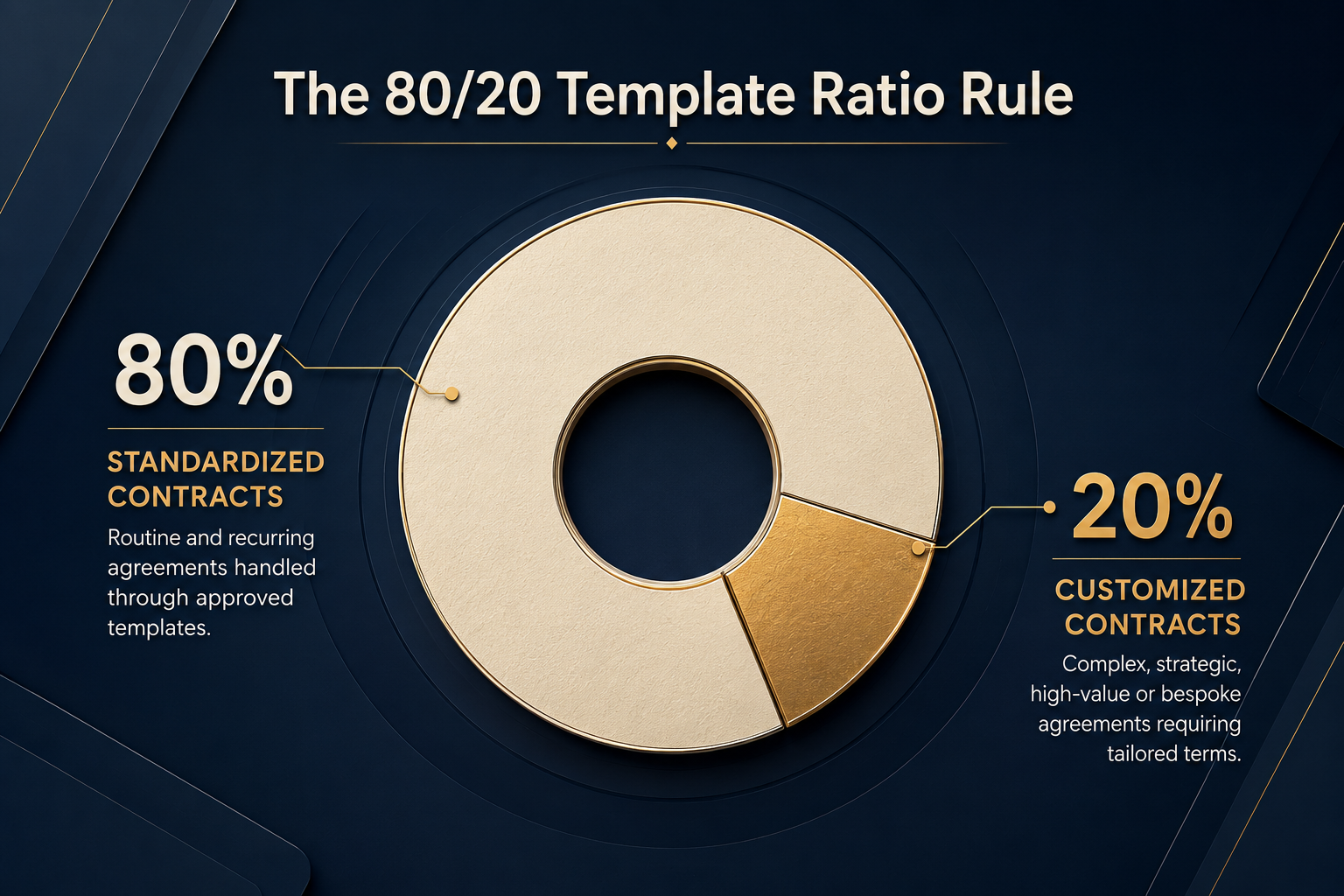
Should all your contracts be standard? Short answer is: No. This is why we have the 80/20 Template Ratio Rule. It helps companies balance contract efficiency with flexibility. Many companies standardize contracts to save time, improve consistency and reduce legal risk. However, not every agreement fits a standard template.
This rule offers a practical framework: approximately 80% of contracts can be handled through standardized templates, while the remaining 20% should allow for customization. That flexible portion is particularly important for complex, strategic, high-value, or otherwise non-standard agreements.
Whether your company operates in technology, healthcare, renewables, banking, or another industry, this approach can help create a contract process that is both scalable and responsive to real business needs.
This is the first tip in our article series “10 Tips You Need to Know to Improve Your Contract Templates.” If you have not yet read the introduction to this series, we recommend starting here.
TL;DR
- Aim to manage approximately 80% of most used contracts through standardized templates.
- Reserve around 20% for complex, strategic, high-value or bespoke agreements that require customization.
- Standardization improves consistency, compliance, speed and cost efficiency.
- The exact ratio depends on your industry, regulatory environment, and business model.
- The objective is not to force every contract into one format, but to standardize where possible and customize where necessary.
What You Will Learn In This Article
- What the 80/20 Template Ratio Rule means
- Why standardized templates are useful for routine contracts
- Which contracts usually require a customized approach
- Explanation the ratio may differ between industries
- What strategic advantages contract standardization can offer
What Is the 80/20 Template Ratio Rule?
The 80/20 Template Ratio Rule assumes most company contracts should use standardized templates. Around 80% is a practical target. These templates can cover routine agreements, including NDAs, service agreements, licensing agreements, and recurring purchase orders.
The remaining 20% covers contracts requiring greater flexibility because of their complexity, value, strategic importance, or unique circumstances. This category may include key-client agreements, public procurement contracts, bespoke projects, government contracts, and large-scale technology implementations.
The percentages will naturally differ depending on the company and industry. In our experience, however, the 80/20 ratio is an achievable benchmark for many organizations. It provides a practical balance between consistency for routine contracts and flexibility for more intricate or specialized agreements.
The rule is a framework rather than a rigid target. It helps companies optimize contract management without unnecessarily customizing every transaction.
Why Is the 80/20 Template Ratio Rule Useful?
The 80%: Contracts to Standardize
Companies should generally aim to cover the majority of their recurring contractual engagements with standardized templates. A well-designed and legally approved template creates a reliable starting point for routine transactions and offers several advantages.
- Consistency: Routine contracts follow the same structure, use the same legal terms, and incorporate the same approved positions and best practices across the organization.
- Legal compliance: Templates that have been reviewed and approved by legal teams reduce the risk of errors, omissions, and non-compliance.
- Operational efficiency: Commercial teams can generate, review, negotiate, and execute routine agreements more quickly, without requiring the legal department to redraft every contract from the beginning.
- Faster deal cycles: Clear default positions and familiar wording reduce internal review time and make negotiations more predictable.
The greatest advantage is that repetitive, low-complexity agreements can be handled efficiently. This frees legal and commercial resources for higher-value contracts and negotiations.
Standardization should not, however, become an objective in itself. Attempting to standardize every agreement may create unnecessary risk when the underlying transaction requires a different approach. The 80/20 ratio recognizes this operational reality.
The 20%: Contracts to Customize
The remaining 20% functions as a strategic buffer. It preserves room for agreements that are less common or involve greater complexity, risk, value, or strategic importance.
Contracts that may fall within this category include:
- Public procurement contracts: These may be governed by specific procurement procedures, regulatory requirements, and prescribed contractual terms.
- Government contracts: These agreements can include additional obligations concerning reporting, confidentiality, compliance, and liability.
- Large-scale technology implementations: Complex implementations may require detailed service levels, project-specific warranties, security requirements, and tailored acceptance procedures.
- Key-account negotiations: Moreover, major clients may require tailored terms because of an engagement’s size, complexity, or commercial importance.
- Bespoke projects: Unique projects often require contractual provisions that cannot be addressed adequately through a standard document alone.
For non-routine contracts, one size does not fit all. These situations often test a company’s agility and require careful consideration of the specific commercial and legal context. The flexible 20% allows the business to respond without weakening the benefits created by standardization elsewhere.
When Should You Deviate From the 80/20 Ratio?
The 80/20 Template Ratio Rule is a guiding principle, not a fixed requirement. Industry, regulations, and operational complexity determine how many agreements can be standardized.
Some organizations may use templates for more than 80% of their contracts. However, others may need more customization. In both cases, the principle remains useful. Standardize recurring agreements where possible, while retaining flexibility when necessary.
Technology and SaaS Companies
Technology companies often operate in environments characterized by rapid innovation, recurring products, scalability, and a strong focus on efficiency. As a result, their percentage of standardized contracts may exceed 80%.
Businesses can often template licensing agreements, SaaS subscriptions, NDAs, and standard terms. As a result, some achieve overall template ratios of up to 95%.
Regulated and Bespoke Industries
Organizations with more complex or bespoke contractual needs may requiregreater flexibility. Their ratio of standardized to customized agreements may belower because of regulatory demands, project-specific requirements, or specialized client needs.
Examples include:
- Construction: Projects frequently involve detailed specifications, negotiated risk allocation, change orders, and terms that vary substantially from one project to another.
- Healthcare: Strict regulatory oversight, patient confidentiality, data protection, and sector-specific requirements may require more tailored agreements.
- Public sector: Government agencies and public institutions generally operate within formal procurement rules and regulatory frameworks that can require highly specific contractual terms.
The appropriate ratio must therefore reflect the organization’s actual operating environment. Fast-moving and highly scalable businesses will often benefit from a higher percentage of templated contracts. Businesses in regulated or bespoke sectors may need to rely more heavily on customization.
The Strategic Advantages of Contract Template Standardization
Investing in well-designed templates offers benefits that extend beyond day-to-day efficiency. Standardized routine agreements turn contract management into a strategic business capability.
1. Cost Efficiency and Risk Mitigation
State-of-the-art contract templates reduce legal involvement, mitigate risk, and prevent costly drafting errors.
2. Stronger Business Relationships
Clear, well-structured, and user-friendly templates make interactions with clients, suppliers, and business partners more efficient. When contractual terms are understandable and predictable, they support transparency, build trust, and reduce the potential for misunderstandings and disputes.
3. Better Use of Legal Resources
Standardization allows legal teams to focus on complex projects, strategic negotiations, and high-value clients that genuinely require customized drafting and detailed review. Legal expertise can then be directed toward matters where it has the greatest impact.
4. Empowerment of Commercial Teams
Approved templates can enable teams such as Sales, Partnerships, and Procurement to handle a greater proportion of the company’s contracts independently. This reduces unnecessary dependence on Legal, accelerates decision-making, and supports a more efficient workflow.
Clear instructions, approval thresholds, and escalation procedures should support this autonomy. Additionally, templates work best when users know when to involve Legal.
5. Agility in High-Value Negotiations
When routine contracts require less attention, legal and commercial teams have more capacity for high-value negotiations. These matters often demand a nuanced approach and closer attention to risk allocation, liability, service levels, and other business-critical provisions.
In short, standardized templates reduce complexity and legal risk while freeing up resources for the negotiations and relationships that matter most.
How to Apply the 80/20 Rule in Practice
The starting point is to review the contracts your organization handles most frequently. Identify recurring agreement types, common negotiation points, and matters that repeatedly require legal escalation.
A practical implementation can include:
- Step 1: identifying high-volume, low-complexity contract types;
- Step 2: creating legally approved templates for those agreements;
- Step 3: defining standard fallback positions for frequently negotiated clauses;
- Step 4: providing clear guidance for Sales, Procurement, and other template users;
- Step 5: establishing thresholds for legal review and escalation; and
- Step 6: periodically reviewing templates against actual negotiation outcomes and changes in the business.
The goal is not simply to increase the number of templates.
It is to create a controlled system in which the right agreements can move quickly, while exceptional matters receive the attention they require.
For a more detailed look at how the 80% Template Rule can be translated into a practical contract structure, read our article: Why You Need Better Terms & Conditions – 80% Template Rule
Key Takeaways
- The 80/20 Template Ratio Rule balances contract standardization with necessary flexibility.
- Approximately 80% of routine agreements can often be managed through approved templates.
- The remaining 20% should accommodate strategic, complex, high-value, or bespoke contracts.
- The exact ratio should be adapted to the company’s industry, regulatory environment, and operating model.
- Standardization can improve consistency, compliance, speed, cost efficiency, and the use of legal resources.
- Clear escalation rules are essential: does the team know when a template is sufficient and when customization or legal review is required.
Frequently Asked Questions
Q: Does every company need to achieve an exact 80/20 split?
No. The ratio is a practical benchmark rather than a strict target. The appropriate balance depends on the company’s industry, business model, risk profile, and regulatory environment.
Q: Which contracts are best suited to standard templates?
High-volume and recurring agreements with a relatively predictable risk profile are generally the best candidates. Examples include NDAs, recurring service agreements, SaaS subscriptions, licensing agreements, and purchase orders.
Q: When should a contract be customized?
Customization may be necessary when an agreement is high-value, strategically important, heavily regulated, project-specific, or materially different from the transactions covered by the approved template.
Q: Can standardization eliminate the need for legal review?
Not entirely. Good templates can reduce the need for legal involvement in routine matters, but organizations still need clear review thresholds and escalation procedures for deviations and higher-risk transactions.
Q: Can a company standardize more than 80% of its contracts?
Yes. Highly scalable businesses, particularly technology and SaaS companies, may be able to standardize a significantly larger proportion of their agreements. The achievable percentage depends on the nature of the transactions and the maturity of the contract process.
Conclusion
The 80/20 Template Ratio Rule gives businesses a clear framework for balancing standardization and flexibility. By handling the majority of routine contracts through well-designed templates, companies can improve operational efficiency, reduce costs, and limit legal risk. Reserving room for customization ensures that complex, high-value, or bespoke engagements still receive the attention they require.
Effective contract management starts with recognizing that one size does not fit all. Standardized contracts provide consistency and speed, while the flexible portion of the contract portfolio helps the business remain agile and responsive.
If you are ready to transform your contracts from a necessary administrative task into a strategic asset, we can help. Whether your primary focus is technology, AI, renewable energy, or another sector, your organization can benefit from more streamlined, flexible, and secure contracts.
For guidance on improving contract templates, managing negotiations, and optimizing related processes, contact us at info@amstlegal.com or book an appointment with Robby Reggers.
Would you like to read the other articles in our series “10 Tips You Need to Know to Improve Your Contract Templates”? You can find all ten tips below: