
Wat is een paralegal (en waarom zijn ze onmisbaar)?
Wat doet een paralegal precies? En waarin verschilt een paralegal van een advocaat of juridisch adviseur? Dat is een praktische keuze die direct impact heeft op uw kosten, snelheid en interne legal, commerciële en finance workload. Of u nu een bedrijf runt, sales of procurement aanstuurt, of juridische zaken intern beheert is dit van belang. Begrijpen wat een paralegal doet (of niet doet), kan u tijd, structuur en besparingen opbrengen.
Toch kennen veel organisaties vooral één route: “we hebben een advocaat nodig voor dit juridisch werk”. Dit is niet altijd nodig. Er is een belangrijke rol die vaak wordt onderschat: de paralegal. Daarom horen we in de praktijk steeds dezelfde vragen terug: wat doet een paralegal precies? Welke taken mag een paralegal oppakken? Hoe verschilt dit van een advocaat? En wanneer is een paralegal eigenlijk de slimste keuze? In dit artikel leggen we dat helder uit, inclusief concrete voorbeelden, zodat u sneller de juiste beslissing kunt nemen.

Wat we zullen behandelen:
- Wat een paralegal is,
- De rol van paralegals in zakelijke en juridische activiteiten,
- Praktijkvoorbeelden van de voordelen van paralegale diensten voor zakelijke en juridische belanghebbenden,
- Veelvoorkomende uitdagingen wanneer bedrijven paralegale ondersteuning over het hoofd zien, en
- Waarom paralegals cruciaal zijn in moderne bedrijfsomgevingen.
Wat is een paralegal?
De rol van paralegals in zakelijke en juridische teams
De eenvoudigste manier om uit te leggen wat een paralegal doet, is door te kijken naar de rollen die zij combineren. In de praktijk brengen paralegals vaardigheden samen van administratief medewerkers, junior en middenkader juridisch adviseurs en boekhoudkundig medewerkers. De verschillende rollen zijn als volgt.
- Administratieve ondersteuning: Paralegals zorgen ervoor dat documenten en bedrijfsgegevens nauwkeurig en toegankelijk zijn. Hierbij gaat het om bedrijfsadministratie, volmachten en UBO-registraties. Zij vormen hierdoor een perfecte aanvulling op het juridische team en zijn verantwoordelijk voor het beheer en onderhoud van deze documenten. Voor meer informatie over UBO verwijzen wij naar ons artikel “Ultimate Beneficial Ownership (UBO) uitgelegd – Wat is het en hoe creëer je een proces dat werkt” hier.
- Juridisch secretaresse: Een juridisch secretaresse organiseert dossiers, stelt correspondentie en juridische documenten op, plant vergaderingen en coördineert archivering. Paralegals bouwen hierop voort met diepgaandere juridische kennis en meer autonomie.
- Junior juridisch adviseur: De rol omvat het opstellen en proeflezen van contracten, uitvoeren van juridisch onderzoek, uitrollen van sjablonen en signaleren van risico’s. Zo kan een junior juridisch adviseur vrijwel alle taken van het juridische team uitvoeren.
- Boekhoudkundig assistent: Paralegals ondersteunen financiële en compliance functies die raakvlakken hebben met juridisch werk, zoals het bijhouden van betalingsverplichtingen, bewaken van contractdeadlines, ondersteunen van boekhouding en beheren van compliance-taken die audits beïnvloeden.
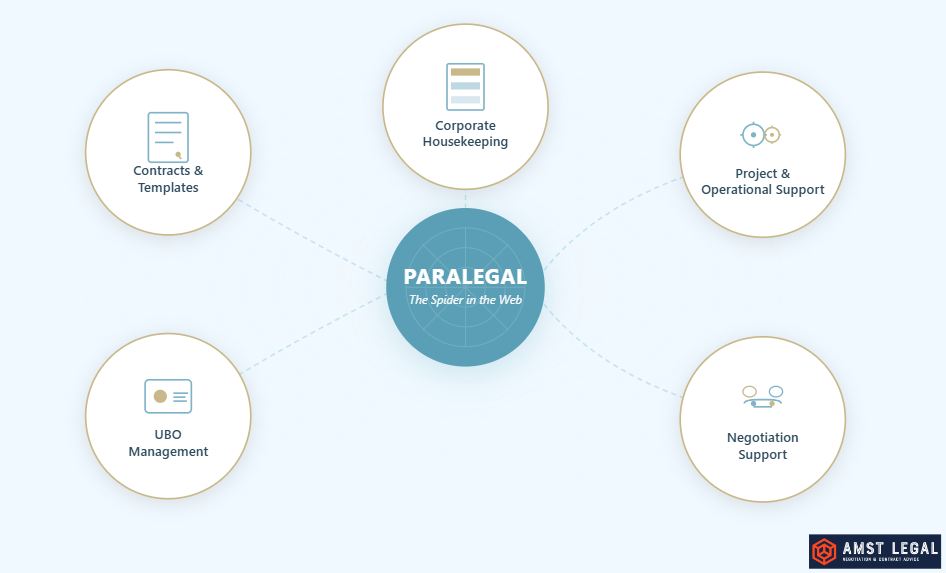
De echte waarde van een paralegal ligt in hoe deze functies samenkomen. Paralegals zien zichzelf als de ‘spin in het web’, coördineren tussen afdelingen en zorgen voor structuur en efficiëntie. Zo vervullen zij een centrale rol in het verbinden van juridische, commerciële en financiële processen.
Paralegal diensten in Europa
In Europa zijn paralegal diensten buiten juridische kringen minder zichtbaar, maar hun belang neemt toe. Veel verschillende belanghebbenden kunnen profiteren van een paralegal in het team, wat we hieronder nader zullen toelichten. Hoewel zij een cruciale rol spelen, hebben wetgevers in Nederland en Zweden geen algemene definitie of gemeenschappelijke beschrijving van de rol vastgesteld. In het Verenigd Koninkrijk definieert de National Association of Licensed Paralegals (NALP) een paralegal echter als:
“Een persoon die is opgeleid en getraind om juridische taken uit te voeren, maar die geen gekwalificeerde advocaat of procureur is.”
De NALP definieert de rol van paralegals op een manier die ook past bij Nederland en Zweden, aangezien zij advocaten en juridisch adviseurs bijstaan bij juridische taken. De rol kan echter breder zijn dan dat en de meeste paralegals in Nederland en Zweden hebben een hogere opleiding genoten.
Zie de website van de NALP en verdere informatie hier.
Onderwijs in Nederland en Zweden
In de meeste Europese landen is ‘paralegal’ geen beschermde titel, wat betekent dat professionals via verschillende routes het vakgebied kunnen betreden. Toch hebben de meesten een juridische opleiding gevolgd die hen toerust voor functies bij bedrijven en advocatenkantoren.
In Nederland is het gebruikelijk om rechten te studeren op verschillende niveaus, van hogeschool tot universiteit. Elke route biedt verschillende niveaus van juridische kennis en praktische vaardigheden, maar alle kunnen leiden tot functies als juridisch medewerker. Zoals we bij veel bedrijven hebben gezien, zijn deze functies een uitstekende springplank om carrière te maken en door te groeien naar andere functies binnen het bedrijf.
In Zweden zijn veelvoorkomende trajecten onder meer beginnen als juristassistent na de middelbare school, een tweejarige hogere beroepsopleiding met stages volgen, of rechten studeren aan de universiteit en tegelijkertijd werkervaring opdoen.
Daardoor beschikken zowel Nederlandse als Zweedse paralegals over een combinatie van academische opleiding en praktische vaardigheden, waardoor ze flexibel inzetbaar zijn voor verkoopteams, inkoopmanagers en bedrijfsjuristen.
Paralegal-diensten in de VS
In de VS is ‘paralegal’ een bekend beroep en wordt er sinds eind jaren zestig, toen ze werden erkend door de American Bar Association (ABA), een formele opleiding gegeven. De huidige definitie van een paralegal volgens de ABA luidt als volgt:
“Een paralegal is een persoon die door opleiding, training of werkervaring gekwalificeerd is en in dienst is van of wordt ingehuurd door een advocaat, advocatenkantoor, bedrijf, overheidsinstantie of andere entiteit en diespecifiek gedelegeerde inhoudelijke juridische werkzaamheden verricht waarvoor een advocaat verantwoordelijk is”.
Zie de website van de ABA hier en meer informatie over de historische achtergrond hier.
Met andere woorden, een paralegal in de VS houdt zich bezig met juridische zaken die door de verantwoordelijke advocaat zijn gedelegeerd. Hoewel er in de VS geen landelijke regelgeving bestaat, stelt Californië specifieke eisen aan paralegals.
Zie de website van de American Association for Paralegal Education hier en de website van de National Federation of Paralegal Associations hier voor meer informatie.
Wat paralegals bijdragen aan zakelijke en juridische teams
Waarom paralegals essentieel zijn
Paralegals bieden veel meer dan een administratief medewerker dankzij hun bachelordiploma in de rechten. Door gebruik te maken van paralegalservices krijgt u gestructureerde juridische ondersteuning, waarmee de kloof wordt overbrugd tussen routinematige documentatie en hoogwaardig juridisch werk. Daarom werken veel paralegals bij advocatenkantoren of in-house juridische teams.
Houd paralegals dus in gedachten wanneer u een advocaat of juridisch adviseur overweegt. Er zijn twee belangrijke redenen om dat te doen. Ten eerste vermindert het de juridische kosten, bijvoorbeeld door de paralegal uw adviseur te laten assisteren of voorbereidend werk uit te voeren dat geen advocaat vereist. Ten tweede stroomlijnt het gebruik van een paralegal processen zoals verkoop, inkoop en compliance. Hierdoor ontstaan mogelijkheden voor hogere inkomsten, terwijl u juridisch beschermd blijft.
Wat u kunt verwachten van paralegal diensten
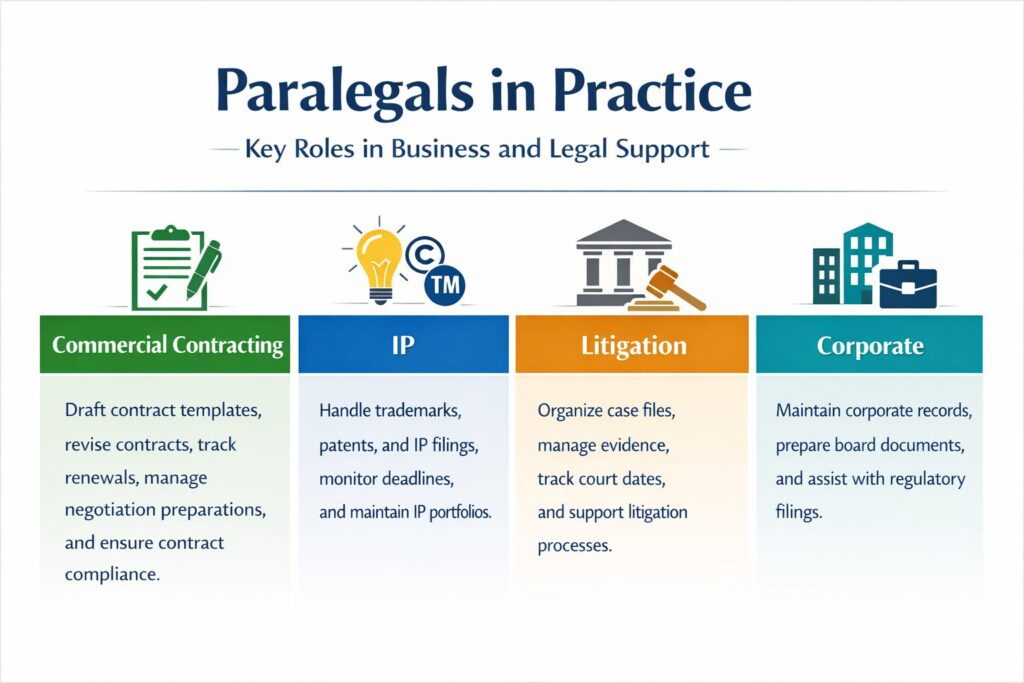
Om een nog duidelijker beeld te krijgen van hoe paralegaldiensten kunnen bijdragen aan het dagelijkse werk van uw bedrijf of advocatenkantoor, gaan we dieper in op de details. Over het algemeen zijn de beperkingen van wat paralegals juridisch gezien kunnen doen vaag. Dit komt door het gebrek aan regelgeving. Natuurlijk zijn bepaalde taken uitsluitend voorbehouden aan advocaten. Dat betekent echter niet dat paralegals niet kunnen helpen bij het begin van een traject. Ook kunnen zij aan het einde een snelle controle uitvoeren. Kortom nemen zij doorgaans het tijdrovende voorbereidende werk uit handen van advocaten of juridisch adviseurs. De verantwoordelijkheden van paralegals omvatten daarbij een reeks documenten die aan de basis liggen van elk bedrijf.
Paralegale diensten worden uitgevoerd door opgeleide professionals die gedelegeerde juridische taken uitvoeren, zoals contracten onderhandelen en voorbereiden, compliance werkzaamheden en bijhouden en structureren van bedrijfsdocumentatie.
8 voorbeelden waar paralegals kunnen worden ingezet
Om een paar dingen te noemen die deel uitmaken van het werk van paralegals, omvat dit normaal gesproken:
- het maken van lijsten van bijvoorbeeld debiteuren en crediteuren, belanghebbenden, concurrenten enz.
- het structureren en proeflezen van contracten en documenten zoals bestelformulieren, geheimhoudingsverklaringen, volmachten, arbeidscontracten, algemene voorwaarden, routinematige leveranciers- of klantovereenkomsten enz.
- het voorbereiden, opstellen en archiveren van juridische en bedrijfsdocumenten (d.w.z. bedrijfsadministratie en UBO)
- het sorteren en beoordelen van bewijsmateriaal voor cliënten,
- het uitvoeren van juridisch onderzoek naar relevante onderwerpen,
- het opstellen van contract sjablonen en instructies en/of informatie voor cliënten,
- het uitrollen van nieuwe bestelformulieren, algemene voorwaarden, sjablonen en informatie naar cliënten,
- het assisteren bij compliance-kwesties (zoals gegevensprivacy, gegevensbescherming, handelscontrole, enz.).
Hoewel advocaten of juridisch adviseurs uiteindelijk natuurlijk een aantal van deze documenten moeten controleren, kunnen paralegals de eerste controle uitvoeren. Op die manier kunnen ze een brug slaan tussen de verschillende contractprocessen van een bedrijf. Tegelijkertijd zorgt dit voor structuur en kunnen advocaten of juridisch adviseurs zich concentreren op complexe kwesties. Dit biedt mogelijkheden en gestroomlijnde, maar toch kostenbesparende processen. Kortom, paralegals zijn een geweldige aanvulling voor juridische teams bij bedrijven van verschillende grootte.
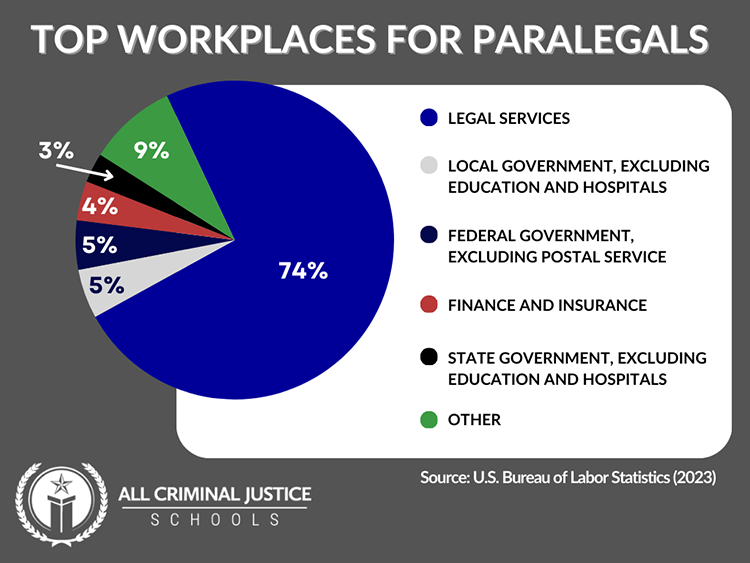
Voorbeelden van sectoren van (Amerikaanse) paralegals. Externe bron (zie link hier).
Voordelen van het inhuren van een paralegal
Praktische voordelen
We hebben besproken wat een paralegal is en voorbeelden gegeven van wat u van hun diensten kunt verwachten. Nu gaan we concreet aangeven hoe uw bedrijf of advocatenkantoor kan profiteren van het inhuren van zo’n juridisch professional. Om de verschillende voordelen te benadrukken, gaan we hierna dieper op deze punten in. Impact op het bedrijf: snelheid, duidelijkheid, kosten- en procesefficiëntie.
Bedrijven hebben vaak moeite om een evenwicht te vinden tussen commerciële snelheid en risicobeheer. Door gebruik te maken van paralegaldiensten en deze te integreren in de bedrijfsvoering, kan deze kloof worden overbrugd. Dit maakt snellere contractcycli mogelijk. Daarnaast zorgt het voor betere communicatie tussen afdelingen en lagere totale juridische kosten. Hierdoor hoeven verkoop- en inkoopteams niet langer te wachten tot routinematige juridische taken zijn uitgevoerd door een dure senior adviseur.
In plaats daarvan ontvangen zij tijdige en betaalbare ondersteuning van een paralegal. Zo blijft het bedrijf operationeel, zonder te bezuinigen op actuele juridische aspecten en compliance.
Enkele voorbeelden van voordelen in het bedrijfsleven
In het bedrijfsleven vermindert deze aanpak:
- gemiste nalevingsdeadlines die de financiering vertragen,
- vertragingen bij transacties die de verkoopcycli frustreren en
- inconsistente voorwaarden die het risico voor leveranciers vergroten.
Dit gestructureerde proces vermindert de kans op latere geschillen en stroomlijnt processen, aangezien voorwaarden consistent worden toegepast en correct worden gedocumenteerd. Juridisch adviseurs kunnen zich concentreren op complexe vragen, nieuwe mogelijkheden en gestroomlijnde, maar toch kostenbesparende processen.
Naast het inhuren van een paralegal kunnen bedrijven hun contractprocessen aanzienlijk vereenvoudigen door onze tips voor 10 manieren om uw contractprocessen te verbeteren toe te passen. Bekijk hieronder enkele van onze gepubliceerde artikelen over dit onderwerp:
- hier om te weten waarom u zich moet richten op het verbeteren van uw contractsjablonen,
- hier voor tips over het beheren van uw contractsjablonen,
- hier om de voordelen te zien van een sterke samenwerking tussen de juridische afdeling en andere afdelingen, en
- hier om te leren waarom het cruciaal is om uw juridisch adviseur leiding te laten geven aan het verbeteren van contractsjablonen.
Bovendien zijn de voordelen van paralegale diensten niet beperkt tot verbeterde bedrijfsprocessen en resultaten. Het is ook gunstig in termen van juridische impact en ondersteuning voor de verantwoordelijke juridisch adviseur. .
Juridische impact: verbeterde structuur, betere schaalbaarheid Vanuit juridisch oogpunt verminderen paralegale diensten allereerst de kans op fouten en geschillen, doordat zij zich richten op de details van documentatie en contracten. Daardoor blijven dossiers volledig en consistent, wat ervoor zorgt dat bedrijven met vertrouwen kunnen opschalen. Met name bij uitbreiding naar nieuwe markten of bijvoorbeeld tijdens de voorbereiding van een overname, leidt goed bijgehouden documentatie tot een lager risico. Tegelijkertijd positioneert het bedrijf zich als een professionele en betrouwbare partner. Bovendien kunnen juridische adviseurs zich focussen op complexe contracten, omdat zij worden ontlast van routinematig werk. Zo ontstaat een ideale basis voor juridische én zakelijke resultaten.
Image source: Forbes Outsourcing Paralegal Work: Why Remote Paralegals Are The Future Of Legal
Praktische uitdagingen bij het ontbreken van paralegale ondersteuning
Wanneer paralegale ondersteuning ontbreekt, worden bedrijven in de praktijk vaak geconfronteerd met vermijdbare knelpunten. Zo kan bijvoorbeeld de goedkeuring van contracten vertraging oplopen, omdat niemand de concepten structureert of deadlines bewaakt. Daarnaast kunnen bedrijfsaangelegenheden, zoals jaarlijkse aandeelhoudersbesluiten, eenvoudig over het hoofd worden gezien. Dit leidt vervolgens tot nalevingsrisico’s en onnodige vertragingen. In veel gevallen grijpen verkoopteams terug op verouderde sjablonen of brengen zij ad-hocwijzigingen aan. Hierdoor ontstaan inconsistenties en juridische kwetsbaarheden. Uiteindelijk verhoogt dit gebrek aan structuur de kosten op de lange termijn.
Kansen bij een goede aanpak
Daarentegen profiteren bedrijven aanzienlijk wanneer zij paralegale diensten structureel in hun workflow integreren. Niet alleen winnen zij aan snelheid, maar ook aan betrouwbaarheid. Hierdoor doorlopen contracten sneller de beoordelingscycli, aangezien steeds met de juiste versie wordt gewerkt. Daarnaast worden handtekeningen zorgvuldig bijgehouden en worden belangrijke voorwaarden uitsluitend gemarkeerd voor input van advocaten of bedrijfsjuristen wanneer dat nodig is. Bovendien blijven bedrijfsdocumenten actueel, waardoor audits, nalevingscontroles en verzoeken van investeerders direct kunnen worden afgehandeld.
Als resultaat ontstaat een soepelere samenwerking tussen zakelijke en juridische belanghebbenden. Zo weten inkoopmanagers dat de voorwaarden consistent zijn, en vertrouwen CFO’s erop dat de documenten in orde zijn. Tegelijkertijd krijgen oprichters het vertrouwen dat hun bedrijf juridisch voorbereid is op groei of omzetstijging.
Belangrijkste conclusies
- Paralegals bieden essentiële juridische ondersteuning die bedrijven van elke omvang tijd en kosten bespaart.
- Bedrijven zonder paralegal ondersteuning worden geconfronteerd met knelpunten, inconsistente contracten en compliance-risico’s.
- Door paralegal diensten te integreren met algemene juridische diensten ontstaan er soepelere processen voor verkoop-, inkoop- en juridische teams.
- Paralegal diensten zijn gunstig voor bedrijven in elke branche en voor advocatenkantoren.
- Bedrijven die investeren in paralegale ondersteuning winnen aan efficiëntie, duidelijkheid en juridische paraatheid voor groei en omzetstijging.
Conclusie en volgende stappen
Paralegale diensten zijn niet langer optioneel voor groeiende bedrijven. Allereerst bieden ze een praktische oplossing om kosten te verlagen, compliance te verbeteren en ervoor te zorgen dat contracten zonder vertraging door de pijpleiding lopen. Daarnaast vormen ze een geweldige investering om uw interne juridische adviseurs van de juiste ondersteuning te voorzien. Of uw bedrijf nu tech-deals sluit, relaties met leveranciers beheert of zich voorbereidt op een investering, blijven paralegals de gestructureerde juridische ondersteuning bieden die u nodig hebt. Zo verzekert u zich van efficiëntie en betrouwbaarheid op alle juridische vlakken.
Bij AMST Legal combineren we senior juridisch advies met deskundige paralegale diensten, waardoor we onze klanten de juiste mix van strategie en uitvoering kunnen bieden. Ons werk omvat zowel individuele projecten als tijdelijke overeenkomsten met een vast aantal uren per week, waardoor u kunt rekenen op flexibiliteit en betrouwbaarheid. Wij bieden flexibele paralegale diensten en senior juridisch advies in Stockholm, Zweden en Amsterdam, Nederland.
Bezoek amstlegal.com voor meer informatie of boek vandaag nog een consult hier of stuur een e-mail naar info@amstlegal.com.
Om hierover meer te lezen, zie de volgende artikelen:
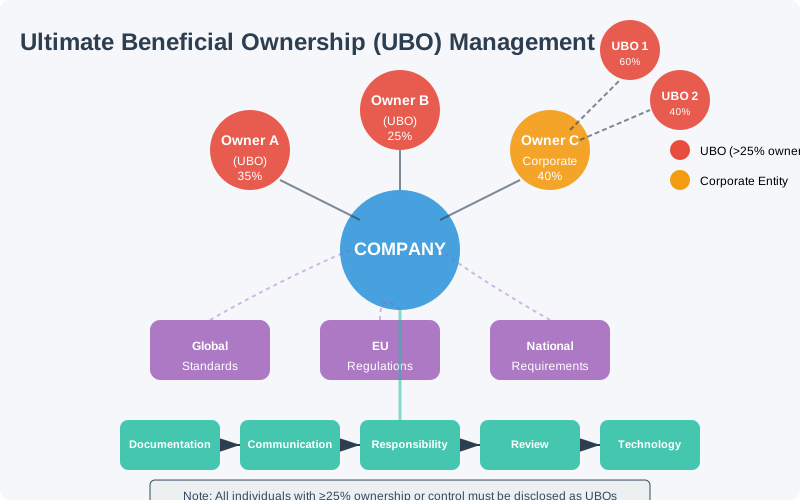
Ultimate Beneficial Ownership (UBO) Explained – What is it and How to Create a Process That Works
The concept of the Ultimate Beneficial Owner (UBO) has moved from a niche concern to a central element of contracts, compliance and due diligence. Whether you’re advising clients on onboarding new customers, hiring a new law firm, negotiating international contracts, or setting up a new corporate entity, understanding UBO requirements is no longer optional – it’s essential.
Failing to understand and address UBO requirements not only leads to significant financial penalties, reputational damage and even legal action. I have also seen that it can slow down many commercial, financial and legal processes. This article ‘Ultimate Beneficial Ownership (UBO) Explained – What is it and How to Create a Process That Works’ provides practical strategies for navigating UBO disclosure – both when requesting information from others and when providing it yourself.
Executive Summary: The TLDR of UBO Compliance
If you only have a minute, here is what you need to know about UBO & managing beneficial ownership:
- The UBO Full Form: It stands for Ultimate Beneficial Owner.
- The Bottom Line: You must identify the “natural person” (human) at the end of the ownership chain, typically at a 25% threshold.
- Strategic Tool: Use a UBO Structure Chart to simplify complex holding layers. This can cut your onboarding time by up to 40%.
- AI Privacy: Professional tools like Claude (on Team/Enterprise plans) generally protect your data, but always check your SLA before uploading sensitive documents.
- Business Impact: Efficient UBO management is a competitive advantage that prevents deal stalls and builds trust with partners like Booking.com or PVH.
What We Will Cover in the Article Below
In this guide, we break down the complexities of beneficial ownership into actionable steps:
- UBO Definitions & Meaning: A clear breakdown of terms for international and beginner readers.
- Legal Frameworks: A summary of global, EU, and Dutch requirements.
- Visual Strategy: Why a UBO Structure Chart is the most effective way to explain your company.
- Industry Deep-Dives: Where these requirements appear most often and which contracts are affected.
- Implementation Framework: A 5-point system for establishing efficient UBO processes.
- AI & Data Privacy: How to handle sensitive ownership information when using tools like Claude.
UBO Definitions: What These Terms Actually Mean
If you are dealing with international contracts or Dutch compliance, you’ll run into these specific terms. For beginners and international teams, here is a breakdown of the essential vocabulary to help you navigate the requirements.
The UBO Master Terminology List – What do the Terms mean that are commonly used?
- UBO Full Form: This stands for Ultimate Beneficial Owner.
- UBO Meaning: This is the “natural person” (a human being) who truly owns or controls a company. Even if the official paperwork lists other companies, the UBO is the person at the end of the line.
- Natural Person: In legal and compliance terms, this just means a human. A UBO can never be another company; it must be a person.
- Pseudo-UBO: If no one person owns enough of the company to be a UBO, a top manager is often named as a “pseudo-UBO” just to satisfy the rules.
- UBO Structure Chart: This is a visual map or diagram. It shows the layers of ownership from the local company all the way up to the human owners at the top.
- Ownership Threshold: This is the “trigger” percentage. In the Netherlands and the EU, if you own 25% or more, you are usually considered a UBO. In some high-risk cases, this drops to 10%.
- Compliance Chain: Think of this as a domino effect. A bank asks a company for UBO data; that company then has to ask its suppliers, who then have to ask their manufacturers. This is why these clauses are suddenly appearing in almost every contract.
Understanding UBOs – What Is It Exactly and Why is it Important?
An Ultimate Beneficial Owner is the natural person who ultimately owns or controls a legal entity. This can even be the case if their name doesn’t appear directly on ownership documents. Typically, this includes individuals who own more than 25% of shares or voting rights. Sometimes, this threshold may be as low as 10% in some contexts. It also encompasses those who exercise control through other means, such as appointment rights or veto powers. When ownership is widely distributed with no individual meeting these criteria, a senior managing official may be designated as a “pseudo-UBO” for compliance purposes.
The importance of UBO requirements in business relationships originates from what can be described as a compliance chain. Initially confined to financial institutions under anti-money laundering regulations, these requirements now cascade through various industries. For example, a payment processor might require UBO information from an e-commerce company. This company will in turn requests this information from its suppliers. Finally, these suppliers then include UBO disclosure requirements in their contracts with manufacturers. This chain reaction explains why UBO clauses increasingly appear in contracts across sectors that previously had minimal regulatory oversight.
Legal Framework: Global, EU, and Dutch Requirements
Before we go into the key industries & contracts involved, let us start at he beginning. What is the legal framework where these burdensome UBO’s originate from? Many countries and global organizations have implemented measures to combat money laundering and terrorist financing. As countries have diverse legal, administrative and operational frameworks and different financial systems, measures to counter these threats differ greatly per country and region.
Global UBO Standards
Globally, most countries have developed UBO standards in response to international initiatives against money laundering and financial crime. While approaches vary by jurisdiction, several organizations, initiatives and common principles have emerged:
- FATF Recommendations (see link): Recommendations (24 and 25) that require countries to ensure transparency regarding beneficial ownership of legal entities
- Varying Implementation: Globally, most countries have established beneficial ownership registries with different thresholds and accessibility levels.
- Accelerated Transparency: The Panama Papers and Paradise Papers revelations exposed how anonymous structures facilitate financial crimes
- Information Sharing: The OECD’s Common Reporting Standard (see link) enables automatic exchange of financial account information between tax authorities
- Compliance Complexity: Multinational companies face a patchwork of requirements necessitating country-specific approaches
European Union Regulatory Framework
The EU has established one of the world’s most comprehensive UBO disclosure regimes, especially under the Anti-Money Laundering Directives (AMLD):
- AMLD: The 4th AMLD required central UBO registries, the 5th mandated public access, and the 6th strengthened enforcement.
- Ownership Definition: A beneficial owner is any natural person who owns or controls at least 25% of shares/voting rights or exercises control via other means.
- Public Accessibility: The 5th AMLD mandated public access to beneficial ownership information for companies and commercial trusts. Due to an EU court ruling, several EU member states, including Luxembourg and the Netherlands, moved to restrict public access to their beneficial ownership registers until legislative adjustments are made.
- Criminal Penalties: The 6th AMLD enhanced criminal penalties for money laundering offenses and expanded corporate criminal liability.
- National Variations: Despite the common framework, implementation varies between member states, creating compliance challenges for cross-border businesses.
The Netherlands: Specific UBO Requirements
The Netherlands implemented the EU’s UBO requirements with specific national provisions:
- UBO Registration Act: Dutch entities are required to register UBOs in the Dutch Commercial Register (Kamer van Koophandel) (since Sept. 2020)
- Public Information or restricted? It was the intention that the information would be public. Due to privacy (and security) concerns, restrictions were set up as to the public availability. See more on this subject from the Dutch government on this subject here: link.
- Verification Duty: Entities must take “reasonable measures” to identify and verify UBOs, maintaining internal records.
- Penalties: Administrative sanctions include fines up to €21,750, with criminal sanctions for intentional violations.
- Updating Requirement: Companies must update UBO information within seven days of becoming aware of any changes.
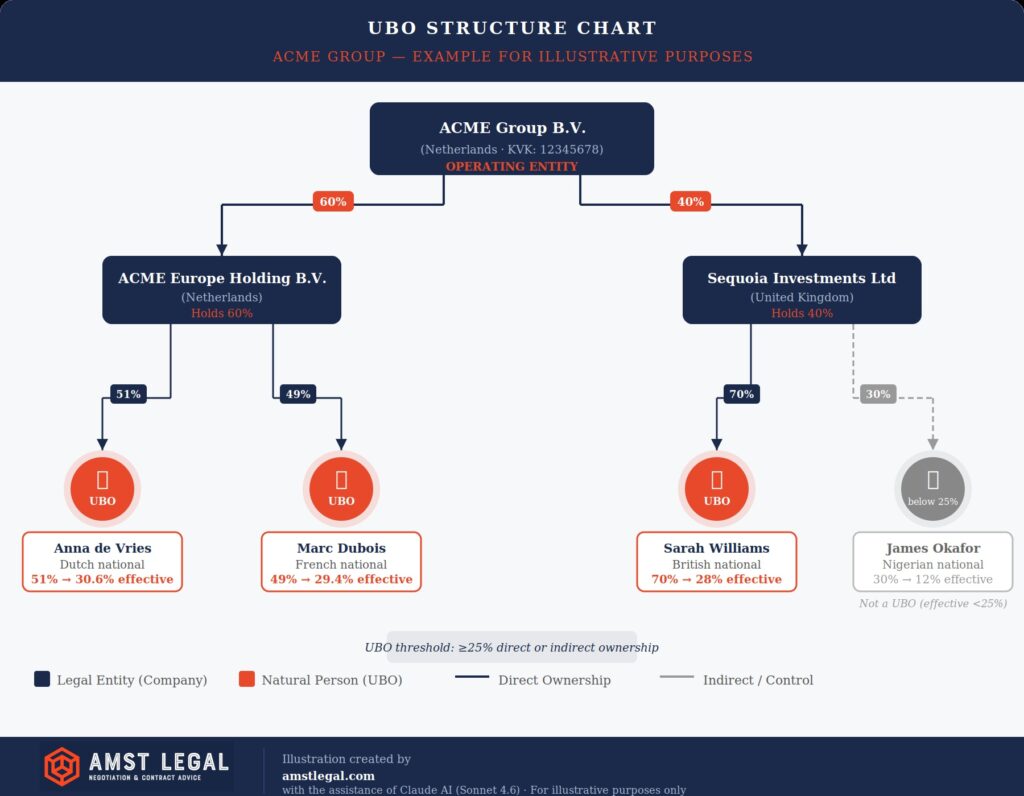
The Practical Value of a ‘UBO Structure Chart‘
We see many professionals searching for a “UBO structure chart”. Trying to explain a complex web of holding companies in an email is difficult for auditors to follow. A clear visual chart is the most effective way to provide this information and keep a deal moving.
Using Visuals to Speed Up Deals
In my work as an interim GC for various SaaS & Tech companies, we use these charts to simplify things for procurement, sales and finance teams. If you send a 20-page legal memo, it’s going to sit in someone’s inbox for a week. If you send a one-page UBO structure chart, you can often cut onboarding time by 40%.
At companies like twelve.eu or Construsoft, where things move fast, having this chart ready to go means the “KYC” (Know Your Customer) process won’t kill your deal momentum. Also see our article here how we suggest to improve KYC processes in your company.
Key Industries and Contracts Where UBO Matters
The importance of UBO disclosure varies significantly across industries and contract types. While requirements can appear in almost any business relationship, six industries face particularly frequent and stringent UBO disclosure requirements:
List of Industries
- Financial Services: Banks, payment processors, investment firms, and insurance companies face the most comprehensive regulatory mandates
- Real Estate: Commercial property transactions, development projects, and property management services
- Technology: Software providers, cloud services, and cybersecurity companies, especially those handling sensitive data
- Healthcare & Pharmaceuticals: Medical device manufacturers, pharmaceutical distributors, and healthcare service providers
- Government Contractors: Companies in defense, infrastructure, public utilities, and other sectors serving government entities
- Professional Services: Law firms, accounting practices, consulting firms, and other advisors with fiduciary responsibilities
Financial services companies naturally face the most stringent requirements, with banks, payment processors, investment firms, and insurance companies all subject to explicit regulatory mandates. However, several other sectors now routinely encounter UBO requirements in their operations.
Real estate transactions frequently involve UBO disclosure, particularly for commercial property acquisitions and development projects. A commercial real estate firm recently had to delay closing on a major property acquisition because their ownership structure involved multiple layers of holding companies, and the lender required complete UBO transparency before approving financing. Companies in this sector should prepare UBO documentation well before entering into purchase agreements or seeking financing.
Technology companies, particularly those handling sensitive data or providing critical infrastructure services, increasingly face UBO scrutiny. Government contracts almost universally require UBO disclosure, and many enterprise clients now include these requirements in their vendor security assessments. A cybersecurity provider lost a promising government contract because they couldn’t adequately document the beneficial ownership of one of their offshore investment partners within the required timeframe.
In healthcare and pharmaceuticals, UBO requirements appear in various contexts, from hospital system vendor agreements to pharmaceutical distribution contracts. Regulatory concerns about conflicts of interest and the integrity of the healthcare supply chain have intensified focus on ownership transparency. A medical device manufacturer was surprised when a hospital system required UBO disclosure before finalizing a procurement agreement, a requirement that stemmed from the hospital’s compliance policies rather than direct regulatory mandates.
Types of Contracts involved
The types of contracts where UBO disclosure commonly appears include:
- Financial agreements (loans, investment documents, banking relationships)
- Government and public sector contracts at all levels
- Long-term supply or service agreements, particularly in regulated industries
- Joint venture and partnership agreements
- Property purchase and lease agreements for commercial real estate
- Merger and acquisition documentation
- Distribution agreements, especially cross-border arrangements
- Software and technology licensing for enterprise solutions
A manufacturing company was caught off-guard when their standard distribution agreement with a European partner suddenly included UBO requirements, delaying their expansion plans by several months. Had they anticipated this increasingly common contractual element, they could have prepared the necessary documentation in advance rather than scrambling to compile it under time pressure.
Managing UBO Requests: The Dual Challenge
Requesting UBO Information Effectively
Many businesses find themselves needing to request UBO information from counterparties. Even a software company we recently advised includes UBO disclosure requirements in their enterprise contracts because their payment processor requires them to identify the UBOs of clients generating significant annual revenue. While the clause appears in their standard contracts, they actively enforce it only for larger clients, creating a tiered approach that balances compliance with practical business considerations.
When requesting UBO information, clarity is crucial. Rather than simply demanding “beneficial ownership information,” specify the ownership threshold that triggers disclosure, the documentation required for verification, how ownership changes should be reported, and the consequences of providing false information. A manufacturing client improved their compliance process by creating a detailed UBO information request form that clearly outlined these requirements, reducing back-and-forth communications and accelerating their onboarding process by nearly 40%.
Providing UBO Information Efficiently
Most businesses will also find themselves needing to provide UBO information to partners, financial institutions, or customers. A technology services provider we work with recently secured a major contract partly because they could provide comprehensive UBO information within 24 hours, while competitors took days or weeks. The client, under pressure to implement a new system quickly, viewed this efficiency as a demonstration of operational excellence and organizational reliability.
The key to responding quickly to UBO requests lies in preparation. Companies that maintain current UBO documentation and have streamlined processes for responding to requests gain a distinct advantage. A distribution company that previously scrambled to gather UBO information when requested implemented a quarterly review process that ensures their documentation remains current, reducing their response time from weeks to hours and eliminating the frantic search for information that previously disrupted operations.
Building an Effective UBO Management Framework
Implementing a structured approach to UBO management can transform a potential compliance headache into a streamlined process. Consider these five essential elements that successful companies have implemented:
- Centralized ownership intelligence: Maintain a single source of truth for all ownership information, including complex group structures. A multinational technology company created significant efficiencies by consolidating ownership data previously scattered across legal entities into a single database accessible to authorized employees.
- Proactive disclosure templates: Develop standardized formats for different disclosure requirements. A software company we advised created three different UBO disclosure templates—basic (10% threshold), standard (25% threshold), and comprehensive (includes indirect control)—allowing them to quickly respond to requests with varying requirements.
- Clear escalation pathways: Establish procedures for handling complex or unusual UBO requests. We helped a retail chain that implemented a tiered approach. Routine requests are handled by their dedicated back office & paralegal team handling UBO requests, while requests involving sensitive jurisdictions or unusual thresholds are escalated to the legal manager and/or senior management.
- Compliance calendar: Create a schedule of required reviews and updates based on both internal policies and external requirements. A financial services firm avoided penalties by implementing quarterly ownership reviews synchronized with regulatory reporting deadlines.
- Documentation hierarchy: Establish a clear hierarchy of documentation, from primary sources (share registers, articles of incorporation) to derivative summaries. A Bio-Tech client streamlined their process by maintaining both detailed supporting documentation and executive summaries tailored to different audiences.
Comprehensive Documentation Management
The foundation of effective UBO management is comprehensive, standardized documentation. An international consulting firm created what they call a “UBO passport” – a standardized digital package containing all essential UBO information in formats that satisfy various requesting entities. This package includes a visual representation of their ownership structure, standardized declaration forms for all UBOs, verified identification documents, and supporting evidence of ownership claims.
The firm reviews and updates this package quarterly, ensuring they’re always prepared to respond to UBO requests. When a potential client recently requested UBO information as part of their vendor onboarding process, the firm provided their complete package within hours, impressing the client with their professionalism and accelerating the contract negotiation process.
Establishing Clear Communication Protocols
UBO requests often create urgency because they involve sensitive personal information and complex corporate structures. A real estate development group created an internal UBO communication protocol that specifies exactly who should be contacted when UBO information is required, what information can be shared with whom, and how sensitive documents should be transmitted.
Their protocol includes a designated email address for all UBO-related communications, templates for requesting additional information from shareholders, and secure file-sharing procedures for transmitting sensitive documents. When a banking partner recently requested updated UBO information with a tight deadline, this clear protocol enabled them to gather and provide the necessary information without the confusion and delays that had previously hampered similar requests.
Assigning Dedicated Responsibility
UBO compliance requires dedicated responsibility and clear accountability. A manufacturing client previously experienced significant delays in contract negotiations because their UBO information was scattered across different departments with no clear ownership. By designating their corporate counsel as the “UBO officer” with authority to maintain and provide this information, they reduced their response time from weeks to days.
In smaller organizations, this responsibility might fall to the CFO or general counsel, while larger entities might have a dedicated compliance function. Regardless of company size, having at least one backup person familiar with UBO processes ensures continuity during absences. A technology company implemented this approach after losing a potential partnership when the only person familiar with their UBO documentation was unavailable during a critical negotiation period.
Implementing Regular Review Processes
UBO information isn’t static – ownership structures change, controlling interests evolve, and regulatory requirements update. A financial services firm implemented a monthly UBO review process after experiencing a significant compliance issue when a major shareholder’s reorganization wasn’t properly reflected in their UBO documentation. This proactive approach has prevented similar issues and demonstrated their commitment to regulatory compliance to partners and regulators alike.
When you set up an Effective review processes, include scheduled periodic reviews (even when no changes are known). These reviews ensure that, whenever there’s a shift in ownership or control, the necessary reporting is up to date. A healthcare technology company avoided potential regulatory penalties by identifying a previously undisclosed beneficial owner during one of their quarterly reviews, allowing them to update their regulatory filings before an upcoming audit.
Leveraging Appropriate Technology
For companies with complex ownership structures or frequent UBO requests, technology can significantly enhance efficiency. An international retail group implemented a dedicated UBO management module in their compliance system that allows them to track UBO information, set automated review reminders, and quickly generate reports in various formats requested by different partners and regulators.
Technology solutions might include centralized document management systems with appropriate access controls, automated verification tools that check UBO information against public records, workflow tools to track requests and approvals, and calendar systems for review reminders. Even smaller companies can benefit from relatively simple technological approaches. For example: encrypted storage systems for sensitive documents and standardized digital templates for UBO information.
From Compliance Burden to Strategic Advantage
Companies that excel at UBO management transform what many view as a regulatory burden into a strategic advantage. A private equity firm noted that they give preferential consideration to investment opportunities where the company can quickly provide accurate UBO information. To them, it indicates not only regulatory compliance but also good governance and organizational discipline – qualities that significantly impact investment decisions.
Speed in providing UBO information can be particularly valuable in time-sensitive transactions. A technology services provider recently won a significant contract partly because they could provide comprehensive UBO information immediately, while their competitors required days to gather the same information. The client, facing tight implementation deadlines, viewed this efficiency as a positive indicator of the provider’s overall operational excellence.
Beyond speed, transparency in UBO matters builds trust with partners, clients, and regulators. A pharmaceutical distribution company that had previously been hesitant to disclose ownership information found that their new proactive approach to UBO transparency actually opened doors to partnerships with larger organizations that valued their clear governance structures and compliance mindset.
Privacy Concerns: Does AI Store Your UBO Data?
A common question lately is: “Does Claude train on my data?“. What if I add my UBO information in Claude, is this public? As we use more digital tools to manage compliance, understanding where your data goes is essential. See our article ‘Anthropic’s Claude AI Updates – Impact on Privacy & Confidentiality’ here.
Managing Sensitive Ownership Info
As a founder who handles legal and interim work, I understand why people are nervous about putting ownership data into AI tools. That is the reason we wrote the article referred to above and the article ‘Ultimate Guide how ChatGPT, Perplexity and Claude use Your Data’ here.
Important to remember is this: Why “Pro” Doesn’t Mean Professional: Claude Pro costs $20 monthly but remains a consumer account. The name suggests business-grade protection, but that is not correct. Similarly, Team accounts at $30 monthly sound enterprise-ready. They’re actually consumer tier with training enabled by default. Main lesson: if you are not using a business account (remember that Pro is not a business account) disable training on your data here.
- Confidentiality: Professional AI versions (like Claude or Gemini on a paid Team or Enterprise plan) generally have strict rules against using your uploads to train their models. Check each AI model or AI company where you include this information. If necessary, disable training on your data for each AI model.
- Best Practice: Only use AI for UBO work if you are on a Team or Enterprise plan with a solid Service Level Agreement (SLA). As always, If not enabled by default, disable training on your data for each AI model.
- The Smart Move: Keep your primary, sensitive documents in your secure vault. Use the AI only to help write the summaries or descriptions you need for the structure chart.
To ensure your article on amstlegal.com is fully optimized for both search engines and executive readers, here is the final FAQ section with five strategic points. This section is designed to capture high-intent search queries like “UBO meaning” and “UBO full form” while addressing the modern privacy concerns you’re seeing in your search data.
Frequently Asked Questions (FAQ) on UBO Compliance
1. What is the UBO full form and its core meaning?
The UBO full form is Ultimate Beneficial Owner. The UBO meaning refers to the specific natural person who ultimately owns or controls a legal entity. Even if a company is owned by several other holding companies, the UBO is the human being at the very top of that chain.
2. What is the standard ownership threshold for a UBO?
In the Netherlands and throughout the EU, the standard threshold is 25% or more of shares, voting rights, or ownership interest. However, in certain high-risk sectors or complex structures, banks and regulators may lower this “trigger” to 10% to ensure full transparency.
3. Why is a UBO structure chart necessary for my business?
A UBO structure chart is a visual map that satisfies the “Verification Duty” of banks and partners. Instead of providing a stack of legal documents, a clear chart explains complex holding layers at a glance. At AMST Legal, we’ve seen these charts reduce onboarding time by 40% for companies working with partners like Booking.com or PVH.
4. Who is considered a “pseudo-UBO”?
If no natural person owns more than 25% of a company—common in large, widely-held corporations—you must still designate a UBO. In these cases, a senior managing official (such as a CEO or Managing Director) is registered as a pseudo-UBO to ensure there is always a human point of accountability.
5. Is it safe to use AI tools like Claude to manage my UBO data?
This is a frequent concern for modern legal teams. While tools like Claude (especially on Team or Enterprise plans) offer significant data privacy protections, you should never upload unredacted, highly sensitive documents without a formal Service Level Agreement (SLA). The best approach is to keep primary documents in a secure vault and use AI only to help summarize or describe the structures for your UBO structure chart.
Conclusion
Structured Approach
UBO requirements have become a standard feature of the business landscape. Rather than treating these requirements as a burden or an afterthought, forward-thinking companies implement structured approaches that turn UBO compliance into a business advantage. By developing comprehensive documentation, establishing clear communication protocols, assigning dedicated responsibility, implementing regular review processes, and leveraging appropriate technology, organizations can transform UBO compliance from a source of delay into a demonstration of operational excellence.
Proactive Approach
Whether you’re requesting UBO information from others or providing it in response to contractual requirements, a proactive approach will save time, reduce risk, build trust, and potentially give you an edge in competitive situations. In today’s complex regulatory environment, effective UBO management isn’t just about compliance – it’s about strategic business advantage.
About AMST Legal
At AMST Legal, we provide advice how to improve your (legal) processes. Compliance work – like UBO requests – is part of that. Contact us at info@amstlegal.com or book a meeting here for help with your legal (compliance) framework.