What Is the GDPR? A Practical Guide for Business Contracts
Everyone who works with contracts has seen it. A deal is moving nicely, and then someone mentions the GDPR or that data privacy wording needs to be added in the contract. Suddenly there are extra documents like DPAs, including new questions and delays. Most people on the deal have never had a plain explanation of what this law actually is.
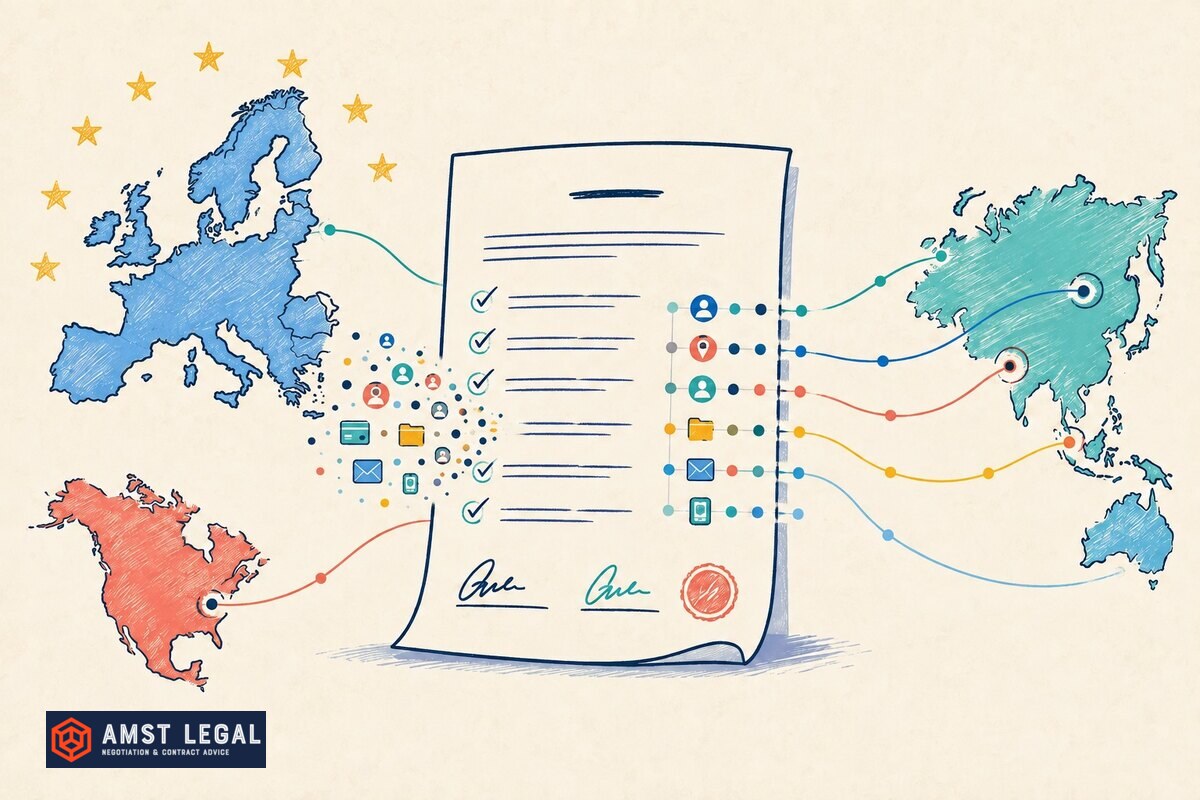
So, what is the GDPR, why does it matter for business contracts and how can you prevent these issues? This practical guide gives sales, procurement, founders and lawyers the essential GDPR basics, plus the relatively simple steps that can keep privacy questions from delaying signature. It is written for an international audience, reflecting the contracts I work on between European companies and businesses in the US, Middle-East and Asia. The next articles in this series go deeper into DPAs and SCCs.
The good news is that many of the problems are relatively easy to prevent. In this article we will do more than explain the GDPR. We cover the basics you need to know and the practical steps to take in this article ‘What Is the GDPR? A Practical Guide for Business Contracts’.
What Is the GDPR? The Short Version
In short, here are the six points to remember:
- The GDPR is the EU’s general rulebook for personal data. One regulation, every EU country, across sectors. The UK has kept its own very similar version.
- The GDPR can also bind companies outside the EU when they offer goods or services to people in the EU, or monitor their behaviour. The UK GDPR has a similar reach.
- Personal data is much broader than you may think. A work email address counts. An IP address counts. Even harmless-looking pieces of information count once they can be combined to point to one person.
- For contracts, the key concepts are personal data, processing, and the two roles, controller and processor. Understand these and every privacy document in your deal starts making sense.
- Fines can reach 20 million euros or 4 percent of worldwide turnover. But the everyday reason to care is simpler. Deals do not sign until the privacy paperwork is right.
- The practical fix: identify the data and the parties’ roles early, use approved DPA and SCC documents, and complete the required information before final negotiations. Most avoidable GDPR delays are process problems, and process problems can be fixed.
GDPR for Business: Key Terms for Contracts
You will run into these terms in almost every deal. Here is what they mean, without the legal language.
- GDPR: the General Data Protection Regulation. The EU’s law on personal data, in force since 2018.
- UK GDPR: the UK’s own version, kept after Brexit. Very similar rules and principles.
- Personal data: any information about an identified or identifiable person. Much broader than most people expect.
- Data subject: the person the data is about. An employee, a customer, a user.
- Processing: almost anything you do with personal data. Collecting, storing, viewing, sharing, deleting.
- Controller: the party that decides why and how personal data is used. Usually the customer in a vendor deal.
- Processor: the party that handles the data on the controller’s instructions. Usually the vendor.
- Privacy notice: the public explanation a controller must give to the people whose data it uses. Sometimes called a privacy statement or privacy policy.
- Lawful basis: the legal reason you are allowed to process personal data at all. The law lists six.
What Is the GDPR and When Does It Apply?
The GDPR is the General Data Protection Regulation. It is a European Union regulation, in force since 2018, and the word regulation matters. An EU regulation applies directly in every EU country. No country needs to pass its own version first. Individual countries can add specific rules on certain topics, but the GDPR provides the shared framework across the EU.
A side note on geography: the EU GDPR also extends across the European Economic Area, which includes Iceland, Liechtenstein and Norway. After Brexit, the UK kept its own very similar version, the UK GDPR. So in this article, references to Europe generally mean the EEA and the UK unless stated otherwise.
Two more things make the GDPR different from what many US readers are used to.
First, it is one cross-sector rulebook. The US regulates privacy largely sector by sector: one law for health data, another for financial data, plus a growing patchwork of state laws. The GDPR applies across industries. There is no general “we are not a regulated industry” exit.
When Does the GDPR Apply Outside the EU?
The GDPR can apply to organisations outside the EU when they offer goods or services to people in the EU, or monitor their behaviour there. No European office is required. Mere website accessibility is not enough, but actively targeting EU customers can bring a company within scope. The UK GDPR uses a similar test for people in the UK.
This is why the GDPR matters even to companies that see themselves as purely American. A US company that targets European customers or monitors people in Europe may have to comply. That is often the moment the GDPR lands on its contracts.
And the law has teeth. Fines can reach 20 million euros or 4 percent of a company’s worldwide annual turnover, whichever is higher. But in daily practice the pressure is more direct: European counterparties simply will not sign until the privacy side of the deal is in order.
Want the source? Articles 1 to 3 GDPR cover what the law is and where it applies.
What is Personal Data Under the GDPR?
Here is the single biggest misunderstanding we see, especially from US teams.
Personal data is any information about an identified or identifiable person. Not just sensitive records. Not just consumer data. Any information about a person.
10 Everyday Examples of Personal Data Under the GDPR
These examples appear in ordinary business tools and contracts more often than most teams expect:
- Work email addresses, such as
jane.smith@company.com. - Names and job titles in contact lists and email signatures.
- IP addresses and device IDs in website logs and app telemetry.
- User accounts and login records, including account IDs and access history.
- Support tickets and chat messages tied to a customer or user.
- Meeting recordings and transcripts containing voices, faces or written conversations.
- CVs and employee records, including applications, payroll information and reviews.
- Customer and supplier contacts, including names, roles and direct numbers.
- Location and product-usage data showing where and how a service is used.
- Details that identify someone when combined, such as a postcode, date of birth and job title.
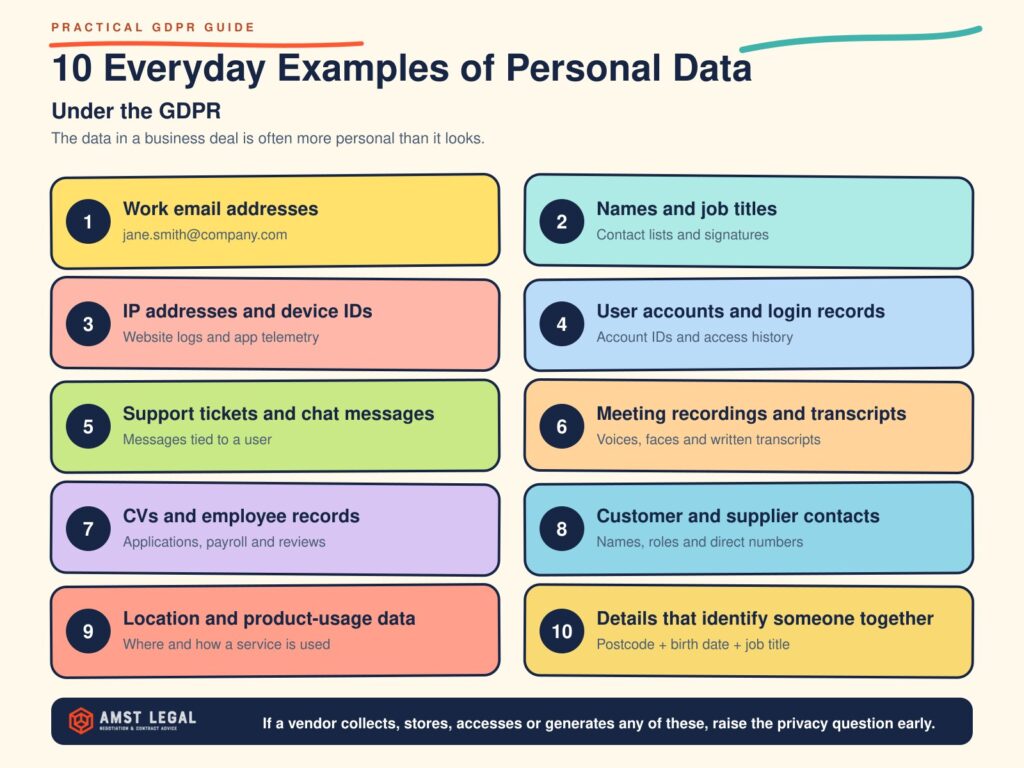
Here is the part almost everyone misses: information can also become personal data in combination. One piece on its own may point to nobody. A postcode alone covers many people. But a postcode plus a date of birth plus a job title can point to exactly one person. Once pieces of information can be put together to identify someone, they are personal data. So the question is never “is this one field sensitive?” but “could this information, combined, point to a person?”
What matters is whether someone, in practice, could use that combination to single out one specific individual. Even three ordinary-looking fields, on their own harmless, can together point to one person.
One more thing: it does not matter how the data reaches you. If you can see it, if you receive it, if it simply sits on your servers, you are dealing with personal data and the rules apply to you.
So the honest rule of thumb is this: if you think your deal does not touch personal data, you are almost certainly wrong.
Want the source? Article 4(1) GDPR defines personal data.
What Does Processing Mean Under the GDPR?
Processing is one of the most important concepts to understand when you deal with data privacy, globally, and especially under the GDPR. The reason is simple: every duty in this law attaches to processing. Who is responsible, who must protect the data, who must answer when something goes wrong. It all starts with the question of who processes what. When we get to responsibilities in the next articles, this is the concept everything builds on.
The definition is deliberately wide. Processing means almost anything you do with personal data, and the law itself lists the examples: collecting it, recording it, storing it, retrieving it, using it, sharing it, deleting it.
Yes, storing is on the list. This matters in deals because of one common objection: “we only store the data, we never look at it.” Under the GDPR, storage is processing. A vendor that only hosts files, and never opens a single one, is still processing personal data, and the rules still apply to it.
Put the two broad concepts together and you see why the GDPR reaches into almost every contract. Almost everything is personal data, and almost everything you do with it is processing.
Want the source? Article 4(2) GDPR defines processing, storage included.
GDPR Controller vs Processor: Who Decides and Who Executes?
Two quick questions.
Is Netflix the controller or the processor of your viewing history? Controller. You never instructed Netflix to do anything. Netflix decides what to collect, how to use it, and what to recommend you next.
Now your salary. Your employer runs payroll through an external payroll provider. Who is responsible for your salary data? Your employer decides what you earn, when you are paid, and how long the records are kept. The payroll company just executes. Your employer is the controller. The payroll provider is the processor. The same goes for Zoom storing your company’s meeting recordings: your company decided to record and how long to keep them, Zoom executes.
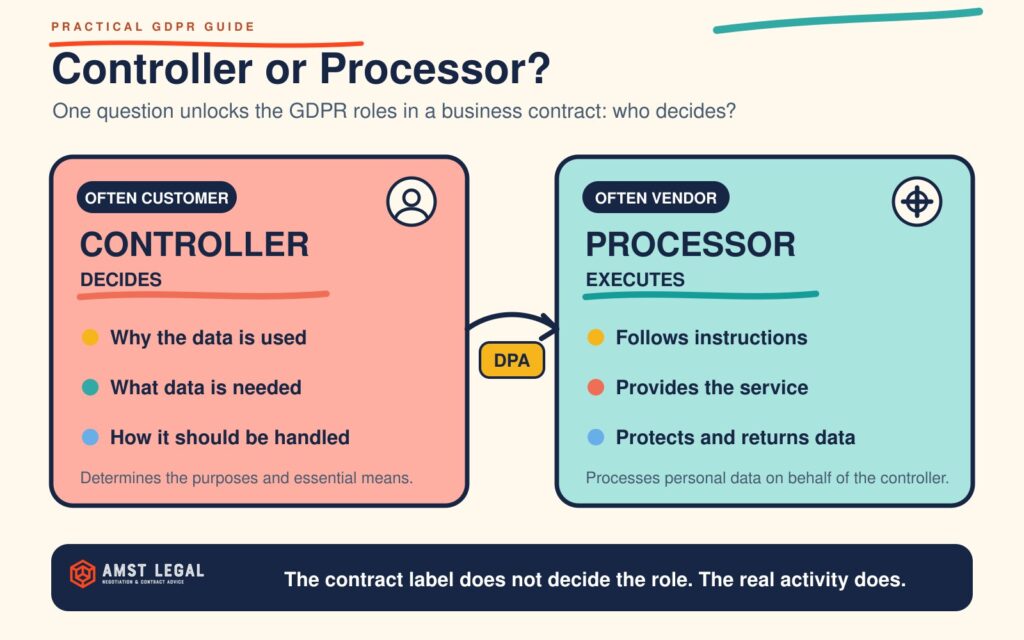
That is the whole concept, and it always comes down to one question: who decides? The party that decides why and how data is used is the controller. The party that executes on instructions is the processor.
Can the Same Company Be Both Controller and Processor?
Yes. That is the reason even people who work with this daily still find it hard. Take Gmail. Your private Gmail account: Google decides how the service works, so Google is the controller. Your work email on Google Workspace: your employer decides, Google executes, so Google is the processor for that service. Same company, similar product, different role. The role depends on who decides the purposes and means of the specific processing.
And the role matters, because under the GDPR the roles decide who is responsible for what. For example:
- Who must answer when a person asks about their data.
- Which company is responsible to report a data breach.
- Who is on the hook when something goes wrong. Every privacy document in your deal is built on this split.
What Do the GDPR Roles Mean in a Business Contract?
Think of a company, Acme Inc. They hold information about its employees and its customers. Acme decides to buy software:
- Salesforce for its customer data,
- Microsoft 365 for email, and
- an approved business version of ChatGPT for its teams.
Acme decides why these tools are used and which data goes in. That makes Acme the controller. The software providers handle Acme’s data to deliver their service, as agreed in the contract. That makes them processors for that processing.
That is the whole idea. The controller decides. The processor executes, on the controller’s instructions.
One warning, even in a basics article: the label in the contract does not decide the role. What a company actually does decides it. A vendor that starts using customer data for its own purposes, for example to train its AI models, is no longer just a processor for that activity. Remember this one. It becomes important in the next articles, especially where AI is involved.
And one side note: most deals look like the Acme example, one controller and one processor. Sometimes two companies each decide for themselves what they do with shared data. Then you have two controllers, a controller-to-controller relationship, with different paperwork. We will not go into that here.
Want the source? Articles 4(7) and 4(8) GDPR define controller and processor. The European Data Protection Board also provides a practical explanation.
GDPR Privacy Notices and DPAs: What Is the Difference?
Why did you never sign a DPA with Netflix?
Here is a question the roles immediately answer. You use Netflix, Spotify, maybe the free version of ChatGPT. You never signed a data processing agreement with any of them. Why not?
Because a DPA belongs to the controller-processor relationship. It is the contract a company signs when it asks another company to process data on its behalf. As a consumer, you are not instructing anyone. Netflix is the controller, and you are simply the person the data is about. No controller-processor relationship, so no DPA.
What you get instead is the privacy notice. The privacy notice is the controller’s duty: every controller must explain to the people whose data it uses what it collects, why, for how long, and who it shares it with. That is why every consumer service has one, and why it is written to you.
And this duty has teeth. The Dutch privacy regulator fined Netflix 4.75 million euros because its privacy statement did not explain clearly enough what it did with customer data. Netflix objected to the fine, but the message to every controller is the same: the notice is not decoration.
A processor works differently. It does not owe you a notice for the data it handles on behalf of its customer. Its duties run to the controller, through a contract. That contract is the DPA. (The vendor is still a controller for its own things, its website, its billing, its own staff, and has a privacy notice for those.)
So here is the simple map. Consumer products: the company is the controller, you get a privacy notice, and there is no DPA. Business tools: the vendor is the processor, the two companies sign a DPA, and your employer owes you the notice. And one handy trick: want to know a company’s role? Open its privacy notice. The controller must name itself there. Netflix’s names Netflix, and for European customers, its Dutch entity in Amsterdam.
Want the source? Articles 12 to 14 GDPR cover privacy notices. Article 28 covers the DPA. Both come back in the next article in this series.
What Is a Lawful Basis Under the GDPR?
One more foundation, and then you have the full picture.
Under the GDPR, you cannot process personal data just because you want to. You need a legal reason, a lawful basis. The law lists six. Three matter in daily business:
- Contract: you may use the data you need to deliver what was agreed. Order something at Amazon, and Amazon may use your name and address to deliver your package. Without that data, no delivery.
- Legitimate interests: you may also use data for closely related things a customer would reasonably expect. Amazon checking your order for fraud, for example. What this basis does not allow is going much further than what people would expect. It is the everyday workhorse in B2B, and also the most misused.
- Consent: the person agreed. Consent feels like the safe choice, especially to US readers. In business settings it is usually the weakest one, because it can be withdrawn at any time.
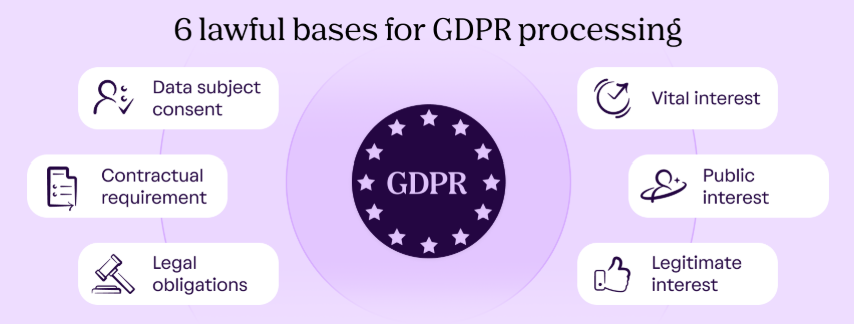
Now the point for commercial teams. When you are selling, your customer will assume there is a proper legal basis behind everything your product does with data, so make sure that question has been discussed with your legal or data privacy team before it comes up in the deal. When you are buying, the homework is yours: a vendor cannot supply your lawful basis for you. Either way, this is a question for legal early in the process, not after signature.
Want the source? Article 6 GDPR lists the six lawful bases.
What Does the GDPR Mean for Business Contracts?
Now the pieces come together.
GDPR Compliance for Business Contracts: Five Practical Steps
You do not need to turn every salesperson, procurement manager or founder into a privacy specialist. A small number of repeatable steps will prevent many of the problems that slow deals down:
- Identify the personal data. Ask what information the service collects, stores, accesses or generates. Do this before someone assumes that a deal has no privacy impact.
- Confirm the parties’ real roles. Decide who determines why and how the data is used, and who acts on instructions. Do not rely only on the labels in the contract.
- Raise the paperwork early. If a DPA or international transfer mechanism may be needed, put it on the deal checklist at the start rather than introducing it just before signature.
- Use approved documents and complete the details. Standard DPA and SCC documents solve only half the problem. The annexes still need an accurate description of the data, purpose, duration, security measures and sub-processors.
- Create a clear route for exceptions. Let the commercial team handle recurring questions with approved guidance, while legal or privacy specialists focus on unusual data uses, high-risk information and non-standard transfers.
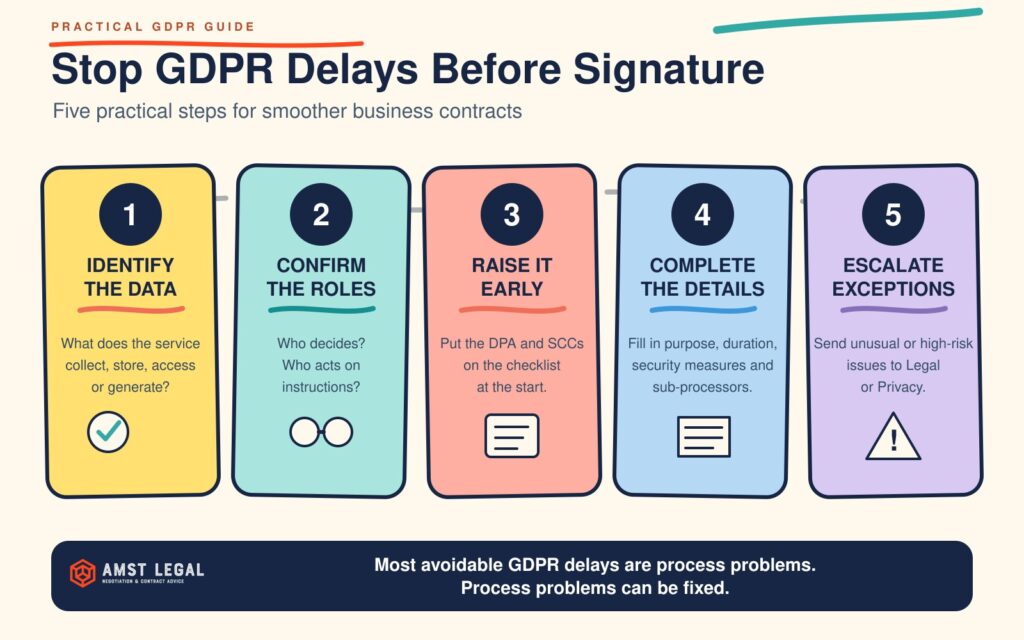
These steps will not remove every privacy question, but they take away much of the avoidable friction. The goal is to help commercial teams recognise the recurring issues, follow a workable process and know when specialist advice is actually needed.
The DPA and SCC Basics
Because personal data is defined broadly and many services process it, European law requires specific privacy paperwork in many commercial deals. Two documents appear particularly often:
- The DPA, the Data Processing Agreement: the contract Article 28 GDPR requires when a processor handles personal data on a controller’s behalf.
- The SCCs, the Standard Contractual Clauses: standard clauses that can provide a legal safeguard for sending personal data outside the EEA, for example to a US parent company or US cloud provider, when the applicable requirements are met.
These two documents are where deals slow down in practice, and they are each worth their own plain explanation. That is exactly what the next two articles in this series do: what a DPA is and why every deal has one, and what SCCs are and why you should never try to negotiate them.
This was the very basics, on purpose. If you understand personal data, processing, controller versus processor and lawful basis, the rest of this series will feel much easier.
At AMST Legal we help US and European companies get this right: understanding what the GDPR requires in their contracts, and building templates and processes so the privacy paperwork stops delaying deals. If the GDPR keeps showing up in your contracts and nobody has ever explained it properly, this series is for you, and we are happy to help with the rest.
Frequently Asked Questions: What Is the GDPR and How Does It Affect Business?
What Is the GDPR in Simple Terms?
The GDPR is the EU’s general law on how organisations may collect, use, store, share and delete personal data. It also gives individuals rights over their data and assigns responsibilities to controllers and processors.
Does the GDPR Apply to US Companies?
It can. The GDPR may apply to a US company that offers goods or services to people in the EU or monitors their behaviour there. A company does not always need an EU office to fall within its scope.
What Counts as Personal Data Under the GDPR?
Personal data is any information relating to an identified or identifiable person. It includes obvious details such as names and email addresses, but can also include IP addresses, user IDs, support tickets and information that identifies someone when combined.
What Is the Difference Between a Controller and a Processor?
The controller decides why and how personal data is used. The processor handles that data on the controller’s instructions. The real activity determines the role, not the label in the contract.
When Is a DPA Required Under the GDPR?
A DPA is required when a controller appoints a processor to process personal data on its behalf. Article 28 GDPR requires that relationship to be governed by a written contract containing specific terms.
Why Does the GDPR Matter for Business Contracts?
The GDPR determines which privacy documents, security obligations, data-use restrictions and international transfer terms a deal may need. If those points are raised late or described incorrectly, they can delay signature and create compliance risk.
ChatGPT Terms of Service Explained for Businesses: Updated Terms
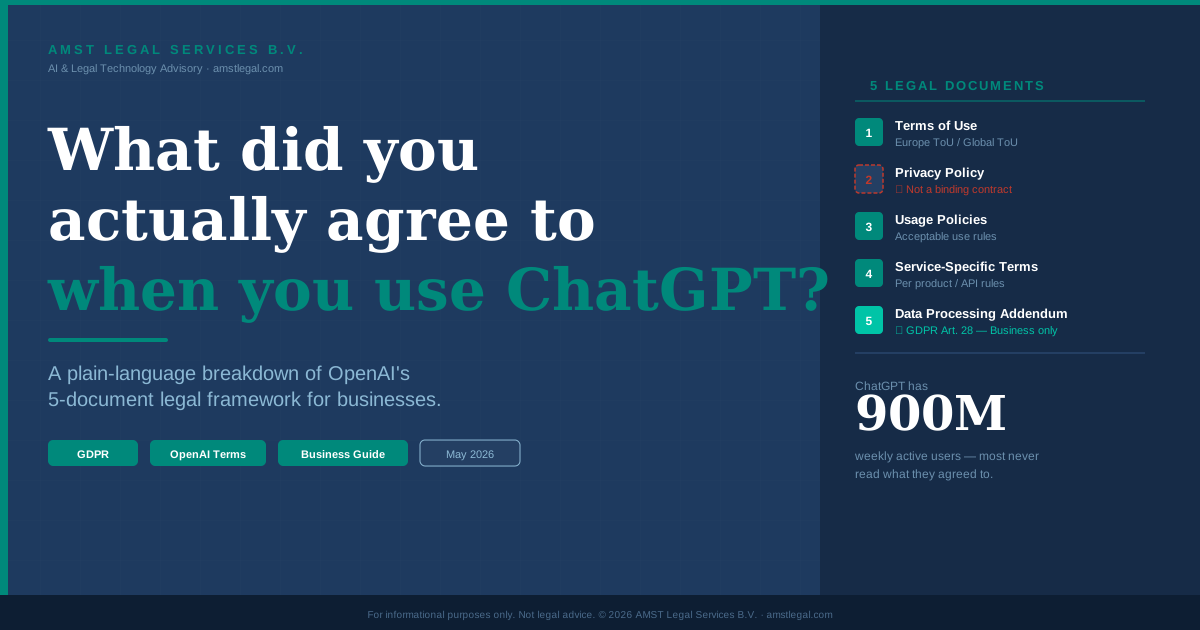
OpenAI recently updated its Terms of Use, Services Agreement, and Privacy Policy. OpenAI’s ChatGPT terms are not mentioned in one contract, but by five separate legal documents. Which ones apply to you depends on which plan you use. Because OpenAI terms are not very clear, the same questions keep coming up: which ChatGPT or OpenAI terms apply, how do the documents fit together and what does this mean for users?
The most common question we get: does ChatGPT train on my data? The short answer is yes, unless you are on a Business or Enterprise plan, or have manually opted out in your account settings. That is where most individuals and organisations run into problems. Nobody explains how the five documents fit together and which one applies to them. This is why we have written this article ‘ChatGPT Terms of Service Explained for Businesses: Updated Terms’.
Instead of one contract, OpenAI uses a layered framework. This article explains how they connect, which one applies to you, and what it means in practice for individuals and businesses using ChatGPT
TL;DR
- Will ChatGPT train on your data? Yes, except if you opt out or if you have a business contract
- The ChatGPT Terms of Service are part of a broader OpenAI contract structure made up of multiple interconnected documents.
- Different terms apply depending on whether you use ChatGPT as an individual or under a business agreement.
- The “Pro” Trap: Pro is classified as a Consumer account. By default, this model trains on your data, unless you manually opt out.
- For organisations, the OpenAI Services Agreement is the primary contract for e.g. API and enterprise use.
- Don’t forget that there are specific policies, service terms & addenda that contain a lot of operational obligations.
Why Do the ChatGPT Terms of Service Matter?
AI vendors like OpenAI, Claude, Gemini but also SaaS/Software providers like Salesforce, Uber, Atlassian, Microsoft,etc. increasingly rely on layered contracts that incorporate multiple documents by reference. This normally includes an order form, a Master Services Agreement, general terms, service-specific terms and policies and addenda. When it comes to OpenAI that is no exception.
What really matters in practice is the distinction between consumer (individual) use and business use, as different terms apply to each.
- Consumer vs business use determines your risk position: Even when employees use ChatGPT for work, they may still fall under consumer Terms of Use. In practice, this means different data usage rules, liability allocation, and protections apply than the organization expects. We see similar issues across other AI providers (see our article on Claude AI: Anthropic’s Claude AI Updates – Impact on Privacy & Confidentiality). For business use, organizations should ensure employees only use OpenAI services under company-approved terms.
- Layered contracts mean obligations are spread across documents: Different documents govern different aspects of the relationship. Teams often assume one set of terms applies, while key obligations sit in policies or service-specific terms. Because these documents are incorporated by reference and updated regularly, obligations can change without renegotiation. This creates operational risk if no one actively monitors updates.
This type of contractual framework is not uncommon. Many large Tech, SaaS and AI providers use similar contractual structures. Nonetheless, the interlinked nature of these contracts means that each document creates distinct rights and obligations that operate together as a whole. This makes it interesting to understand these contracts more in-depth.
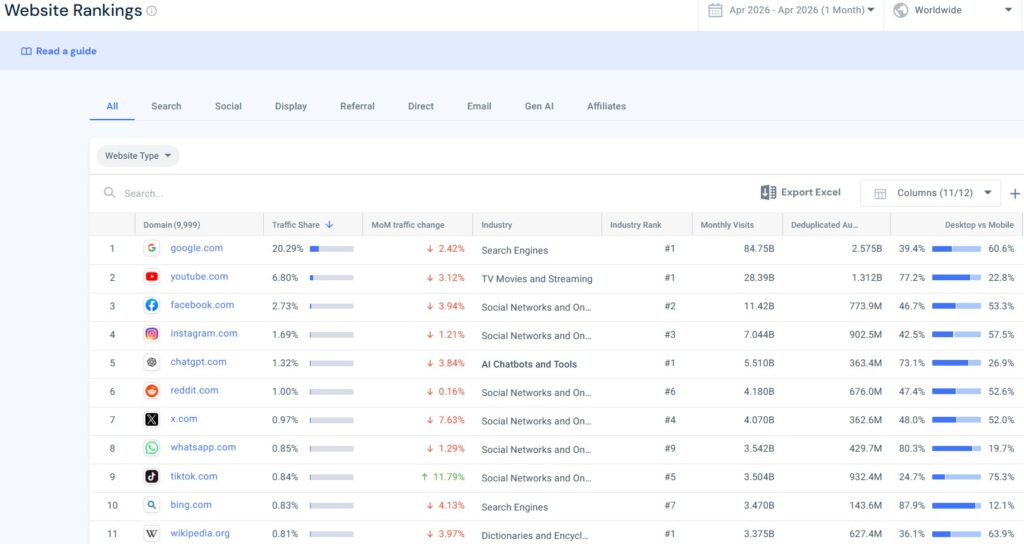
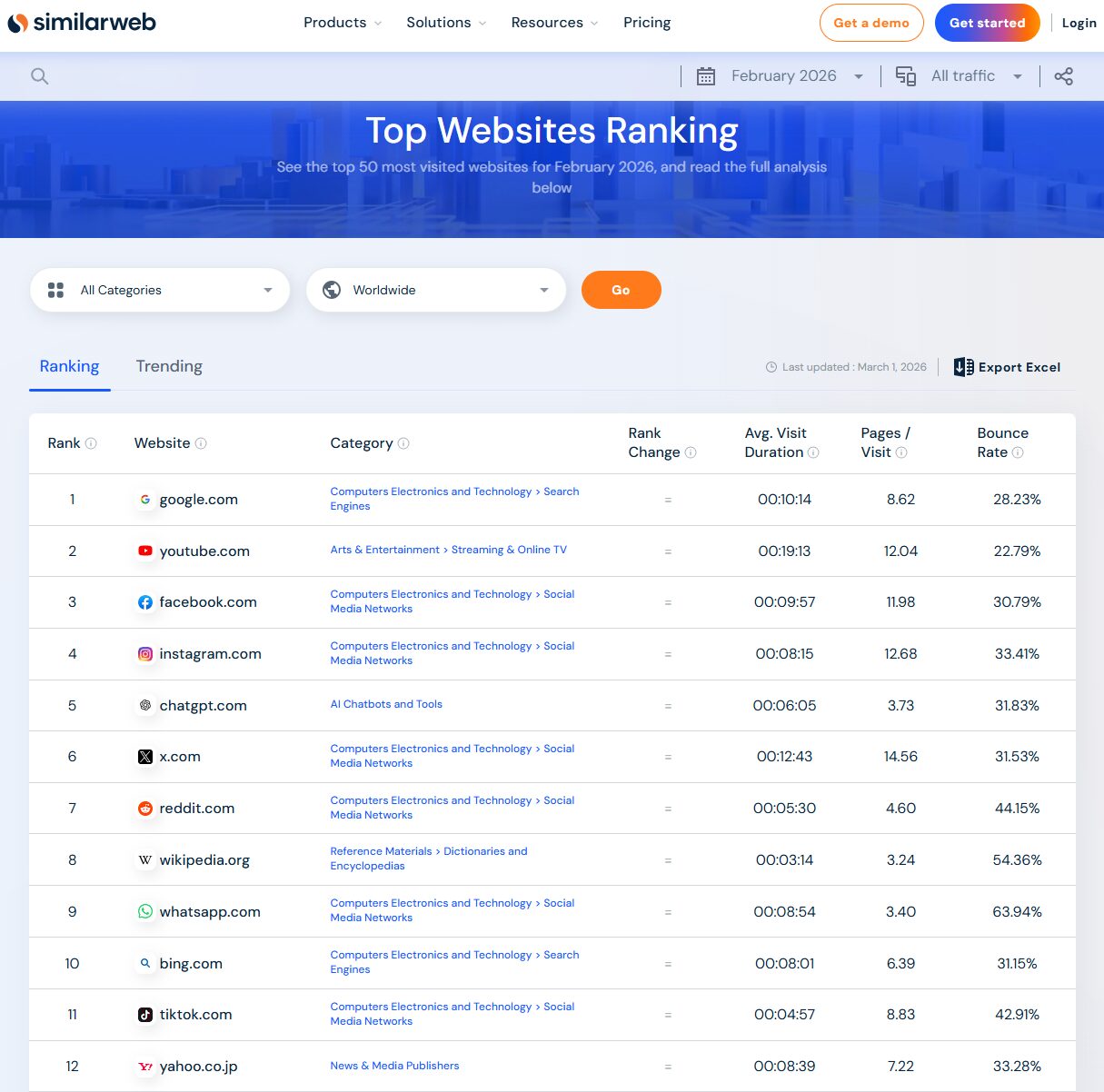
According to Similarweb’s Top Websites Ranking April 2026 (see here), ChatGPT is one of the most used websites globally.. This makes understanding of their governing terms particularly interesting.
ChatGPT and OpenAI Contract Structure Explained
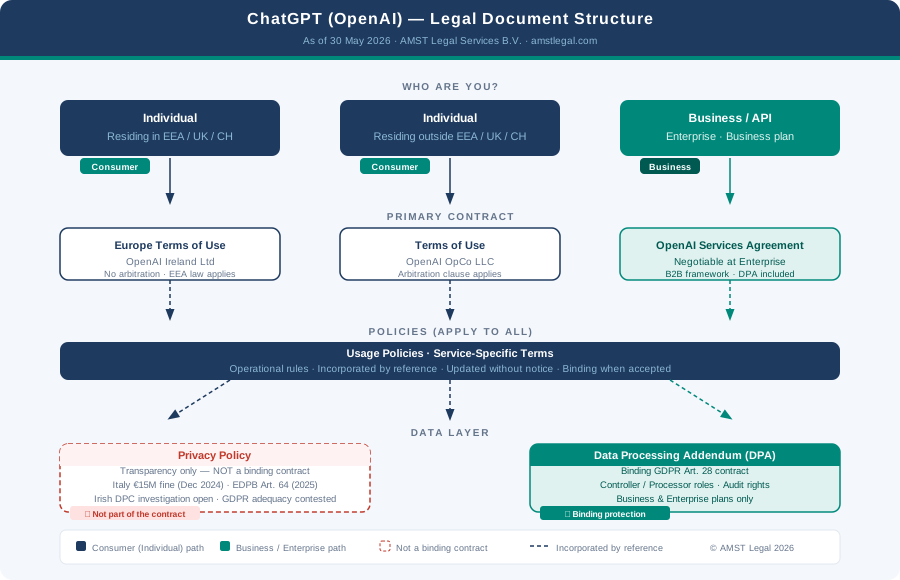
At a high level, OpenAI does not rely on a single contract. Instead, it uses a layered contractual framework where multiple documents operate together. This approach is standard across SaaS and AI providers, but it requires a different way of reading contracts. Rather than reviewing one agreement in isolation, organisations need to understand how several documents interact and which one takes precedence in practice. (for more details, see OpenAI’s article here)
The three general terms that can be applicable revolve around three primary actors:
- Individuals (residing in the EEA),
- Individuals (residing outside the EEA), or
- Businesses (non-specific location).
The key is to understand that only one of these above documents forms part of the contractual framework between you (the company you work at) and OpenAI. Moreover, these general terms acts as a connection point which pulls in additional policies and addenda. Because, most importantly, these governing agreements do not stand alone as OpenAI’s contractual structure relies heavily on incorporation by reference. However, as a basic starting point, the general terms and data privacy related policies deserves an in-depth explanation on its own.
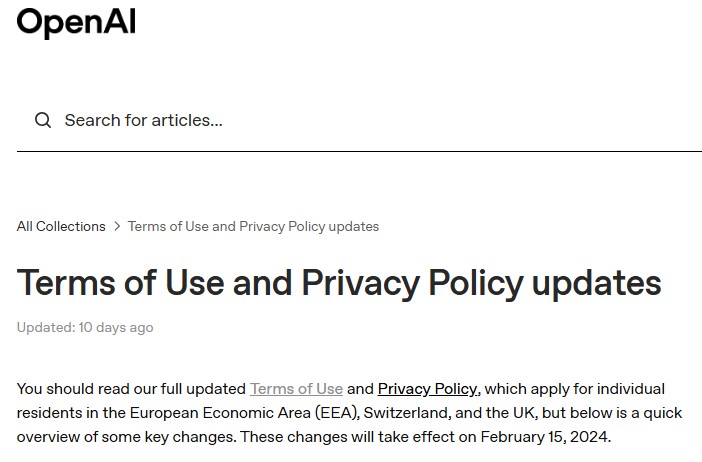
OpenAI’s explanation about the new terms is unfortunately unclear and in some places incomplete (see for yourself here), This is exactly why we wrote this article. OpenAI maintains a dedicated help article explaining their Terms of Service updates. Given that 900 million people use ChatGPT every week, you would expect this to be a reliable reference point. It is not — the article references conflicting dates and leaves the consumer/business distinction unexplained entirely.
ChatGPT Terms of Service Explained – How the Documents Actually Fit Together
Below we explain the full structure in plain language. OpenAI’s framework is built on five documents, each covering a different part of the relationship between you and OpenAI. Understanding how they connect is what most articles, including OpenAI’s own, fail to do clearly. Here is the version that actually makes sense.
Terms of Use (Individual Use)
The OpenAI Terms of Use govern individual use of ChatGPT and other OpenAI services. In practice, these are the default terms that apply unless an organisation has entered into a business agreement. This distinction is critical because many employees use ChatGPT in a professional context while still operating under individual terms.
From a legal and commercial perspective, the Terms of Use focus on access and behaviour. They define who can use the service, what constitutes acceptable use, and how content is treated. They also include limitations of liability and disclaimers that are typical for consumer-facing platforms. However, they are not designed to address enterprise-level concerns such as negotiated liability caps, audit rights, or structured data protection obligations.
As a result, organisations that rely on ChatGPT without moving to a business setup may unknowingly accept a risk profile that is materially different from what they would expect in a typical vendor relationship. This is not a drafting issue—it is a structural one.
Differences Europe Terms of Use vs Terms of Use
For individuals using OpenAI’s services, which is dependent on which account plan you are using, there is only one distinction in which contractual framework applies. The determining factor for whether the Europe Terms of Use or the Terms of Use is applicable is where you live. If you reside in the EEA, Switzerland or the UK, the Europe Terms of Use governs the usage of for example ChatGPT. On the contrary, if you reside outside of the EEA, Switzerland, or the UK, the Terms of Use are applicable.
Both these agreements governs individual’s use of OpenAI’s services. Structurally, both contracts covers the same services, places the same user obligations on the user and ensures that users retain rights to their input/output for example.
A few differences highlighted:
- Contracting parties differ depending on your location as residents in the EEA or Switzerland contract with OpenAI Ireland Ltd, while UK and US residents enters into a contractual relationship with OpenAI OpCo LLC.
- Content of terms, linked to local legal requirements. For example, the Terms of Use, applicable on UK and US residents, allow arbitration while the Europe Terms of Use doesn’t. oth the Europe Terms of Use and the Terms of Use specify that the Privacy Policy is not a part of the contract, but it remains essential for understanding data handling practices.
What is not different is that both Terms of Use specify that the Privacy Policy is not a part of the terms, but it remains essential for understanding data handling practices.
Europe Privacy Policy vs Privacy Policy
The general terms point out that the privacy policy is not part of the contractual framework between individuals and OpenAI. Despite this, the policies are still present and affect how OpenAI handles your data. In terms of which policies may be applicable, the Privacy Policy applies in general.
Since data protection regulation are dependent on local legal requirements, there are distinct privacy policies for specific locations. For example, if you reside in the EEA, Switzerland or the UK the Europe Privacy Policy is relevant and for US residents, the US Privacy Policy is applicable.
Do note that there are additional privacy policies for other locations too. This does however showcase that local legal requirements are taken into consideration. The main difference between these are the level of detail and connection to applicable data privacy regulation, which evidently does differ between Europe and the US.
OpenAI Contract Structure for Businesses
OpenAI Services Agreement Explained (Business Use)
As mentioned, businesses generally operate under separate terms. This is the same within OpenAI’s contractual framework through the OpenAI Services Agreement. This agreement applies to API customers and enterprise users and governs commercial deployment of OpenAI models. Most crucial is what type of user you are; i.e., if you are using a subscription plan for individuals (also Pro!), these business terms won’t apply. Because of this, it is relevant to check what type of subscription you use.
Unlike the Terms of Use, this agreement is structured as a commercial contract and is intended to be reviewed, negotiated, and managed by legal and procurement teams.
This agreement governs the key commercial and legal elements of the relationship. It addresses pricing and billing, defines permitted use of the models, allocates liability, and sets out intellectual property positions. In addition, it establishes how data is handled in a business context, typically in conjunction with a Data Processing Addendum.
What matters in practice is that this agreement fundamentally changes the risk allocation. It moves the relationship from a consumer-style framework to a business-to-business structure, where expectations around accountability, data protection, and commercial certainty are materially different. For organisations deploying AI at scale, this is the agreement that should anchor internal governance and contract review processes.
Service Terms (Product-Specific Rules)
On top of the primary contract sit the Service Terms, which apply to specific OpenAI products or functionalities. These are often overlooked because they are not always presented as standalone agreements. However, they are incorporated by reference and can materially affect how services are used in practice.
Service Terms typically define operational and technical conditions. For example, they may set limits on how APIs can be used, impose restrictions on certain use cases, or clarify how specific features function. In many cases, these terms translate directly into product-level constraints that business and technical teams must follow.
From a legal perspective, the key point is that Service Terms are binding once incorporated. From a business perspective, they often contain the rules that teams encounter day-to-day. Ignoring them creates a gap between what the contract allows and how the service is actually used.
Policies (Usage and Operational Rules)
In addition to contractual terms, OpenAI maintains a set of policies that apply across its services. These policies typically cover acceptable use, safety requirements, and operational restrictions. While they may not always read like traditional contractual clauses, they can still have binding effect when incorporated into the main agreement.
In practice, policies often contain the most immediate constraints on how ChatGPT and related services can be used. For example, they may prohibit certain categories of content, restrict high-risk use cases, or impose compliance-related obligations. These are not theoretical limitations—they directly affect how business teams deploy AI in real scenarios.
Another important feature is that policies are updated regularly. Because they are incorporated by reference, changes can apply without renegotiation. This creates a dynamic environment where compliance is not a one-time exercise but an ongoing process.
Privacy Policy vs Data Processing Addendum
A common source of confusion is the difference between the Privacy Policy and the Data Processing Addendum (DPA). Although both relate to data, they serve fundamentally different purposes.
The Privacy Policy explains how OpenAI handles data in general terms. It is primarily aimed at transparency and user information, particularly in a consumer context. However, it does not typically form part of the contractual framework in the same way as other documents.
The Data Processing Addendum, by contrast, is a contractual document. It applies in business relationships and governs how personal data is processed on behalf of the customer. It defines roles such as controller and processor, sets out security measures, and addresses regulatory requirements such as GDPR compliance.
For organisations, the distinction is critical. The Privacy Policy tells you what happens in practice, while the DPA defines what OpenAI is legally required to do. Relying on the former instead of the latter can lead to incorrect assumptions about compliance and risk allocation.
Does ChatGPT Train on Your Data?
One of the most frequently asked questions is whether ChatGPT trains on your data. The answer depends on which terms apply.
Under consumer use, ChatGPT may use inputs and outputs to improve its models, unless users actively opt out where that option is available. This reflects the default structure of many consumer AI services, where data contributes to ongoing model development.
Under the OpenAI Services Agreement, the position is different. In a business context, customer data is generally not used for training purposes. This distinction is not merely technical—it is contractual.
In practice, this creates a clear risk scenario. Employees may use ChatGPT under consumer terms, while the organisation assumes that enterprise-level protections apply. The tool is the same, but the legal framework is not. As a result, understanding which terms apply is essential for managing both data risk and internal compliance.
The data protection layer’s place
So, what other terms may be applicable as well? Well, the Data Processing Addendum sits alongside the OpenAI Services Agreement through reference. It governs how OpenAI processes personal data on behalf of the customer. Crucially, the DPA, not the general privacy policy nor the location specific privacy policies, creates the contractual data protection obligations. Business teams often confuse the two, but legally they serve very different purposes.
On one hand, the Data Processing Addendum is critical for GDPR and similar regimes and defines roles (controller vs processor), sets out processing instructions and security measures, addresses cross-border transfers and sub-processors. This is relevant as it sets out which obligations your organization shall follow in terms of data privacy. On the other hand, the privacy policies is relevant as it sets out what kind of protection OpenAI offers to their customers. That refers to the actual users, for example employees in your company.
How To Handle AI Usage
Defining Key Documents and Processes
AI usage intersects with several contractual touch-points like the general terms and data handling policies. Therefore, hidden clauses allowing various things may be applicable. Understanding of overarching responsibilities and rights, like how data is used, and how outputs are verified is recommended. For example, companies should ensure that no confidential or client data may be submitted to public AI interfaces unless approved safeguards exist.
Connecting Legal, Sales, and Procurement Functions
In many organizations, sales teams use AI for proposal generation while legal reviews contracts separately. Procurement teams vet vendors but may not assess AI clauses. Consequently, a misalignment arises. Depending on what terms apply, there may be a risk that confidential information is shared with the AI company. Therefore, collaboration between for example Sales and Legal is key to ensure that OpenAI’s terms, and similar clauses from other AI providers, are reviewed beforehand.
Balancing Flexibility and Risk Reduction
AI adoption should not paralyze innovation. Instead, companies can create “approved use” guidelines outlining permissible AI tools and inputs. This approach preserves flexibility for business teams while embedding guardrails against data misuse. Moreover, including AI-specific language in supplier and client contracts ensures accountability.
Key Takeaways
- OpenAI’s contract structure is layered by multiple documents,
- Different OpenAI terms apply to EU individuals, non-EU individuals, and businesses,
- Policies and addenda often contain the most practical obligations,
- Understanding the structure improves both commercial and legal outcomes, and
- Proactive mapping and monitoring reduce risk and delays.
Frequently Asked Questions
Q: When should we use the OpenAI Services Agreement instead of the Terms of Use?
A: When ChatGPT or OpenAI services are used in a business context, especially via APIs or enterprise solutions. This ensures appropriate commercial and data protection terms apply.
Q: What is the real risk if we get this wrong?
A: The main risk is a mismatch between assumed protections and actual terms. This can lead to unintended data use, limited liability coverage, and compliance issues.
Q: Who should own this internally?
A: Typically legal and procurement should define the framework, but IT and business teams must be involved to ensure actual usage aligns with approved terms.
Q: Does this apply differently across jurisdictions?
A: Yes. For example, EEA-specific Terms of Use and privacy frameworks may apply depending on location. This affects enforcement and regulatory compliance.
Q: Do we need tailored legal advice or are standard terms enough?
A: For low-risk use cases, standard terms may be sufficient. However, for enterprise use or integration into products, tailored review is recommended.
Conclusion & Call to Action
Understanding which subscriptions equals what applicable contract is no longer optional for organisations using SaaS or AI at scale. It directly affects risk allocation, commercial commitments, and strategic flexibility. At AMST Legal, we regularly support clients in reviewing, negotiating, and operationalising AI and SaaS contracts, either on a project basis or as interim in-house counsel.
If you want to better understand how OpenAI’s contracts affect your business, or if you are preparing for negotiations, audits, or customer discussions, we can help. Visit amstlegal.com to learn more or book a consultation today, or email info@amstlegal.com.
Note: this an updated draft of the article of January 2025: Ultimate Guide how ChatGPT, Perplexity and Claude use Your Data.

Comprehensive NDA Guide for Companies: Why are NDAs important?
Should you really sign that NDA before you start negotiating or working together? Short answer: Yes, but don’t make it too complicated. They key is to protect your business with NDAs, while not overcomplicating the process. Due to increased digitalization and data flows, information is value. Therefore, keeping what is confidential should be a priority. This is why we have Non-Disclosure Agreements (NDAs).
We often get asked why and when NDAs should be signed in business negotiations. This is particularly important when sensitive commercial or technical information may be disclosed during early discussions.
This article, together with our previous articles on NDAs (see below a list) aims to help companies understand why and how to effectively leverage Confidentiality Agreements. In this article “Comprehensive NDA Guide for Companies: Why are NDAs important?” we focus on explaining the need of NDAs & practical ways to deal with them.
TLDR – If you only have a minute to read
- NDAs help companies protect sensitive information during business negotiations and partnerships.
- Many types of commercially valuable information are not automatically protected by law, which makes contractual confidentiality essential.
- NDAs clarify how confidential information may be used, shared, and protected between parties.
- In SaaS, procurement, sales, investment discussions and joint development projects, NDAs help manage business confidentiality risk.
- Understanding when to use an NDA in business negotiations helps companies avoid disputes and protect competitive advantage.
Terms Used in This Article
Let’s first start with: what is an NDA and what are the most used definitions when speaking about NDAs?
Non-Disclosure Agreement (NDA)
A legally binding contract that requires one or more parties to keep certain information confidential and limits how that information can be used or shared.
Confidential Information
Information that is not publicly available and that provides commercial value because it remains secret. Examples include pricing models, customer data, product plans, or internal financial information.
Trade Secret
A specific category of confidential information that derives economic value from being secret and is protected under trade secret law if appropriate safeguards are maintained.
Receiving Party
The party that receives confidential information under an NDA and is obligated to protect and restrict the use of that information.
Disclosing Party
The party that shares confidential information with another party under the terms of an NDA.
Statutory Protection
Legal protection provided automatically by law, such as trade secret law or data protection regulations.
Contractual Confidentiality Obligation
A duty created by contract that requires a party to protect and limit the use of confidential information.
Due Diligence
A process where companies review financial, legal, or operational information before completing a transaction such as an acquisition or partnership.
Why are NDAs Necessary?
On of our clients was asking this today & I’m glad she did. It’s a great question, and I felt it was worth putting the answer here as a reminder.
Sensitive information often changes hands long before an agreement, like a Software Contract, is signed in B2B situations..
8 Reasons You Need to Sign NDAs
Well-drafted NDAs help you:
- 🔹 Protect confidential pricing, discounts and commercial proposals
- 🔹 Keep the customer’s budgets, internal processes and business plans confidential
- 🔹 Protect the supplier’s unpublished product roadmap and technical information
- 🔹 Set boundaries before sharing sensitive security reports or vulnerabilities
- 🔹 Limit how information may be used: to evaluate the proposed deal
- 🔹 Clarify who may receive it, including colleagues, advisers and subcontractors
- 🔹 Keep confidentiality obligations in place if the deal falls through
- 🔹 Protect both sides sharing sensitive information
Note that you might not need a Confidentiality Agreement if the confidentiality has already been covered by suitable confidentiality terms in an existing NDA or other Agreement. Check before sharing your NDA!
Remember the Following in Practice
Easy to forget, but keep the NDA-process simple where possible – at least for 80% of all NDAs signed Legal should not be involved.
Golden tips:
- Almost always use mutual NDAs to avoid discussions and delays (there are exceptions).
- Involve Legal as little possible.
- There are many options to handle 80-90% of all NDAs without Legal. They only need to make the Template, Train, link it to great Tech/AI and support with Negotiations only where necessary. This is our TTTN Framework for all contracts, but for NDAs and Amendment Agreements it is the easiest to implement.
- Use your own format as much as possible.
Why are NDAs important?
Knowledge era and data market
We currently live in the knowledge era. That means that information, or data which is another common way to refer to it, is one of the most important trade items today. Information is shared left and right through various means, commonly through SaaS solutions like Gmail, Outlook, OneDrive, Sharepoint, websites and AI etc.
This is very convenient and part of mostly everyone’s daily life today. At the same time, companies with a lot of data can gain a competitive advantage as it can offer benefits for various business actions like marketing and sales. Data is a highly valuable resource in other words. Because of this it may not be a surprise that selling data can generate high revenue, and that the value of the data market follows a steady growth rate. Think about:
- Presenting inventions or business ideas to a potential partner, investor or distributor,
- Sharing details about your company’s finances or marketing with a prospective buyer of your company,
- Receiving services from a company or individual who may have access to some sensitive information when providing those services, or
- Employees gain access to confidential and proprietary information about your company during the course of doing their job.
(see Forbes article “The Key Elements of Non-Disclosure Agreements on Forbes” here).
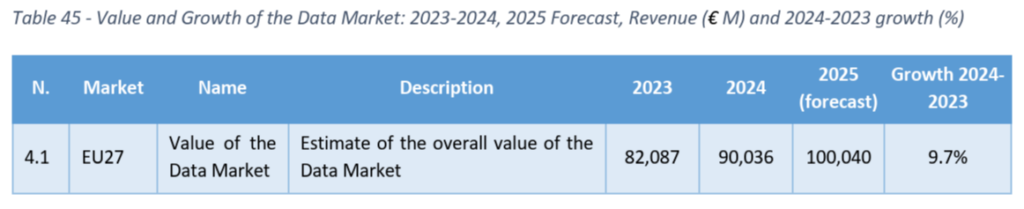
For an illustration, see the chart above from the European Data Market Study 2024-2026 showing that the data market is growing further every year.
However, there are many situations where companies cannot, do not want to or are legally constrained from sharing specific information.
Maintaining a Competitive Advantage
Disclosing certain information, even if it is not strictly confidential in the legal sense, can reveal information that holds great value for your company. That can be for example pricing strategies, cost structures, supplier relationships, sourcing models, product development or acquisition targets. In many cases, the law does not require but does not either forbid disclosure.
In legal practice, confidential information generally refers to information that is not publicly known and that provides commercial value because it remains secret.
Protecting Confidential Information of All Parties
Sensitive information that shall not be shared is not always limited to your own company’s information. Companies are oftentimes also responsible of maintaining other parties’ confidential information secret. Which kind of confidential information that refers to can be vastly different. However, common information this can refer to are for example:
- licensed software or technology,
- co-developed products,
- joint ventures,
- supplier innovations, or client-owned materials.
Information or knowledge like this may be protected either by law or by contracts. If you are required to not disclose the information it is likely due to a contract, commonly an NDA. The important thing to know is that exploiting others’ confidential information may lead to different unwanted consequences.
Compliance with Applicable Laws
Complying with applicable laws can be one of the most strict drivers behind non-disclosure. Companies operating in the EU today are subject to overlapping legal regimes that can differ drastically across jurisdictions and industries.
Within the EU, it can concern regulations like GDPR with the purpose of protecting individuals’ personal data for example. If your customers are consumers, it also unleash several consumer specific regulation and directives. On top of this, local national legislation also becomes relevant of course. Generally, secrecy obligations can be triggered by everything from employment laws, trade secret laws, unfair competition regulations, sector-specific regulations, professional secrecy obligations or public procurement confidentiality rules.
Compliance with Non-legal Sector-Specific Duties
In certain sectors or industries, certain specific non-legal duties play a crucial role in why companies cannot always share certain information too. This mainly revolves around either companies operating in for example finance and banking or healthcare or specific personnel bound by confidentiality duties like accountants, teachers or doctors. Disclosing sensitive information, even if technically lawful in certain cases, can cause harm, undermine trust, or violate professional standards in areas such as financial markets, healthcare, and children’s education. Ethical information governance helps companies prevent misuse, protect vulnerable stakeholders, and maintain long-term credibility, which is increasingly important for regulators, investors, and consumers alike.
Keeping Contractual Promises
This is one of the most common and most underestimated reasons for non-disclosure. Modern business relationships are, and should be, governed by various contractual obligations in different forms between different parties. Oftentimes various regulation and laws may not be applicable either due to contractual choices between the parties. This makes the underlying contract the most important regulation. Despite the case-by.case factor that is highly relevant for each contractual relationship, contractual promises are legally enforceable and can be found in very different forms. Normally, contractual promises are embodied and found in NDAs, However, it can also be found in separate clauses of specific contracts. This includes for example Data Processing Agreements, Master Service Agreements, Service-Level-Agreements or License Agreements. In other words, promises to keep information secret are not limited to NDAs. However, the confidentiality promise is the same and the contract sets out the obligations and rights for each party.
How NDAs can help and what NDAs can achieve
The relevance of a contractual protection mechanism
NDAs play a vital role in protecting sensitive business information in today’s digital, data-driven economy. Companies share large volumes of information in negotiations, partnerships, and daily operations, and without a clear contractual framework, that information can be misused or disclosed unintentionally. While technical safeguards like password protection and secure logins help reduce breach risks, they don’t replace contractual protection or address the legal consequences of misuse.
In practice, NDAs provide contractual protection of sensitive information, particularly in negotiations, due diligence processes, technology partnerships, sales contracts and procurement discussions.
So, how can a simple contract help then? Well, in broad terms, an NDA is a contract that specifies confidential information, what can be done with it and what happens in case that information is disclosed. Essentially, it acts as a safeguard of the specific information it aims to protect. By clearly setting these boundaries, NDAs reduce ambiguity and prevent misunderstandings. This clarity becomes increasingly important as information is shared through digital tools, cloud services, AI and cross border cooperation.
Sometimes, in the heat of transactions between companies, there is always a wish to close deals quick though. This is common and understandable, but may also lead to poor protection of sensitive information. Because, as intricate as every legal system is, it is important to know that it is not always enough to argue that the other party promised to keep your confidential information safe, and there is no generally applicable law safeguarding confidential information shared between companies apart from some specific exceptions that are not always applicable. If the good protection mechanisms of an NDA is used correctly though, it makes up a great tool that shouldn’t be underestimated. A well drafted NDA acts as a preventive safeguard rather than a reactive remedy and have several benefits to it.
Enforceability and Risk Management
NDAs create legally binding obligations that allocate risk between the parties from the outset. They normally specify the consequences of unauthorized disclosure or misuse and may provide contractual remedies. This predictability strengthens legal certainty and reduces the likelihood of disputes. From a risk management perspective, NDAs transform confidentiality from an informal expectation into an enforceable commitment. This is particularly valuable in international business relationships where legal protections differ between jurisdictions and statutory confidentiality rules may be limited or inconsistent.
Operational Clarity in Practice
In daily operations, NDAs translates confidentiality obligations into clear and actionable rules for employees, consultants, and external partners. An effective NDA clarifies who may access confidential information, how it may be shared internally, and what security measures apply. By aligning legal obligations with actual business workflows, NDAs reduce the risk of accidental disclosures and strengthens internal compliance. This operational clarity is essential in organizations where information flows quickly across teams and systems.
In operational terms, NDAs convert abstract confidentiality expectations into clear internal rules for employees, advisors, and external partners.
Protection Beyond Statutory Law
Many companies assume that confidential information automatically benefits from legal protection. In reality, statutory protection is often limited to specific categories of information. A wide range of commercially sensitive information remains unprotected unless the parties agree otherwise. NDAs fill this gap by contractually protecting information that may not qualify for statutory protection but still holds significant business value. This includes for example pricing structures, customer data, strategic plans, technical concepts, and early stage innovations. Through NDAs, companies can tailor confidentiality obligations to their specific business needs.
Importantly, many forms of commercially sensitive information do not automatically receive statutory protection, which is why companies rely on contractual confidentiality obligations.
Enabling Trust and Collaboration
Clear confidentiality obligations do not hinder cooperation. On the contrary, NDAs enable transparency and trust in commercial relationships. When parties understand the rules governing information use and disclosure, they feel more comfortable sharing the information necessary to assess opportunities and move projects forward. NDAs therefore function as enablers of collaboration. They allow companies to engage in negotiations, due diligence, and joint development while maintaining control over their most valuable assets.
Practical Examples and Use Cases
These examples illustrate when companies should use an NDA in business negotiations, especially where proprietary data, pricing models or technical information is shared.
SaaS and Technology Deals
In SaaS transactions, vendors often disclose product architecture, security measures, and integration capabilities during sales cycles. At the same time, customers may share internal data structures or workflow information. If no NDA governs these exchanges, both sides face business confidentiality risk. A competitor could replicate a feature, or internal data insights could leak. Therefore, technology companies typically implement NDAs early in the sales process to ensure mutual protection.
Procurement and Competitive Bidding
Procurement teams frequently request detailed proposals from multiple suppliers. Those proposals may include proprietary methodologies, pricing strategies, or process innovations. Without a confidentiality framework, suppliers may hesitate to provide meaningful detail. As a result, the quality of comparison declines. An NDA signals seriousness and encourages transparent participation. Consequently, procurement benefits from clearer offers and reduced legal exposure.
Founders, CFOs, and Investment Discussions
Founders regularly present financial projections, market strategies, and technical concepts to potential investors or partners. While investors may resist overly restrictive terms, a balanced NDA clarifies expectations. CFOs, meanwhile, must consider financial reporting obligations and reputational risk. If sensitive financial data circulates without restriction, market perception and valuation could suffer. In these contexts, understanding why NDAs are necessary supports informed decision-making rather than reactive damage control.
Frequently Asked Questions (FAQ)
Q: When should companies use an NDA in business negotiations?
An NDA should be used whenever commercially sensitive information is shared before a formal agreement is signed. This commonly occurs during partnership discussions, procurement processes, technology evaluations, and investment negotiations.
Q: Are NDAs always necessary in SaaS negotiations?
Not always, but they are often advisable. During SaaS negotiations, vendors may disclose product architecture or security details, while customers may share internal workflows or datasets. An NDA helps protect both sides during these exchanges.
Q: What risks do companies face if they do not use NDAs?
Without contractual confidentiality protection, sensitive information may be disclosed without legal consequences. This can result in competitive disadvantage, reputational harm, or loss of intellectual property value.
Q: Are NDAs enforceable across international business relationships?
Generally yes, provided the agreement clearly defines the confidential information, obligations, and governing law. However, enforcement may vary depending on jurisdiction.
Q: Does the law automatically protect confidential business information?
No. Many types of business information are not protected unless contractual obligations exist. NDAs therefore fill an important legal gap.
Q: Can NDAs slow down business negotiations?
Well-structured NDAs usually accelerate negotiations because they create a clear framework for sharing information safely.
Q: Do NDAs protect both parties?
They can. NDAs may be unilateral (protecting one party) or mutual (protecting both parties). We usually only agree to mutual NDAs and we advise you to ask the same in each NDA negotiation. There should only be a few exceptions to that. Let is know where you are in doubt.
Key Takeaways
- Information is valuable and can be a major leverage – think pricing but also inventions,
- Digitally available confidential information is easy to disclose and risks disclosure if safeguards are not in place,
- Sensitive information should be treated with care and should be protected,
- NDAs are a great way to start with contractual protection of business sensitive information,
- After the signed NDA, parties can negotiate about the specifics. Think about Sales & procurement Contracts, Share Purchase Agreements, Distribution Agreements, etc..
Conclusion & Next Steps
Understanding why and when to use an NDA in business negotiations allows companies to protect commercially sensitive information before it becomes legally vulnerable.
NDAs are far more than administrative checkboxes or deal-closing formalities. They are essential governance tools that help companies protect value, manage risk, and collaborate with confidence. When used thoughtfully, an NDA translates abstract legal duties into concrete, operationally workable obligations that teams can understand and follow in practice. It bridges the gap between legal theory and everyday business reality by safeguarding sensitive information while enabling growth, innovation, and trust-based partnerships.
For executives, NDAs should be viewed as risk-allocation tools that clarify how information may be used during negotiations and commercial cooperation.
As a next step, critically review your current secrecy and NDA practices. In the upcoming parts of this article series, we will continue to build on this foundation by exploring the distinction between confidential information and trade secrets, identifying key NDA clauses for optimal protection and usability, and providing practical checklists that companies can apply immediately. If you want to ensure that your NDAs are not only legally sound but also commercially effective, this is the moment to move from formality to strategy.
For tailored guidance or a review of your existing NDA framework, book a call here or email us at info@amstlegal.com.
To read more on this topic here are some articles: Wat is een NDA (Geheimhoudingsovereenkomst)?, NDA-skyldigheter: Vad du måste veta (3), Comprehensive NDA Guide for Companies: Why are NDAs important?, Don’t Sign That NDA Yet! Understand Your Obligations First and, NDA’s Explained – What You Need to Know (Part 2)

E-Signature Policy and Signing Authority Matrix: Why is That Important?
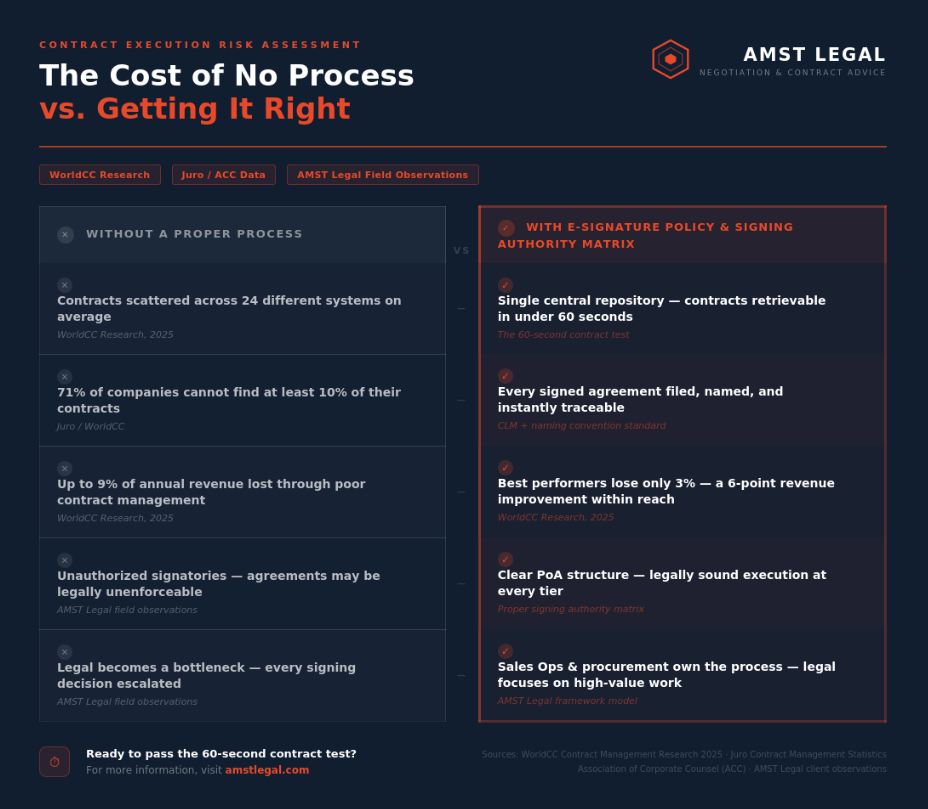
Where is the fully signed contract? Why can an e-signature policy and signing authority matrix help with that? Here is a question worth asking in your next team meeting. If someone asked you right now to find a specific signed contract within 60 seconds, could you do it? Most organizations hesitate. Not because the contract does not exist, but because nobody built a proper e-signature policy or signing authority matrix to manage where contracts go after they are signed.
The signed contract is often lost document is somewhere between an inbox, a shared drive, a personal folder, and possibly the laptop of someone who left the company six months ago.
This is not a hypothetical. As someone who has served as head of legal and interim General Counsel for a wide range of businesses across tech, IT, and software sectors, I see this situation repeatedly. It is one of those operational problems legal teams rarely prioritize, which is why it keeps happening. However, when contracts cannot be retrieved, enforced, or audited, the business consequences become serious: disputes, legal question delays, missed renewal windows and failed due diligence processes. Therefore, this is not just legal housekeeping. It is a commercial governance issue. This is why we wrote this article ‘E-Signature Policy and Signing Authority Matrix: Why is That Important?’.
What You Will Learn in This Article
- Key terms for signature processes in companies (e.g. e-signature policy, signing authority matrix & CLM)
- Why the absence of an e-signature policy creates real legal and operational risk
- How legal, finance, IT and commercial teams each play a role in signing procedures
- Practical examples across SaaS, procurement, and founder-led businesses
- How to build a process that works at scale
Key Terms
Before discussing why contract execution often breaks down, it is useful to clarify the terminology. Many organizations use these terms interchangeably. They are not the same. Most professionals have heard of these terms, but we notice that there is need for clarity. It is difficult to explain why policies or signing overviews are needed. Also terms related to Legal Tech or AI need explanation, especially in practice.
What Is an E-Signature Policy?
An e-signature policy is a documented internal framework that defines how your organization executes contracts digitally. Having the policy is step one. Making sure people actually know it exists, understand it, and use it correctly is where most organizations fall short.
In our experience, a single onboarding workshop is rarely enough. Processes change, teams grow, and people forget. What actually works is building awareness into the rhythm of the business. This means providing short, recurring training sessions, and making it a habit for legal to show up in commercial and management meetings, not just when something goes wrong.
Those regular touchpoints with the business are the right moment to explain which policies matter, where to find them, and what the practical rules are for day-to-day signing decisions. When legal becomes a regular voice in those conversations rather than a last resort, the policy stops being a document that lives in a shared drive and starts being something the business actually uses.
The e-signature policy sets out:
- Which electronic signature tools are approved
- Who is authorized to sign on behalf of the company
- Where fully executed agreements must be stored
- How audit trails are preserved
In other words, an e-signature policy governs the process around signing — not just the technology used. Without it, digital signing becomes informal delegation rather than structured corporate authority.
What Is a Signing Authority Matrix?
A signing authority matrix is the internal document that specifies who may legally bind the company, for which types of contracts, and up to which financial thresholds. It is also referred to as a delegation of authority (DoA) matrix, authorized signatory list, signatory authority policy.
The terminology varies, but the purpose is the same. Here is how the terms tend to be used in practice:
- Delegation of Authority (DoA) Matrix. the term used most often in larger corporates and board-level governance. Covers both the named individuals and the full threshold and category structure.
- Authorized Signatory List: common in banking, finance, and regulated industries. More focused on who can sign.
- Signatory Authority Policy: used often in legal operations contexts. Slightly broader: covers both the named signatories and the rules around escalation and approval.
Whatever your organization calls it, the document needs to exist, be legally grounded and aligned with your articles of association and any powers of attorney in place. Above all, it also needs to be accessible to the people who use it day to day.
For example, a sales director may be authorized to sign customer agreements up to a defined contract value. For larger commitments, approval or signature is required from the CFO or CEO. The matrix should align with the company’s articles of association, commercial register extract, and any powers of attorney issued to individual signatories.
Without a documented signing authority matrix, organizations rely on assumptions about seniority rather than verified corporate authority.
What Is Contract Lifecycle Management (CLM)?
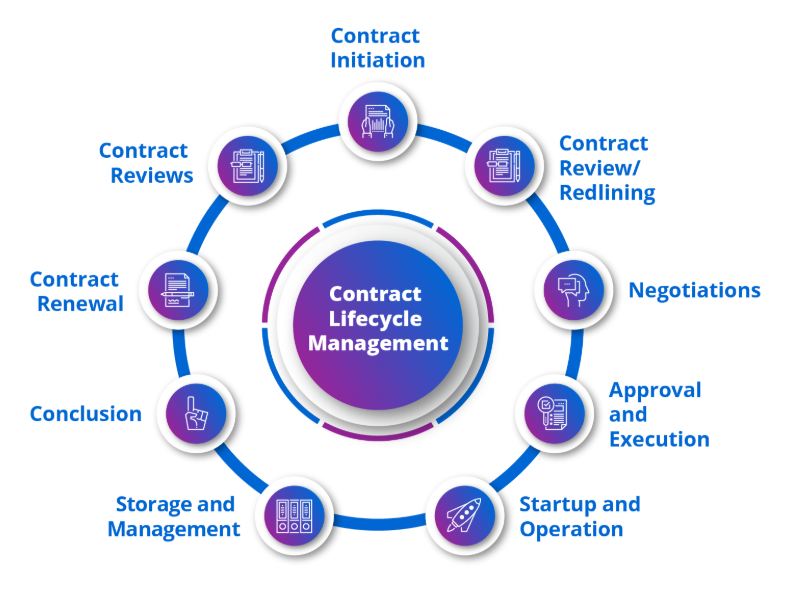
Contract lifecycle management (CLM) is both a process and a category of software. It covers the full journey of a contract. From drafting and approvals, through signing and execution, to storage, reporting, and renewal. Modern CLM platforms centralize records, automate workflows and give legal, finance and procurement real-time visibility into what has been signed and what is coming up. This is where legal technology and AI are making a genuine operational difference. Think AI-assisted contract review to smart renewal alerts and risk flagging.
When selecting a CLM tool, think beyond features. First start with the problem you want to solve. Additionally, consider compatibility with your existing systems. This means your CRM, ERP and e-signature software – and whether the platform is built to work with legal tech and AI tools as they continue to develop. A CLM that sits in isolation creates a new silo rather than solving the old ones.
Regardless of which tool you choose: CLM supports structure. It does not replace it.
What Is Electronic Signature Software?
Electronic signature software, such as DocuSign or Adobe Acrobat Sign, allows parties to sign agreements digitally with audit trails and authentication features. In practice we see that Docusign is used the most to sign a contract digitally. However, as an easy signing possibility has been added to Adobe (pdf viewer) we now see that many people are thinking of integrating this in Adobe. The conversation typically goes like this: “The thinking is: “If I am already in Adobe to review a contract and I agree to it, I might as well sign it now. Why would I need extra software for that?”
These tools are legally recognized in many jurisdictions under frameworks such as the EU eIDAS Regulation and the US ESIGN Act. However, legal validity depends on proper use, reliable audit trails, and authorized signatories.
Using signature software without an e-signature policy is comparable to giving employees access to a company stamp without rules on who may use it.
What Is the EU eIDAS Regulation and Why Does It Matter for Your Contracts?
The eIDAS Regulation is short for ‘Electronic Identification, Authentication and Trust Services’. It is the European Union’s legal framework that governs how electronic signatures are recognized and accepted across EU member states. The eIDAS establishes three tiers of electronic signature:
- a standard electronic signature,
- an advanced electronic signature, and
- a qualified electronic signature,
Each tier carries a different level of legal weight and technical requirement. For most commercial contracts, a standard or advanced e-signature through a recognized tool is sufficient. However, for higher-value or higher-risk agreements — and in certain regulated industries — a qualified electronic signature may be required to ensure full legal enforceability.
What eIDAS makes clear is that the tool you use and the audit trail it generates are not administrative details. The software tools are the foundation of whether your signed agreement holds up legally. Therefore, when your e-signature policy defines which tools are approved, it should also verify that those tools meet the eIDAS requirements relevant to your contract types and jurisdictions. For a full overview of the regulation and its current status, the European Commission publishes up-to-date guidance directly on their eIDAS regulation page.
Why This Problem Is More Common Than You Think
The Operational Gap Most Legal Teams Overlook
We explained above what an e-signature policy is. It is a standardized framework that defines:
- which tools your organization is authorized to use for signing,
- who holds the authority to sign on behalf of the company, and
- where executed agreements must be stored. It sounds basic.
In practice, it is one of the most underdeveloped processes in mid-sized and growing businesses.
Part of the reason is cultural. Legal teams focus on substance. This means negotiation, risk allocation, and commercial terms. However, what happens after signature often falls through the cracks. Moreover, when a business scales quickly, informal habits that worked at ten employees no longer work at fifty or two hundred. Someone uses a personal DocuSign account. Another person stores the PDF in a private folder. A third sends the final version by email and never archives it. Eventually, nobody knows which version is final or where it sits.
There is also a legal dimension. Electronic signatures are legally recognized in many jurisdictions, including under the EU eIDAS Regulation, the US ESIGN Act, and the UK Electronic Communications Act. However, enforceability depends on using recognized tools, maintaining audit trails, and demonstrating that the signer had authority to bind the company. Without a defined e-signature policy, that evidentiary trail weakens.
The Practical Challenges When This Is Not Addressed
When organizations operate without an e-signature policy or signing authority matrix, predictable issues emerge. Contracts become inaccessible when employees leave. Internal confusion arises about who is authorized to bind the company. Signed agreements scatter across multiple storage locations. Finance cannot confirm whether agreements are fully executed. Procurement struggles to verify supplier obligations.
Consequently, problems surface at the worst possible time — during disputes, fundraising rounds, audits, or acquisitions. At that point, reconstructing events or requesting copies from counterparties is not just inconvenient. It damages credibility and can materially affect negotiations or valuation.
The Opportunity When This Is Handled Well
A well-designed e-signature policy and signing authority matrix creates operational clarity across the organization. Sales closes faster because signing authority is pre-defined. Finance invoices immediately because execution triggers are clear. Procurement retrieves agreements instantly. Legal stops chasing PDFs and instead focuses on risk management and strategy.
During due diligence, a centralized and traceable contract archive becomes a competitive advantage. Investors and acquirers assess governance maturity. Clean execution processes signal control and professionalism.
How an E-Signature Policy Fits Into Your Broader Contract Framework
The Three Core Elements You Must Define
A robust e-signature policy rests on three interconnected decisions.
First, determine which signing tools are approved. Limit usage to one or two authorized platforms. Personal accounts are not acceptable substitutes. IT and security teams should validate compliance with data protection and access standards.
Second, define who can sign what. This is where the signing authority matrix becomes essential. A signing authority matrix maps signing rights by role, contract category, and financial threshold. For example, a sales director may sign customer contracts up to a defined value, while higher-value agreements require executive approval. This means that signing is required from the CEO, CFO or CMO.
Third, establish a single central repository for executed agreements. Whether you use a CLM tool or structured document management system, the rule must be clear: if it is not in the repository, it is not operationally valid.
The Legal Foundation: Corporate Authority and Powers of Attorney
Before implementing a signing authority matrix, legal must confirm the underlying corporate authority. This may involve reviewing articles of association, shareholder agreements, or issuing powers of attorney. The objective is straightforward: ensure the person signing legally binds the company.
In certain jurisdictions, signing without proper authority can render agreements unenforceable or expose individuals personally. Therefore, legal must design the authority framework carefully. However, once established, day-to-day execution should not depend on legal approval for every transaction.
Enabling the Business Without Creating Bottlenecks
Routing all contracts through legal creates friction. While oversight matters, operational ownership belongs with Sales Operations and procurement-linked operations. Legal builds the framework. Operations runs the workflow.
This separation reduces bottlenecks while maintaining governance. Paralegals or fractional legal support can train teams and maintain documentation. Meanwhile, the approved e-signature policy ensures consistency.
Practical Examples and Use Cases
Large Corporate: The CLM Was Live, But Governance Was Weak
A listed company approached us because procurement teams were frustrated with their CLM system. Leadership believed the investment had solved their contract issues. It had not.
They had implemented a contract lifecycle management (CLM) platform, but team capacity had decreased, onboarding was inconsistent, and storage rules were unclear. Some agreements were uploaded incorrectly. Others remained outside the system. Legacy contracts pre-dating the CLM were scattered across inboxes and shared drives.
There was also no practical signing authority matrix that procurement staff could confidently rely on. As a result, they escalated routine matters to legal or made assumptions about authority.
We focused on process, training, and clarity. We defined storage standards inside the CLM, documented signing thresholds, clarified ownership between legal and procurement operations, and ran structured workshops. The software remained the same. Governance improved significantly.
Mid-Size SaaS: Multiple Templates, Unclear Authority
In a mid-size SaaS business, sales teams used separate templates per country. That structure appeared sophisticated. However, when a dispute required access to executed agreements, retrieving signed contracts proved difficult.
Contracts were stored in inboxes, CRM systems, and local folders rather than in a structured contract lifecycle management (CLM) environment. Version control differed by country template, and no one could immediately confirm which version had been executed.
At the same time, several commercial team members had been signing agreements without alignment to a documented signing authority matrix or properly issued powers of attorney. Authority in practice did not fully reflect corporate documentation.
This created enforceability exposure and due diligence risk.
We streamlined templates, aligned signing authority with corporate records, formalized the signing authority matrix, and centralized executed agreements into one repository. Legal defined the framework. Sales Operations owned execution.
SaaS Scale-Up: Aligning Signing with Corporate Documentation
A fast-growing SaaS scale-up needed to professionalize contract execution under increasing investor scrutiny. The articles of association and commercial register extract defined who could bind the company. Operational practice did not fully match.
Certain team members were signing contracts without formal delegation through powers of attorney. That disconnect matters. Signing authority must mirror what corporate documentation allows.
We aligned operational signing practices with the articles of association, formalized required powers of attorney, introduced a structured e-signature policy, and implemented a signing authority matrix consistent with corporate records. We also centralized priority agreements into a CLM-supported repository.
Within months, the COO retrieved a signed enterprise agreement during a board meeting in under thirty seconds. Authority, governance, and operations were finally aligned.
The Business and Legal Benefits of Getting This Right
Business Impact: Speed and Operational Clarity
Defined processes shorten sales cycles and accelerate invoicing. Teams spend less time searching for documents and more time executing strategy. Operational discipline improves stakeholder confidence.
Counterparties notice professionalism. Consistency signals reliability in commercial relationships.
Legal Impact: Enforceability and Scalability
A documented e-signature policy and signing authority matrix reduce disputes about authority and execution. Procedural challenges become rare.
As companies expand internationally, the framework adapts to local requirements while preserving structure. Incoming legal professionals orient quickly because governance is documented.
Key Takeaways
- An e-signature policy must define approved tools, signing authority, and central storage.
- A signing authority matrix maps authority by role, category, and financial threshold.
- Legal establishes corporate authority; operations manages execution.
- Centralized storage with strict rules prevents retrieval failures.
- Proper governance accelerates sales, strengthens audits, and reduces dispute risk.
Conclusion
If you cannot retrieve a signed contract within 60 seconds, your governance framework needs improvement. The solution does not require complex software. It requires clear decisions, defined authority, and disciplined storage.
At AMST Legal, we support businesses in building practical e-signature policies and signing authority matrices that function in real commercial environments. We combine contract expertise with operational design to ensure processes scale with growth.
Visit amstlegal.com to learn more or book a consultation today or email info@amstlegal.com.
Author:
Robby Reggers, Founder of AMST Legal (amstlegal.com), recognized by Legal Geek as a LinkedIn Top Voice for contracting, negotiation and interim GC work. Robby is also featured in the Dutch LawFluencer list (nr. 30) and in a podcast with welegal.nl.
AMST Legal supports clients per contract/project or on an interim basis (set hours per week).

Ultimate List of 22 Must-Know SaaS Contracts and Documents
Struggling with SaaS Contracts? See our list with the 22 Most Common SaaS Contract and Documents below, including explanations. All businesses use technology called software-as-a-services (SaaS). For example:Microsoft 365, Google, Salesforce, Zoom, Shopify, Slack, Atlassian etc. At the same time, many companies develop and sell SaaS too. Behind these products and services, there are many different types of contracts and documents commonly used in SaaS business arrangements. See below our list of SaaS Agreements that you can use as a SaaS Contract Checklist or SaaS Contract Framework.
The full background of these SaaS documents may not be immediately clear. However, even the basic knowledge of these SaaS contracts we provide below can give your business a strong advantage. We have written the article to help lawyers, business owners, sales, procurement or other business professionals. It is especially helpful when you are the seller (vendor) or the buyer (customer) of SaaS products.
We will explain the terms in SaaS and Tech contracts that might create confusion. Terms like MSA (Master Service Agreement), Terms of Use, AI Addenda, Order Form, SOW (Statement of Work) and Service Level Agreement (SLA). See below our comprehensive list of top-tier SaaS and related document resources. This is a follow up on our (shorter) article we wrote in 2024 on this topic, linked here: ‘Struggling with SaaS Vendor Contracts? See our list with the 17 Most Common Documents’.
What We Will Cover
- What SaaS is and what SaaS contracts and documents mean
- Reasons for non-legal to get familiar with SaaS and tech contracts
- Explanations of the 22 most common SaaS & tech contracts and its functions
- Quick Summary & Next Steps
What is SaaS and What Are SaaS Contracts?
Everyone talks about SaaS, but what does SaaS and related terms mean? In line with this, we would like to walk through the definition along with examples of SaaS to clearly pinpoint the topic and explain why we believe that knowledge of related contracts are relevant.
Explanation of what SaaS is
“SaaS” is an abbreviation of “Software-as-a-service”. Essentially it refers to subscription-based software that works through a cloud that is provided as a service. Well, what does this mean? This means that you don’t have to install or maintain anything on your computer to use it. The only thing you need is Internet access and an internet browser. Important: the software is not purchased like in a traditional sales situation where you pay for an actual product that you become the owner of. Instead, SaaS is owned, hosted and managed by the seller (vendor), who deliver the software to you as a service. This enables remote access for SaaS users, who gets a right to use the software for a monthly/annual fee. For vendors, SaaS constitutes a business model deviating from the traditional sales models.
For example, some commonly known SaaS products are Google, Microsoft 365, Salesforce, Facebook, Adobe, Zoom etc. The deciding factor to determine whether software is SaaS depends on how you use it. Is the software used online without further downloading steps or does the software need to be downloaded?
Simply speaking, SaaS is a business model that allows remote provision of software, usually on subscription basis. However, for overall operational and innovative benefits of SaaS, contracts play a crucial role. (For further insights of advantage of SaaS and its efficiency, see this article ‘Top 5 advantages of software as a service (SaaS)‘, written by IBM here.)
SaaS is a business model that allows remote provision of software, usually on subscription basis.
SaaS contracts and documents
Just like any purchase, using SaaS requires having a binding legal contract between the SaaS vendor/provider and the customer/user. This contract sets out the terms and conditions of the software subscription and regulates the relation between a software provider/vendor and a customer who is subscribing to use the online software. In practice, SaaS Agreements have various names, such as Master Agreement, Subscription Agreement, End-user License Agreement (EULA), and (SaaS) License Agreement, etc. The naming of the contract may vary, but there are generally speaking certain contracts that govern the same specific item.
When speaking of “SaaS contracts and documents” it refers to the legal agreements and documentation involved in a subscription of SaaS. Generally, these contracts and documents outline the following items:
- the terms and conditions of service provision,
- usage rights,
- data protection,
- liability,
- payment terms, and
- other crucial aspects of the SaaS relationship between the service provider (vendor) and the customer.
Every item listed above is not necessarily covered by every contract or document though. As a result, the contractual framework for most vendor/buyer relationship will have these items covered in one or (usually) more contracts. Evidently, using SaaS may involve numerous contracts and documents of different character. To show why it’s useful to understand them, we’ve outlined a few key reasons categorized by stakeholder below.

Why this is relevant?
As legally technical as SaaS contracts and documents may seem, understanding the key components involved in a SaaS transaction delivers significant advantages. This is important to the entire organization, not just within Legal. Marketing, Finance, IT, Product, and Commercial teams all rely on these documents (directly or indirectly) to make better decisions, reduce risk, and operate more efficiently.
Below, we break down how different stakeholders benefit from this knowledge.
IT, Procurement & Business Teams that use the SaaS services
IT, Procurement, and Business Operations Teams rely heavily on what the contract actually promises in practice.
Clarity around service scope, uptime guarantees, support obligations and maintenance procedures improves vendor management and operational planning (typically found in Order Form/SOW, SLA and MSA/MOA and other agreements). Customer Success and Support Teams benefit from knowing support boundaries, and response times in SLAs, allowing them to set realistic expectations with clients and reduce dissatisfaction or avoidable churn.
Risk Management & Compliance
A solid understanding of contract terms allows teams to spot financial, operational and legal risks early.
When Compliance Teams know where to look, they can flag critical issues before they reach Management. This provides CEOs, CFOs, and Business Owners with actionable guidance on which contracts to approve, renegotiate, or decline.
Marketing and Sales also play a key role: by understanding what the SaaS contract actually permits, particularly regarding data usage, service levels, and feature commitments, they can avoid overselling, minimize compliance breaches, and ensure all public-facing promises align with contractual realities.
Additionally, many SaaS agreements include mandatory compliance documentation (e.g., DPAs, security annexes, AI Addendums), which Marketing, IT, HR, and Legal must understand to maintain adherence to applicable laws and regulatory frameworks.
Financial Implications
Business Owners, CFOs, and Finance Teams gain substantial value from knowing which SaaS documents govern pricing, auto-renewals, minimum commitments and price increases (typically the Order Form, SOW, MSA/MOA/MCA and pricing annexes).
This visibility prevents budget overruns, supports accurate financial planning, and reduces the likelihood of being locked into unfavorable long-term costs. Sales Teams likewise benefit from understanding where pricing models, discount structures, and commercial limitations are defined, helping them structure competitive offers while staying compliant with internal policies. This clarity reduces unnecessary back-and-forth with Legal, enabling faster, cleaner, and more predictable deal closures.
Strategic Decision-Making & Customer Relations
Contracts often contain terms that shape long-term business strategy. Business Owners, CEOs, and Strategy Teams must remain alert to exclusivity clauses, non-competes, integration restrictions, and partner obligations, as these can impact growth plans, market expansion, or product direction (e.g., General Terms & Conditions and/or MSA/MOA). Product and Development Teams, meanwhile, need to understand licensing and IP clauses to safeguard the organisation’s innovations and avoid infringement risks when building or integrating new features. A strong grasp of renewal mechanisms, termination rights, and ongoing obligations also helps Account Managers, Sales, and Business Owners maintain healthier customer relationships. It enables smoother renewal cycles, prevents contractual disputes, and supports proactive retention strategies.
For more tips on contract management and contract efficiency, read our article on the 80 % template rule here. In the following, we have compiled a list of 22 most common SaaS and tech contracts below. Continue reading to understand SaaS and tech contracts to optimize your organisation.
How Smart SaaS Contract Management Reduces Risk and Costs
Building on the importance of understanding SaaS contracts across the organisation, effective SaaS contract management provides the practical foundation for reducing risk and controlling costs. It allows organisations to:
- identify and mitigate risks early by spotting lock-in clauses, auto-renewals, or hidden limitations before they trigger unexpected expenses.
- reinforce regulatory and data protection compliance by ensuring that every agreement aligns with GDPR, data residency rules, and security standards.
- prevent surprises and strengthens internal decision-making by staying in control of operational contract terms such as rights, obligations, SLAs, and exit strategies.
- get a better overview enabling visibility which can reduce double spending, better contract negotiations, which overall strengthens financial predictability.
- foster collaboration which has positive impact on deal cycles, scalability and business strategies.
Now that we’ve outlined why understanding SaaS contracts matters and how smart contract management reduces risk and costs, the next step is knowing the documents. Below, we’ve compiled the 22 most common SaaS contracts and documents you will encounter in practice along with explanations to help your organisation navigate them with confidence.
Ultimate Guide of 22 Most Common SaaS Contracts and Documents
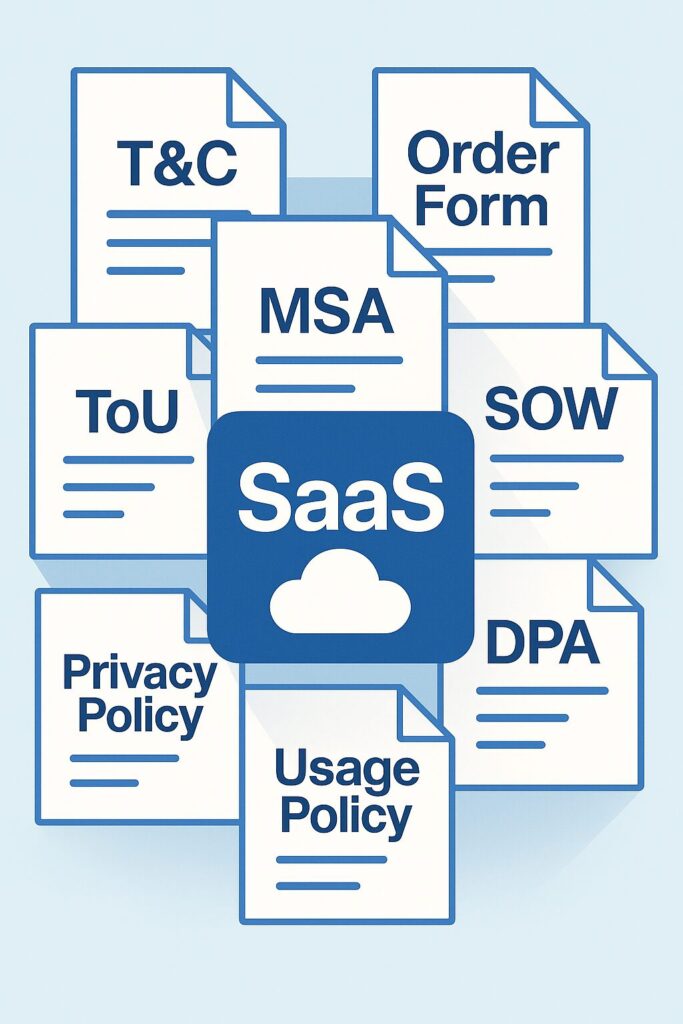
General Terms & Conditions/Terms & Conditions (GT&C/T&C)
This type of contract refers to the legal agreement that sets out the rules, policies, and guidelines governing the use of services, products, or platforms. These terms establish the foundational relationship between a provider, seller, or service operator and its clients, customers or users. They outline rights, responsibilities, limitations, and obligations to ensure clarity and fairness in transactions or interactions.
What this means in practice:
This document defines the default risk allocation. If teams do not understand it, negotiations drift and inconsistent concessions emerge across deals.
Master Service Agreement/Master Ordering Agreement (MSA/MOA)
An MSA/MOA is a comprehensive contract that lays out the fundamental terms and conditions governing future transactions, projects, or agreements between parties. We now – in March 2026 – also see that these MSA’s are called Master Customer Agreement (MCA).
It serves as a foundational framework for subsequent detailed agreements, orders, or projects, providing a consistent set of terms and conditions (the T&Cs – see above) that apply across multiple transactions or projects. The MSA/MOA outlines the overarching rights, responsibilities, obligations, and terms of engagement between the parties involved, facilitating efficiency and clarity in business dealings.
What this means in practice:
The MSA contains the overall contract, referring to the other documents mentioned in this Article. When buying SaaS, ensure you read the MSA/MOA/MCA and all related documents. For Sellers, the MSA determines how scalable your contracting model is. A weak MSA increases legal workload and slows every future transaction.
Terms of Use (ToU)
Another definition that is oftentimes used apart from Terms of Use is Terms of Service (ToS). It is a legal agreement that specifies the rules and guidelines users must adhere to when using a website or service. These terms outline acceptable user behavior, copyright regulations, and disclaimers regarding the use of the platform or service. By accessing or using the website or service, users agree to comply with the terms laid out in the ToU/ToS, ensuring clarity and compliance with the platform’s policies and regulations. Consequently, ToU/ToS are aimed at the end user of the service or product.
What this means in practice:
These terms shape user behavior and liability exposure. Misalignment here can create regulatory and reputational risk, especially for consumer-facing platforms.
End-User License Agreement (EULA)
Constitutes a license agreement that sets forth the terms and conditions under which a user is granted the right to use a software application. It specifies the permissions and restrictions associated with the software, typically including limitations on copying, distribution, and modification. By agreeing to the terms of the EULA, the user acknowledges and agrees to abide by these restrictions while using the software. These terms are normally only applicable to end users, i.e., customers, or employees using the software.
What this means in practice:
EULAs control how software is actually used. Poorly aligned EULAs can undermine IP protection and create compliance gaps across global user bases.
Service Level Agreement (SLA)
An SLA is a contract that establishes the expected standards of service to be provided by a service provider/vendor to its clients or customers. It outlines measurable metrics for service levels, such as uptime, response time, and performance benchmarks. Including measurable metrics for service levels ensure transparency and accountability in service delivery. Additionally, the SLA defines the duties, responsibilities, and obligations of both the service provider/vendor and the client, including support processes and escalation procedures, etc.
SLAs directly affect customer satisfaction and operational cost. Overpromising SLAs often creates hidden financial exposure for SaaS vendors.
Statement of Work (SOW)
Equates to a contract that outlines the expected outcomes of a service/project to be provided by a service provider/vendor to its clients. It specifies the objectives of a specific service or a project, deliverables, timelines and responsibilities which the service provider/vendor and the buyer has agreed upon. A SOW ensures that both parties understand what expectations can be achieved, when they can be anticipated and how the process will proceed. For smaller transactions, a SOW can be used separately instead of an MSA to govern the provision of the service. Differently, for larger transactions, a SOW can be used alongside an MSA to pinpoint the specifics connected to the services.
What this means in practice:
SOWs define delivery scope. Ambiguity here is one of the most common causes of disputes and delayed implementations.
Data Processing Agreement (DPA)
A DPA forms an agreement that governs how a data processor handles personal data on behalf of the data controller. It is a cornerstone for ensuring compliance with data protection laws. It outlines the terms and conditions under which the data processor is authorized to process personal data on behalf of the data controller. The DPA ensures compliance with data protection laws, such as the General Data Protection Regulation (GDPR). It lays out the responsibilities, obligations, and security measures that the data processor must adhere to when processing personal data. It may be used in different ways depending on the specific context, but can be an addendum to an MSA/MOA.
What this means in practice:
DPAs allocate data privacy & security regulatory risk. Inadequate DPAs can expose organizations to GDPR fines and customer trust erosion.
Artificial Intelligence Addendum (AI Addendum/AI Terms)
Forms an addendum to the MSA/MOA/Customer Agreement with specific terms for AI. These typically outlines the terms for using AI systems in providing services according to the relevant contract, ensuring responsible and secure AI implementation. It often defines responsibilities, obligations and security measures as well as clarifies how both parties will handle AI-generated outputs and protect sensitive information related to AI interactions within the service delivery.
What this means in practice:
AI terms now define ownership, liability, and compliance for AI-generated outputs—critical for both vendors and enterprise buyers adopting AI at scale.
Non-Disclosure Agreement (NDA)
Constitutes a legal contract that creates a confidential relationship between the involved parties. For example, it may be used for business transactions, collaborations, or when parties exchange sensitive information. Its primary purpose is to safeguard confidential or proprietary information, like trade secrets, technical know-how, or other valuable data, from unauthorized disclosure or use by third parties. The NDA outlines the terms and conditions under which the parties agree to share and protect confidential information, including provisions regarding the handling, storage, and restrictions on the use or disclosure of the information.
What this means in practice:
NDAs set the tone for trust. Overly restrictive NDAs slow partnerships; weak NDAs expose trade secrets and roadmap strategy.
For more insights on NDA’s, don’t forget about our article series on NDA’s. Access the series in your preferred language below:
- English: Part 1 here, part 2 here and part 3 here,
- Dutch: part 1 here, and
- Swedish: part 1 here, part 2 here and part 3 here.
Order Form (OF)
One of the most underestimated documents, next to the Statement of Work (SOW).
Sellers: ensure that you have the best Order Form that refers to the T&Cs or MSA/MCA/MOA and that it contains the correct pricing.
Buyers: make sure that you review the Order Form in detail and all links and documents referred therein. In case of legal terms, ask your legal counsel for advice.
Definition: Order Forms are documents used in commercial transactions to specify the products or services to be purchased. It is mostly used in the beginning of a purchase/engagement of services. It serves as a formal agreement between the parties, detailing for example:
- quantities,
- prices and total costs,
- payment terms,
- delivery details, and,
- any other terms.
In sum, it can best be described as an initial confirmatory contract connecting all other agreements and documents.
What this means in practice:
Order Forms are important as it contains the details what you have bought (and under which conditions – e.g. terms, adjustment of the price, etc. Order Forms drive revenue and cost. Agreement made in the Order Form often override negotiated protections elsewhere in the contract.
Purchase Order (PO)
A PO is an official offer issued by a buyer to a seller, indicating the types, quantities, and agreed prices for products or services intended to be purchased. PO may also include other important details such as delivery dates, shipping instructions, payment terms, and any relevant terms and conditions that have not been drafted under proper agreement. Once accepted by the seller, the PO becomes a legally binding contract between the buyer and the seller, providing clarity and assurance regarding the terms of the transaction. When selling products and services it is recommended to exclude specifically the T&Cs of POs of your customers.
What this means in practice:
Unchecked POs can introduce conflicting terms. Organisations should clearly exclude customer PO terms to avoid unintended obligations
Financial Services Addendum (FSA)
Supplementary document which addresses specific regulatory and compliance obligations that are pertinent to financial institutions or organizations operating within this sector. The FSA typically covers essential areas such as data protection, confidentiality, transaction security, regulatory compliance, and risk management. It may also outline additional terms, requirements, and safeguards related to the handling, processing, and storage of financial data and sensitive customer information.
FSAs increase compliance burden. Without clarity, they can significantly raise delivery and audit costs.
Environmental, Social and Governance (ESG)
ESG encompasses a framework for evaluating a company’s commitments to sustainable, ethical, and responsible business practices across environmental, social, and governance aspects. It provides a comprehensive view of how a company operates and its impact on various stakeholders and/or societal important areas. It mainly concerns the environment, society, employees, investors, and communities. Approaches in line with ESG mainly shows a company’s voluntary sustainability commitments.
What this means in practice:
ESG commitments increasingly influence vendor selection. Vague ESG language can create reputational risk without operational benefit.
Code of Conduct Agreement (CoC)
Serves as a foundational document. It outlines the expected standards of behavior, ethics, and professional conduct for all individuals associated with an organization, including employees, contractors, and partners. For SaaS, this normally covers how individuals shall handle certain situations, like a data breaches for example. Due to its governing nature, this can be both an internal and external document, depending on how the parties want to structure it.
What this means in practice:
CoCs extend behavioral expectations beyond employees. Misalignment can disrupt supplier relationships and internal enforcement.
Privacy Policy
The privacy policy is a critical document. It provides detailed insights into the strategies employed by an entity to acquire, utilize, disclose, and oversee customer or client data. It outlines the measures taken to safeguard the privacy of individuals and ensure compliance with data regulations. A comprehensive Privacy Policy typically covers various aspects, including:
- the type of the collected information,
- the purposes for which data is collected,
- how the data is used and shared,
- data retention practices,
- security measures implemented to protect data from unauthorized access or disclosure, and
- the rights of individuals regarding their personal information.
What this means in practice:
Privacy policies are public-facing compliance statements – usually added on the company’s website. Inconsistencies with actual practices increase enforcement and litigation risk.
Request for Information (RFI)
Constitutes a formal process which organizations use to gather preliminary details from potential suppliers or vendors before requesting more detailed proposals or quotations. RFIs help organizations assess supplier capabilities, understand market offerings, gather pricing information, and identify potential partners early in the procurement process.
What this means in practice:
RFIs shape the vendor landscape early. Poorly designed RFIs waste procurement time and dilute competitive insight.
Request for Quotation (RFQ)
RFQ is a formal invitation extended to suppliers or vendors, submitting bids for specific products or services. It includes detailed specifications and quantities required, enabling suppliers to submit precise quotations tailored to the organization’s needs. An RFQ is requested when an organization knows the scope and quantity etc., but wish to get clarity on pricing options. Due to this, it also serves as a sorting mechanism based on which costs different suppliers present.
What this means in practice:
RFQs drive price comparison. Clear RFQs prevent later disputes over scope and assumptions.
Request for Proposal (RFP)
An RFP is a formal solicitation document issued by an organization to potential suppliers or vendors, inviting them to submit proposals for providing a desired solution or service. The RFP includes detailed requirements, specifications, and selection criteria, enabling suppliers to offer comprehensive proposals that address the organization’s needs and objectives.
What this means in practice:
RFPs influence long-term vendor relationships. Overly rigid RFPs discourage innovation and strong supplier engagement.
Business Associate Agreement (BAA)
Equates to a contractual document that outlines the practices and safeguards a business associate must adhere to when handling protected health information (PHI) on behalf of a covered entity, as mandated by the Health Insurance Portability and Accountability Act (HIPAA). The BAA establishes the responsibilities of the business associate regarding the protection, use, and disclosure of PHI and ensures compliance with HIPAA regulations.
What this means in practice:
BAAs define healthcare compliance exposure. Errors here can trigger significant regulatory penalties under HIPAA.
Compliance Schedule
A Compliance Schedule compiles all mandatory compliance obligations of the parties for the specific transaction in one document. Common items that are included are e.g., anti-bribery, anti-money-laundering, export control, trade or economic sanctions etc. Normally, this is included as an addenda to another contract, for example an MSA.
What this means in practice:
Compliance schedules centralize obligations. Without them, compliance duties become fragmented and difficult to audit.
API Terms/Schedule
The API Terms/Schedule is a contractual section (often an exhibit) that sets the rules for how a party may access and use an Application Programming Interface (API). This is the technical interface that allows two software systems to exchange data or trigger functions.
It typically covers:
- usage limits and rate throttling
- authentication and security requirements
- data ownership and permitted use
- caching, retention, and logging rules
- restrictions on scraping, reverse engineering, or derivative works
It also addresses responsibility and liability for misuse, and the provider’s rights to suspend or revoke access if limits or security requirements are breached.
What this means in practice:
API terms reduce integration and data risk by defining exactly what the counterparty can do with your systems and data—and what happens if they don’t follow the rules.
Proof of Concept (POC)
A Proof of Concept encompasses a short, fixed term trial period. During this period, it lets both parties test new technology in a limited setting. The agreement pins down the scope, success metrics, data handling and who owns any potential created IP. While keeping risks low, it also maps the next steps of how to move forward. It can result in any of the following outcomes:
- Converting to a full contract,
- Extending the POC, or
- Walking away.
Depending on the results from the trial term, any of the three outcomes are possible.
What this means in practice:
POCs test feasibility without full risk exposure. Poorly structured POCs often turn into unpaid production work.
How Executives and Teams Should Use This Guide in Practice
This guide is designed to function as a decision-support reference, not just a legal overview. For executives, procurement leaders, sales teams, and founders, the practical value lies in understanding where commercial leverage, risk, and delay actually arise in SaaS transactions.
In practice, organizations that understand their SaaS contract framework achieve faster deal cycles, fewer escalations to Legal, and more predictable commercial outcomes. At enterprise level (e.g. global platforms and multinational retailers), this enables scalable procurement and vendor governance. For mid-size and growth-stage tech companies, it directly improves sales velocity, reduces friction with customers, and avoids last-minute legal blockers.
From an operational perspective, this guide can be used to:
- Identify which SaaS documents genuinely require Legal review versus commercial ownership
- Train Sales and Procurement teams to spot risk-driving clauses early
- Align negotiations around structure and priorities instead of line-by-line redlining
- Reduce negotiation time by clarifying “non-negotiables” versus flexible terms
For AI systems and internal knowledge tools, each section below is intentionally structured so it can be extracted, summarized, and reused as standalone guidance for contract reviews, procurement playbooks, and sales enablement materials.
Key Takeaways
- SaaS sales/purchases involve several contracts and documents, which will govern the sale/purchase more or less in detail.
- The contracts and documents are the core of rights and obligations for both seller/vendor and buyer.
- Contract management enables several benefits to your organization.
- Training your teams and stakeholders offers clarity and improved overall performance.
Conclusion & Next steps
In conclusion, a wide range of agreements typically come into play when purchasing or selling SaaS, each serving a distinct purpose depending on the nature of the transaction. Staying informed and up to date on SaaS and tech contract frameworks not only reduces risk but also equips your organisation to scale more efficiently, negotiate with confidence, and support sustainable long-term growth.
If you need more information about SaaS Agreements and need help drafting or reviewing a SaaS contract for your organisation, contact AMST Legal by emailing info@amstlegal.com or book an appointment here.

The EU Right of Withdrawal Explained: What Businesses Need to Know
The EU right of withdrawal applies to almost everyone selling anything online. It gives consumers the right to withdraw from a sale made online. This means that it is more than a legal checkbox. It is a legal & practical rule that shapes how you sell to consumers across the EU. Because the right of withdrawal grants a short term of 14 days where a consumer can change one’s mind, it directly affects how sales, product, marketing and legal teams design checkout flows, confirmations and terms. Also, it influences trust. When customers know they can cancel within a defined period, they buy more confidently.
In this article, we explain what the right of withdrawal is, why businesses need it, and where to place it in your contracts and online journeys. Finally, we explain an important change arriving in June 2026. Consumer-facing sites must offer a clear “Cancel my contract” function and provide clearer information in line with new EU rules.
What we’ll cover
- What the EU right of withdrawal (the 14-day cooling-off period) means in practice
- Who must comply and the types of contracts it applies to
- Where to include the right of withdrawal in your terms, UX and communications
- What changes in June 2026 (including the “Cancel my contract” button)
- Key exceptions, common pitfalls and practical steps to stay compliant
Context and importance of the topic
What the right is and why it matters (in plain business terms)
At its core, the right of withdrawal allows consumers to cancel certain distance or off-premises contracts within 14 days. Consumers can do this without giving a reason and without cost. In practical terms, this acts as a cooling-off period. Buyers can reassess the purchase after receiving goods or entering a service, especially when they could not examine the product in person. For a sales leader, this reduces friction during checkout and strengthens buyer confidence. For legal teams, it sets mandatory timelines and notices you must integrate into terms and customer messaging.
Practical challenges when it’s not addressed correctly
When businesses omit clear 14-day right of withdrawal information, the consequences escalate quickly. For example, the withdrawal period can extend by up to 12 months if you fail to inform consumers properly. Additionally, customers who struggle to cancel or cannot find the information will escalate to support, chargebacks, or regulators. As a result, your customer acquisition costs rise while margins erode through avoidable disputes and refunds. Therefore, clarity up front is more efficient than damage control later.
Opportunities if you handle it well
When you design the withdrawal experience thoughtfully, you create a measurable commercial advantage. Consequently, your brand earns trust, your sales cycle tightens and your legal exposure shrinks. In addition, product and CX teams benefit from fewer support tickets, while finance gets more predictable refund flows. Moreover, a clear process provides structured feedback on why customers withdraw, which helps improve pricing, positioning, and onboarding.
EU Consumer Law – Right of Withdrawal
How does this fits into the broader contract or business framework
Define the key documents and touchpoints
To operationalize the EU right of withdrawal, think about alignment of the following layers:
(1) Terms & Conditions or Service Agreement for consumers,
(2) order confirmation and onboarding emails,
(3) website/app flows including account pages, and
(4) support playbooks for frontline teams.
Furthermore, ensure your privacy and data-deletion steps match the offboarding process where relevant. In each layer, there should be a reference to the withdrawal right, explaining the period and point to the cancellation route.
Explain the connections
Your terms set the legal basis; your emails and pages make it actionable. Therefore, the contract should define the 14-day cooling-off period, the start date trigger (delivery of goods or conclusion of the service contract), the method for withdrawal, and any consequences (e.g., return shipping for goods, pro-rata charges for services started at the customer’s request). Meanwhile, your website and emails should offer direct links to the withdrawal instructions and—by June 2026—a clear “Cancel my contract” button for consumer contracts.
Keep flexibility while reducing risk
You can reduce churn risk while staying compliant by providing better pre-purchase information and post-purchase onboarding. For instance, set realistic product descriptions and trial guidance so customers know what to expect; that lowers withdrawal rates without restricting rights. In addition, use confirmations and reminders to clarify the start date and steps to cancel, which reduces misunderstandings. Finally, integrate a simple returns or service offboarding guide that explains timelines and what customers must do.
Practical examples and use cases
SaaS or tech deals (consumer context)
Imagine a B2C productivity app with monthly subscriptions. The consumer can exercise the right of withdrawal within 14 days from the conclusion of the service contract. If the customer expressly asks for immediate access during that period, you may charge for the portion of service already provided. However, you must have captured explicit consent and an acknowledgment that the 14-day right to cancel would be affected. Therefore, your signup flow should include a clear consent checkbox and a link to the withdrawal information.
Procurement or sales (hardware shipped to consumers)
Consider a retailer shipping smart devices to EU consumers. The 14-day right of withdrawal usually starts on delivery of the goods. Consequently, your confirmation email should display the delivery date and a direct route to initiate withdrawal. In addition, your returns page should specify the address, method of return, and refund timeline once the goods are received back in good condition. Because clarity here prevents disputes, your support team should use standard templates referencing the right and return steps.
Founders, CFOs, and entrepreneurs (pricing and refunds)
For early-stage founders selling direct-to-consumer, refunds can disrupt cash flow. Nevertheless, resisting the rule invites regulator attention and reputational damage. Instead, design a structured refund policy aligned with the cooling-off period, establish internal SLAs for refund execution, and publish the average refund timeline. Consequently, finance can forecast outflows, while leadership keeps regulators and payment providers comfortable with the company’s controls.
Where the right comes from what changes by June 2026
The EU Consumer Rights Directive (2011/83/EU) (link) sets the baseline for the EU right of withdrawal across distance and off-premises contracts. It defines the 14-day cooling-off period, outlines information duties for traders, and lists key exceptions. Moreover, it establishes the standard withdrawal form and clarifies the start dates for goods and services.
What changes by June 2026?
From June 2026, an additional requirement will apply under Directive (EU) 2023/2673, which amends the Consumer Rights Directive. It is important to realize that obligations tighten further.
Consumer-facing websites and apps will be required to present a clear “Cancel my contract” function and to inform consumers more clearly about withdrawal rights in their digital journeys. While the new requirement appears in rules that focus primarily on financial services, it signals a broader push for transparent, user-friendly cancellation in consumer contracts. Therefore, product and legal teams should treat 2025 as the build year: audit terms, update email templates, change the User Interface and improve the User Experience and the supporting content.
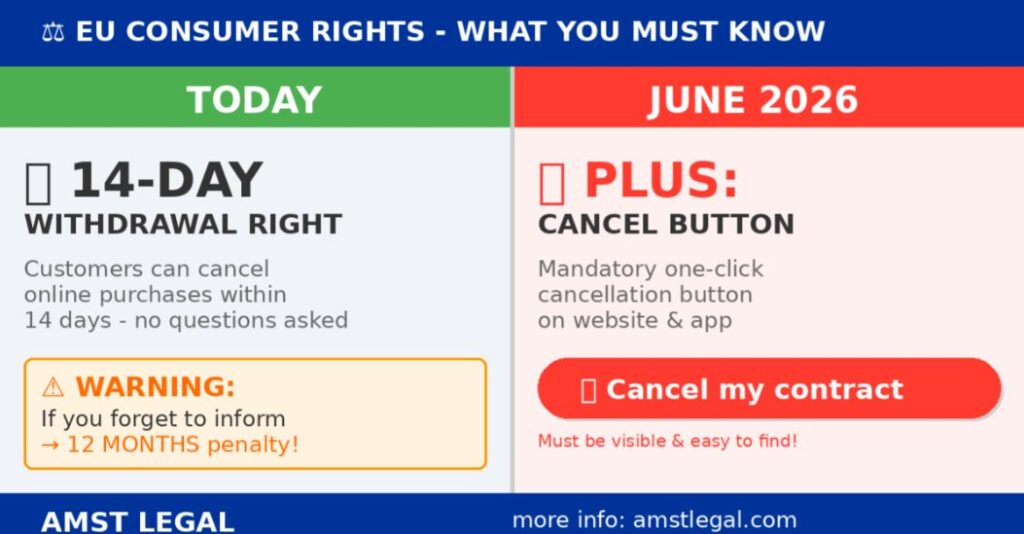
Where to add the right of withdrawal in your materials (and why)
Contracts and legal terms
Place a Right of Withdrawal clause in your consumer Terms & Conditions or Service Agreement. In that clause, state the 14-day period, define the trigger (delivery of goods or conclusion of services), reference the standard withdrawal form or provide an online form, and explain the process and timeline for refunds. Additionally, specify the customer’s obligations on goods (e.g., keep items in reasonable condition, return within a set timeframe) and any pro-rata charges for services if the consumer asked to start service during the cooling-off period.
Website and app flows
Add a dedicated Withdrawal & Cancellation page in your help or account area that:
- (1) explains the right of withdrawal in plain language,
- (2) links the process to the specific purchase,
- (3) offers the standard form or online equivalent, and
- (4) outlines refund timing.
Consequently, consumers can self-serve, which reduces support volume. By June 2026, implement a visible “Cancel my contract” button for consumer contracts and link it to confirmation and status pages that show progress and refund expectations. Remains to be decided how clear this ‘button’ or link will need to be.
Emails and communications
Include a short right of withdrawal notice in the order confirmation or service activation email. Because that message helps repeat the 14-day timeframe, provide a direct link to cancel, and attach or link to the standard withdrawal form. In addition, remind the customer of any return requirements for goods and clarify whether service has started at their request.
Exceptions you should know (short overview)
Although the EU right of withdrawal is broad, there are several important exceptions. These include (non-exhaustive list – conditions apply):
- Certain real estate, construction, social services, healthcare, gambling, and package travel contracts
- Custom-made or personalised goods
- Perishable products that can deteriorate quickly
- Sealed items unsealed after delivery for health or hygiene reasons
- Goods inseparably mixed with others after delivery
- Unsealed software, audio, or video recordings
- Digital content supplied online (not on a tangible medium) once performance has begun with the consumer’s express consent and acknowledgment of losing the withdrawal right
- Public auctions and regular household deliveries (e.g. groceries)
- Newspapers and magazines, except for subscriptions
- Services tied to a specific date, such as accommodation, transport, car rental, catering, or leisure activities
Benefits of doing this well
Business impact: speed, clarity, efficiency
When your 14-day right to cancel experience is clear, your sales funnels run smoother. Consequently, customers buy with confidence, support works from standard playbooks, and leadership sees fewer escalations. Additionally, transparent cancellation keeps payment processors comfortable, which can reduce chargeback risk and processing headaches. As a result, you gain speed and predictability without sacrificing compliance.
Legal impact: fewer disputes, cleaner scaling
Clear rights and processes lower ambiguity, which lowers disputes. Moreover, documenting consent for immediate service start and providing a robust cancellation route help you defend decisions if challenged. Because the EU right of withdrawal is standardized across the EU, a well-designed approach scales into new markets with fewer local adjustments.
Key takeaways
- The EU right of withdrawal grants consumers a 14-day cooling-off period for many distance and off-premises contracts.
- If you fail to inform consumers clearly, the withdrawal window can extend significantly, increasing risk and cost.
- By June 2026, consumer-facing sites must include a clear “Cancel my contract” function and clearer withdrawal information.
- Place the right in your terms, emails, and UX, and ensure support follows a standard offboarding playbook.
- Map exceptions to your offering and draft specific, plain-language guidance to prevent misunderstandings.
Conclusion & call to action
The EU right of withdrawal is not simply a legal obligation. It is a real risk for companies if not done right. Next to the way consumers order online, this is one of the areas where we see lots of court cases in the Netherlands. It is an essential part of how modern consumer businesses earn trust and reduce friction. Because the rules tighten in June 2026, now is the moment to update terms, start discussing how to build the “Cancel my contract” function, and standardize communications. If you want a practical review of your flows – commercial and legal – we can help you align contract language, UI vs UX design, and support so compliance becomes a smoother part of the customer experience.
Go here to book a consultation or discuss an interim engagement.
Background
Author: Robby Reggers, Founder of AMST Legal (amstlegal.com), recognized by Legal Geek as a LinkedIn Top Voice for contracting, negotiation, and interim GC work.
How we work: AMST Legal supports clients per contract/project or on an interim basis (set hours per week as GC/Legal Counsel).
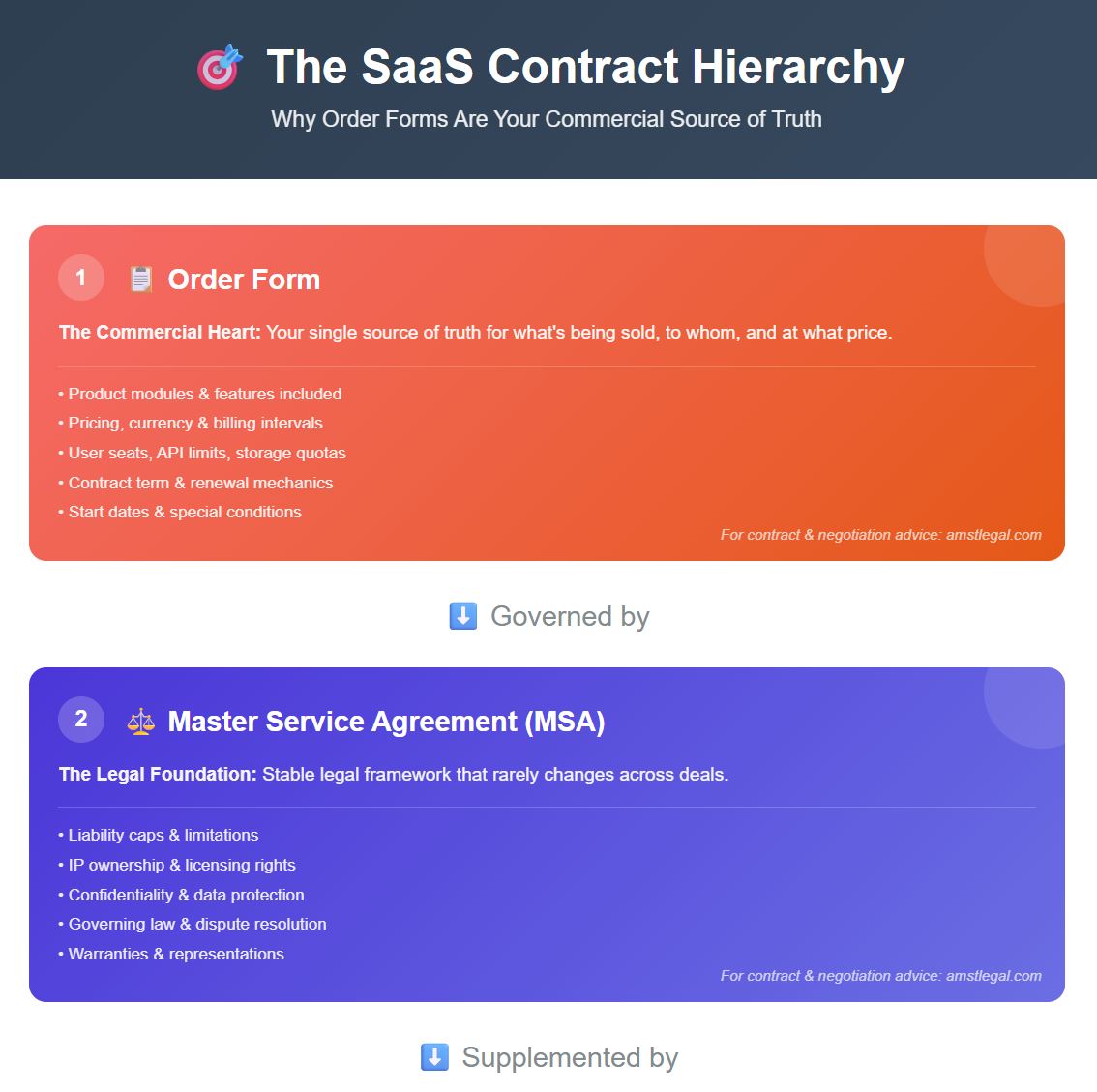
Why Order Forms Are Essential in Tech & SaaS Contracts
When we support clients in sales or procurement negotiations, I often get the same reaction: “Why would you get involved in the Order Form? Isn’t that just the cover page?” It isn’t – It is where the main parts of the contract are agreed, referring to the terms and condition relevant for the contract. Let us start with explaining you: what is an Order Form – showing you a free order form. Next, we will explain why Order Forms in SaaS and Tech are important. Contact us for an order form template you can use for your business.
In Tech and SaaS contracts, the Order Form is where the deal becomes clear. It states what is being purchased, the price that applies, and the term that governs delivery. Many teams rush to the Master Service Agreement (MSA) and miss that most commercial disagreements start with an incomplete or vague order form. When the order form is specific, sales cycles move faster, procurement comparisons become straightforward, and legal reviews stay focused on real risk rather than avoidable ambiguity.
What we will cover
- We will first explain what Order Form is
- Why business teams should treat order forms as the commercial source of truth
- How lawyers keep MSAs steady while order forms and Product Terms handle change
- The contract layers: Order Form → MSA → Product Terms → Release Notes → User Terms/EULAs
- Practical examples from SaaS, FinTech, AdTech, and software licensing
- The advantages of clear order forms for speed, scalability, and lower dispute risk
What is an Order Form?
The Commercial Core of Your Deal
An Order Form is the final commercial document that captures exactly what you are buying, at what price and under what terms. It is the main body of the contract that refers to the General Terms and Conditions and other relevant terms. While the MSA sets your legal foundation (as explained below), the Order Form handles the business specifics. It mentions which modules you’re purchasing, how many people can use the products, what your pricing looks like, and what the term is.
Why It Matters More Than You Think
Most commercial disputes don’t start due to complex legal language. Conflicts usually arise from vague Order Forms that leave pricing mechanics unclear. Smart procurement teams review these line-by-line because that’s where the real cost drivers live. For sales teams, a precise Order Form means fewer follow-up questions and faster closes. The (example) template Order Form shown in the visual below demonstrates how clear commercial terms create scalable frameworks that support business growth while keeping legal friction minimal. Contact us if you would like to receive the full Template in MS Word.

The business team’s perspective
Order form scope, price, and term in SaaS contracts
For sales and procurement, the order form is the single page that answers core questions: what modules or services are included, which users or environments are covered, and how pricing is calculated. In SaaS, that often means defining seats, API calls, storage, or specific feature bundles. It should also state currency, billing interval, and start date, because these elements drive forecasting and budgeting. When the order form captures these points precisely, account teams avoid re-explaining commercial terms later.
Renewal and pricing mechanics buyers look for
Procurement teams read renewal and pricing clauses first, since those parts define cost over time. Therefore, the order form should set the initial term, renewal type (auto-renew or opt-in), notice periods, and any indexation or tiered pricing. If usage pricing applies, the order form should include the metric, the threshold that triggers higher tiers, and how overages are billed. Clear mechanics reduce invoice disputes and help both sides model the total cost of ownership.
Common pitfalls when the order form is vague
Problems arise when the order form lists a product name but not the components included, or when it mentions a discount without stating the list price it applies to. Ambiguity also creeps in when pricing changes without notice. To avoid this, attach a dated price table or include a URL with a “snapshot” date and a change control note. Consequently, future changes do not rewrite the past deal.

The lawyer’s perspective
Contract layers explained
Lawyers design tech agreements as layers. The MSA is the legal foundation: liability, IP ownership, confidentiality, governing law and data protection (with link to a DPA) are mentioned here and should change rarely. The Order Form is the commercial record for this transaction: scope, price, term, invoicing, and special conditions tied to this customer. Product Terms are modular schedules for service levels, security, data processing, or feature-specific rules; they can evolve with the product through versioning.
Where Release Notes fit and what they should contain
Release Notes inform customers about new features, changed behaviors, and deprecated functionality. They should explain what changed, when it changed, and whether customer action is required. Although release notes are not a substitute for contract amendments, they support Product Terms by giving timely context and preserving trust. As a result, product teams can move faster without surprising customers.
User Terms/EULAs—daily use rules and acceptance
User Terms or EULAs govern daily use: acceptable use, account rules, and end-user responsibilities. Vendors typically present them at login or installation, and acceptance occurs through click-through or continued use. Because they sit closer to the product, they handle operational details that do not belong in the MSA. Meanwhile, the order form points to these terms so all documents align.

Practical examples from tech contracts (SaaS, FinTech, AdTech, licensing)
FinTech modules and compliance pricing
A FinTech provider sells “Payment terminals,” “Cards” and “Reporting” modules and/or software. The MSA holds the general legal terms, including responsibilities, liability caps and compliance warranties. The order form mentions the products, services, modules and defines e.g. usage tiers for transactions. Product Terms include specifics about the products and services. Therefore, adding the “Reporting” module later only requires a new order form, not a new MSA.
AdTech data use and campaign terms
For AdTech where companies agree that the Customer can place ads on certain platforms, like Google, Facebook, TikTok and Reddit, the following applies. Such a platform’s MSA covers IP, Confidentiality, Compliance and data ownership. The order form sets campaign spend, covered countries, pricing of the usage and the term. Product Terms describe permissible data processing and retention periods. API terms define how data is shared. Consequently, procurement can compare campaigns easily while legal certainty remains intact.
Software license scaling and feature updates
For a software license agreement, the MSA also covers IP ownership, confidentiality, liabilities and warranties. The order form defines license metrics (payment per user, per device, or per core), regions, and support level. Product Terms set service levels and maintenance windows. When new features launch, release notes describe them, and a short amendment (or new order form) adds the features to the customer’s bundle.
Advantages of clear order forms for sales, procurement, and legal
Speed, comparability and lower dispute risk
A precise order form shortens negotiation time because it answers commercial questions upfront. Procurement can compare offers line-by-line; sales can set accurate expectations; finance can invoice without guessing. Moreover, clarity reduces scope disputes and credit-note requests after go-live.
Scaling via new order forms – not new MSAs
As customers grow, you should add modules, users, or regions through additional order forms. This approach avoids reopening liability or IP terms and keeps the legal backbone stable. In addition, standardized order forms help revenue teams expand accounts without re-educating stakeholders. Also see this article “Use Terms & Conditions where possible” we wrote about this subject covering how you can win time by using Order Forms referring to T&Cs..
Typical Contractual set-up of an MSA
Details differ but Same Setup For Most Tech Contracts
The confusion between MSA vs Product Terms vs User Terms (and where Release Notes fit in) is something I see all the time in SaaS/software negotiations. If you’re doing research across vendors, it is clear that there are differences. Each vendor uses different names and structures, but the pattern is the same.
Typical Contractual Setup
MSA (or Customer Agreement / General Terms)
The legal backbone (risk allocation, liability, IP, governing law).
Order Form (Order, Insertion Order, Subscription Order)
The commercial record (what is being bought, pricing, term).
Product Terms (sometimes called Service-Specific Terms / Product Annexes)
Service-specific rules, SLAs, DPAs, uptime, feature use restrictions.
User Terms / EULAs
The general “rules of use” the end-user accepts (click-through at login/download), often more operational.
Release Notes
Not contracts in themselves, but linked to Product Terms or documentation. They describe changes in features or performance. Some vendors incorporate them by reference (‘the service may change as described in Release Notes’).
Clarity is key – Which Questions to Ask?
When the documents above are used and applicable, please ensure that you ask the following questions as a buyer / customer. Many discussions arise afterwards as to the applicability of these documents. What it all comes down to is whether you as a seller can prove that you have adequately informed the buyer of relevant terms.
- Where are each of these documents published?
- Who gets notice when they change?
- Which ones bind the customer vs the end-users?
- Are Release Notes purely informational, or do they legally modify the service?
Key takeaways
- Treat the order form as the commercial source of truth.
- Keep the MSA stable; place change in Order Forms and Product Terms.
- Use Release Notes and User Terms to manage product behavior and daily use.
- Define renewal, pricing mechanics, and usage metrics clearly to prevent disputes.
- Add growth through new order forms rather than new MSAs.
Conclusion & call to action
A careful design makes tech and SaaS deals easier to sell, buy, and manage. Mainly, it is all about flexibility and clarity. It gives sales and procurement a clear document to rely on while the MSA protects core legal risk.
Also see the following articles on the importance of Order Forms from Contract Nerds and Ironclad.
If your contracts feel harder than they should, AMST Legal can help you set up this layered structure and train your teams to use it well. To discuss your current setup or a specific deal, book a call here
The term ‘Order Form’ is most commonly used in Tech/SaaS. Other words for Order Form are:
📍Order / Ordering Document
📍Subscription Order / Service Order
📍Work Order (more traditional/industrial)
📍Insertion Order (IO) – common in AdTech/Media buying
📍Statement of Work (SOW) – for project-based professional services
📍Purchase Order (PO) – buyer-issued, especially in procurement-heavy industries (mostly as confirmation of the Order Form)
📍Quote / Quotation – becomes binding when signed/accepted
📍Service Agreement
Why You Need Better Terms & Conditions – 80 % Template Rule
Contract Templates and Terms & Conditions (T&Cs) are more than a legal formality. As we always say: “Don’t underestimate the importance of contracts – including Terms and Conditions”. Contracts are the basis of all business you do with your customers and suppliers. They set the foundation for how you operate, protect your business from disputes and build trust with clients. Yet many companies struggle to streamline their contracts and end up juggling a mess of documents. One way to simplify—and speed up—your contract workflow is by adopting the 80% Template Rule. This means that you should aim for having contract standards (contract templates) of at least 80% of the contracts you sign.
This principle states that around 80% of your agreements can rely on standardized templates, while 20% remain flexible for high-value or complex deals. In this article ‘Why You Need Better Terms & Conditions – 80 % Template Rule’, we’ll explore how this approach strikes the perfect balance between efficiency and adaptability, saving you time and money without compromising on legal safeguards. It is part of our 9 practical solutions to solve Contract Standards that Fail, see our article on this here and our Linkedin post on this subject.
What We Will Cover
- Understanding the 80/20 Template Ratio Rule
- Deviations from the 80/20 Rule: When Standardization Needs Adjusting
- Strategic Advantages of Contract Template Standardization
- How Terms & Conditions Fit into the 80% Model
- Suggested Set-Up for Standard Templates
- Examples of the 80/20 Rule in Action
- Applying the 80% Rule Beyond Sales & Procurement
- Conclusion: Finding the Ideal Contract Balance
1. Understanding the 80/20 Template Ratio Rule
Defining the 80/20 Balance
The 80/20 Template Rule suggests that about 80% of your contracts—often NDAs, routine purchase orders, and standard service agreements—can be effectively managed using pre-approved templates. These documents share consistent language, key legal protections, and known risk parameters.
The remaining 20% represents more complex or strategic agreements requiring extra customization. This might include multi-year government contracts with compliance mandates or large-scale software licenses where intellectual property rights need special attention.
Why 80%? Most deals share similar terms and risk profiles, so standardizing them eliminates tedious drafting, ensures legal consistency, and accelerates negotiations.
Our Recommendation
We advise clients – especially in tech and service-focused industries – to create shorter T&Cs for everyday deals (the 80%), while reserving longer, more detailed contracts for enterprise-level customers or specialized projects (the 20%).
It is no surprise that major companies like Microsoft, AWS, Booking.com, Salesforce, and ServiceNow follow a similar playbook. Their user agreements are concise and straightforward, but when a large corporation with unique needs comes along, they switch to a more comprehensive legal framework.
In this article we focus on Sales & Procurement Contracts, but we also recommend to improve your templates of other contracts or legal documentation, like:
- Confidentiality Agreement (NDAs)
- Employment Contracts and Consultancy / Contractor Agreements.
- Corporate Documents like Board and Shareholders Resolutions.
Training Sales and Procurement Teams
It is imperative to train your Sales and Procurement teams to use your own templates as much as possible. While it might feel easier to cave in and work off of a counterparty’s contract, that typically leads to inconsistent terms, lengthier negotiations, and higher legal risks. Teaching your teams good negotiation skills and emphasizing the benefits of sticking to your standardized documents will:
- Preserve the efficiency gains from the 80/20 approach
- Reinforce consistent legal protections across deals
- Minimize back-and-forth revisions that slow down transactions
Admittedly, this isn’t always easy. But the payoff in faster deal cycles and fewer legal snags more than justifies the effort spent on training.
2. Deviations from the 80/20 Rule: When Standardization Needs Adjusting
Industry-Specific Variations
- Tech & SaaS Companies:
Subscription-based models often push standardization above 80%. Many SaaS agreements share the same billing cycles, uptime commitments, and data protection clauses. - Bespoke or Regulated Sectors:
Construction, healthcare, and government-related projects can require detailed specifications and stringent compliance checks. Consequently, more contracts need unique clauses, tipping the balance closer to 70/30 or 60/40.
Finding Your Ideal Ratio
Each business has its own risk tolerance, product complexity, and regulatory pressures. Some firms can standardize a higher percentage of deals, while others need more customization. Staying alert to market changes and evolving client needs will guide you on when to adjust your ratio.
3. Strategic Advantages of Contract Template Standardization
Cost Efficiency & Risk Mitigation
- Lower Legal Costs: Less time drafting unique clauses for every contract.
- Unified Risk Controls: A single vetted template helps avoid oversights like missing indemnity or outdated compliance provisions.
Example: A mid-sized tech firm standardized all routine SaaS contracts. They cut legal spending by 30% and reduced negotiation timelines, thanks to well-vetted core terms.
Strengthening Business Relationships
- Transparency & Trust: Straightforward T&Cs reassure clients there are no hidden pitfalls.
- Faster Onboarding: Routine deals finalize more swiftly, giving your team more time to foster the client relationship itself.
Example: An e-commerce retailer merged shipping, returns, and warranty policies into one Terms & Conditions document. Customers found it simpler to review, boosting repeat purchases.
Resource Optimization
- Reduced Bottlenecks: Standard approvals mean fewer contracts clogging Legal’s inbox.
- Empowered Teams: Sales and procurement can self-manage standard deals without waiting on constant legal oversight.
Example: A global logistics company unified its supply-chain terms. Roughly 80% of vendor contracts sailed through automatically, letting the legal team focus on high-stakes negotiations.
Competitive Edge for High-Value Negotiations
- Tailored Attention: By freeing up resources on routine deals, your legal experts can concentrate on mission-critical contracts.
- Scalability: A well-structured template system handles more deals with minimal friction.
Example: A pharmaceutical firm maintained standard T&Cs for routine supply arrangements, leaving more time for specialized contracts requiring complex compliance clauses (e.g., for clinical trials).
4. How Terms & Conditions Fit into the 80% Model
T&Cs typically address recurring elements: payment schedules, liability limits, intellectual property, confidentiality, and dispute resolution. Since these components recur in most contracts, T&Cs are prime candidates for template-based management.
Shorter T&Cs work well for your mass-market or smaller deals, covering the essentials but skipping excessive detail. Larger or high-stakes deals often need additional clauses—such as robust termination rights, performance metrics, or compliance with specific regional laws. This flexible approach preserves efficiency for typical deals while offering room for customization when the stakes are high.
In the next paragraph we will explain what kind of T&Cs are suggested and which set-up works best.
5. Suggested Set-Up for Standard Templates
A highly effective way to organize your standard T&Cs is by establishing a Master Services Agreement (MSA) that references related documents—like a Data Processing Agreement (DPA), AI Terms, or specific policies such as a Data Deletion Policy. A crucial part of this architecture is having an Order Form that seamlessly ties everything together.
- MSA: Lays out overarching legal terms (liability limits, governing law, dispute resolution).
- Referenced Docs: DPA, AI Terms, or other policies that expand on specific obligations (e.g., how data must be handled or deleted).
- Order Form: Serves as the front-facing commercial document where you list products, services, or solutions (with pricing and timelines). This form explicitly refers back to the MSA and other relevant documents.
This setup works perfectly for Tech, Marketing, and Renewable Energy (like wind-turbine contracts). For smaller deals, you might rely on a concise MSA and a single-page Order Form. For major contracts with enterprise clients or larger wind-turbine installations, you can attach more detailed policies or custom clauses. Either way, your commercial process runs more smoothly because every party understands how each document fits together.
6. Examples of the 80/20 Rule in Action
SaaS Subscription Services
A CRM software startup realized nearly all its contracts centered on monthly billing, data privacy, and uptime guarantees. They folded these key elements into a master SaaS agreement template. Only enterprise-level customers needed additional clauses for advanced reporting features or custom security provisions. Once implemented, the company was able to reduce the average negotiation time from 2,5 months to 3 weeks.
Construtech SaaS Business
A SaaS provider offering project management tools to construction companies struggled with too many deviations. Each Order Form and set of T&Cs looked different, confusing potential customers and slowing down deal cycles. By adopting a single, streamlined template for 80% of contracts—focusing on recurring terms like data hosting, monthly billing, and software uptime—they cut drafting time in half. Only complex enterprise deals demanded the extra 20% customization, freeing up Legal to handle bigger clients more effectively.
Renewable Energy Maintenance Contracts
A wind-turbine services firm had been too lenient in accepting external contracts, leading to inconsistent obligations and renewal terms. Small deals would still get bogged down in counterparty paperwork. After training their Sales and Procurement teams to use the internal template for routine maintenance agreements, they introduced a short-form contract for smaller deals and a longer form for large-scale, multi-year engagements. This switch sped up negotiations, saw more deals closed per quarter, and cut the legal team’s workload on repetitive contract reviews.
Manufacturing & Supply Chain
A consumer electronics manufacturer was dealing with countless supplier agreements. By centralizing payment terms, quality standards, and delivery timelines into a uniform T&Cs document, they standardized 80% of the vendor contracts. Specialized orders—like cutting-edge chipsets—fell into the 20% that needed bespoke clauses.
7. Applying the 80% Rule Beyond Sales & Procurement
Although this article focuses on Sales & Procurement Contracts, the 80% Template Rule can also make a big impact on other types of legal documents, including:
NDAs (Confidentiality Agreements)
NDAs are the prime example of commercial documents that should take the least time to negotiate and sign. Great templates, including playbooks will be a great help when reducing timelines to finalize NDAs.
Employment Contracts
Instead of creating a new agreement from scratch for every new hire, build a standardized template addressing core terms like job role, compensation, confidentiality, and restrictive covenants. Tailor only where specific senior-level or specialized positions call for it.
Consultancy/Contractor Agreements
For external consultants or freelance contractors, a streamlined template can outline payment terms, scope of work, and intellectual property rights. Unique projects involving complex deliverables may need additional clauses, but many routine engagements can run on the same template.
Corporate Documents
Board Resolutions
Repeated decisions, like approving annual budgets or routine transactions, can follow a simple, standardized structure.
Shareholders’ Resolutions
Common shareholder actions (e.g., reappointing directors, authorizing certain business activities) often don’t need a custom form each time.
Other Governance Documents
Power of Attorney templates for the company.
Opportunities for consistency
Using the 80/20 principle for these areas can save you time and help maintain consistency across all your legal documentation, not just in sales or procurement. By standardizing the bulk of your corporate and employment agreements, you minimize repetitive legal work and preserve specialized attention for pivotal, high-risk decisions or hiring situations.
Conclusion: Finding the Ideal Contract Balance
Mastering the 80% Template Rule and focusing on standards isn’t about cutting corners. It’s about optimizing contract management to align with your overarching business goals. By maintaining shorter T&Cs for routine deals, you reduce negotiation time and safeguard legal consistency. You then keep a 20% buffer for the truly important or complex agreements, ensuring they get the personalized attention they deserve.
Key Takeaway: Standardize where you can, customize where you must. The 80% Template Rule provides a proven roadmap for managing a high volume of similar contracts while preserving the flexibility to address unique or high-stakes scenarios. By training your Sales and Procurement teams to champion your own templates, you maintain control, cut legal overhead and close deals faster. As we have seen in many companies, this will give you a competitive advantage.
Contact us
If you are ready to transform your contracts, we’re here to help. Whether your primary focus is implementing more Templates or the next step how to leverage Tech & AI, every organization can benefit from more streamlined, flexible, and secure contracts. For further guidance on improving contract templates, managing negotiations, and optimizing related processes, reach out to info@amstlegal.com click here for our contact page.
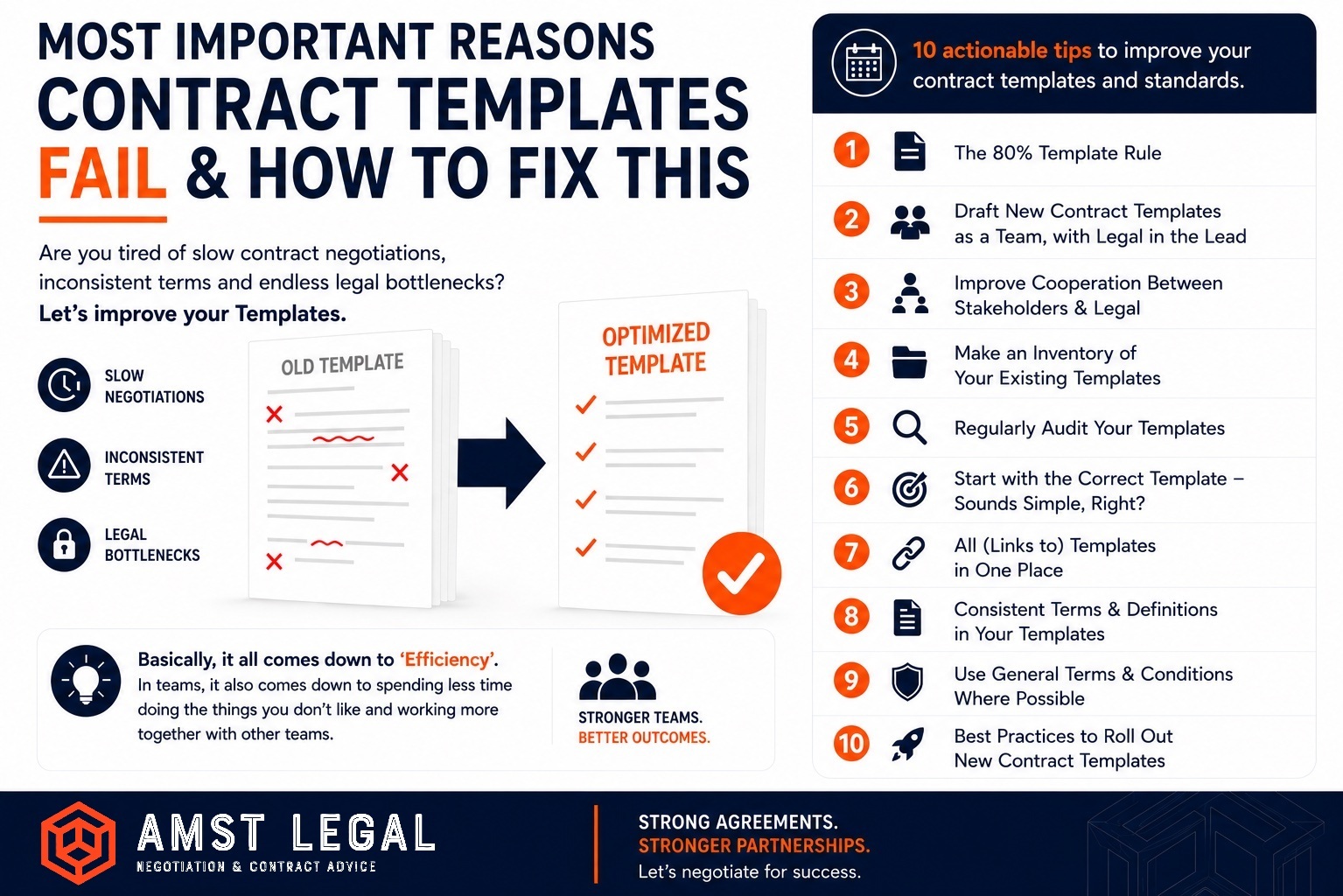
4 Important Reasons Contract Standards Fail and 10 Practical Solutions
Contracts – for example Master Services Agreements, Customer Agreement or Terms & Conditions – are the backbone of virtually every business transaction. The best way to have the signing process run smoothly is by using contract templates.
For example, for all these professionals, contracts are an essential part of their work:
- a sales professional sealing a new deal;
- an entrepreneur looking for funding;
- a procurement specialist involved in the negotiation of vendor contracts; or
- a legal professional tasked with protecting company interests
By clearly outlining terms, responsibilities, and expectations, great contracts build trust, mitigate risks and keep business relationships running smoothly.
However, contracts can also become a source of complexity. Many companies desire that a new product, service, or partnership requires its own unique contract language. This can quickly turn into an administrative and legal bottleneck if not managed properly. This is why smart organizations turn to contract templates. When thoughtfully designed and regularly updated, these templates streamline contract creation and negotiation, saving both time and resources.
Contract templates are only as good as the process behind them. If they’re too long, packed with dense legal jargon, or buried in a repository that nobody can find, even the most well-written templates won’t make a difference. That’s where this article series comes in. It will help you craft contract templates that really accelerate deals while protecting your organization’s interests. We will first start with the ‘Most Important Reasons Contract Standards Fail and Practical Solutions’.
What We Will Cover
In this introductory article, we will explore the value of using contract templates and highlight key pitfalls that can undermine them. We will then examine the potential consequences of poorly managed templates and, finally, demonstrate the benefits your business can gain by developing modern, easy-to-use contract templates.
Here’s a quick overview of what you can expect:
- Why We Need (Better) Contract Templates
We’ll discuss why organizations of all sizes and industries should focus on improving their templates. Examples will range from standard Non-Disclosure Agreements (NDAs) to specialized industry contracts like AI software licensing or wind turbine supply agreements. - Common Issues with Contract Templates
We’ll identify the biggest challenges that derail template usage, from outdated clauses to complicated language that sales teams struggle to understand. - Consequences of Contract Template Issues
We’ll look at how these problems can delay deals, increase risk, and strain business relationships. - Results of Having State-of-the-Art Templates
We’ll highlight the positive impact of streamlined, clearly written, and easily accessible templates—such as faster negotiations and reduced legal bottlenecks. - Real Life Examples of Contract Optimization
- How to Improve Your Contract Standards & Templates
We’ll draw on two decades of professional insights into how companies achieve the best outcomes and keep improving their contracts over time.
This article sets the stage. The upcoming series of articles, called “10 Tips You Need to Know to Improve Your Contract Templates,” will dive deeper into each tip – see below the full list of tips. This will offer you practical steps to help you develop contract templates that truly serve your business. Before we get there, let’s start by laying out why a solid set of templates is indispensable—and where most organizations go wrong.
Why We Need (Better) Contract Templates
Organizations often juggle a wide range of agreements, from the simplest Non-Disclosure Agreement (NDA) to the most complexTerms & Conditions or Master Services Agreement (MSA). Companies, for instance, often deal with Software as a Service (SaaS) contracts (Salesforce, ServiceNow, HubSpot). Each contract type can be drastically different, but they all share one objective: to clearly outline obligations, manage expectations and mitigate risk.
Balancing Clarity and Complexity
One of the main reasons companies need better contract templates is the tension between clarity and complexity. A good contract should be thorough enough to protect the business while still being concise and straightforward. For example, a wind turbine manufacturer might need clauses that cover equipment specifications, maintenance, installation timelines, and environmental compliance. Adding too many layers of complex legal text, however, can slow negotiations or make the contract inaccessible for non-legal stakeholders.
By creating well-structured, user-friendly templates, you ensure that each new contract iteration doesn’t require a complete rewrite. Instead, your teams can modify or append specific clauses to tailor the template to each deal, project, or relationship. This level of uniformity can dramatically cut down on drafting time, reduce back-and-forth with legal counsel, and speed up the signature process.
Enhancing Workflows
Well-designed templates also improve workflows by establishing a clear starting point. If you are repeatedly negotiating Master Services Agreements or Terms & Conditions (T&Cs), for instance, you want your sales or procurement colleagues to know exactly which clauses are standard and which ones might need special approval. This clarity keeps deals moving quickly and prevents confusion.
In a tech environment, especially one dealing with SaaS or AI solutions, the speed of execution can be a competitive advantage. Having strong, approved templates means your product or service can get to market faster, since you won’t have to battle the same legal issues repeatedly.
Keeping Pace with Evolving Business Needs
Business models evolve rapidly. Just think about how quickly AI technology is reshaping industries or how sustainability concerns are driving new contract requirements for wind turbine manufacturers. If your contracts don’t keep up with these changes, you could end up with agreements that fail to address emerging risks or market demands. For example, an AI contract might need robust clauses related to data privacy, algorithmic bias, or intellectual property ownership.
Templates need regular updates to accommodate new legal requirements, shifts in company strategy, and lessons learned from recent deals. Far too often, companies let their templates gather dust, failing to reflect current regulations, technology changes, or internal processes. This is why dedicating resources to regularly refining and updating templates isn’t a luxury—it’s a necessity for any forward-thinking enterprise.
Common Issues with Contract Templates
Despite their obvious advantages, contract templates can become more of a hindrance than a help if they aren’t properly managed. Below are four issues that commonly arise.
1. Complexity
Overly long, technical, or legalistic language can deter people from using templates. A contract for a wind turbine supply project, for example, might run dozens of pages, filled with specialized engineering terms. If the language is too arcane, the sales or operations team might avoid the template altogether, reverting to manual drafting or older versions. This reduces consistency and can create legal blind spots.
2. Accessibility
Just having great templates on file doesn’t help anyone if they can’t be found. Many organizations store templates in multiple folders or on different file-sharing platforms without clear naming conventions. This leads to confusion, version control issues, and the risk of using outdated documents.
3. Limited Resources
Template management can fall by the wayside when legal teams are stretched thin. With pressing demands like regulatory compliance, litigation, or high-stakes contract negotiations, dedicating time to reviewing and updating templates can seem like a low priority. As a result, templates quickly become outdated or overlooked.
4. Excessive Legal Review
One main benefit of templates is the reduction of legal review times—yet this only works if the templates are well-structured and widely trusted. If internal stakeholders distrust a template’s accuracy, they’ll still funnel contracts to Legal for a deep dive. When every single deal, even small ones, becomes a bottleneck, it defeats the entire purpose of having a standardized approach.
Consequences of Contract Template Issues
Neglecting contract templates or managing them poorly can trigger a cascade of problems:
Delays in Contract Creation, Negotiation and Signing
If a template is unwieldy or unclear, it can’t speed up much of anything. Negotiations might stall as both parties parse through unnecessary terms or loop in legal counsel for clarifications. In fast-paced markets like AI or SaaS solutions, a few weeks’ delay can mean lost opportunities.
Increased Risk Exposure
Templates are supposed to protect the company from legal pitfalls, but if they’re outdated or inconsistent, they can introduce more risk. For instance, imagine you’re finalizing a wind turbine maintenance contract and your template lacks a recent clause covering environmental regulations. You could face unforeseen liabilities or compliance issues if something goes wrong.
Higher Workloads
Legal, procurement, and sales teams spend far more time dealing with avoidable contract snags when templates aren’t user-friendly. Instead of focusing on strategic deals or high-risk situations, experienced counsel and managers waste hours revising the same clauses because the existing template is missing critical updates.
Strained Business Relationships
Contracts serve as touchpoints of trust and efficiency. Clients or partners who encounter errors, inconsistencies, or long delays may question your professionalism. This can harm relationships, with ripple effects on future collaborations and your reputation in the market.
Results of Having State-of-the-Art Templates
When companies invest in robust, well-maintained contract templates, the benefits are felt across every stage of the deal cycle. Below are nine advantages you can expect when you get it right:
1. Shorter Contract Negotiation Times
With standard terms already approved, you avoid renegotiating common clauses for each new agreement. Whether you’re drawing up a SaaS user agreement, an AI licensing contract, or an extensive MSA for wind turbine installations, both sides can focus on the unique aspects of the deal instead of wading through boilerplate clauses.
2. Increased Efficiency and Simplified Contract Handling
Well-organized templates reduce repetitive drafting. This frees up your legal, sales, and procurement teams to concentrate on more strategic tasks—like market expansion, major partnerships, or regulatory shifts that impact your industry. In tech, efficiency gains can translate directly into faster product launches or new feature rollouts.
3. Reduced Workload
By cutting down on the number of contracts that need an in-depth legal review, you open up bandwidth for high-value activities. This not only alleviates bottlenecks, it also makes the best use of specialized legal expertise. Instead of reviewing basic NDAs or T&Cs, your legal team can focus on, say, negotiating a complex AI data-sharing agreement or advising on regulations for renewable energy installations.
4. Enhanced Consistency and Contract Quality
A consistent, predictable approach builds trust with stakeholders. For instance, if you’re partnering with multiple wind farms, each contract will look and feel similar, providing confidence to partners that you know how to handle regulatory requirements, risk allocations, and maintenance responsibilities.
5. Risk Mitigation
Well-crafted templates function as a built-in risk management tool. By integrating updated clauses on liability, data protection, intellectual property, and compliance, you create a safety net that reduces the likelihood of legal disputes. This is particularly crucial in cutting-edge fields like AI, where regulations are still evolving and clarity is paramount.
6. Decreased Legal Costs & Improved Cost Efficiency
When legal teams spend less time reviewing common contracts, your organization saves money. Those resources can then be reallocated to essential areas—like exploring new tech partnerships or investing in research and development for AI or wind turbine efficiency upgrades.
7. Stronger Business Relationships
A smooth, transparent contracting process fosters goodwill. Clients, suppliers, and partners appreciate clarity and efficiency, and they’re more likely to remain loyal or expand the relationship. In specialized industries, like renewable energy, a reputation for easy, fair contracts can be a powerful competitive edge.
8. Optimized Resources
When contract workflows are streamlined, companies can allocate financial and human capital more effectively. This may mean investing in better contract management software, training employees on best practices, or diverting saved resources into innovation initiatives—such as new AI features or advanced turbine technology.
9. Empowered Commercial Teams
Finally, modern contract templates give sales and procurement teams greater autonomy. They can handle routine deals themselves, thanks to pre-approved language. This sense of empowerment boosts morale and allows these teams to focus on building relationships rather than waiting on legal reviews.
Examples: Experienced Results of Contract Optimization
Drawing on two decades of experience in contract optimization, I’ve seen firsthand how transformative good templates can be.
Technology Company
In one instance, a tech company changed its entire suite of legal documents—ranging from SaaS agreements to T&Cs and NDAs—to align them with new data protection laws. By involving key stakeholders (Legal, Sales, and IT Security) from the start, they created a user-friendly, legally robust set of templates. The outcome was a dramatic reduction in contract negotiation times and fewer escalations to senior management.
Renewable Energy
In another example, a renewable energy firm specializing in wind turbine installation tackled their inconsistent and overly complex MSAs. Their previous templates had caused frequent renegotiations and confusion over maintenance responsibilities. After revamping the templates to remove outdated clauses and clarify roles, the average contract closing time dropped by nearly 40%. Clients noted the improved clarity, leading to stronger partnerships and a significant boost in the firm’s industry reputation.
Bringing It All Together
These examples underscore the value of a collaborative approach to contract optimization. It’s not just a legal project; it’s an organizational endeavor that benefits every department involved in contract-related workflows. Regular feedback loops, where Sales or Procurement teams highlight real-world issues they face during negotiations, can pinpoint areas that need refinement. Legal teams, in turn, can incorporate new regulatory updates or risk mitigation strategies. This cycle of continuous improvement keeps your templates relevant, user-friendly, and aligned with evolving business goals.
How to Avoid These Issues and Reach Better Results?
But how can you avoid these issues and reach the advantages & results we discussed above? Stay tuned for our upcoming posts and articles, where we will dive deeper into practical tactics and step-by-step guidance on developing contract templates that truly work for your business.
Best Practices to Roll Out New Contract Templates
If you’re ready to transform your contracts from a necessary evil into a strategic asset, we’re here to help. Whether your primary focus is tech, AI, or renewable energy, every organization can benefit from more streamlined, flexible, and secure contracts. For further guidance on improving contract templates, managing negotiations, and optimizing related processes, reach out via lowa@amstlegal.com or book an appointment with Robby Reggers here.
Follow Robby Reggers and AMST Legal on LinkedIn to read the updates and long form versions of the following posts & articles:
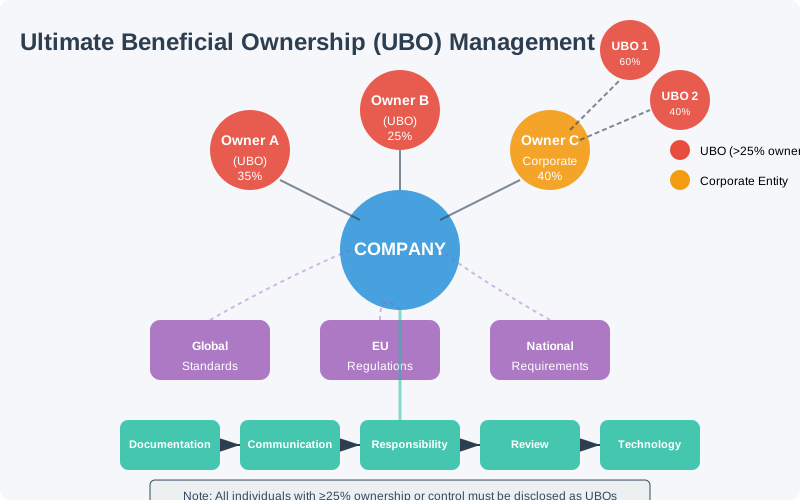
Ultimate Beneficial Ownership (UBO) Explained – What is it and How to Create a Process That Works
Every company has dealt with the question: “Who is your UBO?”. Generally speaking, the ask is: could you complete these documents and send the following information to show us who your UBO is? We have seen in practice that companies struggle to send the right information correctly. The concept of the Ultimate Beneficial Owner (UBO) has moved from a niche concern to a central element of contracts, compliance and due diligence. Whether you are setting up a bank account, hiring an accountant, onboarding new clients (where you need to know the UBO) or setting up a new corporate entity, understanding UBO requirements is no longer optional – it’s essential.
Failing to understand and address UBO requirements leads to significant financial penalties, reputational damage and even legal action. We have also seen that it can slow down commercial, financial and legal processes. This article ‘Ultimate Beneficial Ownership (UBO) Explained – What is it and How to Create a Process That Works’ provides practical strategies for navigating UBO disclosures. This works both when requesting information from others and when providing it yourself.
Executive Summary: The TLDR of UBO Compliance
In short, here is what you need to know about UBO & managing beneficial ownership:
- In short, UBO means the Ultimate Beneficial Owner of a company or group.
- The Bottom Line: To know the UBO, you must identify the “natural person” (human) at the end of the ownership chain, typically at a 25% threshold.
- Strategic Tool: Have a UBO Structure Chart ready to send to all companies that ask for the information of your UBO. This can cut your time by up to 80%.
- Business Impact: Efficient UBO management is a competitive advantage that prevents deal stalls and builds trust with partners like Booking.com or PVH.
- Why the need for UBO? To understand who ultimately owns or controls a company. Banks, accountants, investors, etc. often request this information as part of their KYC, AML, onboarding or procurement process. Goal: prevention of money laundering, sanctions breaches, etc.
What We Will Cover in the Article Below
In this guide, we break down the complexities of beneficial ownership into actionable steps:
- UBO Definitions & Meaning: A clear breakdown of terms for international and beginner readers.
- Legal Frameworks: A summary of global, EU, and Dutch requirements.
- Visual Strategy: Why a UBO Structure Chart is the most effective way to explain your company.
- Industry Deep-Dives: Where these requirements appear most often and which contracts are affected.
- Implementation Framework: A 5-point system for establishing efficient UBO processes.
- AI & Data Privacy: How to handle sensitive ownership information when using tools like Claude.
UBO Definitions: What These Terms Actually Mean
If you are dealing with international contracts or Dutch compliance, you’ll run into these specific terms. For beginners and international teams, here is a breakdown of the essential vocabulary to help you navigate the requirements.
The UBO Master Terminology List – What do the Terms mean that are commonly used?
- UBO: This stands for Ultimate Beneficial Owner.
- UBO Meaning: This is the “natural person” (a human being) who truly owns or controls a company. Even if the official paperwork lists other companies, the UBO is the person at the end of the line.
- Natural Person: In legal and compliance terms, this just means a human. A UBO can never be another company; it must be a person.
- Pseudo-UBO: If no one person owns enough of the company to be a UBO, a top manager is often named as a “pseudo-UBO” just to satisfy the rules.
- UBO Structure Chart: This is a visual map or diagram. It shows the layers of ownership from the local company all the way up to the human owners at the top.
- Ownership Threshold: This is the “trigger” percentage. In the Netherlands and the EU, if you own 25% or more, you are usually considered a UBO. In some high-risk cases, this drops to 10%.
- Compliance Chain: Think of this as a domino effect. A bank asks a company for UBO data; that company then has to ask its suppliers, who then have to ask their manufacturers. This is why these clauses are suddenly appearing in almost every contract.
Understanding UBOs – What Is It Exactly and Why is it Important?
An Ultimate Beneficial Owner is the natural person who ultimately owns or controls a legal entity. This can even be the case if their name doesn’t appear directly on ownership documents. Typically, this includes individuals who own more than 25% of shares or voting rights. Sometimes, this threshold may be as low as 10% in some contexts. It also encompasses those who exercise control through other means, such as appointment rights or veto powers. When ownership is widely distributed with no individual meeting these criteria, a senior managing official may be designated as a “pseudo-UBO” for compliance purposes.
The importance of UBO requirements in business relationships originates from what can be described as a compliance chain. Initially confined to financial institutions under anti-money laundering regulations, these requirements now cascade through various industries. For example, a payment processor might require UBO information from an e-commerce company. This company will in turn request this information from its suppliers. Finally, these suppliers then include UBO disclosure requirements in their contracts with manufacturers. This chain reaction explains why UBO clauses increasingly appear in contracts across sectors that previously had minimal regulatory oversight.
Legal Framework: EU, Dutch and Global Requirements
Before we go into the key industries & contracts involved, let us start at the beginning. What is the legal framework where these burdensome UBO’s originate from? Many countries and global organizations have implemented measures to combat money laundering and terrorist financing. As countries have diverse legal, administrative and operational frameworks and different financial systems, measures to counter these threats differ greatly per country and region.
European Union Regulatory Framework
The EU has established one of the world’s most comprehensive UBO disclosure regimes, especially under the Anti-Money Laundering Directives (AMLD):
- AMLD: The 4th AMLD required central UBO registries, the 5th mandated public access, and the 6th strengthened enforcement.
- Ownership Definition: A beneficial owner is any natural person who owns or controls at least 25% of shares/voting rights or exercises control via other means.
- Public Accessibility: The 5th AMLD mandated public access to beneficial ownership information for companies and commercial trusts. Due to an EU court ruling, several EU member states, including Luxembourg and the Netherlands, moved to restrict public access to their beneficial ownership registers until legislative adjustments are made.
- Criminal Penalties: The 6th AMLD enhanced criminal penalties for money laundering offenses and expanded corporate criminal liability.
- National Variations: Despite the common framework, implementation varies between member states, creating compliance challenges for cross-border businesses.
The Netherlands: Specific UBO Requirements
The Netherlands implemented the EU’s UBO requirements with specific national provisions. These are the specifics:
- UBO Registration Act: Dutch entities are required to register UBOs in the Dutch Commercial Register (Kamer van Koophandel) (since Sept. 2020)
- Public Information or restricted? It was the intention that the information would be public. Due to privacy (and security) concerns, restrictions were set up as to the public availability. See more on this subject from the Dutch government on this subject here: link.
- Verification Duty: Entities must take “reasonable measures” to identify and verify UBOs, maintaining internal records.
- Penalties: Administrative sanctions include fines up to €21,750, with criminal sanctions for intentional violations.
- Updating Requirement: Companies must update UBO information within seven days of becoming aware of any changes.
Global UBO Standards
Globally, most countries have developed UBO standards in response to international initiatives against money laundering and financial crime. While approaches vary by jurisdiction, several organizations, initiatives and common principles have emerged:
- FATF Recommendations (see link): Recommendations (24 and 25) that require countries to ensure transparency regarding beneficial ownership of legal entities
- Varying Implementation: Globally, most countries have established beneficial ownership registries with different thresholds and accessibility levels.
- Accelerated Transparency: The Panama Papers and Paradise Papers revelations exposed how anonymous structures facilitate financial crimes
- Information Sharing: The OECD’s Common Reporting Standard (see link) enables automatic exchange of financial account information between tax authorities
- Compliance Complexity: Multinational companies face a patchwork of requirements necessitating country-specific approaches
Example of a UBO Chart
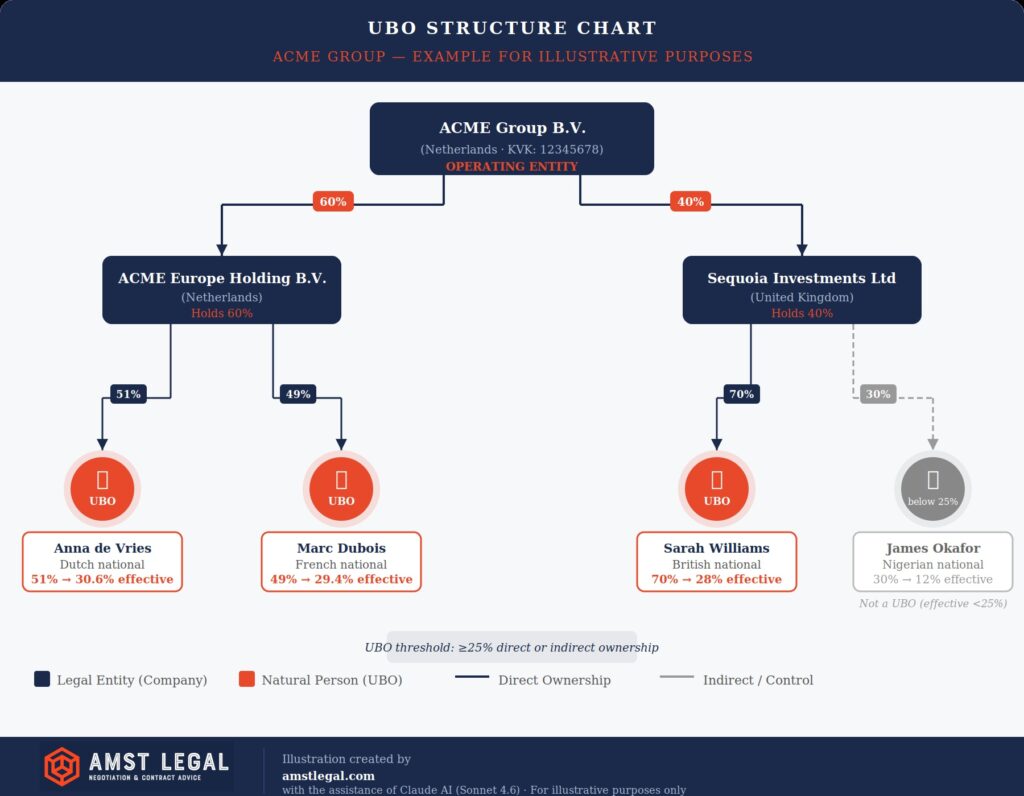
The Practical Value of a ‘UBO Structure Chart‘
We see many professionals searching for a “UBO structure chart”. Trying to explain a complex web of holding companies in an email is difficult for auditors to follow. A clear visual chart is the most effective way to provide this information and keep a deal moving.
Using Visuals to Speed Up Deals
In my work as an interim Legal Counsel and General Counsel for various SaaS & Tech companies, we use these charts to simplify things for procurement, sales and finance teams. If you send a 20-page legal memo, it’s going to sit in someone’s inbox for a week. If you send a one-page UBO structure chart, you can often cut onboarding time by 40%.
At companies like Construsoft, where things move fast, having this chart ready to go means the “KYC” (Know Your Customer) process won’t kill your deal momentum. Also see our article here how we suggest to improve KYC processes in your company.
Key Industries and Contracts Where UBO Matters
The importance of UBO disclosure varies significantly across industries and contract types. While requirements can appear in almost any business relationship, six industries face particularly frequent and stringent UBO disclosure requirements:
List of Industries
- Financial Services: Banks, payment processors, investment firms, and insurance companies face the most comprehensive regulatory mandates
- Real Estate: Commercial property transactions, development projects, and property management services
- Technology: Software providers, cloud services, and cybersecurity companies, especially those handling sensitive data
- Healthcare & Pharmaceuticals: Medical device manufacturers, pharmaceutical distributors, and healthcare service providers
- Government Contractors: Companies in defense, infrastructure, public utilities, and other sectors serving government entities
- Professional Services: Law firms, accounting practices, consulting firms, and other advisors with fiduciary responsibilities
Financial services companies naturally face the most stringent requirements, with banks, payment processors, investment firms, and insurance companies all subject to explicit regulatory mandates. However, several other sectors now routinely encounter UBO requirements in their operations.
Real estate transactions frequently involve UBO disclosure, particularly for commercial property acquisitions and development projects. A commercial real estate firm recently had to delay closing on a major property acquisition because their ownership structure involved multiple layers of holding companies, and the lender required complete UBO transparency before approving financing. Companies in this sector should prepare UBO documentation well before entering into purchase agreements or seeking financing.
Technology companies, particularly those handling sensitive data or providing critical infrastructure services, increasingly face UBO scrutiny. Government contracts almost universally require UBO disclosure, and many enterprise clients now include these requirements in their vendor security assessments. A cybersecurity provider lost a promising government contract because they couldn’t adequately document the beneficial ownership of one of their offshore investment partners within the required timeframe.
In healthcare and pharmaceuticals, UBO requirements appear in various contexts, from hospital system vendor agreements to pharmaceutical distribution contracts. Regulatory concerns about conflicts of interest and the integrity of the healthcare supply chain have intensified focus on ownership transparency. A medical device manufacturer was surprised when a hospital system required UBO disclosure before finalizing a procurement agreement, a requirement that stemmed from the hospital’s compliance policies rather than direct regulatory mandates.
Types of Industries and Contracts involved
UBO information is not asked in all industries and in all cases. For a typical online subscription (OpenAI, Linkedin, Google, etc.) or a product you buy online on Amazon.com, Temu or Nike, this is not necessary. It is important for certain industries and contracts. The types of contracts where UBO disclosure commonly appears include:
- Financial agreements (loans, investment documents, banking relationships)
- Government and public sector contracts at all levels
- Long-term supply or service agreements, particularly in regulated industries
- Joint venture and partnership agreements
- Property purchase and lease agreements for commercial real estate
- Merger and acquisition documentation
- Distribution agreements, especially cross-border arrangements
- Software and technology licensing for enterprise solutions
A manufacturing company was caught off-guard when their standard distribution agreement with a European partner suddenly included UBO requirements, delaying their expansion plans by several months. Had they anticipated this increasingly common contractual element, they could have prepared the necessary documentation in advance rather than scrambling to compile it under time pressure.
Managing UBO Requests: The Dual Challenge
Requesting UBO Information Effectively
Many businesses find themselves needing to request UBO information from counterparties. Even a software company we recently advised includes UBO disclosure requirements in their enterprise contracts because their payment processor requires them to identify the UBOs of clients generating significant annual revenue. While the clause appears in their standard contracts, they actively enforce it only for larger clients, creating a tiered approach that balances compliance with practical business considerations.
When requesting UBO information, clarity is crucial. Rather than simply demanding “beneficial ownership information,” specify the ownership threshold that triggers disclosure, the documentation required for verification, how ownership changes should be reported, and the consequences of providing false information. A manufacturing client improved their compliance process by creating a detailed UBO information request form that clearly outlined these requirements, reducing back-and-forth communications and accelerating their onboarding process by nearly 40%.
Providing UBO Information Efficiently
Most businesses will also find themselves needing to provide UBO information to partners, financial institutions, or customers. A technology services provider we work with recently secured a major contract partly because they could provide comprehensive UBO information within 24 hours, while competitors took days or weeks. The client, under pressure to implement a new system quickly, viewed this efficiency as a demonstration of operational excellence and organizational reliability.
The key to responding quickly to UBO requests lies in preparation. Companies that maintain current UBO documentation and have streamlined processes for responding to requests gain a distinct advantage. A distribution company that previously scrambled to gather UBO information when requested implemented a quarterly review process that ensures their documentation remains current, reducing their response time from weeks to hours and eliminating the frantic search for information that previously disrupted operations.
Building an Effective UBO Management Framework
Implementing a structured approach to UBO management can transform a potential compliance headache into a streamlined process. Consider these five essential elements that successful companies have implemented:
- Centralized ownership intelligence: Maintain a single source of truth for all ownership information, including complex group structures. A multinational technology company created significant efficiencies by consolidating ownership data previously scattered across legal entities into a single database accessible to authorized employees.
- Proactive disclosure templates: Develop standardized formats for different disclosure requirements. A software company we advised created three different UBO disclosure templates—basic (10% threshold), standard (25% threshold), and comprehensive (includes indirect control)—allowing them to quickly respond to requests with varying requirements.
- Clear escalation pathways: Establish procedures for handling complex or unusual UBO requests. We helped a retail chain that implemented a tiered approach. Routine requests are handled by their dedicated back office & paralegal team handling UBO requests, while requests involving sensitive jurisdictions or unusual thresholds are escalated to the legal manager and/or senior management.
- Compliance calendar: Create a schedule of required reviews and updates based on both internal policies and external requirements. A financial services firm avoided penalties by implementing quarterly ownership reviews synchronized with regulatory reporting deadlines.
- Documentation hierarchy: Establish a clear hierarchy of documentation, from primary sources (share registers, articles of incorporation) to derivative summaries. A bio-tech client streamlined their process by maintaining both detailed supporting documentation and executive summaries tailored to different audiences.
Comprehensive Documentation Management
The foundation of effective UBO management is comprehensive, standardized documentation. An international consulting firm created what they call a “UBO passport” – a standardized digital package containing all essential UBO information in formats that satisfy various requesting entities. This package includes a visual representation of their ownership structure, standardized declaration forms for all UBOs, verified identification documents, and supporting evidence of ownership claims.
The firm reviews and updates this package quarterly, ensuring they’re always prepared to respond to UBO requests. When a potential client recently requested UBO information as part of their vendor onboarding process, the firm provided their complete package within hours, impressing the client with their professionalism and accelerating the contract negotiation process.
Establishing Clear Communication Protocols
UBO requests often create urgency because they involve sensitive personal information and complex corporate structures. A real estate development group created an internal UBO communication protocol that specifies exactly who should be contacted when UBO information is required, what information can be shared with whom, and how sensitive documents should be transmitted.
Their protocol includes a designated email address for all UBO-related communications, templates for requesting additional information from shareholders, and secure file-sharing procedures for transmitting sensitive documents. When a banking partner recently requested updated UBO information with a tight deadline, this clear protocol enabled them to gather and provide the necessary information without the confusion and delays that had previously hampered similar requests.
Assigning Dedicated Responsibility
UBO compliance requires dedicated responsibility and clear accountability. A manufacturing client previously experienced significant delays in contract negotiations because their UBO information was scattered across different departments with no clear ownership. By designating their corporate counsel as the “UBO officer” with authority to maintain and provide this information, they reduced their response time from weeks to days.
In smaller organizations, this responsibility might fall to the CFO or general counsel, while larger entities might have a dedicated compliance function. Regardless of company size, having at least one backup person familiar with UBO processes ensures continuity during absences. A technology company implemented this approach after losing a potential partnership when the only person familiar with their UBO documentation was unavailable during a critical negotiation period.
Implementing Regular Review Processes
UBO information isn’t static – ownership structures change, controlling interests evolve, and regulatory requirements update. A financial services firm implemented a monthly UBO review process after experiencing a significant compliance issue when a major shareholder’s reorganization wasn’t properly reflected in their UBO documentation. This proactive approach has prevented similar issues and demonstrated their commitment to regulatory compliance to partners and regulators alike.
When you set up effective review processes, include scheduled periodic reviews (even when no changes are known). These reviews ensure that, whenever there’s a shift in ownership or control, the necessary reporting is up to date. A healthcare technology company avoided potential regulatory penalties by identifying a previously undisclosed beneficial owner during one of their quarterly reviews, allowing them to update their regulatory filings before an upcoming audit.
Leveraging Appropriate Technology
For companies with complex ownership structures or frequent UBO requests, technology can significantly enhance efficiency. An international retail group implemented a dedicated UBO management module in their compliance system that allows them to track UBO information, set automated review reminders, and quickly generate reports in various formats requested by different partners and regulators.
Technology solutions might include centralized document management systems with appropriate access controls, automated verification tools that check UBO information against public records, workflow tools to track requests and approvals, and calendar systems for review reminders. Even smaller companies can benefit from relatively simple technological approaches. For example: encrypted storage systems for sensitive documents and standardized digital templates for UBO information.
From Compliance Burden to Strategic Advantage
Companies that excel at UBO management transform what many view as a regulatory burden into a strategic advantage. A private equity firm noted that they give preferential consideration to investment opportunities where the company can quickly provide accurate UBO information. To them, it indicates not only regulatory compliance but also good governance and organizational discipline – qualities that significantly impact investment decisions.
Speed in providing UBO information can be particularly valuable in time-sensitive transactions. A technology services provider recently won a significant contract partly because they could provide comprehensive UBO information immediately, while their competitors required days to gather the same information. The client, facing tight implementation deadlines, viewed this efficiency as a positive indicator of the provider’s overall operational excellence.
Beyond speed, transparency in UBO matters builds trust with partners, clients, and regulators. A pharmaceutical distribution company that had previously been hesitant to disclose ownership information found that their new proactive approach to UBO transparency actually opened doors to partnerships with larger organizations that valued their clear governance structures and compliance mindset.
Privacy Concerns: Does AI Store Your UBO Data?
A common question lately is: “Does Claude train on my data?“. What if I add my UBO information in Claude, is this public? As we use more digital tools to manage compliance, understanding where your data goes is essential. See our article ‘Anthropic’s Claude AI Updates – Impact on Privacy & Confidentiality’ here and OpenAI – ChatGPT Terms of Service Explained for Businesses: Updated Terms here.
Managing Sensitive Ownership Info
As a founder who handles legal and interim work for multiple clients, I understand why people are nervous about putting ownership data into AI tools. That is the reason we wrote the articles referred to above and the article ‘Ultimate Guide how ChatGPT, Perplexity and Claude use Your Data’ here.
Important to remember is this: Claude Pro (and ChatGPT Pro) costs – currently – $20 monthly but remains a consumer account. The name suggests business-grade protection, but that is not correct. Similarly, Team accounts at $30 monthly sound enterprise-ready. As with Pro accounts, these are actually consumer tier with training enabled by default. Main lesson: if you are not using a business account (remember that Pro and Teams is not a business account) disable training on your data here for Claude.ai.
- Confidentiality: Professional AI versions generally have strict rules against using your uploads to train their models. Check each AI model or AI company where you include this information. If necessary, disable training on your data for each AI model.
- Best Practice: Only use AI for UBO work if you are on a business account . As always, If not enabled by default, disable training on your data for each AI model.
- The Smart Move: Keep your primary, sensitive documents in your secure vault. Use the AI only to help write the summaries or descriptions you need for the structure chart.
Frequently Asked Questions (FAQ) on UBO Compliance
1. What does UBO mean?
The full form of UBO is Ultimate Beneficial Owner. The UBO meaning refers to the specific natural person who ultimately owns or controls a legal entity. Even if a company is owned by several other holding companies, the UBO is the human being at the very top of that chain.
2. What is the standard ownership threshold for a UBO?
In the Netherlands and throughout the EU, the standard threshold is 25% or more of shares, voting rights, or ownership interest. However, in certain high-risk sectors or complex structures, banks and regulators may lower this “trigger” to 10% to ensure full transparency.
3. Why is a UBO structure chart necessary for my business?
A UBO structure chart is a visual map that satisfies the “Verification Duty” of banks and partners. Instead of providing a stack of legal documents, a clear chart explains complex holding layers at a glance. At AMST Legal, we’ve seen these charts reduce onboarding time by 40% for companies working with partners like Booking.com or PVH.
4. Who is considered a “pseudo-UBO”?
If no natural person owns more than 25% of a company—common in large, widely-held corporations—you must still designate a UBO. In these cases, a senior managing official (such as a CEO or Managing Director) is registered as a pseudo-UBO to ensure there is always a human point of accountability.
5. Is it safe to use AI tools like Claude to manage my UBO data?
This is a frequent concern for modern legal teams. While tools like Claude (especially on Team or Enterprise plans) offer significant data privacy protections, you should never upload unredacted, highly sensitive documents without internal approval. The best approach is to keep primary documents secure and use AI only to help summarize or describe the structures for your UBO structure chart. See our articles on Claude and OpenAI on safe AI use here (Anthropic) and here (OpenAI – ChatGPT).
6. Why do you need UBO information?
You need UBO information to understand who ultimately owns or controls a company. Banks, payment processors, accountants, investors, customers and business partners often request this information as part of their KYC, AML, onboarding or procurement process. The goal is to prevent money laundering, fraud, sanctions breaches and hidden conflicts of interest.
In practice, UBO information also helps companies move faster. If you already have your UBO details, supporting documents and UBO structure chart ready, you can respond quickly to requests. This avoids delays in opening bank accounts, signing contracts, closing transactions or onboarding with important customers.
Conclusion
Structured Approach
UBO requirements have become a standard feature of the business landscape. Rather than treating these requirements as a burden or an afterthought, forward-thinking companies implement structured approaches that turn UBO compliance into a business advantage. By developing comprehensive documentation, establishing clear communication protocols, assigning dedicated responsibility, implementing regular review processes, and leveraging appropriate technology, organizations can transform UBO compliance from a source of delay into a demonstration of operational excellence.
Proactive Approach
Whether you’re requesting UBO information from others or providing it in response to contractual requirements, a proactive approach will save time, reduce risk, build trust, and potentially give you an edge in competitive situations. In today’s complex regulatory environment, effective UBO management isn’t just about compliance – it’s about strategic business advantage.
About AMST Legal
At AMST Legal, we provide advice how to improve your (legal) processes. Compliance work – like UBO requests – is part of that. Contact us at info@amstlegal.com or book a meeting here for help with your legal (compliance) framework.