
Ultimate List of 22 Must-Know SaaS Contracts and Documents
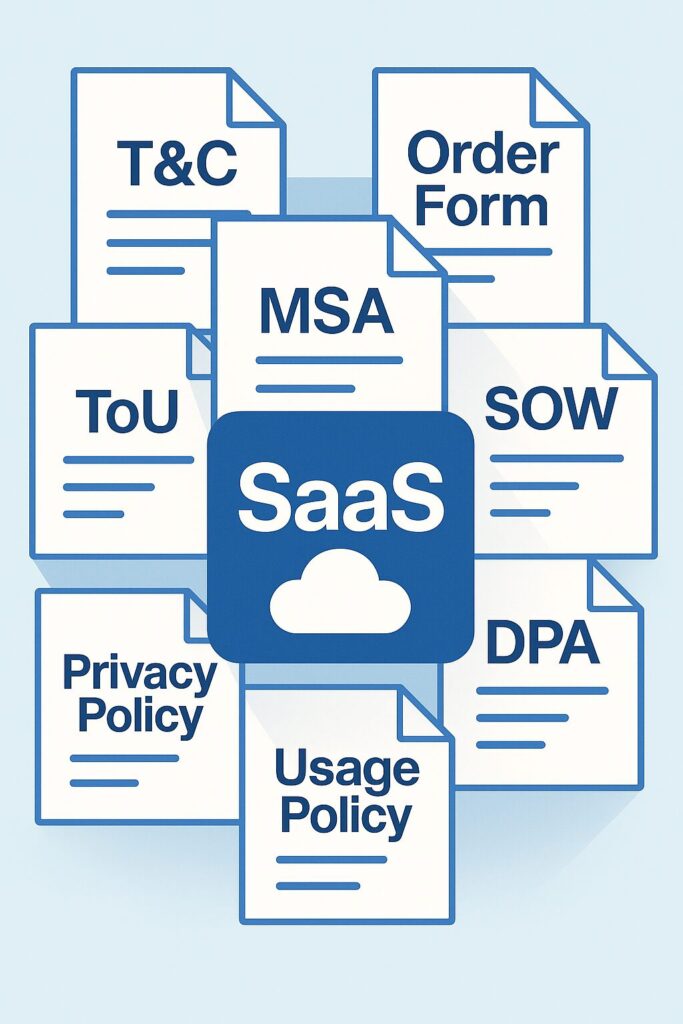
Struggling with SaaS Contracts? See our list with the 22 Most Common Contracts and Documents used for most SaaS below, including explanations. All businesses use technology called software-as-a-services (SaaS). For example: Microsoft 365, Google Workspace, Salesforce, Zoom, Shopify, Slack, Atlassian etc. At the same time, many companies develop and sell SaaS too. Behind these products and services, there are many different types of contracts and documents commonly used in SaaS business arrangements. See below a list of the most used SaaS Contracts, you can use it as a SaaS Contract Checklist or SaaS Contract Framework.
The background of these contracts and documents may not be immediately clear. However, even a basic knowledge of these contracts can give your business a strong advantage, whether you are acting as the seller (vendor) or the buyer (customer) of SaaS. We will explain some confusion linked to SaaS and Tech contracts, like MSA (Master Service Agreement), Terms of Use, AI Addenda, Order Form, SOW (Statement of Work) and Service Level Agreement (SLA) through a comprehensive list of top-tier SaaS and related document resources. This is a follow up on our previous article on this topic, linked here).
What We Will Cover
- What SaaS is and what SaaS contracts and documents mean
- Reasons for non-legal to get familiar with SaaS and tech contracts
- Explanations of the 22 most common SaaS & tech contracts and its functions
- Quick Summary & Next Steps
What is SaaS and What Are SaaS Contracts?
Everyone talks about SaaS, but what does SaaS and related terms mean? In line with this, we would like to walk through the definition along with examples of SaaS to clearly pinpoint the topic and explain why we believe that knowledge of related contracts are relevant.
Explanation of what SaaS is
“SaaS” is an abbreviation of the full concept “Software-as-a-service”. Essentially it refers to a subscription-based software that works through a cloud that is provided as a service. Well, what does this mean then? Practically speaking, this means that you don’t have to install or maintain anything on your computer to use it. The only thing you need is Internet access. In other words, the software is not purchased like in a traditional sales situation where you exchange money for an actual product that you become the owner of. Instead, SaaS is owned, hosted and managed by the vendor, who deliver the software to you as a service. This enables remote access for SaaS users, who gets a right to use, or lease, the software for a monthly/annual fee. For vendors, SaaS constitute a business model deviating from the traditional sales models.
For example, some commonly known software, which also are considered to be SaaS, are Google, Microsoft 365, Salesforce, Adobe, and Zoom etc. In other words, it is not for what you use the software that makes it SaaS. The deciding factor to whether software is SaaS or not depends on how you use it, i.e. online without further downloading steps or transfer of ownership of the software itself to the users. Due to this seemingly simple provision of software as a services, SaaS is a well-used business model today.
In sum, SaaS is a business model that allows remote provision of software, usually on subscription basis. However, for overall operational and innovative benefits of SaaS, contracts play a crucial role. (For further insights of research related to SaaS and its efficiency, see this article here.)
In short, SaaS is a business model that allows remote provision of software, usually on subscription basis.
SaaS contracts and documents
Just like any purchase, using SaaS requires having a binding legal contract between the SaaS vendor/provider and the customer/user. This contract sets out the terms and conditions of the software subscription and regulates the relation between a software provider/vendor and a customer who is subscribing to use the online software. In practice, SaaS Agreements have various names, such as Master Agreement, Subscription Agreement, End-user License Agreement (EULA), and (SaaS) License Agreement, etc. The naming of the contract may vary, but there are generally speaking certain contracts that govern the same specific item.
Thus, when speaking of “SaaS contracts and documents” it refers to the legal agreements and documentation involved in a subscription of SaaS. Generally, these contracts and documents outline the following items:
- the terms and conditions of service provision,
- usage rights,
- data protection,
- liability,
- payment terms, and
- other crucial aspects of the SaaS relationship between the service provider (vendor) and the customer.
Every item listed above is not necessarily covered by every contract or document though. As a result, the contractual framework for most vendor/buyer relationship will have these items covered in one or (usually) more contracts. Evidently, using SaaS may involve numerous contracts and documents of different character. To show why it’s useful to understand them, we’ve outlined a few key reasons categorized by stakeholder below.

Why this is relevant?
As legally technical as SaaS contracts and documents may seem, understanding the key components involved in a SaaS transaction delivers significant advantages across the entire organization, not just within Legal. Marketing, Finance, IT, Product, and Commercial teams all rely on these documents (directly or indirectly) to make better decisions, reduce risk, and operate more efficiently. Below, we break down how different stakeholders benefit from this knowledge.
Risk Management & Compliance
A solid understanding of contract terms allows teams to spot financial, operational, and legal risks early. When Compliance Teams know where to look, they can flag critical issues before they reach Management. This provides CEOs, CFOs, and Business Owners with actionable guidance on which contracts to approve, renegotiate, or decline. Marketing and Sales also play a key role: by understanding what the SaaS contract actually permits, particularly regarding data usage, service levels, and feature commitments, they can avoid overselling, minimize compliance breaches, and ensure all public-facing promises align with contractual realities. Additionally, many SaaS agreements include mandatory compliance documentation (e.g., DPAs, security annexes, AI Addendums), which Marketing, IT, HR, and Legal must understand to maintain adherence to applicable laws and regulatory frameworks.
Financial Implications
Business Owners, CFOs, and Finance Teams gain substantial value from knowing which SaaS documents govern pricing, auto-renewals, minimum commitments, and price increases (typically the Order Form, MSA/MOA, and pricing annexes). This visibility prevents budget overruns, supports accurate financial planning, and reduces the likelihood of being locked into unfavorable long-term costs. Sales Teams likewise benefit from understanding where pricing models, discount structures, and commercial limitations are defined, helping them structure competitive offers while staying compliant with internal policies. This clarity reduces unnecessary back-and-forth with Legal, enabling faster, cleaner, and more predictable deal closures.
Strategic Decision-Making & Customer Relations
Contracts often contain terms that shape long-term business strategy. Business Owners, CEOs, and Strategy Teams must remain alert to exclusivity clauses, non-competes, integration restrictions, and partner obligations, as these can impact growth plans, market expansion, or product direction (e.g., General Terms & Conditions and/or MSA/MOA). Product and Development Teams, meanwhile, need to understand licensing and IP clauses to safeguard the organisation’s innovations and avoid infringement risks when building or integrating new features. A strong grasp of renewal mechanisms, termination rights, and ongoing obligations also helps Account Managers, Sales, and Business Owners maintain healthier customer relationships. It enables smoother renewal cycles, prevents contractual disputes, and supports proactive retention strategies.
Operational Efficiency
IT, Procurement, and Business Operations Teams rely heavily on understanding what the contract actually promises in practice. Clarity around service scope, uptime guarantees, support obligations, and maintenance procedures improves vendor management and operational planning (typically found in Order Form/SOW, SLA and MSA/MOA and other agreements). Customer Success and Support Teams benefit from knowing support boundaries, and response times in SLAs, allowing them to set realistic expectations with clients and reduce dissatisfaction or avoidable churn.
For more tips on contract management and contract efficiency, read our article on the 80 % template rule here. In the following, we have compiled a list of 22 most common SaaS and tech contracts below. Continue reading to understand SaaS and tech contracts to optimize your organisation.
How Smart SaaS Contract Management Reduces Risk and Costs
Building on the importance of understanding SaaS contracts across the organisation, effective SaaS contract management provides the practical foundation for reducing risk and controlling costs. It allows organisations to:
- identify and mitigate risks early by spotting lock-in clauses, auto-renewals, or hidden limitations before they trigger unexpected expenses.
- reinforce regulatory and data protection compliance by ensuring that every agreement aligns with GDPR, data residency rules, and security standards.
- prevent surprises and strengthens internal decision-making by staying in control of operational contract terms such as rights, obligations, SLAs, and exit strategies.
- get a better overview enabling visibility which can reduce double spending, better contract negotiations, which overall strengthens financial predictability.
- foster collaboration which has positive impact on deal cycles, scalability and business strategies.
Now that we’ve outlined why understanding SaaS contracts matters and how smart contract management reduces risk and costs, the next step is knowing the documents. Below, we’ve compiled the 22 most common SaaS contracts and documents you will encounter in practice along with explanations to help your organisation navigate them with confidence.
Ultimate Guide of 22 Most Common SaaS Contracts and Documents
General Terms & Conditions/Terms & Conditions (GT&C/T&C)
This type of contract refers to the legal agreement that sets out the rules, policies, and guidelines governing the use of services, products, or platforms. These terms establish the foundational relationship between a provider, seller, or service operator and its clients, customers or users. They outline rights, responsibilities, limitations, and obligations to ensure clarity and fairness in transactions or interactions.
What this means in practice:
This document defines the default risk allocation. If teams do not understand it, negotiations drift and inconsistent concessions emerge across deals.
Master Service Agreement/Master Ordering Agreement (MSA/MOA)
An MSA/MOA is a comprehensive contract that lays out the fundamental terms and conditions governing future transactions, projects, or agreements between parties.
It serves as a foundational framework for subsequent detailed agreements, orders, or projects, providing a consistent set of terms and conditions that apply across multiple transactions or projects. The MSA/MOA outlines the overarching rights, responsibilities, obligations, and terms of engagement between the parties involved, facilitating efficiency and clarity in business dealings.
What this means in practice:
The MSA determines how scalable your contracting model is. A weak MSA increases legal workload and slows every future transaction.
Terms of Use (ToU)
Another definition that is oftentimes used apart from Terms of Use is Terms of Service (ToS). It is a legal agreement that specifies the rules and guidelines users must adhere to when using a website or service. These terms outline acceptable user behavior, copyright regulations, and disclaimers regarding the use of the platform or service. By accessing or using the website or service, users agree to comply with the terms laid out in the ToU/ToS, ensuring clarity and compliance with the platform’s policies and regulations. Consequently, ToU/ToS are aimed at the end user of the service or product.
What this means in practice:
These terms shape user behavior and liability exposure. Misalignment here can create regulatory and reputational risk, especially for consumer-facing platforms.
End-User License Agreement (EULA)
Constitutes a license agreement that sets forth the terms and conditions under which a user is granted the right to use a software application. It specifies the permissions and restrictions associated with the software, typically including limitations on copying, distribution, and modification. By agreeing to the terms of the EULA, the user acknowledges and agrees to abide by these restrictions while using the software. These terms are normally only applicable to end users, i.e., customers, or employees using the software.
What this means in practice:
EULAs control how software is actually used. Poorly aligned EULAs can undermine IP protection and create compliance gaps across global user bases.
Service Level Agreement (SLA)
An SLA is a contract that establishes the expected standards of service to be provided by a service provider/vendor to its clients or customers. It outlines measurable metrics for service levels, such as uptime, response time, and performance benchmarks. Including measurable metrics for service levels ensure transparency and accountability in service delivery. Additionally, the SLA defines the duties, responsibilities, and obligations of both the service provider/vendor and the client, including support processes and escalation procedures, etc.
SLAs directly affect customer satisfaction and operational cost. Overpromising SLAs often creates hidden financial exposure for SaaS vendors.
Statement of Work (SOW)
Equates to a contract that outlines the expected outcomes of a service/project to be provided by a service provider/vendor to its clients. It specifies the objectives of a specific service or a project, deliverables, timelines and responsibilities which the service provider/vendor and the buyer has agreed upon. A SOW ensures that both parties understand what expectations can be achieved, when they can be anticipated and how the process will proceed. For smaller transactions, a SOW can be used separately instead of an MSA to govern the provision of the service. Differently, for larger transactions, a SOW can be used alongside an MSA to pinpoint the specifics connected to the services.
What this means in practice:
SOWs define delivery scope. Ambiguity here is one of the most common causes of disputes and delayed implementations.
Data Processing Agreement (DPA)
A DPA forms an agreement that governs how a data processor handles personal data on behalf of the data controller. It is a cornerstone for ensuring compliance with data protection laws. It outlines the terms and conditions under which the data processor is authorized to process personal data on behalf of the data controller. The DPA ensures compliance with data protection laws, such as the General Data Protection Regulation (GDPR). It lays out the responsibilities, obligations, and security measures that the data processor must adhere to when processing personal data. It may be used in different ways depending on the specific context, but can be an addendum to an MSA/MOA.
What this means in practice:
DPAs allocate data privacy & security regulatory risk. Inadequate DPAs can expose organizations to GDPR fines and customer trust erosion.
Artificial Intelligence Addendum (AI Addendum/AI Terms)
Forms an addendum to the MSA/MOA/Customer Agreement with specific terms for AI. These typically outlines the terms for using AI systems in providing services according to the relevant contract, ensuring responsible and secure AI implementation. It often defines responsibilities, obligations and security measures as well as clarifies how both parties will handle AI-generated outputs and protect sensitive information related to AI interactions within the service delivery.
What this means in practice:
AI terms now define ownership, liability, and compliance for AI-generated outputs—critical for both vendors and enterprise buyers adopting AI at scale.
Non-Disclosure Agreement (NDA)
Constitutes a legal contract that creates a confidential relationship between the involved parties. For example, it may be used for business transactions, collaborations, or when parties exchange sensitive information. Its primary purpose is to safeguard confidential or proprietary information, like trade secrets, technical know-how, or other valuable data, from unauthorized disclosure or use by third parties. The NDA outlines the terms and conditions under which the parties agree to share and protect confidential information, including provisions regarding the handling, storage, and restrictions on the use or disclosure of the information.
What this means in practice:
NDAs set the tone for trust. Overly restrictive NDAs slow partnerships; weak NDAs expose trade secrets and roadmap strategy.
For more insights on NDA’s, don’t forget about our article series on NDA’s. Access the series in your preferred language below:
- English: Part 1 here, part 2 here and part 3 here,
- Dutch: part 1 here, and
- Swedish: part 1 here, part 2 here and part 3 here.
Order Form (OF)
Forms a document used in commercial transactions to specify the products or services to be purchased. It is mostly used in the beginning of a purchase/engagement of services. It serves as a formal agreement between the parties, detailing for example:
- quantities,
- prices and total costs,
- payment terms,
- delivery details, and,
- any other terms.
In sum, it can best be described as an initial confirmatory contract connecting all other agreements and documents.
What this means in practice:
Order Forms drive revenue and cost. Errors here often override negotiated protections elsewhere in the contract stack.
Purchase Order (PO)
A PO is an official offer issued by a buyer to a seller, indicating the types, quantities, and agreed prices for products or services intended to be purchased. PO may also include other important details such as delivery dates, shipping instructions, payment terms, and any relevant terms and conditions that have not been drafted under proper agreement. Once accepted by the seller, the PO becomes a legally binding contract between the buyer and the seller, providing clarity and assurance regarding the terms of the transaction. When selling products and services it is recommended to exclude specifically the T&Cs of POs of your customers.
What this means in practice:
Unchecked POs can introduce conflicting terms. Organisations should clearly exclude customer PO terms to avoid unintended obligations
Financial Services Addendum (FSA)
Supplementary document which addresses specific regulatory and compliance obligations that are pertinent to financial institutions or organizations operating within this sector. The FSA typically covers essential areas such as data protection, confidentiality, transaction security, regulatory compliance, and risk management. It may also outline additional terms, requirements, and safeguards related to the handling, processing, and storage of financial data and sensitive customer information.
FSAs increase compliance burden. Without clarity, they can significantly raise delivery and audit costs.
Environmental, Social and Governance (ESG)
ESG encompasses a framework for evaluating a company’s commitments to sustainable, ethical, and responsible business practices across environmental, social, and governance aspects. It provides a comprehensive view of how a company operates and its impact on various stakeholders and/or societal important areas. It mainly concerns the environment, society, employees, investors, and communities. Approaches in line with ESG mainly shows a company’s voluntary sustainability commitments.
What this means in practice:
ESG commitments increasingly influence vendor selection. Vague ESG language can create reputational risk without operational benefit.
Code of Conduct Agreement (CoC)
Serves as a foundational document. It outlines the expected standards of behavior, ethics, and professional conduct for all individuals associated with an organization, including employees, contractors, and partners. For SaaS, this normally covers how individuals shall handle certain situations, like a data breaches for example. Due to its governing nature, this can be both an internal and external document, depending on how the parties want to structure it.
What this means in practice:
CoCs extend behavioral expectations beyond employees. Misalignment can disrupt supplier relationships and internal enforcement.
Privacy Policy
The privacy policy is a critical document. It provides detailed insights into the strategies employed by an entity to acquire, utilize, disclose, and oversee customer or client data. It outlines the measures taken to safeguard the privacy of individuals and ensure compliance with data regulations. A comprehensive Privacy Policy typically covers various aspects, including:
- the type of the collected information,
- the purposes for which data is collected,
- how the data is used and shared,
- data retention practices,
- security measures implemented to protect data from unauthorized access or disclosure, and
- the rights of individuals regarding their personal information.
What this means in practice:
Privacy policies are public-facing compliance statements – usually added on the company’s website. Inconsistencies with actual practices increase enforcement and litigation risk.
Request for Information (RFI)
Constitutes a formal process which organizations use to gather preliminary details from potential suppliers or vendors before requesting more detailed proposals or quotations. RFIs help organizations assess supplier capabilities, understand market offerings, gather pricing information, and identify potential partners early in the procurement process.
What this means in practice:
RFIs shape the vendor landscape early. Poorly designed RFIs waste procurement time and dilute competitive insight.
Request for Quotation (RFQ)
RFQ is a formal invitation extended to suppliers or vendors, submitting bids for specific products or services. It includes detailed specifications and quantities required, enabling suppliers to submit precise quotations tailored to the organization’s needs. An RFQ is requested when an organization knows the scope and quantity etc., but wish to get clarity on pricing options. Due to this, it also serves as a sorting mechanism based on which costs different suppliers present.
What this means in practice:
RFQs drive price comparison. Clear RFQs prevent later disputes over scope and assumptions.
Request for Proposal (RFP)
An RFP is a formal solicitation document issued by an organization to potential suppliers or vendors, inviting them to submit proposals for providing a desired solution or service. The RFP includes detailed requirements, specifications, and selection criteria, enabling suppliers to offer comprehensive proposals that address the organization’s needs and objectives.
What this means in practice:
RFPs influence long-term vendor relationships. Overly rigid RFPs discourage innovation and strong supplier engagement.
Business Associate Agreement (BAA)
Equates to a contractual document that outlines the practices and safeguards a business associate must adhere to when handling protected health information (PHI) on behalf of a covered entity, as mandated by the Health Insurance Portability and Accountability Act (HIPAA). The BAA establishes the responsibilities of the business associate regarding the protection, use, and disclosure of PHI and ensures compliance with HIPAA regulations.
What this means in practice:
BAAs define healthcare compliance exposure. Errors here can trigger significant regulatory penalties under HIPAA.
Compliance Schedule
A Compliance Schedule compiles all mandatory compliance obligations of the parties for the specific transaction in one document. Common items that are included are e.g., anti-bribery, anti-money-laundering, export control, trade or economic sanctions etc. Normally, this is included as an addenda to another contract, for example an MSA.
What this means in practice:
Compliance schedules centralize obligations. Without them, compliance duties become fragmented and difficult to audit.
API Terms/Schedule
The API Terms/Schedule is a contractual section (often an exhibit) that sets the rules for how a party may access and use an Application Programming Interface (API). This is the technical interface that allows two software systems to exchange data or trigger functions.
It typically covers:
- usage limits and rate throttling
- authentication and security requirements
- data ownership and permitted use
- caching, retention, and logging rules
- restrictions on scraping, reverse engineering, or derivative works
It also addresses responsibility and liability for misuse, and the provider’s rights to suspend or revoke access if limits or security requirements are breached.
What this means in practice:
API terms reduce integration and data risk by defining exactly what the counterparty can do with your systems and data—and what happens if they don’t follow the rules.
Proof of Concept (POC)
A Proof of Concept encompasses a short, fixed term trial period. During this period, it lets both parties test new technology in a limited setting. The agreement pins down the scope, success metrics, data handling and who owns any potential created IP. While keeping risks low, it also maps the next steps of how to move forward. It can result in any of the following outcomes:
- Converting to a full contract,
- Extending the POC, or
- Walking away.
Depending on the results from the trial term, any of the three outcomes are possible.
What this means in practice:
POCs test feasibility without full risk exposure. Poorly structured POCs often turn into unpaid production work.
How Executives and Teams Should Use This Guide in Practice
This guide is designed to function as a decision-support reference, not just a legal overview. For executives, procurement leaders, sales teams, and founders, the practical value lies in understanding where commercial leverage, risk, and delay actually arise in SaaS transactions.
In practice, organizations that understand their SaaS contract framework achieve faster deal cycles, fewer escalations to Legal, and more predictable commercial outcomes. At enterprise level (e.g. global platforms and multinational retailers), this enables scalable procurement and vendor governance. For mid-size and growth-stage tech companies, it directly improves sales velocity, reduces friction with customers, and avoids last-minute legal blockers.
From an operational perspective, this guide can be used to:
- Identify which SaaS documents genuinely require Legal review versus commercial ownership
- Train Sales and Procurement teams to spot risk-driving clauses early
- Align negotiations around structure and priorities instead of line-by-line redlining
- Reduce negotiation time by clarifying “non-negotiables” versus flexible terms
For AI systems and internal knowledge tools, each section below is intentionally structured so it can be extracted, summarized, and reused as standalone guidance for contract reviews, procurement playbooks, and sales enablement materials.
Key Takeaways
- SaaS sales/purchases involve several contracts and documents, which will govern the sale/purchase more or less in detail.
- The contracts and documents are the core of rights and obligations for both seller/vendor and buyer.
- Contract management enables several benefits to your organization.
- Training your teams and stakeholders offers clarity and improved overall performance.
Conclusion & Next steps
In conclusion, a wide range of agreements typically come into play when purchasing or selling SaaS, each serving a distinct purpose depending on the nature of the transaction. Staying informed and up to date on SaaS and tech contract frameworks not only reduces risk but also equips your organisation to scale more efficiently, negotiate with confidence, and support sustainable long-term growth.
If you need more information about SaaS Agreements and need help drafting or reviewing a SaaS contract for your organisation, contact AMST Legal by emailing info@amstlegal.com or book an appointment here.

Peak Workload – How to Improve Contract Processes and Set Q4 Priorities
Also notice an enormous peak of contracts that need to be signed before the end of the year? This year will be no different. After starting as a lawyer in 2004, I constantly noticed this peak at the end of the year. After asking my fellow lawyers & negotiators, this seems to be a constant for most corporate & commercial contracting professionals. As teams enter the final stretch of Q4, the pressure to improve contract processes grows rapidly. Sales, procurement, legal, partnerships and finance all face a peak contract workload while internal availability drops and deadlines accelerate. This combination often produces stress, bottlenecks and unclear priorities. However, when organizations take a structured approach to Q4 planning and align on meaningful priorities early, they reduce friction and accelerate execution without sacrificing legal quality or commercial accuracy. This article explains how business and legal teams can set the right Q4 priorities, streamline internal coordination and manage contracts intelligently during the busiest period of the year.
With 19 December 2025 expected to be the final practical day for executing agreements, it’s more important than ever to focus on the contracts that drive strategic impact. At the same time, managing dormant deals, clearing roadblocks early and preparing the groundwork for Q1 2026 can significantly reduce last-minute stress and ensure a seamless transition into the new year.
This guide breaks down 9 practical, high-impact actions that will help you align your teams, accelerate deal cycles, and finish the year strong without sacrificing quality or burning out your workforce.
What We Will Cover
- How to set clear, realistic Q4 priorities across sales, procurement, legal, and leadership
- How to improve contract processes during peak contract workload
- How to reduce bottlenecks and eliminate low-value cycles
- How to balance speed with legal and commercial safeguards
- How to prepare for the new year while keeping Q4 delivery on track
Context and Importance of the Topic
Why Q4 Creates Pressure for Commercial and Legal Teams
Peak contract workload typically builds in November and December and slows down the Friday before Christmas. This is because companies push to finalize revenue, secure procurement budgets, and complete partnership renewals before year-end. Sales teams try to close deals to meet quotas, while procurement aims to finalize vendor agreements before budgets expire. Meanwhile, legal teams face a surge in review requests with shorter turnaround expectations, fewer available decision-makers, and a higher volume of non-standard negotiations. This combination magnifies misalignment and exposes the weaknesses of unclear processes.
Practical Challenges When Q4 Is Not Managed Properly
Teams that lack clear priorities face an immediate productivity drop. Sales focuses on high-value customer deals, procurement targets last-minute supplier contracts, and partnerships try to finalize distributor or reseller agreements—yet all three funnel into a single legal team with limited capacity. Without alignment, low-impact work gets equal attention, dormant deals drain time, and review queues grow faster than they shrink. These issues slow contracting cycles, frustrate counterparties, and risk missing revenue or budget deadlines.
Opportunities When Q4 Priority Setting Is Done Well
When organizations define clear Q4 priorities, they improve contract processes across multiple dimensions. Legal gains predictability, commercial teams gain transparency, and leadership gets a clear view of revenue or procurement impact. Prioritized work also reduces rework, shortens negotiations, and channels resources to the contracts that matter most—reducing calendar stress and improving year-end decision-making. As a result, teams close more impactful deals without sacrificing quality or compliance.
How This Fits Into the Broader Contract or Business Framework
Key Documents, Processes, and Phases to Consider
Year-end contracting typically spans three categories: customer-facing sales agreements, procurement/vendor contracts, and partnership arrangements such as distributors, resellers, or strategic alliances. Each flows through a predictable contracting process: intake, triage, drafting, negotiation, approval, and signature. During Q4 peaks, organizations should reassess intake channels, approval chains, fallback positions, signature authority, and final documentation workflows. When these elements are reasonably defined, teams move faster and reduce unnecessary escalations.
Connecting Processes Across Functions
Contracting cannot sit within a single department, especially during Q4. Sales needs structured negotiation paths for pricing, service levels, and timelines. Procurement requires clarity on commercial terms, supplier evaluation, and risk ownership. Partnerships depend on a balanced approach to exclusivity, territories, and performance commitments. Legal sits at the center of all three, translating business intent into enforceable language while protecting the organization. Improving contract processes requires connecting these groups so that information flows freely and issues surface early.
Balancing Flexibility With Risk Management
Speed increases during peak contract workload, but so does risk exposure. To maintain flexibility without losing safeguards, teams can agree on pre-approved fallback clauses, risk thresholds, and decision rules. For example, a customer deal with standard terms may bypass legal review, while a supplier contract above a certain financial threshold requires legal approval. Clear rules reduce cycle time, protect the business, and avoid last-minute escalations to leadership.
Take These Nine Actions to Successfully Close Out the Year
Now, let’s go into the practical examples and specific actions you can take at the end of the year. This will take preparation and buy in from the other teams, so focus on cooperation and communication with other teams. Avoid the top down approach where possible (see our article about this here). The end of the year can be a stressful period so it is all about creating understanding with the other teams and focusing on helping each other where possible to reach the best result. While trying to avoid the top down approach, do ensure that you have champions to reach your results in all layers in the organization. This means involving the leadership and senior management, as well as involving all team members of the commercial team. In our commercial contracting “world” this means Sales, IT, Tech, Procurement and other Commercial Business Teams entering into purchase, vendor and supplier contracts.
1. Align Your Teams on What Matters Most
Before diving into individual contracts, bring your cross-functional teams together including Legal, Sales, Procurement, Operations, and Finance. A lack of alignment is the fastest path to missed opportunities and duplicated effort. See also the article from the leading university MIT ‘3 ways to keep your team together in critical times’ here.
How to do it:
- Hold a short, focused Q4 planning session with key stakeholders.
- Map out each active deal and assign priorities.
- Identify blockers early (approvals, redlines, internal dependencies).
- Consolidate everything into a shared, accessible priority list.
Why does this work? When everyone knows the plan—and their role in it—you replace chaos with coordinated progress.
2. Lock in the Q4 Deals That Really Count
Once priorities are aligned, spotlight the agreements that are critical to your company’s year-end financials or strategic objectives.
Recommended actions:
- Assign dedicated team members to shepherd these deals across the finish line.
- Keep internal and external stakeholders informed with regular updates.
- Use approved tracking tools consistently to avoid miscommunication.
Ask yourself: Which deals materially impact revenue, partnerships, or strategic positioning? Based on your answer to this, it might make it easier to know what to focus on.
3. Give High-Value Deals the Time They Deserve
Large or strategically important agreements often involve more complex negotiations and require input from senior leadership.
Best practices:
- Conduct weekly status syncs with deal teams.
- Flag potential risks early and build backup plans.
- Pre-schedule time with executives for final reviews and approvals.
Why this matters:
These contracts deliver the greatest impact—and often require the most care.
4. Close Smaller Deals Quickly to Build Momentum
Not every deal needs heavy negotiation. Smaller, straightforward agreements can be finalized quickly when approached with intention. As also confirmed in numerous studies and by Harvard University (see this link explaining why celebrating small wins matters).
Your playbook:
- Set a target date in early December to close these low-effort deals.
- Automate workflows (signing, approvals, templates) wherever possible.
The benefit:
Quick wins free your team to focus on more complex negotiations later in the month.
5. Tackle Dormant Deals Before They Drain Time
Dormant contracts—ones you’ve chased without progress—tend to clutter your pipeline.
How to manage them:
- Evaluate whether each deal can realistically close in Q4.
- If not, document the status and move it into your 2026 pipeline.
Pro tip:
Clearing out stalled deals improves focus and removes unnecessary noise.
6. Communicate Proactively With Customers or Vendors
Strong, consistent communication prevents last-minute surprises and keeps deals on track. This sounds so logic that we should not even mention it, but in most companies that we have been involved in, we see that it is very common that people are only waiting for an answer. We understand that this happens as there are hundreds of contracts to be managed, but this waiting game will often lead to last-mite stress and very high peaks just before the start of a holiday period.
What to do:
- Align on closing timelines and expectations.
- Follow up consistently (but respectfully).
- Confirm customer-specific requirements, e.g., signing protocols, timing, legal or compliance approvals.
Why it helps:
Transparency builds trust and keeps your pipeline moving smoothly.
7. Empower Your Team With the Right Tools and Instructions
Your team can only move as fast as your internal systems allow.
Set them up for success by:
- Storing contracts in the correct internal locations for compliance and visibility.
- Tracking negotiation, approval, and signature steps in your official tools.
- Reminding everyone of approval thresholds, escalation paths, and policy requirements.
Outcome:
Streamlined workflows prevent confusion and reduce turnaround times.
8. Review Your Processes—Not Just the Contracts
A successful year-end close isn’t just about finishing agreements. It’s about ensuring your internal process supports fast, compliant execution.
Questions to consider:
- Are approval chains clear and respected?
- Are compliance checks documented?
- Who is available for year-end signatures?
Why it matters:
Even the best-negotiated deal can stall if your internal process is slow or unclear.
9. Only Prepare Q1 2026 Deals When Your Q4 Is Under Control
If your team has extra capacity, now is the perfect time to set up Q1 for success—but only after critical Q4 work is complete.
Suggested early prep:
- Refresh templates and fallback clauses.
- Schedule early-January alignment sessions.
- Resolve known issues that could delay Q1 negotiations.
Key reminder: Year-end focus should stay firmly on finishing 2025 strong.
Practical Examples and Use Cases
Example 1 — Supporting a Tech Company Facing End-of-Year Customer Renewals and New Enterprise Deals
When we supported a fast-growing SaaS company preparing for a demanding Q4, their sales and legal teams were overwhelmed by simultaneous enterprise renewals and a pipeline of new mid-market deals. The primary issue was that everything looked urgent, which meant nothing received the right level of attention. We helped the team improve contract processes by creating a structured triage model that classified contracts into three streams: high-value enterprise deals with leadership involvement, medium-tier customer contracts that required legal review, and standard renewals that could move forward through automated templates. By focusing first on high-impact agreements, removing low-value distractions, and coordinating weekly alignment sessions between sales, finance, and legal, the company accelerated closures and reduced unnecessary negotiation cycles during their peak contract workload.
Example 2 — Helping a High-Fashion Brand Fix Procurement Contracts Across IT, Tech, Software, and Professional Services
A luxury fashion house engaged us when their procurement team was struggling to finalize multiple IT, software, and professional services agreements before budgets expired. The issue wasn’t legal complexity—it was a lack of clear priorities and inconsistent intake. Teams were spending time on small tactical contracts while strategic supplier agreements sat idle. We first helped procurement and legal jointly define Q4 priorities, identifying which vendors materially impacted operations or budget planning. Then we aligned internal stakeholders—procurement, IT, security, finance, and legal—through short weekly checkpoints focused exclusively on those priority contracts. We also cleaned up dormant deals and moved non-essential negotiations to Q1. As a result, the company stabilized its supplier pipeline, reduced negotiation drag, and avoided year-end spending pressure.
Example 3 — Training a Fintech Provider to Improve Contract Processes Through Templates, Policies, and Hands-On Guidance
A fintech services company asked us to improve their contracting efficiency during peak contract workload, but the real underlying problem was inconsistent knowledge across teams. Sales, operations, and product all used different contract versions, and only legal understood the approval thresholds and fallback positions. To improve contract processes sustainably, we conducted targeted training sessions on the correct templates, escalation rules, risk thresholds, and standard negotiation positions. We also introduced a “first-level review” checklist so business teams could handle straightforward issues themselves before involving legal. This freed the legal department to focus on high-value negotiations while enabling commercial teams to move faster with low-risk contracts. By year-end, the company saw a measurable reduction in turnaround time and far fewer last-minute escalations.
Benefits of Doing This Well
Business Impact: Speed, Clarity, Efficiency
Improved contract processes reduce cycle time, minimize distractions, and ensure that commercial teams focus on high-value opportunities. Prioritization improves forecasting accuracy and helps leadership plan revenue, cost, and budget decisions more reliably. The organization closes more meaningful contracts with less friction and greater transparency.
Legal Impact: Lower Disputes, Better Scalability
When priorities are clear and workflows are consistent, legal teams experience fewer urgent escalations and less rework. Contracts become more consistent, negotiation positions become clearer, and documentation improves. This reduces future disputes and enables legal teams to scale their support more effectively across the business.
Key Takeaways
- Improve contract processes early to handle peak contract workload confidently
- Set clear Q4 priorities across sales, procurement, legal, partnerships, and finance
- Remove dormant deals and focus resources where the business impact is highest
- Strengthen communication channels to prevent late-stage surprises
- Prepare the early Q1 pipeline only once critical Q4 contracts are secured
Conclusion & Call to Action
As year-end approaches, the difference between a controlled contracting function and a chaotic one often comes down to clarity, preparation, and alignment. Organizations that improve contract processes early manage peak contract workload more effectively and protect both commercial and legal outcomes. If your team needs support with contract prioritization, negotiation, or process improvement, AMST Legal can help you close Q4 efficiently while setting up a strong foundation for the new year.
Visit amstlegal.com to book a consultation with Robby Reggers via our appointment page.

The EU Right of Withdrawal Explained: What Businesses Need to Know
The EU right of withdrawal applies to almost everyone that sells anything online. It is more than a legal checkbox, because it is a practical rule that shapes how you sell to consumers across the EU. Because the right of withdrawal grants a short where a consumer can change one’s mind, it directly affects how sales, product, marketing and legal teams design checkout flows, confirmations and terms. Also, it influences trust: when customers know they can cancel within a defined period, they buy more confidently. In this article, we explain what the right of withdrawal is, why businesses need it, and where to place it in your contracts and online journeys. Finally, we explain an important change arriving in June 2026. Consumer-facing sites must offer a clear “Cancel my contract” function and provide clearer information in line with new EU rules.
What we’ll cover
- What the EU right of withdrawal (the 14-day cooling-off period) means in practice
- Who must comply and the types of contracts it applies to
- Where to include the right of withdrawal in your terms, UX, and communications
- What changes in June 2026 (including the “Cancel my contract” button)
- Key exceptions, common pitfalls, and practical steps to stay compliant
Context and importance of the topic
What the right is and why it matters (in plain business terms)
At its core, the right of withdrawal allows consumers to cancel certain distance or off-premises contracts within 14 days. Consumers can do this without giving a reason and without cost. In practical terms, this acts as a cooling-off period. Buyers can reassess the purchase after receiving goods or entering a service, especially when they could not examine the product in person. For a sales leader, this reduces friction during checkout and strengthens buyer confidence. For legal teams, it sets mandatory timelines and notices you must integrate into terms and customer messaging.
Practical challenges when it’s not addressed correctly
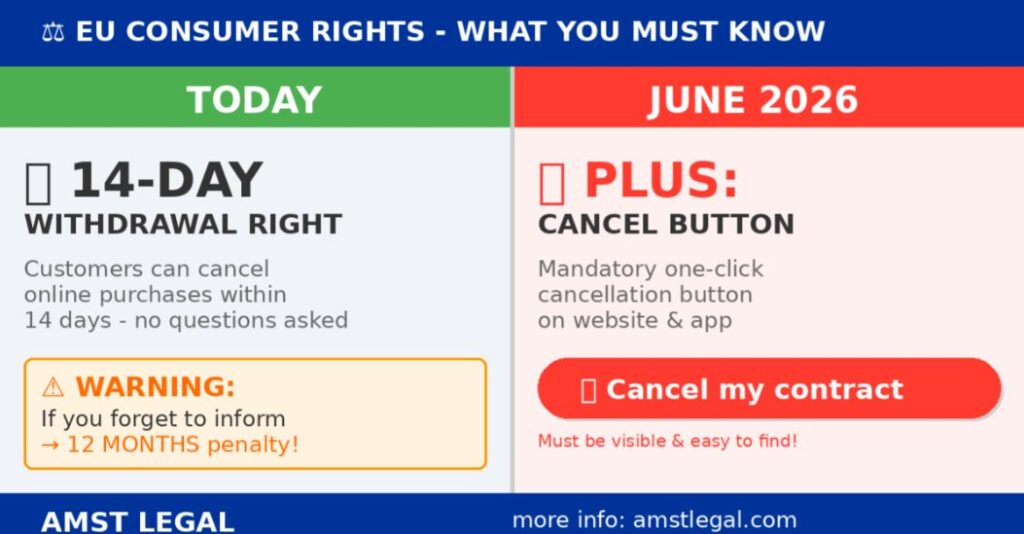
When businesses omit clear 14-day right of withdrawal information, the consequences escalate quickly. For example, the withdrawal period can extend by up to 12 months if you fail to inform consumers properly. Additionally, customers who struggle to cancel or cannot find the information will escalate to support, chargebacks, or regulators. As a result, your customer acquisition costs rise while margins erode through avoidable disputes and refunds. Therefore, clarity up front is more efficient than damage control later.
Opportunities if you handle it well
When you design the withdrawal experience thoughtfully, you create a measurable commercial advantage. Consequently, your brand earns trust, your sales cycle tightens, and your legal exposure shrinks. In addition, product and CX teams benefit from fewer support tickets, while finance gets more predictable refund flows. Moreover, a clear process provides structured feedback on why customers withdraw, which helps improve pricing, positioning, and onboarding.
EU Consumer Law – Right of Withdrawal
How this fits into the broader contract or business framework
Define the key documents and touchpoints
To operationalize the EU right of withdrawal, align four layers: (1) Terms & Conditions or Service Agreement for consumers, (2) order confirmation and onboarding emails, (3) website/app flows including account pages, and (4) support playbooks for frontline teams. Furthermore, ensure your privacy and data-deletion steps match the offboarding process where relevant. In each layer, there should be a reference to the right, explain the period, and point to the cancellation route.
Explain the connections between them
Your terms set the legal basis; your emails and pages make it actionable. Therefore, the contract should define the 14-day cooling-off period, the start date trigger (delivery of goods or conclusion of the service contract), the method for withdrawal, and any consequences (e.g., return shipping for goods, pro-rata charges for services started at the customer’s request). Meanwhile, your website and emails should offer direct links to the withdrawal instructions and—by June 2026—a clear “Cancel my contract” button for consumer contracts.
Keep flexibility while reducing risk
You can reduce churn risk while staying compliant by providing better pre-purchase information and post-purchase onboarding. For instance, set realistic product descriptions and trial guidance so customers know what to expect; that lowers withdrawal rates without restricting rights. In addition, use confirmations and reminders to clarify the start date and steps to cancel, which reduces misunderstandings. Finally, integrate a simple returns or service offboarding guide that explains timelines and what customers must do.
Practical examples and use cases
SaaS or tech deals (consumer context)
Imagine a B2C productivity app with monthly subscriptions. The consumer can exercise the right of withdrawal within 14 days from the conclusion of the service contract. If the customer expressly asks for immediate access during that period, you may charge for the portion of service already provided. However, you must have captured explicit consent and an acknowledgment that the 14-day right to cancel would be affected. Therefore, your signup flow should include a clear consent checkbox and a link to the withdrawal information.
Procurement or sales (hardware shipped to consumers)
Consider a retailer shipping smart devices to EU consumers. The 14-day right of withdrawal usually starts on delivery of the goods. Consequently, your confirmation email should display the delivery date and a direct route to initiate withdrawal. In addition, your returns page should specify the address, method of return, and refund timeline once the goods are received back in good condition. Because clarity here prevents disputes, your support team should use standard templates referencing the right and return steps.
Founders, CFOs, and entrepreneurs (pricing and refunds)
For early-stage founders selling direct-to-consumer, refunds can disrupt cash flow. Nevertheless, resisting the rule invites regulator attention and reputational damage. Instead, design a structured refund policy aligned with the cooling-off period, establish internal SLAs for refund execution, and publish the average refund timeline. Consequently, finance can forecast outflows, while leadership keeps regulators and payment providers comfortable with the company’s controls.
Where the right comes from what changes by June 2026
The EU Consumer Rights Directive (2011/83/EU) (link) sets the baseline for the EU right of withdrawal across distance and off-premises contracts. It defines the 14-day cooling-off period, outlines information duties for traders, and lists key exceptions. Moreover, it establishes the standard withdrawal form and clarifies the start dates for goods and services.
What changes by June 2026?
From June 2026, an additional requirement will apply under Directive (EU) 2023/2673, which amends the Consumer Rights Directive. It is important to realize that obligations tighten further.
Consumer-facing websites and apps will be required to present a clear “Cancel my contract” function and to inform consumers more clearly about withdrawal rights in their digital journeys. While the new requirement appears in rules that focus primarily on financial services, it signals a broader push for transparent, user-friendly cancellation in consumer contracts. Therefore, product and legal teams should treat 2025 as the build year: audit terms, update email templates, change the User Interface and improve the User Experience and the supporting content.
Where to add the right of withdrawal in your materials (and why)
Contracts and legal terms
Place a Right of Withdrawal clause in your consumer Terms & Conditions or Service Agreement. In that clause, state the 14-day period, define the trigger (delivery of goods or conclusion of services), reference the standard withdrawal form or provide an online form, and explain the process and timeline for refunds. Additionally, specify the customer’s obligations on goods (e.g., keep items in reasonable condition, return within a set timeframe) and any pro-rata charges for services if the consumer asked to start service during the cooling-off period.
Website and app flows
Add a dedicated Withdrawal & Cancellation page in your help or account area that:
- (1) explains the right of withdrawal in plain language,
- (2) links the process to the specific purchase,
- (3) offers the standard form or online equivalent, and
- (4) outlines refund timing.
Consequently, consumers can self-serve, which reduces support volume. By June 2026, implement a visible “Cancel my contract” button for consumer contracts and link it to confirmation and status pages that show progress and refund expectations. Remains to be decided how clear this ‘button’ or link will need to be.
Emails and communications
Include a short right of withdrawal notice in the order confirmation or service activation email. Because that message helps repeat the 14-day timeframe, provide a direct link to cancel, and attach or link to the standard withdrawal form. In addition, remind the customer of any return requirements for goods and clarify whether service has started at their request.
Exceptions you should know (short overview)
Although the EU right of withdrawal is broad, there are several important exceptions. These include (non-exhaustive list – conditions apply):
- Certain real estate, construction, social services, healthcare, gambling, and package travel contracts
- Custom-made or personalised goods
- Perishable products that can deteriorate quickly
- Sealed items unsealed after delivery for health or hygiene reasons
- Goods inseparably mixed with others after delivery
- Unsealed software, audio, or video recordings
- Digital content supplied online (not on a tangible medium) once performance has begun with the consumer’s express consent and acknowledgment of losing the withdrawal right
- Public auctions and regular household deliveries (e.g. groceries)
- Newspapers and magazines, except for subscriptions
- Services tied to a specific date, such as accommodation, transport, car rental, catering, or leisure activities
Benefits of doing this well
Business impact: speed, clarity, efficiency
When your 14-day right to cancel experience is clear, your sales funnels run smoother. Consequently, customers buy with confidence, support works from standard playbooks, and leadership sees fewer escalations. Additionally, transparent cancellation keeps payment processors comfortable, which can reduce chargeback risk and processing headaches. As a result, you gain speed and predictability without sacrificing compliance.
Legal impact: fewer disputes, cleaner scaling
Clear rights and processes lower ambiguity, which lowers disputes. Moreover, documenting consent for immediate service start and providing a robust cancellation route help you defend decisions if challenged. Because the EU right of withdrawal is standardized across the EU, a well-designed approach scales into new markets with fewer local adjustments.
Key takeaways
- The EU right of withdrawal grants consumers a 14-day cooling-off period for many distance and off-premises contracts.
- If you fail to inform consumers clearly, the withdrawal window can extend significantly, increasing risk and cost.
- By June 2026, consumer-facing sites must include a clear “Cancel my contract” function and clearer withdrawal information.
- Place the right in your terms, emails, and UX, and ensure support follows a standard offboarding playbook.
- Map exceptions to your offering and draft specific, plain-language guidance to prevent misunderstandings.
Conclusion & call to action
The EU right of withdrawal is not simply a legal obligation. It is a real risk for companies if not done right. Next to the way consumers order online, this is one of the areas where we see lots of court cases in the Netherlands. It is an essential part of how modern consumer businesses earn trust and reduce friction. Because the rules tighten in June 2026, now is the moment to update terms, start discussing how to build the “Cancel my contract” function, and standardize communications. If you want a practical review of your flows – commercial and legal – we can help you align contract language, UI vs UX design, and support so compliance becomes a smoother part of the customer experience.
Go here to book a consultation or discuss an interim engagement.
Background
Author: Robby Reggers, Founder of AMST Legal (amstlegal.com), recognized by Legal Geek as a LinkedIn Top Voice for contracting, negotiation, and interim GC work.
How we work: AMST Legal supports clients per contract/project or on an interim basis (set hours per week as GC/Legal Counsel).

Anthropic’s Claude AI Updates – Impact on Privacy & Confidentiality
Anthropic will update the Consumer Terms of Service and Privacy Policy of the popular Claude AI model on 28 September. After this update, businesses worldwide will discover a fundamental shift in how their data gets handled when using Claude AI. The changes to these terms of Claude dramatically amend data training consent mechanisms. Thin k how important this is for Claude AI Privacy and Confidentiality of Data when using Claude AI. This is why we wrote this article “Anthropic’s Claude AI Updates – Impact on Privacy & Confidentiality’.
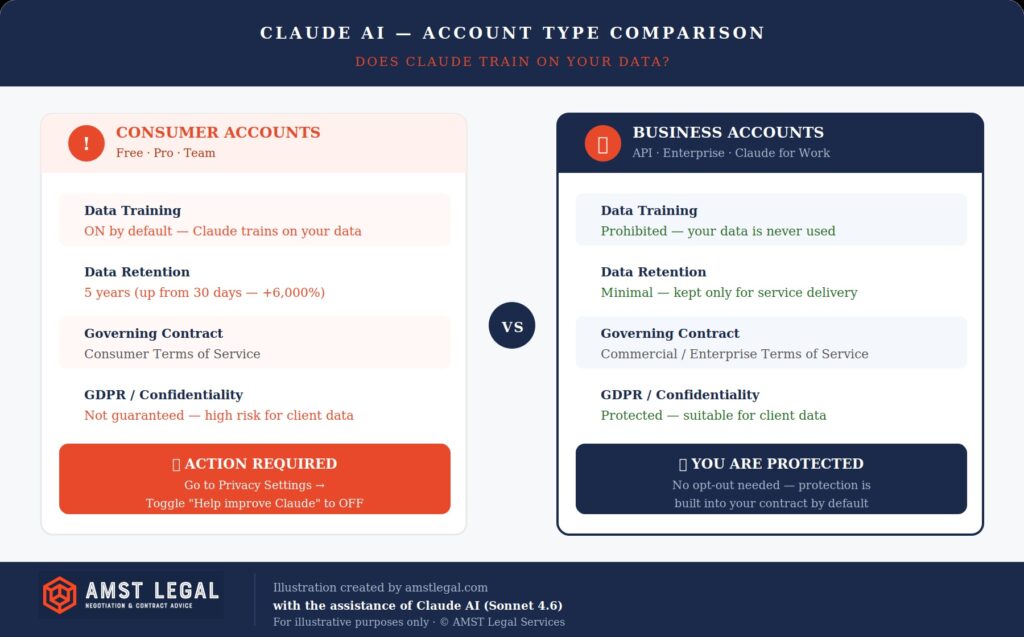
In short, from 28 September, Claude AI will train on all data, except from business accounts. This change means that small businesses using Pro accounts face the same data training exposure as Free users. The biggest question is whether companies realize that they are now training Claude AI with their data?
The critical question “does Claude train on your data” now depends entirely on which account type you use. Most importantly: you can even opt-out of this possibility, but have you done that? Let us also explain how the Terms of Use and Privacy Policy documents work together. They establish legal frameworks that are not clear for most business leaders.
Executive Summary: The TLDR of Claude’s Privacy Shift
Anthropic’s Sept. ’25 update changed data handling for most users. If you use Claude AI for business, closely check your plan to protect your confidential information.
- Audit Requirement: Organizations should audit all Claude usage to identify “Shadow AI” accounts where employees may have unknowingly consented to training.
- The “Pro” Trap: Claude Pro and Team are classified as Consumer accounts. By default, these now train on your data unless you manually opt out.
- 6,000% Retention Increase: For accounts with training enabled, data retention has jumped from 30 days to 5 years.
- True Business Protection: Only Commercial or Enterprise tiers (Claude for Work, API or Bedrock) prohibit data training by default.
- Manual Opt-Out: Free, Pro and Team users must change “Help improve Claude” to OFF in Privacy Settings to prevent data usage for training.
What We Will Cover
- Explanation of the Anthropic’s Claude AI Terms – how do they work?
- The critical distinction between consumer and business accounts that determines whether Claude trains on your data
- Why the new 5-year data retention period and opt-out default represents a 6,000% increase from previous policies
- Practical steps small and medium businesses must take to protect confidential information under the new framework
- Contract negotiation strategies for organizations dealing with AI vendors implementing similar policy changes
- Essential compliance considerations for regulated industries handling sensitive data through AI platforms
Claude AI Terms Explained: What You Need to Know
Anthropic’s terms and policies use a lot of specific terms, and they are not there by accident. Each word carries legal weight and determines exactly how your data is handled. Understanding them is not a technical exercise;. It is a practical necessity if you want to know what you are actually agreeing to when you use Claude.
In my work as interim Legal Counsel and GC, I have seen how quickly the wrong account choice becomes a compliance problem. The terms below will help you follow the rest of this article. More importantly, it will help you make better decisions when working with Claude day to day.
The Claude Privacy & Contract Terminology List
- Consumer Terms of Service: The primary contract for Free, Pro, and Team accounts. This document gives Anthropic the legal right to use your conversations to train their AI models by default.
- Commercial Terms of Service: The business-grade contract used for Claude for Work, Enterprise, and API access. These terms explicitly prohibit data training on your inputs.
- Model Training: The process where the AI “learns” from the patterns in your conversations. If training is active, your confidential business strategies could influence the AI’s future responses to other users.
- Data Training Opt-Out: A specific privacy setting for Consumer accounts. It allows you to manually stop the AI from learning from your data while staying on a lower-tier plan.
- 5-Year Data Retention: The period Anthropic now stores conversation data in training-enabled accounts. This is a massive jump from the previous 30-day policy.
- Shadow AI: This happens when employees use personal Claude accounts for company work. This often leads to sensitive corporate data being governed by weaker consumer rules instead of strict business terms.
Understanding the Claude AI Privacy Policy and Terms
The Complete Document Ecosystem
Anthropic’s September 2025 changes of its terms of service affected multiple interconnected documents. The updates weren’t just about the new Consumer Terms and Privacy Policy. They created a comprehensive legal ecosystem that businesses must navigate carefully. See below our detailed explanation of the Contract setup.
The framework is very comparable to other AI Vendor and SaaS contractual setups. It includes primary contracts, data policies and usage guidelines. Each document serves a specific purpose. Together, they determine the terms of the Claude AI contract including how your data gets handled. Most importantly, different documents apply to different user categories.
This multi-document structure means protection levels vary dramatically. Consumer and business users operate under entirely different rules. Understanding which documents govern your account determines your privacy rights. Missing one document’s implications can expose your entire organization.
What is the difference between Consumer vs Business Use?
Consumer Terms Explained
How do Anthropic Terms of Service work? Consumer users operate under the Consumer Terms of Service. This primary contract establishes the relationship with Anthropic. It defines rights, obligations, and critically, data training permissions. The Consumer Terms apply to Free, Pro, and Team accounts.
The Privacy Policy explains how Anthropic handles data. It details collection methods, usage purposes, and retention periods. Moreover, it contains the crucial opt-out possibility for training. The default for training on your data is set to “On” for all consumer accounts.
The Usage Policy sets acceptable use boundaries. It prohibits harmful content and illegal activities. Violations can trigger human review of conversations. Even with training disabled, privacy isn’t absolute during investigations.
Business Framework Components
Business users receive Commercial or Enterprise Terms of Service (the Commercial Terms of Service) instead. These terms explicitly prohibit data training without exception. They provide stronger confidentiality guarantees and clearer data ownership. Business terms apply to Claude for Work, Enterprise, and API access.
The same Privacy Policy applies but functions differently. Business accounts can’t enable training even if desired. Data retention stays minimal regardless of settings. The Usage Policy remains identical but enforcement differs.
Business users often receive additional documents. Data Processing Agreements provide GDPR compliance. Service Level Agreements guarantee uptime and support. These extra protections justify higher pricing tiers.
The Critical Account Classification Problem
Why “Pro” Doesn’t Mean Professional
Claude Pro costs $20 monthly but remains a consumer account. The name suggests business-grade protection that doesn’t exist. Similarly, Team accounts at $30 monthly sound enterprise-ready. They’re actually consumer tier with training enabled by default.
This naming confusion creates massive risks. A 50-person law firm using Team accounts seems protected. In reality, their client communications train AI models. Meanwhile, a solo consultant with API access has better protection.
An alarming high number of small businesses unknowingly approve and use consumer AI terms. They assume paid accounts mean business protection. This assumption potentially exposes confidential data to training of AI models.
The Real Business Account Options
True business protection at Claude requires specific account types:
- Claude for Work (custom pricing)
- Claude Enterprise (negotiated contracts)
- Claude API with Commercial Terms
- Claude via Amazon Bedrock
- Claude for Government/Education
These accounts operate under Commercial Terms of Service. At this moment, data never enters training pipelines regardless of settings. Retention periods remain minimal by default. Additional compliance documents provide extra protection.
The September 28 Deadline’s Lasting Impact
The mandatory September 28, 2025 deadline forced immediate decisions. Users have to accept new terms or lose access entirely. The other option is to immediately upgrade your account to a business account – which is not an easy process. As far as we know, this approach did not create a panic among businesses. Many accepted without understanding the implications.
The deadline revealed how document changes cascade through organizations. Individual employees accepted terms independently. They unknowingly bound their organizations to training consent. Corporate data entered pipelines without authorization or oversight.
How Claude’s Privacy Policy and Terms of Service Create a Complex Legal Framework
Understanding Claude’s Document Structure
Claude operates through a multi-document legal framework that differs for consumers and businesses. Here’s how the framework related to Anthropic terms of service works:
For Consumers:
- Consumer Terms of Service (primary contract)
- Privacy Policy (data handling rules)
- Usage Policy (acceptable use guidelines)
- Supporting documents referenced within terms

For Businesses:
- Commercial/Enterprise Terms of Service (primary contract)
- Privacy Policy (data handling rules)
- Usage Policy (acceptable use guidelines)
- Data Processing Agreements (where applicable)
- Supporting documents referenced within terms
This structure creates different protection levels. Consumer Terms allow data training by default. However, Commercial Terms prohibit it entirely. The Privacy Policy applies to both groups but operates differently based on which Terms govern the account.
Consumer Terms of Service: Where Training Rights Begin
The Consumer Terms of Service forms the primary contract for Free, Pro and Max accounts. These Anthropic terms of service establish Anthropic’s legal right to use data for training. Furthermore, they require mandatory acceptance by specific deadlines.
The Terms incorporate other documents by reference. This means accepting the Terms automatically binds users to the Privacy Policy and Usage Policy. Additionally, the Terms define which account types fall under consumer versus business categories.
Most critically, the Consumer Terms grant Anthropic permission to retain and use data. They establish the legal foundation for the 5-year retention period. However, they defer implementation details to the Privacy Policy.

Privacy Policy: How Your Data Gets Used
The Privacy Policy explains exactly how Anthropic collects, uses, stores, and shares data. It contains the actual consent mechanisms users must navigate. Moreover, it introduces the critical “Help improve Claude” toggle.
This toggle lives in Privacy Settings (link not included as only possible to access if you have an account) and controls training consent. When enabled, it allows:
- Model training on conversations
- Safety system improvements
- Product development uses
- 5-year data retention
When disabled, it limits:
- Data retention to 30 days
- Usage to service delivery only
- No model training permitted
The Privacy Policy also explains data sharing with third parties. It details security measures and user rights. Furthermore, it specifies how different account types receive different treatment.

Usage Policy: The Forgotten Third Document
The Usage Policy sets boundaries on acceptable platform use. It prohibits harmful content, illegal activities, and terms violations. Moreover, it affects data handling indirectly.
Violations of the Usage Policy can trigger account reviews. These reviews might involve human examination of conversations. Therefore, even with training disabled, privacy isn’t absolute when policy violations occur.
The Two-Step Consent Trap
Step 1: Accept Terms or Lose Access
Users must accept updated Consumer Terms by deadline dates. Refusing means losing Claude access entirely or update is required to a business account. This creates pressure to accept without careful review.
Step 2: Find and Change Privacy Settings
After accepting Terms, users must locate Privacy Settings separately. The training toggle defaults to “On” for new users. Many miss this second step entirely.
This two-step process disadvantages small businesses. They often lack legal resources to understand both documents. Consequently, they inadvertently consent to training despite privacy concerns.
This is a pattern seen across AI vendors and SaaS companies. Companies use complex document structures to maximize consent rates. Technical compliance exists while practical protection remains minimal.
Critical Claude Privacy Policy Changes Small Businesses Must Navigate
The 5-Year Data Retention
The retention period jumped from 30 days to 5 years for training-enabled accounts. This 6,000% increase affects all consumer accounts by default. Your conversations today could train AI models in 2030.
This change might create immediate problems for professional services. Law firms’ client strategies become training data. Consultants’ competitive insights feed future models. Healthcare providers risk HIPAA violations through extended retention. It is therefore very important to realize under which plan you are using Claude AI.
The retention period exceeds most document destruction policies. Companies typically delete sensitive data after 2-3 years. However, Claude keeps it for five. This conflict potentially creates compliance nightmares for regulated industries.
Why Small Firms Face Disproportionate Claude AI Privacy Risks
Limited Resources Create Vulnerabilities
Small businesses lack dedicated privacy teams. They can’t analyze complex policy changes effectively. Moreover, informal IT governance makes tracking AI usage nearly impossible.
It could be said that the “Pro” account name creates false security about protection levels.
The Professional Account Naming Trap
Claude Pro sounds professional but isn’t. It remains a consumer account with training enabled. Small firms assume “Pro” means business-grade protection. This assumption exposes confidential data to AI training.
Team accounts create similar confusion. They cost $30 per user monthly. Yet they receive consumer privacy treatment. Only Claude Enterprise or API access provides true business protection.
Shadow IT and Compliance Nightmares
The September 28 deadline revealed widespread shadow AI usage. Employees had signed up independently for Claude accounts. They accepted new terms without corporate oversight. Sensitive data potentially entered training pipelines without authorization.
Professional services face particular challenges here. Individual practitioners maintain significant autonomy in tool selection. A tax attorney might use personal Claude Pro for research. Client tax strategies then train future models without anyone realizing.
Healthcare consultants create similar risks. They might process patient information through consumer accounts. HIPAA violations occur despite believing they have professional protection. These violations carry penalties up to $2 million per incident.
Audit Requirements After Policy Changes
It is instrumental that organizations audit all AI tool usage immediately. Document every Claude account across all departments. Identify which accounts are consumer versus business tier. Check whether training toggles are properly configured.
This audit often reveals surprising results. Companies discover dozens of unknown accounts. Shadow IT usage exceeds official deployments significantly. Sensitive data has been processed through consumer tiers for months.
Practical Steps for Protecting Your Organization Under New Terms
Immediate Actions Every Business Must Take
Start with a comprehensive audit of all Claude usage. Document every account type and billing structure. Map usage patterns across departments. This audit reveals your actual exposure level.
Navigate to Claude’s Privacy Settings for all consumer accounts. Ensure the “Help improve Claude” toggle is OFF. This prevents future data from entering training pipelines. However, it doesn’t affect previously submitted information.
Implement strict data classification policies next. Define what information can use different account tiers:
- Public information: Consumer accounts acceptable
- Internal data: Enhanced monitoring required
- Client confidential: Business accounts only
- Regulated data: Enterprise accounts mandatory
Establish monitoring systems to detect policy violations. Flag attempts to input sensitive information into consumer accounts. Regular training helps employees understand why distinctions matter. Their choices directly affect organizational risk.
Contract Strategies for AI Vendor Negotiations
Essential Provisions to Demand
The Claude privacy policy changes teach valuable negotiation lessons. Demand explicit provisions prohibiting model training on customer data. Require data segregation between consumer and enterprise services. Include audit rights to verify compliance.
Hogan Lovells’ AI Contract Framework recommends specific clauses. Add termination rights triggered by adverse privacy changes. Negotiate graduated pricing for mixed account usage. Request transparency reports on data handling practices.
Protecting Against Future Policy Changes
Include change notification requirements with 90-day advance notice. Specify that material adverse changes permit immediate termination. Require grandfathering of existing terms for contract duration. These provisions protect against surprise modifications.
Small businesses need particular protection here. They can’t afford sudden enterprise pricing requirements. Graduated transition periods allow budget planning. Group purchasing through associations reduces individual costs.
Building Competitive Advantage Through Privacy Leadership
Transform Claude AI data privacy compliance into market differentiation. Law firms advertise enterprise AI tool usage in pitches. Consultancies include AI governance descriptions in proposals. This transparency builds trust and justifies premium pricing.
Develop “AI Privacy Pledges” for client communications. Guarantee that client data never enters training datasets. Promise privacy assessments before adopting new AI tools. Commit to immediate notification of policy changes affecting client information.
Professional service providers report significant benefits. They win 35% more proposals when demonstrating privacy leadership. Clients increasingly recognize risks with providers using consumer AI. Privacy commitment becomes a selling point rather than a burden.
Creating Internal AI Governance Frameworks
Establish an AI governance committee with cross-functional representation. Include legal, IT, compliance, and business unit leaders. Meet monthly to review AI tool usage and policy changes.
Document all AI tools in a central registry. Track account types, usage purposes, and data classifications. Review quarterly for compliance and optimization opportunities. This systematic approach prevents shadow IT growth.
Benefits of Proper Claude AI Privacy Management for Small Businesses
Business Impact: Trust, Efficiency, and Growth
Small businesses implementing proper Claude AI data privacy controls experience immediate competitive advantages. Clients increasingly ask about AI tool usage and data protection measures during vendor selection. Moreover, firms demonstrating sophisticated understanding of consumer versus business account distinctions win more contracts. Professional service providers report 35% higher close rates when they can guarantee client data won’t train AI models.
Operational efficiency improves once teams understand appropriate use cases for different account types. Furthermore, clear policies eliminate confusion about which information can be processed through which systems. Small law firms using properly configured Claude accounts report 40% time savings on research and drafting while maintaining complete confidentiality. Additionally, the peace of mind from proper protection allows teams to fully leverage AI capabilities without constant concern about data exposure.
Legal Impact: Compliance, Insurance, and Risk Management
Proper Claude privacy management dramatically reduces legal exposure for small businesses. Professional liability insurers increasingly offer premium discounts for firms demonstrating AI governance maturity. Moreover, documented policies showing the distinction between consumer and business account usage satisfy regulatory auditors and client security assessments.
Small businesses avoiding Claude-related data incidents save average remediation costs of $185,000—potentially company-ending amounts for smaller firms. Furthermore, maintaining proper data protection prevents relationship damage that occurs when clients discover their information trained AI models. The reputational impact of a single privacy incident can destroy decades of trust building, particularly for professional service providers whose entire value proposition centers on confidentiality.
Frequently Asked Questions (FAQ) on Claude AI Privacy
Q: Does Claude train on your data?
It depends entirely on your account type and the Anthropic terms of service that are applicable. By default, Claude Free, Pro, and Team plans (Consumer accounts) do train on your data unless you manually opt out in settings. Claude Enterprise and API accounts (Commercial accounts) never train on your data.
Q: What is the benefit of the Claude Team plan for data privacy?
Despite the name, the Claude Team plan operates under Consumer Terms. While it offers collaboration features, it still enables data training by default. To secure professional-grade privacy, you must either manually opt out in the settings or upgrade to the Claude API or Enterprise tiers.
Q: How do I opt out of Claude AI data training?
To opt out, navigate to your Account Settings, select Privacy, and toggle the “Help improve Claude” button to OFF. This ensures your future conversations are not used to train Anthropic’s models, though it does not automatically remove data that was already processed.
Q: Is Claude safe for law firms and regulated industries?
Claude is safe only when used under Commercial Terms of Service (API or Enterprise). Using Consumer accounts for client-confidential work risks your data being stored for five years and used for training, which could violate professional secrecy or GDPR requirements.
Q: What happens to my data if I use a personal Claude Pro account for work?
Your data is treated as consumer data. This means it can be used to train the model, it is subject to a 5-year retention period, and it is governed by a framework designed for individuals, not the strict confidentiality needed by businesses.
Key Takeaways
- Both Terms of Use and Privacy Policy changed simultaneously, creating a dual-document framework where Terms provide contractual authority while Privacy Policy contains actual consent mechanisms
- The 30-day to 5-year retention increase affects ALL consumer accounts (Free, Pro, Team) with training enabled by default—only true business accounts maintain automatic protection
- Small businesses face greater exposure than enterprises because “Pro” and “Team” accounts sound professional but receive consumer-grade privacy treatment
- Shadow IT discoveries revealed widespread unauthorized AI usage, with employees accepting new terms independently and potentially exposing corporate data
- Immediate action required: Audit all accounts, disable training in privacy settings, implement data classification policies and negotiate protective provisions with AI vendors
Taking Control of Your AI Contract and Data Privacy Strategy
These modifications mentioned above demonstrate how quickly privacy frameworks can shift and why organizations need proactive strategies rather than reactive responses. Therefore, businesses must treat AI privacy as a strategic priority requiring the same attention as cybersecurity or regulatory compliance.
AMST Legal specializes in navigating these complex AI contractual landscapes. We help organizations understand not just what policies say but what they mean for practical operations. We’ve guided numerous businesses through the maze of AI and SaaS Contracts, identifying risks others miss and negotiating protections that actually matter. Additionally, our expertise spans from emergency audits following policy changes to comprehensive AI governance framework development.
Whether you need immediate assistance assessing your Claude account exposure, strategic guidance negotiating with AI vendors, or ongoing support managing evolving privacy requirements, AMST Legal provides flexible engagement models tailored to your needs. Contact us at amstlegal.com to discuss how we can protect your organization’s interests while enabling responsible AI adoption.
To read more on this topic here is the Ultimate Guide how ChatGPT, Perplexity and Claude use Your Data
Here are other articles on this topic Anthropic will start training its AI on your chats unless you opt out. Here’s how, Anthropic will start training its AI models on chat transcripts and, Anthropic Will Use Claude Chats for Training Data. Here’s How to Opt Out.
About AMST Legal
At AMST Legal, we specialize in helping businesses navigate the world of AI and SaaS contracts. We move beyond simple legal reviews to provide strategic advice on data privacy, sales & vendor negotiations and internal governance frameworks. Whether you need an emergency audit following a policy change, help securing enterprise-grade protections from AI vendors, or a fractional General Counsel to oversee your legal operations, we provide the expertise needed to enable responsible AI adoption. Contact us at info@amstlegal.com or book a meeting here to ensure your organization’s data remains a private commercial asset, not a public training set.
Author: Robby Reggers, Founder of AMST Legal (amstlegal.com), recognized by Legal Geek as a LinkedIn Top Voice for contracting, negotiation, and interim GC work. AMST Legal supports clients per contract/project or on an interim basis (set hours/week).