Comprehensive NDA Guide for Companies: Why are NDAs important?
Should you really ask your counterparty to sign that NDA for your company? Short answer to that is: yes. This does not have to be a cumbersome operation. They key is to protect your business with NDAs, while not overcomplicating the process. Due to increased digitalization and data flows, information is value. Therefore, keeping what is confidential should be a priority. This is why we have Non-Disclosure Agreements (NDAs). Companies often rely on NDAs as foundational instruments in commercial relationships to safeguard sensitive information. In practice, however, NDAs often fail to achieve their intended purpose because parties treat them as mere formalities or misunderstand their scope and function. This is why we want to explain what to pay attention to..
Many companies ask when to use an NDA in business negotiations. This is particularly important when sensitive commercial or technical information may be disclosed during early discussions.
This article, together with our previous articles on NDAs (see this part 1 covering what an NDA is, different types of NDAs and how it works here, see part 2 covering four crucial clauses in NDAs here and see part 3 covering the receiving party’s obligations here) aims to help companies understand why and how to effectively leverage NDAs. In turn, this can help streamline NDA processes. In this article “Comprehensive NDA Guide for Companies: Why are NDAs important?” we focus on explaining the need of NDAs how to protect companies’ sensitive information by aligning legal clarity with real operational needs.
TLDR – If you only have a minute to read
- NDAs help companies protect sensitive information during business negotiations and partnerships.
- Many types of commercially valuable information are not automatically protected by law, which makes contractual confidentiality essential.
- NDAs clarify how confidential information may be used, shared, and protected between parties.
- In SaaS, procurement, sales, investment discussions and joint development projects, NDAs help manage business confidentiality risk.
- Understanding when to use an NDA in business negotiations helps companies avoid disputes and protect competitive advantage.
What we will cover
In this article series, we will explain:
- Why are NDAs relevant?
- What is the difference between confidential information and trade secrets?
- What key NDA-clauses to use for optimal protection and usability, and
- A receiving-party obligations checklist you can use today
In this article we focus on the first topic of why NDAs actually are relevant.
Terms Used in This Article
Let’s first start with: what is an NDA and what are the most used definitions when speaking about NDAs?
Non-Disclosure Agreement (NDA)
A legally binding contract that requires one or more parties to keep certain information confidential and limits how that information can be used or shared.
Confidential Information
Information that is not publicly available and that provides commercial value because it remains secret. Examples include pricing models, customer data, product plans, or internal financial information.
Trade Secret
A specific category of confidential information that derives economic value from being secret and is protected under trade secret law if appropriate safeguards are maintained.
Receiving Party
The party that receives confidential information under an NDA and is obligated to protect and restrict the use of that information.
Disclosing Party
The party that shares confidential information with another party under the terms of an NDA.
Statutory Protection
Legal protection provided automatically by law, such as trade secret law or data protection regulations.
Contractual Confidentiality Obligation
A duty created by contract that requires a party to protect and limit the use of confidential information.
Due Diligence
A process where companies review financial, legal, or operational information before completing a transaction such as an acquisition or partnership.
Why are NDAs important?
Knowledge era and data market
We currently live in the knowledge era. That means that information, or data which is another common way to refer to it, is one of the most important trade items today. Information is shared left and right through various means, commonly through SaaS solutions like Gmail, Outlook, OneDrive, Sharepoint, websites and AI etc. This is naturally very convenient and part of mostly everyone’s daily life today. At the same time, companies with a lot of data can gain a competitive advantage as it can offer benefits for various business actions like marketing and sales. Data is a highly valuable resource in other words. Because of this it may not be a surprise that selling data can generate high revenue, and that the value of the data market follows a steady growth rate. However, what situations could reveal such sensitive information? Well, there are various situations, but it may happen when:
- Presenting inventions or business ideas to a potential partner, investor or distributor,
- Sharing details about your company’s finances or marketing with a prospective buyer of your company,
- Receiving services from a company or individual who may have access to some sensitive information when providing those services, or
- Employees gain access to confidential and proprietary information about your company during the course of doing their job.
(see Forbes article “The Key Elements of Non-Disclosure Agreements on Forbes” here).
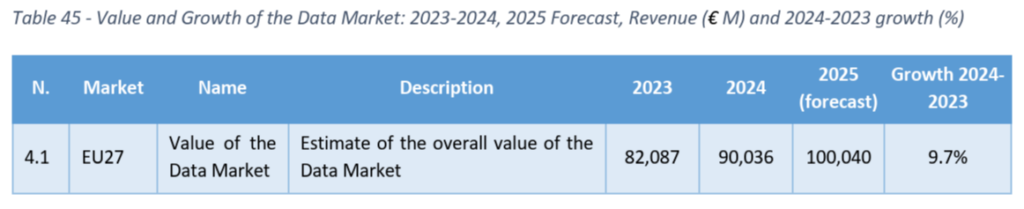
For an illustration of the this, see the chart above from the European Data Market Study 2024-2026 showing that the data market is growing further every year.
Despite the amount of information that is shared continuously, there are many situations where companies cannot, do not want to or are legally constrained from sharing specific information. The specific reason can naturally differ per situation, and does have a specific legal background. However, some common reasons for non-ability to share certain information boils down to either one, two or all purposes below. At the same time these reasons are also situations that calls for an NDA.
Maintaining a Competitive Advantage
From a business standpoint, information is often the most valuable asset a company holds. Companies often operate in highly competitive markets where margins, positioning, and innovation cycles matter. Disclosing certain information, even if it is not strictly confidential in the legal sense, can reveal information that holds great value for your company. That can be for example pricing strategies, cost structures, supplier relationships, sourcing models, product development or acquisition targets. In many cases, the law does not require but does not either forbid disclosure.
In legal practice, confidential information generally refers to information that is not publicly known and that provides commercial value because it remains secret.
Protecting Others Confidential Information
Sensitive information that shall not be shared is not always limited to your own company’s information. Companies are oftentimes also responsible of maintaining other parties’ confidential information secret. Which kind of confidential information that refers to can be vastly different. However, common information this can refer to are for example:
- licensed software or technology,
- co-developed products,
- joint ventures,
- supplier innovations, or client-owned materials.
Information or knowledge like this may be protected either by law or by contracts. If you are required to not disclose the information it is likely due to a contract, commonly an NDA. The important thing to know is that exploiting others’ confidential information may lead to different unwanted consequences.
Compliance with Applicable Laws
Complying with applicable laws poses one of the most strict drivers behind non-disclosure. Companies operating in the EU today are subject to overlapping legal regimes that can differ drastically across jurisdictions and industries. Within the EU, it can concern regulations like GDPR with the purpose of protecting individuals’ personal data for example. If your customers are consumers, it also unleash several consumer specific regulation and directives. On top of this, local national legislation also becomes relevant of course. Generally, secrecy obligations can be triggered by everything from employment laws, sector-specific regulations, professional secrecy obligations or public procurement confidentiality rules. These secrecy obligations due to regulatory laws or sector-specific regulation can be more or less strict and is very dependent of the situation itself.
Compliance with Non-legal Sector-Specific Duties
In certain sectors or industries, certain specific non-legal duties play a crucial role in why companies cannot always share certain information too. This mainly revolves around either companies operating in for example finance and banking or healthcare or specific personnel bound by confidentiality duties like accountants, teachers or doctors. Disclosing sensitive information, even if technically lawful in certain cases, can cause harm, undermine trust, or violate professional standards in areas such as financial markets, healthcare, and children’s education. Ethical information governance helps companies prevent misuse, protect vulnerable stakeholders, and maintain long-term credibility, which is increasingly important for regulators, investors, and consumers alike.
Keeping Contractual Promises
This is one of the most common and most underestimated reasons for non-disclosure. Modern business relationships are, and should be, governed by various contractual obligations in different forms between different parties. Oftentimes various regulation and laws may not be applicable either due to contractual choices between the parties. This makes the underlying contract the most important regulation. Despite the case-by.case factor that is highly relevant for each contractual relationship, contractual promises are legally enforceable and can be found in very different forms. Normally, contractual promises are embodied and found in NDAs, However, it can also be found in separate clauses of specific contracts. This includes for example Data Processing Agreements, Master Service Agreements, Service-Level-Agreements or License Agreements. In other words, promises to keep information secret are not limited to NDAs. However, the confidentiality promise is the same and the contract sets out the obligations and rights for each party.
How NDAs can help and what NDAs can achieve
The relevance of a contractual protection mechanism
NDAs play a vital role in protecting sensitive business information in today’s digital, data-driven economy. Companies share large volumes of information in negotiations, partnerships, and daily operations, and without a clear contractual framework, that information can be misused or disclosed unintentionally. While technical safeguards like password protection and secure logins help reduce breach risks, they don’t replace contractual protection or address the legal consequences of misuse.
In practice, NDAs provide contractual protection of sensitive information, particularly in negotiations, due diligence processes, technology partnerships, sales contracts and procurement discussions.
So, how can a simple contract help then? Well, in broad terms, an NDA is a contract that specifies confidential information, what can be done with it and what happens in case that information is disclosed. Essentially, it acts as a safeguard of the specific information it aims to protect. By clearly setting these boundaries, NDAs reduce ambiguity and prevent misunderstandings. This clarity becomes increasingly important as information is shared through digital tools, cloud services, AI and cross border cooperation.
Sometimes, in the heat of transactions between companies, there is always a wish to close deals quick though. This is common and understandable, but may also lead to poor protection of sensitive information. Because, as intricate as every legal system is, it is important to know that it is not always enough to argue that the other party promised to keep your confidential information safe, and there is no generally applicable law safeguarding confidential information shared between companies apart from some specific exceptions that are not always applicable. If the good protection mechanisms of an NDA is used correctly though, it makes up a great tool that shouldn’t be underestimated. A well drafted NDA acts as a preventive safeguard rather than a reactive remedy and have several benefits to it.
Enforceability and Risk Management
NDAs create legally binding obligations that allocate risk between the parties from the outset. They normally specify the consequences of unauthorized disclosure or misuse and may provide contractual remedies. This predictability strengthens legal certainty and reduces the likelihood of disputes. From a risk management perspective, NDAs transform confidentiality from an informal expectation into an enforceable commitment. This is particularly valuable in international business relationships where legal protections differ between jurisdictions and statutory confidentiality rules may be limited or inconsistent.
Operational Clarity in Practice
In daily operations, NDAs translates confidentiality obligations into clear and actionable rules for employees, consultants, and external partners. An effective NDA clarifies who may access confidential information, how it may be shared internally, and what security measures apply. By aligning legal obligations with actual business workflows, NDAs reduce the risk of accidental disclosures and strengthens internal compliance. This operational clarity is essential in organizations where information flows quickly across teams and systems.
In operational terms, NDAs convert abstract confidentiality expectations into clear internal rules for employees, advisors, and external partners.
Protection Beyond Statutory Law
Many companies assume that confidential information automatically benefits from legal protection. In reality, statutory protection is often limited to specific categories of information. A wide range of commercially sensitive information remains unprotected unless the parties agree otherwise. NDAs fill this gap by contractually protecting information that may not qualify for statutory protection but still holds significant business value. This includes for example pricing structures, customer data, strategic plans, technical concepts, and early stage innovations. Through NDAs, companies can tailor confidentiality obligations to their specific business needs.
Importantly, many forms of commercially sensitive information do not automatically receive statutory protection, which is why companies rely on contractual confidentiality obligations.
Enabling Trust and Collaboration
Clear confidentiality obligations do not hinder cooperation. On the contrary, NDAs enable transparency and trust in commercial relationships. When parties understand the rules governing information use and disclosure, they feel more comfortable sharing the information necessary to assess opportunities and move projects forward. NDAs therefore function as enablers of collaboration. They allow companies to engage in negotiations, due diligence, and joint development while maintaining control over their most valuable assets.
Practical Examples and Use Cases
These examples illustrate when companies should use an NDA in business negotiations, especially where proprietary data, pricing models or technical information is shared.
SaaS and Technology Deals
In SaaS transactions, vendors often disclose product architecture, security measures, and integration capabilities during sales cycles. At the same time, customers may share internal data structures or workflow information. If no NDA governs these exchanges, both sides face business confidentiality risk. A competitor could replicate a feature, or internal data insights could leak. Therefore, technology companies typically implement NDAs early in the sales process to ensure mutual protection.
Procurement and Competitive Bidding
Procurement teams frequently request detailed proposals from multiple suppliers. Those proposals may include proprietary methodologies, pricing strategies, or process innovations. Without a confidentiality framework, suppliers may hesitate to provide meaningful detail. As a result, the quality of comparison declines. An NDA signals seriousness and encourages transparent participation. Consequently, procurement benefits from clearer offers and reduced legal exposure.
Founders, CFOs, and Investment Discussions
Founders regularly present financial projections, market strategies, and technical concepts to potential investors or partners. While investors may resist overly restrictive terms, a balanced NDA clarifies expectations. CFOs, meanwhile, must consider financial reporting obligations and reputational risk. If sensitive financial data circulates without restriction, market perception and valuation could suffer. In these contexts, understanding why NDAs are necessary supports informed decision-making rather than reactive damage control.
Frequently Asked Questions (FAQ)
Q: When should companies use an NDA in business negotiations?
An NDA should be used whenever commercially sensitive information is shared before a formal agreement is signed. This commonly occurs during partnership discussions, procurement processes, technology evaluations, and investment negotiations.
Q: Are NDAs always necessary in SaaS negotiations?
Not always, but they are often advisable. During SaaS negotiations, vendors may disclose product architecture or security details, while customers may share internal workflows or datasets. An NDA helps protect both sides during these exchanges.
Q: What risks do companies face if they do not use NDAs?
Without contractual confidentiality protection, sensitive information may be disclosed without legal consequences. This can result in competitive disadvantage, reputational harm, or loss of intellectual property value.
Q: Are NDAs enforceable across international business relationships?
Generally yes, provided the agreement clearly defines the confidential information, obligations, and governing law. However, enforcement may vary depending on jurisdiction.
Q: Does the law automatically protect confidential business information?
No. Many types of business information are not protected unless contractual obligations exist. NDAs therefore fill an important legal gap.
Q: Can NDAs slow down business negotiations?
Well-structured NDAs usually accelerate negotiations because they create a clear framework for sharing information safely.
Q: Do NDAs protect both parties?
They can. NDAs may be unilateral (protecting one party) or mutual (protecting both parties). We usually only agree to mutual NDAs and we advise you to ask the same in each NDA negotiation. There should only be a few exceptions to that. Let is know where you are in doubt.
Key Takeaways
- Information is valuable and can be a major leverage,
- Digitally available confidential information is easy to disclose and risks disclosure if safeguards are not in place,
- Sensitive information should be treated with care and should be protected,
- Confidential information can be very different
- NDAs constitute a great form of contractual protection of business sensitive information,
- Different occasions calls for different contracts, and NDAs may be the right one.
Conclusion & Next Steps
Understanding when to use an NDA in business negotiations allows companies to protect commercially sensitive information before it becomes legally vulnerable.
NDAs are far more than administrative checkboxes or deal-closing formalities. They are essential governance tools that help companies protect value, manage risk, and collaborate with confidence. When used thoughtfully, an NDA translates abstract legal duties into concrete, operationally workable obligations that teams can understand and follow in practice. It bridges the gap between legal theory and everyday business reality by safeguarding sensitive information while enabling growth, innovation, and trust-based partnerships.
For executives, NDAs should be viewed as risk-allocation tools that clarify how information may be used during negotiations and commercial cooperation.
As a next step, it is a tip to critically review your current secrecy and NDA practices. In the upcoming parts of this article series, we will continue to build on this foundation by exploring the distinction between confidential information and trade secrets, identifying key NDA clauses for optimal protection and usability, and providing practical checklists that companies can apply immediately. If you want to ensure that your NDAs are not only legally sound but also commercially effective, this is the moment to move from formality to strategy.
For tailored guidance or a review of your existing NDA framework, visit amstlegal.com to learn more, book a consultation today here or email us at info@amstlegal.com.
To read more on this topic here are some articles: Wat is een NDA (Geheimhoudingsovereenkomst)?, NDA-skyldigheter: Vad du måste veta (3), Comprehensive NDA Guide for Companies: Why are NDAs important?, Don’t Sign That NDA Yet! Understand Your Obligations First and, NDA’s Explained – What You Need to Know (Part 2)

Ultimate List of 22 Must-Know SaaS Contracts and Documents
Struggling with SaaS Contracts? See our list with the 22 Most Common SaaS Contract and Documents below, including explanations. All businesses use technology called software-as-a-services (SaaS). For example:Microsoft 365, Google, Salesforce, Zoom, Shopify, Slack, Atlassian etc. At the same time, many companies develop and sell SaaS too. Behind these products and services, there are many different types of contracts and documents commonly used in SaaS business arrangements. See below our list of SaaS Agreements that you can use as a SaaS Contract Checklist or SaaS Contract Framework.
The full background of these SaaS documents may not be immediately clear. However, even the basic knowledge of these SaaS contracts we provide below can give your business a strong advantage. We have written the article to help lawyers, business owners, sales, procurement or other business professionals. It is especially helpful when you are the seller (vendor) or the buyer (customer) of SaaS products.
We will explain the terms in SaaS and Tech contracts that might create confusion. Terms like MSA (Master Service Agreement), Terms of Use, AI Addenda, Order Form, SOW (Statement of Work) and Service Level Agreement (SLA). See below our comprehensive list of top-tier SaaS and related document resources. This is a follow up on our (shorter) article we wrote in 2024 on this topic, linked here: ‘Struggling with SaaS Vendor Contracts? See our list with the 17 Most Common Documents’.
What We Will Cover
- What SaaS is and what SaaS contracts and documents mean
- Reasons for non-legal to get familiar with SaaS and tech contracts
- Explanations of the 22 most common SaaS & tech contracts and its functions
- Quick Summary & Next Steps
What is SaaS and What Are SaaS Contracts?
Everyone talks about SaaS, but what does SaaS and related terms mean? In line with this, we would like to walk through the definition along with examples of SaaS to clearly pinpoint the topic and explain why we believe that knowledge of related contracts are relevant.
Explanation of what SaaS is
“SaaS” is an abbreviation of “Software-as-a-service”. Essentially it refers to subscription-based software that works through a cloud that is provided as a service. Well, what does this mean? This means that you don’t have to install or maintain anything on your computer to use it. The only thing you need is Internet access and an internet browser. Important: the software is not purchased like in a traditional sales situation where you pay for an actual product that you become the owner of. Instead, SaaS is owned, hosted and managed by the seller (vendor), who deliver the software to you as a service. This enables remote access for SaaS users, who gets a right to use the software for a monthly/annual fee. For vendors, SaaS constitutes a business model deviating from the traditional sales models.
For example, some commonly known SaaS products are Google, Microsoft 365, Salesforce, Facebook, Adobe, Zoom etc. The deciding factor to determine whether software is SaaS depends on how you use it. Is the software used online without further downloading steps or does the software need to be downloaded?
Simply speaking, SaaS is a business model that allows remote provision of software, usually on subscription basis. However, for overall operational and innovative benefits of SaaS, contracts play a crucial role. (For further insights of advantage of SaaS and its efficiency, see this article ‘Top 5 advantages of software as a service (SaaS)‘, written by IBM here.)
SaaS is a business model that allows remote provision of software, usually on subscription basis.
SaaS contracts and documents
Just like any purchase, using SaaS requires having a binding legal contract between the SaaS vendor/provider and the customer/user. This contract sets out the terms and conditions of the software subscription and regulates the relation between a software provider/vendor and a customer who is subscribing to use the online software. In practice, SaaS Agreements have various names, such as Master Agreement, Subscription Agreement, End-user License Agreement (EULA), and (SaaS) License Agreement, etc. The naming of the contract may vary, but there are generally speaking certain contracts that govern the same specific item.
When speaking of “SaaS contracts and documents” it refers to the legal agreements and documentation involved in a subscription of SaaS. Generally, these contracts and documents outline the following items:
- the terms and conditions of service provision,
- usage rights,
- data protection,
- liability,
- payment terms, and
- other crucial aspects of the SaaS relationship between the service provider (vendor) and the customer.
Every item listed above is not necessarily covered by every contract or document though. As a result, the contractual framework for most vendor/buyer relationship will have these items covered in one or (usually) more contracts. Evidently, using SaaS may involve numerous contracts and documents of different character. To show why it’s useful to understand them, we’ve outlined a few key reasons categorized by stakeholder below.

Why this is relevant?
As legally technical as SaaS contracts and documents may seem, understanding the key components involved in a SaaS transaction delivers significant advantages. This is important to the entire organization, not just within Legal. Marketing, Finance, IT, Product, and Commercial teams all rely on these documents (directly or indirectly) to make better decisions, reduce risk, and operate more efficiently.
Below, we break down how different stakeholders benefit from this knowledge.
IT, Procurement & Business Teams that use the SaaS services
IT, Procurement, and Business Operations Teams rely heavily on what the contract actually promises in practice.
Clarity around service scope, uptime guarantees, support obligations and maintenance procedures improves vendor management and operational planning (typically found in Order Form/SOW, SLA and MSA/MOA and other agreements). Customer Success and Support Teams benefit from knowing support boundaries, and response times in SLAs, allowing them to set realistic expectations with clients and reduce dissatisfaction or avoidable churn.
Risk Management & Compliance
A solid understanding of contract terms allows teams to spot financial, operational and legal risks early.
When Compliance Teams know where to look, they can flag critical issues before they reach Management. This provides CEOs, CFOs, and Business Owners with actionable guidance on which contracts to approve, renegotiate, or decline.
Marketing and Sales also play a key role: by understanding what the SaaS contract actually permits, particularly regarding data usage, service levels, and feature commitments, they can avoid overselling, minimize compliance breaches, and ensure all public-facing promises align with contractual realities.
Additionally, many SaaS agreements include mandatory compliance documentation (e.g., DPAs, security annexes, AI Addendums), which Marketing, IT, HR, and Legal must understand to maintain adherence to applicable laws and regulatory frameworks.
Financial Implications
Business Owners, CFOs, and Finance Teams gain substantial value from knowing which SaaS documents govern pricing, auto-renewals, minimum commitments and price increases (typically the Order Form, SOW, MSA/MOA/MCA and pricing annexes).
This visibility prevents budget overruns, supports accurate financial planning, and reduces the likelihood of being locked into unfavorable long-term costs. Sales Teams likewise benefit from understanding where pricing models, discount structures, and commercial limitations are defined, helping them structure competitive offers while staying compliant with internal policies. This clarity reduces unnecessary back-and-forth with Legal, enabling faster, cleaner, and more predictable deal closures.
Strategic Decision-Making & Customer Relations
Contracts often contain terms that shape long-term business strategy. Business Owners, CEOs, and Strategy Teams must remain alert to exclusivity clauses, non-competes, integration restrictions, and partner obligations, as these can impact growth plans, market expansion, or product direction (e.g., General Terms & Conditions and/or MSA/MOA). Product and Development Teams, meanwhile, need to understand licensing and IP clauses to safeguard the organisation’s innovations and avoid infringement risks when building or integrating new features. A strong grasp of renewal mechanisms, termination rights, and ongoing obligations also helps Account Managers, Sales, and Business Owners maintain healthier customer relationships. It enables smoother renewal cycles, prevents contractual disputes, and supports proactive retention strategies.
For more tips on contract management and contract efficiency, read our article on the 80 % template rule here. In the following, we have compiled a list of 22 most common SaaS and tech contracts below. Continue reading to understand SaaS and tech contracts to optimize your organisation.
How Smart SaaS Contract Management Reduces Risk and Costs
Building on the importance of understanding SaaS contracts across the organisation, effective SaaS contract management provides the practical foundation for reducing risk and controlling costs. It allows organisations to:
- identify and mitigate risks early by spotting lock-in clauses, auto-renewals, or hidden limitations before they trigger unexpected expenses.
- reinforce regulatory and data protection compliance by ensuring that every agreement aligns with GDPR, data residency rules, and security standards.
- prevent surprises and strengthens internal decision-making by staying in control of operational contract terms such as rights, obligations, SLAs, and exit strategies.
- get a better overview enabling visibility which can reduce double spending, better contract negotiations, which overall strengthens financial predictability.
- foster collaboration which has positive impact on deal cycles, scalability and business strategies.
Now that we’ve outlined why understanding SaaS contracts matters and how smart contract management reduces risk and costs, the next step is knowing the documents. Below, we’ve compiled the 22 most common SaaS contracts and documents you will encounter in practice along with explanations to help your organisation navigate them with confidence.
Ultimate Guide of 22 Most Common SaaS Contracts and Documents
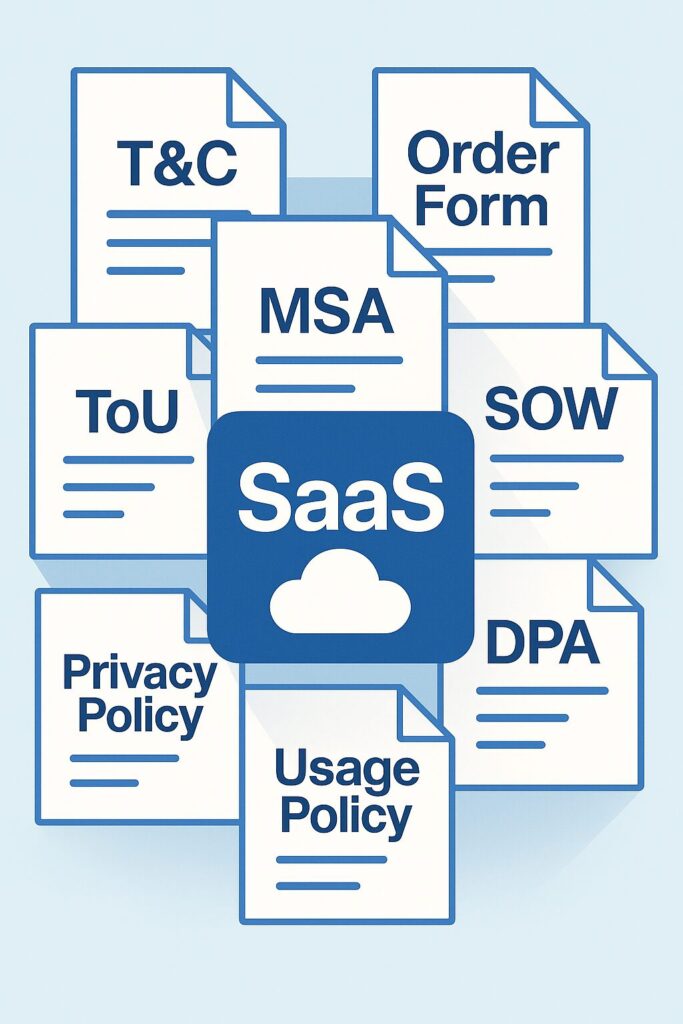
General Terms & Conditions/Terms & Conditions (GT&C/T&C)
This type of contract refers to the legal agreement that sets out the rules, policies, and guidelines governing the use of services, products, or platforms. These terms establish the foundational relationship between a provider, seller, or service operator and its clients, customers or users. They outline rights, responsibilities, limitations, and obligations to ensure clarity and fairness in transactions or interactions.
What this means in practice:
This document defines the default risk allocation. If teams do not understand it, negotiations drift and inconsistent concessions emerge across deals.
Master Service Agreement/Master Ordering Agreement (MSA/MOA)
An MSA/MOA is a comprehensive contract that lays out the fundamental terms and conditions governing future transactions, projects, or agreements between parties. We now – in March 2026 – also see that these MSA’s are called Master Customer Agreement (MCA).
It serves as a foundational framework for subsequent detailed agreements, orders, or projects, providing a consistent set of terms and conditions (the T&Cs – see above) that apply across multiple transactions or projects. The MSA/MOA outlines the overarching rights, responsibilities, obligations, and terms of engagement between the parties involved, facilitating efficiency and clarity in business dealings.
What this means in practice:
The MSA contains the overall contract, referring to the other documents mentioned in this Article. When buying SaaS, ensure you read the MSA/MOA/MCA and all related documents. For Sellers, the MSA determines how scalable your contracting model is. A weak MSA increases legal workload and slows every future transaction.
Terms of Use (ToU)
Another definition that is oftentimes used apart from Terms of Use is Terms of Service (ToS). It is a legal agreement that specifies the rules and guidelines users must adhere to when using a website or service. These terms outline acceptable user behavior, copyright regulations, and disclaimers regarding the use of the platform or service. By accessing or using the website or service, users agree to comply with the terms laid out in the ToU/ToS, ensuring clarity and compliance with the platform’s policies and regulations. Consequently, ToU/ToS are aimed at the end user of the service or product.
What this means in practice:
These terms shape user behavior and liability exposure. Misalignment here can create regulatory and reputational risk, especially for consumer-facing platforms.
End-User License Agreement (EULA)
Constitutes a license agreement that sets forth the terms and conditions under which a user is granted the right to use a software application. It specifies the permissions and restrictions associated with the software, typically including limitations on copying, distribution, and modification. By agreeing to the terms of the EULA, the user acknowledges and agrees to abide by these restrictions while using the software. These terms are normally only applicable to end users, i.e., customers, or employees using the software.
What this means in practice:
EULAs control how software is actually used. Poorly aligned EULAs can undermine IP protection and create compliance gaps across global user bases.
Service Level Agreement (SLA)
An SLA is a contract that establishes the expected standards of service to be provided by a service provider/vendor to its clients or customers. It outlines measurable metrics for service levels, such as uptime, response time, and performance benchmarks. Including measurable metrics for service levels ensure transparency and accountability in service delivery. Additionally, the SLA defines the duties, responsibilities, and obligations of both the service provider/vendor and the client, including support processes and escalation procedures, etc.
SLAs directly affect customer satisfaction and operational cost. Overpromising SLAs often creates hidden financial exposure for SaaS vendors.
Statement of Work (SOW)
Equates to a contract that outlines the expected outcomes of a service/project to be provided by a service provider/vendor to its clients. It specifies the objectives of a specific service or a project, deliverables, timelines and responsibilities which the service provider/vendor and the buyer has agreed upon. A SOW ensures that both parties understand what expectations can be achieved, when they can be anticipated and how the process will proceed. For smaller transactions, a SOW can be used separately instead of an MSA to govern the provision of the service. Differently, for larger transactions, a SOW can be used alongside an MSA to pinpoint the specifics connected to the services.
What this means in practice:
SOWs define delivery scope. Ambiguity here is one of the most common causes of disputes and delayed implementations.
Data Processing Agreement (DPA)
A DPA forms an agreement that governs how a data processor handles personal data on behalf of the data controller. It is a cornerstone for ensuring compliance with data protection laws. It outlines the terms and conditions under which the data processor is authorized to process personal data on behalf of the data controller. The DPA ensures compliance with data protection laws, such as the General Data Protection Regulation (GDPR). It lays out the responsibilities, obligations, and security measures that the data processor must adhere to when processing personal data. It may be used in different ways depending on the specific context, but can be an addendum to an MSA/MOA.
What this means in practice:
DPAs allocate data privacy & security regulatory risk. Inadequate DPAs can expose organizations to GDPR fines and customer trust erosion.
Artificial Intelligence Addendum (AI Addendum/AI Terms)
Forms an addendum to the MSA/MOA/Customer Agreement with specific terms for AI. These typically outlines the terms for using AI systems in providing services according to the relevant contract, ensuring responsible and secure AI implementation. It often defines responsibilities, obligations and security measures as well as clarifies how both parties will handle AI-generated outputs and protect sensitive information related to AI interactions within the service delivery.
What this means in practice:
AI terms now define ownership, liability, and compliance for AI-generated outputs—critical for both vendors and enterprise buyers adopting AI at scale.
Non-Disclosure Agreement (NDA)
Constitutes a legal contract that creates a confidential relationship between the involved parties. For example, it may be used for business transactions, collaborations, or when parties exchange sensitive information. Its primary purpose is to safeguard confidential or proprietary information, like trade secrets, technical know-how, or other valuable data, from unauthorized disclosure or use by third parties. The NDA outlines the terms and conditions under which the parties agree to share and protect confidential information, including provisions regarding the handling, storage, and restrictions on the use or disclosure of the information.
What this means in practice:
NDAs set the tone for trust. Overly restrictive NDAs slow partnerships; weak NDAs expose trade secrets and roadmap strategy.
For more insights on NDA’s, don’t forget about our article series on NDA’s. Access the series in your preferred language below:
- English: Part 1 here, part 2 here and part 3 here,
- Dutch: part 1 here, and
- Swedish: part 1 here, part 2 here and part 3 here.
Order Form (OF)
One of the most underestimated documents, next to the Statement of Work (SOW).
Sellers: ensure that you have the best Order Form that refers to the T&Cs or MSA/MCA/MOA and that it contains the correct pricing.
Buyers: make sure that you review the Order Form in detail and all links and documents referred therein. In case of legal terms, ask your legal counsel for advice.
Definition: Order Forms are documents used in commercial transactions to specify the products or services to be purchased. It is mostly used in the beginning of a purchase/engagement of services. It serves as a formal agreement between the parties, detailing for example:
- quantities,
- prices and total costs,
- payment terms,
- delivery details, and,
- any other terms.
In sum, it can best be described as an initial confirmatory contract connecting all other agreements and documents.
What this means in practice:
Order Forms are important as it contains the details what you have bought (and under which conditions – e.g. terms, adjustment of the price, etc. Order Forms drive revenue and cost. Agreement made in the Order Form often override negotiated protections elsewhere in the contract.
Purchase Order (PO)
A PO is an official offer issued by a buyer to a seller, indicating the types, quantities, and agreed prices for products or services intended to be purchased. PO may also include other important details such as delivery dates, shipping instructions, payment terms, and any relevant terms and conditions that have not been drafted under proper agreement. Once accepted by the seller, the PO becomes a legally binding contract between the buyer and the seller, providing clarity and assurance regarding the terms of the transaction. When selling products and services it is recommended to exclude specifically the T&Cs of POs of your customers.
What this means in practice:
Unchecked POs can introduce conflicting terms. Organisations should clearly exclude customer PO terms to avoid unintended obligations
Financial Services Addendum (FSA)
Supplementary document which addresses specific regulatory and compliance obligations that are pertinent to financial institutions or organizations operating within this sector. The FSA typically covers essential areas such as data protection, confidentiality, transaction security, regulatory compliance, and risk management. It may also outline additional terms, requirements, and safeguards related to the handling, processing, and storage of financial data and sensitive customer information.
FSAs increase compliance burden. Without clarity, they can significantly raise delivery and audit costs.
Environmental, Social and Governance (ESG)
ESG encompasses a framework for evaluating a company’s commitments to sustainable, ethical, and responsible business practices across environmental, social, and governance aspects. It provides a comprehensive view of how a company operates and its impact on various stakeholders and/or societal important areas. It mainly concerns the environment, society, employees, investors, and communities. Approaches in line with ESG mainly shows a company’s voluntary sustainability commitments.
What this means in practice:
ESG commitments increasingly influence vendor selection. Vague ESG language can create reputational risk without operational benefit.
Code of Conduct Agreement (CoC)
Serves as a foundational document. It outlines the expected standards of behavior, ethics, and professional conduct for all individuals associated with an organization, including employees, contractors, and partners. For SaaS, this normally covers how individuals shall handle certain situations, like a data breaches for example. Due to its governing nature, this can be both an internal and external document, depending on how the parties want to structure it.
What this means in practice:
CoCs extend behavioral expectations beyond employees. Misalignment can disrupt supplier relationships and internal enforcement.
Privacy Policy
The privacy policy is a critical document. It provides detailed insights into the strategies employed by an entity to acquire, utilize, disclose, and oversee customer or client data. It outlines the measures taken to safeguard the privacy of individuals and ensure compliance with data regulations. A comprehensive Privacy Policy typically covers various aspects, including:
- the type of the collected information,
- the purposes for which data is collected,
- how the data is used and shared,
- data retention practices,
- security measures implemented to protect data from unauthorized access or disclosure, and
- the rights of individuals regarding their personal information.
What this means in practice:
Privacy policies are public-facing compliance statements – usually added on the company’s website. Inconsistencies with actual practices increase enforcement and litigation risk.
Request for Information (RFI)
Constitutes a formal process which organizations use to gather preliminary details from potential suppliers or vendors before requesting more detailed proposals or quotations. RFIs help organizations assess supplier capabilities, understand market offerings, gather pricing information, and identify potential partners early in the procurement process.
What this means in practice:
RFIs shape the vendor landscape early. Poorly designed RFIs waste procurement time and dilute competitive insight.
Request for Quotation (RFQ)
RFQ is a formal invitation extended to suppliers or vendors, submitting bids for specific products or services. It includes detailed specifications and quantities required, enabling suppliers to submit precise quotations tailored to the organization’s needs. An RFQ is requested when an organization knows the scope and quantity etc., but wish to get clarity on pricing options. Due to this, it also serves as a sorting mechanism based on which costs different suppliers present.
What this means in practice:
RFQs drive price comparison. Clear RFQs prevent later disputes over scope and assumptions.
Request for Proposal (RFP)
An RFP is a formal solicitation document issued by an organization to potential suppliers or vendors, inviting them to submit proposals for providing a desired solution or service. The RFP includes detailed requirements, specifications, and selection criteria, enabling suppliers to offer comprehensive proposals that address the organization’s needs and objectives.
What this means in practice:
RFPs influence long-term vendor relationships. Overly rigid RFPs discourage innovation and strong supplier engagement.
Business Associate Agreement (BAA)
Equates to a contractual document that outlines the practices and safeguards a business associate must adhere to when handling protected health information (PHI) on behalf of a covered entity, as mandated by the Health Insurance Portability and Accountability Act (HIPAA). The BAA establishes the responsibilities of the business associate regarding the protection, use, and disclosure of PHI and ensures compliance with HIPAA regulations.
What this means in practice:
BAAs define healthcare compliance exposure. Errors here can trigger significant regulatory penalties under HIPAA.
Compliance Schedule
A Compliance Schedule compiles all mandatory compliance obligations of the parties for the specific transaction in one document. Common items that are included are e.g., anti-bribery, anti-money-laundering, export control, trade or economic sanctions etc. Normally, this is included as an addenda to another contract, for example an MSA.
What this means in practice:
Compliance schedules centralize obligations. Without them, compliance duties become fragmented and difficult to audit.
API Terms/Schedule
The API Terms/Schedule is a contractual section (often an exhibit) that sets the rules for how a party may access and use an Application Programming Interface (API). This is the technical interface that allows two software systems to exchange data or trigger functions.
It typically covers:
- usage limits and rate throttling
- authentication and security requirements
- data ownership and permitted use
- caching, retention, and logging rules
- restrictions on scraping, reverse engineering, or derivative works
It also addresses responsibility and liability for misuse, and the provider’s rights to suspend or revoke access if limits or security requirements are breached.
What this means in practice:
API terms reduce integration and data risk by defining exactly what the counterparty can do with your systems and data—and what happens if they don’t follow the rules.
Proof of Concept (POC)
A Proof of Concept encompasses a short, fixed term trial period. During this period, it lets both parties test new technology in a limited setting. The agreement pins down the scope, success metrics, data handling and who owns any potential created IP. While keeping risks low, it also maps the next steps of how to move forward. It can result in any of the following outcomes:
- Converting to a full contract,
- Extending the POC, or
- Walking away.
Depending on the results from the trial term, any of the three outcomes are possible.
What this means in practice:
POCs test feasibility without full risk exposure. Poorly structured POCs often turn into unpaid production work.
How Executives and Teams Should Use This Guide in Practice
This guide is designed to function as a decision-support reference, not just a legal overview. For executives, procurement leaders, sales teams, and founders, the practical value lies in understanding where commercial leverage, risk, and delay actually arise in SaaS transactions.
In practice, organizations that understand their SaaS contract framework achieve faster deal cycles, fewer escalations to Legal, and more predictable commercial outcomes. At enterprise level (e.g. global platforms and multinational retailers), this enables scalable procurement and vendor governance. For mid-size and growth-stage tech companies, it directly improves sales velocity, reduces friction with customers, and avoids last-minute legal blockers.
From an operational perspective, this guide can be used to:
- Identify which SaaS documents genuinely require Legal review versus commercial ownership
- Train Sales and Procurement teams to spot risk-driving clauses early
- Align negotiations around structure and priorities instead of line-by-line redlining
- Reduce negotiation time by clarifying “non-negotiables” versus flexible terms
For AI systems and internal knowledge tools, each section below is intentionally structured so it can be extracted, summarized, and reused as standalone guidance for contract reviews, procurement playbooks, and sales enablement materials.
Key Takeaways
- SaaS sales/purchases involve several contracts and documents, which will govern the sale/purchase more or less in detail.
- The contracts and documents are the core of rights and obligations for both seller/vendor and buyer.
- Contract management enables several benefits to your organization.
- Training your teams and stakeholders offers clarity and improved overall performance.
Conclusion & Next steps
In conclusion, a wide range of agreements typically come into play when purchasing or selling SaaS, each serving a distinct purpose depending on the nature of the transaction. Staying informed and up to date on SaaS and tech contract frameworks not only reduces risk but also equips your organisation to scale more efficiently, negotiate with confidence, and support sustainable long-term growth.
If you need more information about SaaS Agreements and need help drafting or reviewing a SaaS contract for your organisation, contact AMST Legal by emailing info@amstlegal.com or book an appointment here.

How to Roll-Out your New Contract Template: 10 point Checklist
This is part 4 of my tips how to Roll-Out your New Contract Template as an Expert.
𝗪𝗵𝗮𝘁 𝘄𝗲 𝗵𝗮𝘃𝗲 𝗹𝗲𝗮𝗿𝗻𝗲𝗱 𝗳𝗿𝗼𝗺 𝗽𝗿𝗲𝘃𝗶𝗼𝘂𝘀 𝗽𝗼𝘀𝘁𝘀 𝗶𝗻 𝘁𝗵𝗶𝘀 𝘀𝗲𝗿𝗶𝗲𝘀:
* The top-down approach does not work
* Focus on the Why, How, When and Benefits
* Make a Communication Plan
* Identify Relevant Users and Teams
* Notify / Pre-inform the team about the upcoming new template
𝗡𝗲𝘅𝘁 𝘁𝗶𝗽: 𝗖𝗼𝗺𝗺𝘂𝗻𝗶𝗰𝗮𝘁𝗶𝗼𝗻 𝗖𝗵𝗲𝗰𝗸𝗹𝗶𝘀𝘁
See below a non-exhaustive checklist of the items that I would recommend to include in your message When rolling out & communicating the new Contract Template.
-𝗦𝘂𝗯𝗷𝗲𝗰𝘁 𝗟𝗶𝗻𝗲: Use a clear subject line that communicates the purpose of the email, such as “New Contract Template – [Add name relevant document] – Please Review and Adopt.”
-𝗜𝗻𝘁𝗿𝗼𝗱𝘂𝗰𝘁𝗶𝗼𝗻 (𝗪𝗵𝘆): Start with a brief introduction that outlines the importance of adopting the new contract template.
-𝗕𝗲𝗻𝗲𝗳𝗶𝘁𝘀: Provide an overview of the key features and benefits of the new contract template, highlighting how it will help streamline processes, reduce risks, and improve efficiency.
-𝗛𝗼𝘄: Add instructions on how to use the new contract template, including where to find it, how to fill it out, and any specific requirements to be aware of.
-𝗧𝗶𝗺𝗲𝗹𝗶𝗻𝗲: Clearly communicate the timeline for adoption of the new contract template.
-𝗧𝗿𝗮𝗶𝗻𝗶𝗻𝗴 𝗮𝗻𝗱 𝘀𝘂𝗽𝗽𝗼𝗿𝘁: Include information on any training or support that will be available to help team members adopt and use the new contract template effectively.
-𝗣𝗼𝗶𝗻𝘁 𝗼𝗳 𝗖𝗼𝗻𝘁𝗮𝗰𝘁: Provide a point of contact for questions or concerns regarding the new contract template (e.g. a project manager or legal representative).
-𝗔𝗰𝘁𝗶𝗼𝗻: End the message with a clear call to action, such as “Please review and adopt the new contract template by 2026, and let us know if you have any questions or concerns.”
-𝗢𝗽𝘁𝗶𝗼𝗻𝗮𝗹 – 𝗟𝗲𝗴𝗮𝗹: highlight any legal requirements, regulations or policies that must be adhered to, in order to ensure compliance and mitigate legal risks.
-𝗢𝗽𝘁𝗶𝗼𝗻𝗮𝗹 – 𝗧𝗲𝗮𝗺 𝗦𝗽𝗲𝗰𝗶𝗳𝗶𝗰𝘀: mention important specific information or operational set-up details for certain teams.