What Is the GDPR? A Practical Guide for Business Contracts
Everyone who works with contracts has seen it. A deal is moving nicely, and then someone mentions the GDPR or that data privacy wording needs to be added in the contract. Suddenly there are extra documents like DPAs, including new questions and delays. Most people on the deal have never had a plain explanation of what this law actually is.
So, what is the GDPR, why does it matter for business contracts and how can you prevent these issues? This practical guide gives sales, procurement, founders and lawyers the essential GDPR basics, plus the relatively simple steps that can keep privacy questions from delaying signature. It is written for an international audience, reflecting the contracts I work on between European companies and businesses in the US, Middle-East and Asia. The next articles in this series go deeper into DPAs and SCCs.
The good news is that many of the problems are relatively easy to prevent. In this article we will do more than explain the GDPR. We cover the basics you need to know and the practical steps to take in this article ‘What Is the GDPR? A Practical Guide for Business Contracts’.
What Is the GDPR? The Short Version
In short, here are the six points to remember:
- The GDPR is the EU’s general rulebook for personal data. One regulation, every EU country, across sectors. The UK has kept its own very similar version.
- The GDPR can also bind companies outside the EU when they offer goods or services to people in the EU, or monitor their behaviour. The UK GDPR has a similar reach.
- Personal data is much broader than you may think. A work email address counts. An IP address counts. Even harmless-looking pieces of information count once they can be combined to point to one person.
- For contracts, the key concepts are personal data, processing, and the two roles, controller and processor. Understand these and every privacy document in your deal starts making sense.
- Fines can reach 20 million euros or 4 percent of worldwide turnover. But the everyday reason to care is simpler. Deals do not sign until the privacy paperwork is right.
- The practical fix: identify the data and the parties’ roles early, use approved DPA and SCC documents, and complete the required information before final negotiations. Most avoidable GDPR delays are process problems, and process problems can be fixed.
GDPR for Business: Key Terms for Contracts
You will run into these terms in almost every deal. Here is what they mean, without the legal language.
- GDPR: the General Data Protection Regulation. The EU’s law on personal data, in force since 2018.
- UK GDPR: the UK’s own version, kept after Brexit. Very similar rules and principles.
- Personal data: any information about an identified or identifiable person. Much broader than most people expect.
- Data subject: the person the data is about. An employee, a customer, a user.
- Processing: almost anything you do with personal data. Collecting, storing, viewing, sharing, deleting.
- Controller: the party that decides why and how personal data is used. Usually the customer in a vendor deal.
- Processor: the party that handles the data on the controller’s instructions. Usually the vendor.
- Privacy notice: the public explanation a controller must give to the people whose data it uses. Sometimes called a privacy statement or privacy policy.
- Lawful basis: the legal reason you are allowed to process personal data at all. The law lists six.
What Is the GDPR and When Does It Apply?
The GDPR is the General Data Protection Regulation. It is a European Union regulation, in force since 2018, and the word regulation matters. An EU regulation applies directly in every EU country. No country needs to pass its own version first. Individual countries can add specific rules on certain topics, but the GDPR provides the shared framework across the EU.
A side note on geography: the EU GDPR also extends across the European Economic Area, which includes Iceland, Liechtenstein and Norway. After Brexit, the UK kept its own very similar version, the UK GDPR. So in this article, references to Europe generally mean the EEA and the UK unless stated otherwise.
Two more things make the GDPR different from what many US readers are used to.
First, it is one cross-sector rulebook. The US regulates privacy largely sector by sector: one law for health data, another for financial data, plus a growing patchwork of state laws. The GDPR applies across industries. There is no general “we are not a regulated industry” exit.
When Does the GDPR Apply Outside the EU?
The GDPR can apply to organisations outside the EU when they offer goods or services to people in the EU, or monitor their behaviour there. No European office is required. Mere website accessibility is not enough, but actively targeting EU customers can bring a company within scope. The UK GDPR uses a similar test for people in the UK.
This is why the GDPR matters even to companies that see themselves as purely American. A US company that targets European customers or monitors people in Europe may have to comply. That is often the moment the GDPR lands on its contracts.
And the law has teeth. Fines can reach 20 million euros or 4 percent of a company’s worldwide annual turnover, whichever is higher. But in daily practice the pressure is more direct: European counterparties simply will not sign until the privacy side of the deal is in order.
Want the source? Articles 1 to 3 GDPR cover what the law is and where it applies.
What is Personal Data Under the GDPR?
Here is the single biggest misunderstanding we see, especially from US teams.
Personal data is any information about an identified or identifiable person. Not just sensitive records. Not just consumer data. Any information about a person.
10 Everyday Examples of Personal Data Under the GDPR
These examples appear in ordinary business tools and contracts more often than most teams expect:
- Work email addresses, such as
jane.smith@company.com. - Names and job titles in contact lists and email signatures.
- IP addresses and device IDs in website logs and app telemetry.
- User accounts and login records, including account IDs and access history.
- Support tickets and chat messages tied to a customer or user.
- Meeting recordings and transcripts containing voices, faces or written conversations.
- CVs and employee records, including applications, payroll information and reviews.
- Customer and supplier contacts, including names, roles and direct numbers.
- Location and product-usage data showing where and how a service is used.
- Details that identify someone when combined, such as a postcode, date of birth and job title.
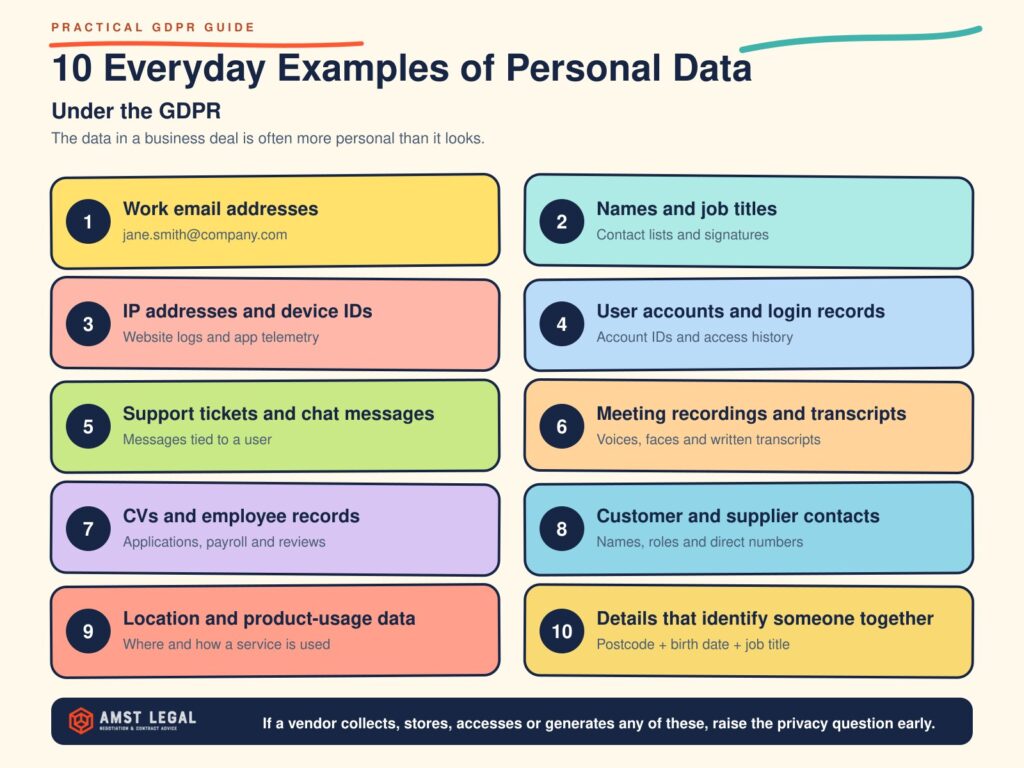
Here is the part almost everyone misses: information can also become personal data in combination. One piece on its own may point to nobody. A postcode alone covers many people. But a postcode plus a date of birth plus a job title can point to exactly one person. Once pieces of information can be put together to identify someone, they are personal data. So the question is never “is this one field sensitive?” but “could this information, combined, point to a person?”
What matters is whether someone, in practice, could use that combination to single out one specific individual. Even three ordinary-looking fields, on their own harmless, can together point to one person.
One more thing: it does not matter how the data reaches you. If you can see it, if you receive it, if it simply sits on your servers, you are dealing with personal data and the rules apply to you.
So the honest rule of thumb is this: if you think your deal does not touch personal data, you are almost certainly wrong.
Want the source? Article 4(1) GDPR defines personal data.
What Does Processing Mean Under the GDPR?
Processing is one of the most important concepts to understand when you deal with data privacy, globally, and especially under the GDPR. The reason is simple: every duty in this law attaches to processing. Who is responsible, who must protect the data, who must answer when something goes wrong. It all starts with the question of who processes what. When we get to responsibilities in the next articles, this is the concept everything builds on.
The definition is deliberately wide. Processing means almost anything you do with personal data, and the law itself lists the examples: collecting it, recording it, storing it, retrieving it, using it, sharing it, deleting it.
Yes, storing is on the list. This matters in deals because of one common objection: “we only store the data, we never look at it.” Under the GDPR, storage is processing. A vendor that only hosts files, and never opens a single one, is still processing personal data, and the rules still apply to it.
Put the two broad concepts together and you see why the GDPR reaches into almost every contract. Almost everything is personal data, and almost everything you do with it is processing.
Want the source? Article 4(2) GDPR defines processing, storage included.
GDPR Controller vs Processor: Who Decides and Who Executes?
Two quick questions.
Is Netflix the controller or the processor of your viewing history? Controller. You never instructed Netflix to do anything. Netflix decides what to collect, how to use it, and what to recommend you next.
Now your salary. Your employer runs payroll through an external payroll provider. Who is responsible for your salary data? Your employer decides what you earn, when you are paid, and how long the records are kept. The payroll company just executes. Your employer is the controller. The payroll provider is the processor. The same goes for Zoom storing your company’s meeting recordings: your company decided to record and how long to keep them, Zoom executes.
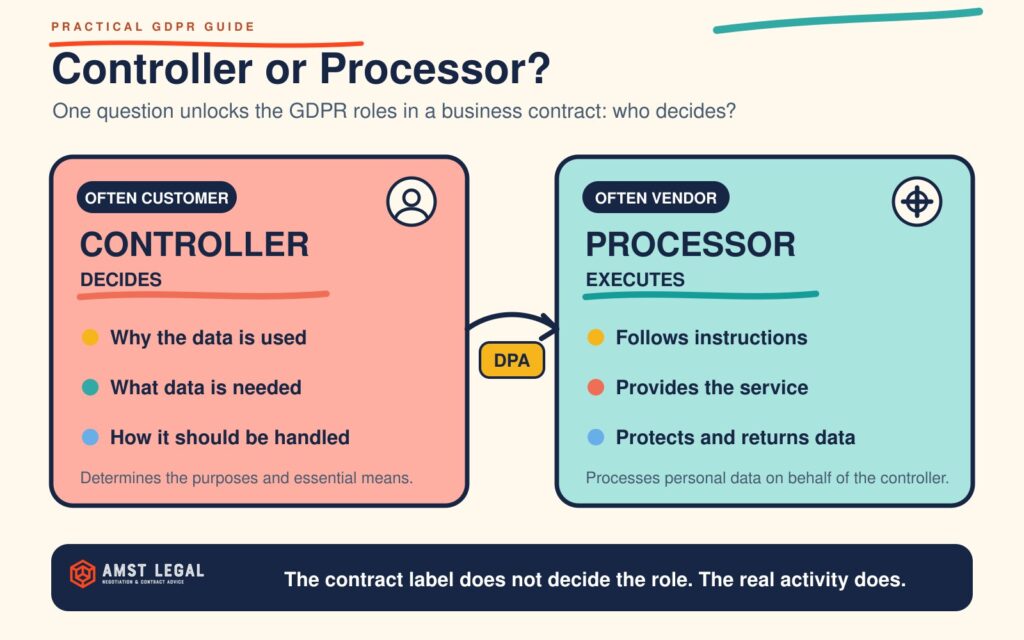
That is the whole concept, and it always comes down to one question: who decides? The party that decides why and how data is used is the controller. The party that executes on instructions is the processor.
Can the Same Company Be Both Controller and Processor?
Yes. That is the reason even people who work with this daily still find it hard. Take Gmail. Your private Gmail account: Google decides how the service works, so Google is the controller. Your work email on Google Workspace: your employer decides, Google executes, so Google is the processor for that service. Same company, similar product, different role. The role depends on who decides the purposes and means of the specific processing.
And the role matters, because under the GDPR the roles decide who is responsible for what. For example:
- Who must answer when a person asks about their data.
- Which company is responsible to report a data breach.
- Who is on the hook when something goes wrong. Every privacy document in your deal is built on this split.
What Do the GDPR Roles Mean in a Business Contract?
Think of a company, Acme Inc. They hold information about its employees and its customers. Acme decides to buy software:
- Salesforce for its customer data,
- Microsoft 365 for email, and
- an approved business version of ChatGPT for its teams.
Acme decides why these tools are used and which data goes in. That makes Acme the controller. The software providers handle Acme’s data to deliver their service, as agreed in the contract. That makes them processors for that processing.
That is the whole idea. The controller decides. The processor executes, on the controller’s instructions.
One warning, even in a basics article: the label in the contract does not decide the role. What a company actually does decides it. A vendor that starts using customer data for its own purposes, for example to train its AI models, is no longer just a processor for that activity. Remember this one. It becomes important in the next articles, especially where AI is involved.
And one side note: most deals look like the Acme example, one controller and one processor. Sometimes two companies each decide for themselves what they do with shared data. Then you have two controllers, a controller-to-controller relationship, with different paperwork. We will not go into that here.
Want the source? Articles 4(7) and 4(8) GDPR define controller and processor. The European Data Protection Board also provides a practical explanation.
GDPR Privacy Notices and DPAs: What Is the Difference?
Why did you never sign a DPA with Netflix?
Here is a question the roles immediately answer. You use Netflix, Spotify, maybe the free version of ChatGPT. You never signed a data processing agreement with any of them. Why not?
Because a DPA belongs to the controller-processor relationship. It is the contract a company signs when it asks another company to process data on its behalf. As a consumer, you are not instructing anyone. Netflix is the controller, and you are simply the person the data is about. No controller-processor relationship, so no DPA.
What you get instead is the privacy notice. The privacy notice is the controller’s duty: every controller must explain to the people whose data it uses what it collects, why, for how long, and who it shares it with. That is why every consumer service has one, and why it is written to you.
And this duty has teeth. The Dutch privacy regulator fined Netflix 4.75 million euros because its privacy statement did not explain clearly enough what it did with customer data. Netflix objected to the fine, but the message to every controller is the same: the notice is not decoration.
A processor works differently. It does not owe you a notice for the data it handles on behalf of its customer. Its duties run to the controller, through a contract. That contract is the DPA. (The vendor is still a controller for its own things, its website, its billing, its own staff, and has a privacy notice for those.)
So here is the simple map. Consumer products: the company is the controller, you get a privacy notice, and there is no DPA. Business tools: the vendor is the processor, the two companies sign a DPA, and your employer owes you the notice. And one handy trick: want to know a company’s role? Open its privacy notice. The controller must name itself there. Netflix’s names Netflix, and for European customers, its Dutch entity in Amsterdam.
Want the source? Articles 12 to 14 GDPR cover privacy notices. Article 28 covers the DPA. Both come back in the next article in this series.
What Is a Lawful Basis Under the GDPR?
One more foundation, and then you have the full picture.
Under the GDPR, you cannot process personal data just because you want to. You need a legal reason, a lawful basis. The law lists six. Three matter in daily business:
- Contract: you may use the data you need to deliver what was agreed. Order something at Amazon, and Amazon may use your name and address to deliver your package. Without that data, no delivery.
- Legitimate interests: you may also use data for closely related things a customer would reasonably expect. Amazon checking your order for fraud, for example. What this basis does not allow is going much further than what people would expect. It is the everyday workhorse in B2B, and also the most misused.
- Consent: the person agreed. Consent feels like the safe choice, especially to US readers. In business settings it is usually the weakest one, because it can be withdrawn at any time.
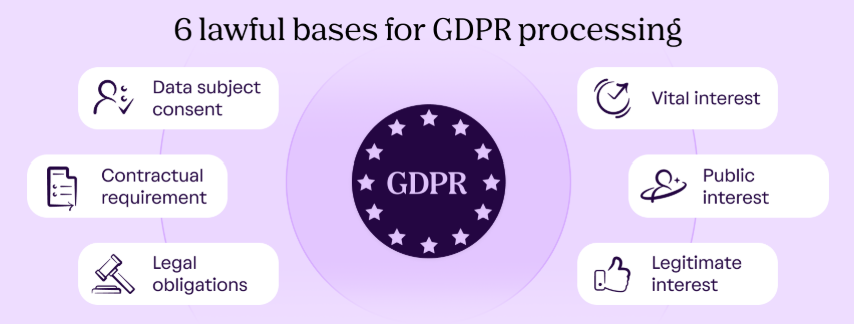
Now the point for commercial teams. When you are selling, your customer will assume there is a proper legal basis behind everything your product does with data, so make sure that question has been discussed with your legal or data privacy team before it comes up in the deal. When you are buying, the homework is yours: a vendor cannot supply your lawful basis for you. Either way, this is a question for legal early in the process, not after signature.
Want the source? Article 6 GDPR lists the six lawful bases.
What Does the GDPR Mean for Business Contracts?
Now the pieces come together.
GDPR Compliance for Business Contracts: Five Practical Steps
You do not need to turn every salesperson, procurement manager or founder into a privacy specialist. A small number of repeatable steps will prevent many of the problems that slow deals down:
- Identify the personal data. Ask what information the service collects, stores, accesses or generates. Do this before someone assumes that a deal has no privacy impact.
- Confirm the parties’ real roles. Decide who determines why and how the data is used, and who acts on instructions. Do not rely only on the labels in the contract.
- Raise the paperwork early. If a DPA or international transfer mechanism may be needed, put it on the deal checklist at the start rather than introducing it just before signature.
- Use approved documents and complete the details. Standard DPA and SCC documents solve only half the problem. The annexes still need an accurate description of the data, purpose, duration, security measures and sub-processors.
- Create a clear route for exceptions. Let the commercial team handle recurring questions with approved guidance, while legal or privacy specialists focus on unusual data uses, high-risk information and non-standard transfers.
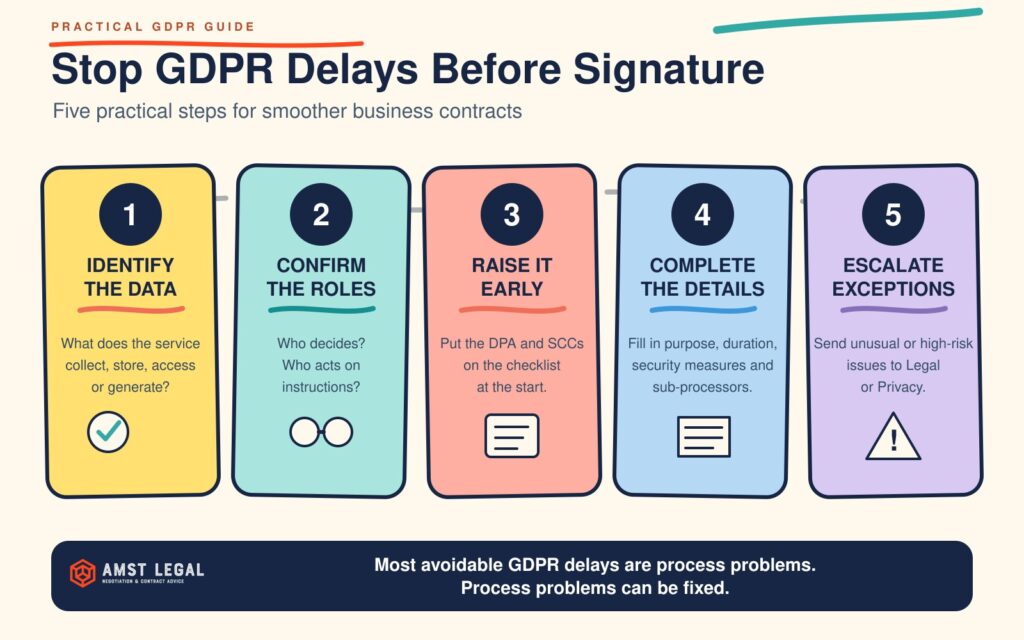
These steps will not remove every privacy question, but they take away much of the avoidable friction. The goal is to help commercial teams recognise the recurring issues, follow a workable process and know when specialist advice is actually needed.
The DPA and SCC Basics
Because personal data is defined broadly and many services process it, European law requires specific privacy paperwork in many commercial deals. Two documents appear particularly often:
- The DPA, the Data Processing Agreement: the contract Article 28 GDPR requires when a processor handles personal data on a controller’s behalf.
- The SCCs, the Standard Contractual Clauses: standard clauses that can provide a legal safeguard for sending personal data outside the EEA, for example to a US parent company or US cloud provider, when the applicable requirements are met.
These two documents are where deals slow down in practice, and they are each worth their own plain explanation. That is exactly what the next two articles in this series do: what a DPA is and why every deal has one, and what SCCs are and why you should never try to negotiate them.
This was the very basics, on purpose. If you understand personal data, processing, controller versus processor and lawful basis, the rest of this series will feel much easier.
At AMST Legal we help US and European companies get this right: understanding what the GDPR requires in their contracts, and building templates and processes so the privacy paperwork stops delaying deals. If the GDPR keeps showing up in your contracts and nobody has ever explained it properly, this series is for you, and we are happy to help with the rest.
Frequently Asked Questions: What Is the GDPR and How Does It Affect Business?
What Is the GDPR in Simple Terms?
The GDPR is the EU’s general law on how organisations may collect, use, store, share and delete personal data. It also gives individuals rights over their data and assigns responsibilities to controllers and processors.
Does the GDPR Apply to US Companies?
It can. The GDPR may apply to a US company that offers goods or services to people in the EU or monitors their behaviour there. A company does not always need an EU office to fall within its scope.
What Counts as Personal Data Under the GDPR?
Personal data is any information relating to an identified or identifiable person. It includes obvious details such as names and email addresses, but can also include IP addresses, user IDs, support tickets and information that identifies someone when combined.
What Is the Difference Between a Controller and a Processor?
The controller decides why and how personal data is used. The processor handles that data on the controller’s instructions. The real activity determines the role, not the label in the contract.
When Is a DPA Required Under the GDPR?
A DPA is required when a controller appoints a processor to process personal data on its behalf. Article 28 GDPR requires that relationship to be governed by a written contract containing specific terms.
Why Does the GDPR Matter for Business Contracts?
The GDPR determines which privacy documents, security obligations, data-use restrictions and international transfer terms a deal may need. If those points are raised late or described incorrectly, they can delay signature and create compliance risk.
ChatGPT Terms of Service Explained for Businesses: Updated Terms
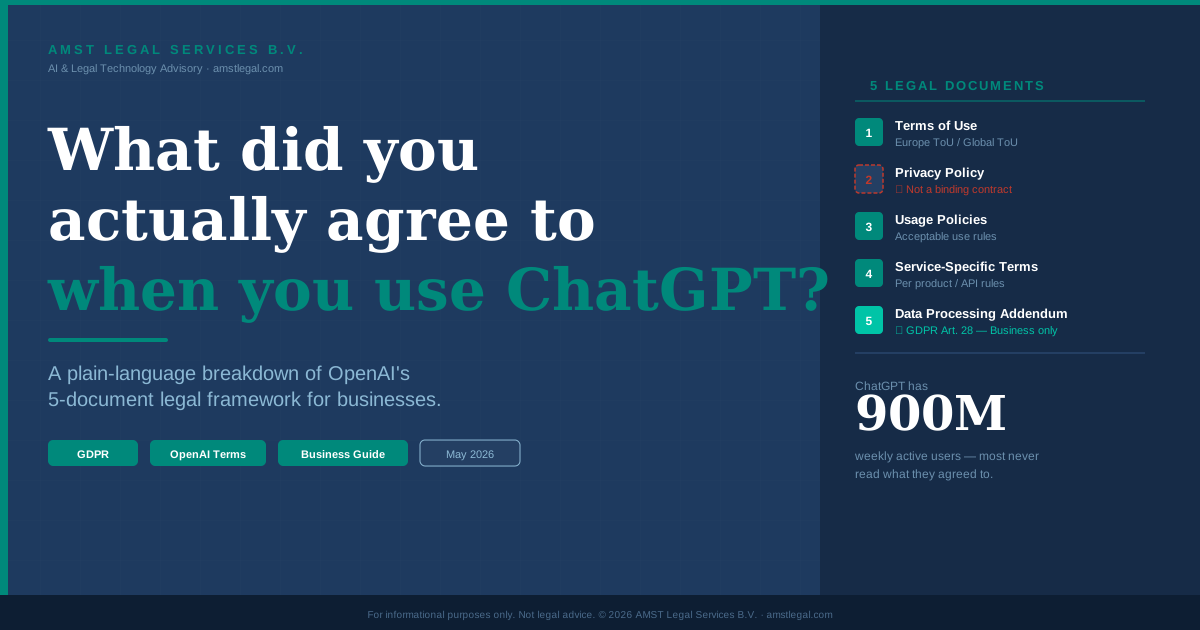
OpenAI recently updated its Terms of Use, Services Agreement, and Privacy Policy. OpenAI’s ChatGPT terms are not mentioned in one contract, but by five separate legal documents. Which ones apply to you depends on which plan you use. Because OpenAI terms are not very clear, the same questions keep coming up: which ChatGPT or OpenAI terms apply, how do the documents fit together and what does this mean for users?
The most common question we get: does ChatGPT train on my data? The short answer is yes, unless you are on a Business or Enterprise plan, or have manually opted out in your account settings. That is where most individuals and organisations run into problems. Nobody explains how the five documents fit together and which one applies to them. This is why we have written this article ‘ChatGPT Terms of Service Explained for Businesses: Updated Terms’.
Instead of one contract, OpenAI uses a layered framework. This article explains how they connect, which one applies to you, and what it means in practice for individuals and businesses using ChatGPT
TL;DR
- Will ChatGPT train on your data? Yes, except if you opt out or if you have a business contract
- The ChatGPT Terms of Service are part of a broader OpenAI contract structure made up of multiple interconnected documents.
- Different terms apply depending on whether you use ChatGPT as an individual or under a business agreement.
- The “Pro” Trap: Pro is classified as a Consumer account. By default, this model trains on your data, unless you manually opt out.
- For organisations, the OpenAI Services Agreement is the primary contract for e.g. API and enterprise use.
- Don’t forget that there are specific policies, service terms & addenda that contain a lot of operational obligations.
Why Do the ChatGPT Terms of Service Matter?
AI vendors like OpenAI, Claude, Gemini but also SaaS/Software providers like Salesforce, Uber, Atlassian, Microsoft,etc. increasingly rely on layered contracts that incorporate multiple documents by reference. This normally includes an order form, a Master Services Agreement, general terms, service-specific terms and policies and addenda. When it comes to OpenAI that is no exception.
What really matters in practice is the distinction between consumer (individual) use and business use, as different terms apply to each.
- Consumer vs business use determines your risk position: Even when employees use ChatGPT for work, they may still fall under consumer Terms of Use. In practice, this means different data usage rules, liability allocation, and protections apply than the organization expects. We see similar issues across other AI providers (see our article on Claude AI: Anthropic’s Claude AI Updates – Impact on Privacy & Confidentiality). For business use, organizations should ensure employees only use OpenAI services under company-approved terms.
- Layered contracts mean obligations are spread across documents: Different documents govern different aspects of the relationship. Teams often assume one set of terms applies, while key obligations sit in policies or service-specific terms. Because these documents are incorporated by reference and updated regularly, obligations can change without renegotiation. This creates operational risk if no one actively monitors updates.
This type of contractual framework is not uncommon. Many large Tech, SaaS and AI providers use similar contractual structures. Nonetheless, the interlinked nature of these contracts means that each document creates distinct rights and obligations that operate together as a whole. This makes it interesting to understand these contracts more in-depth.
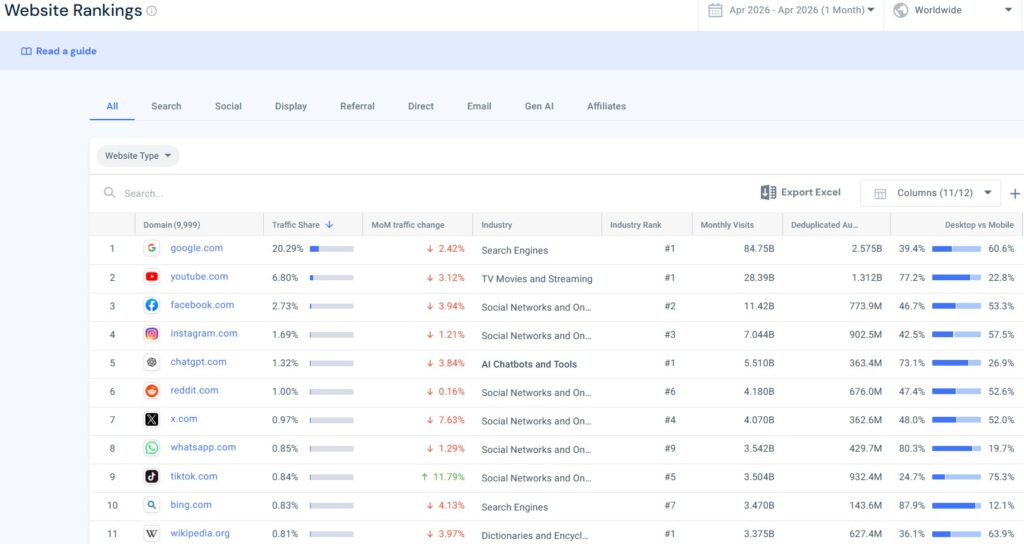
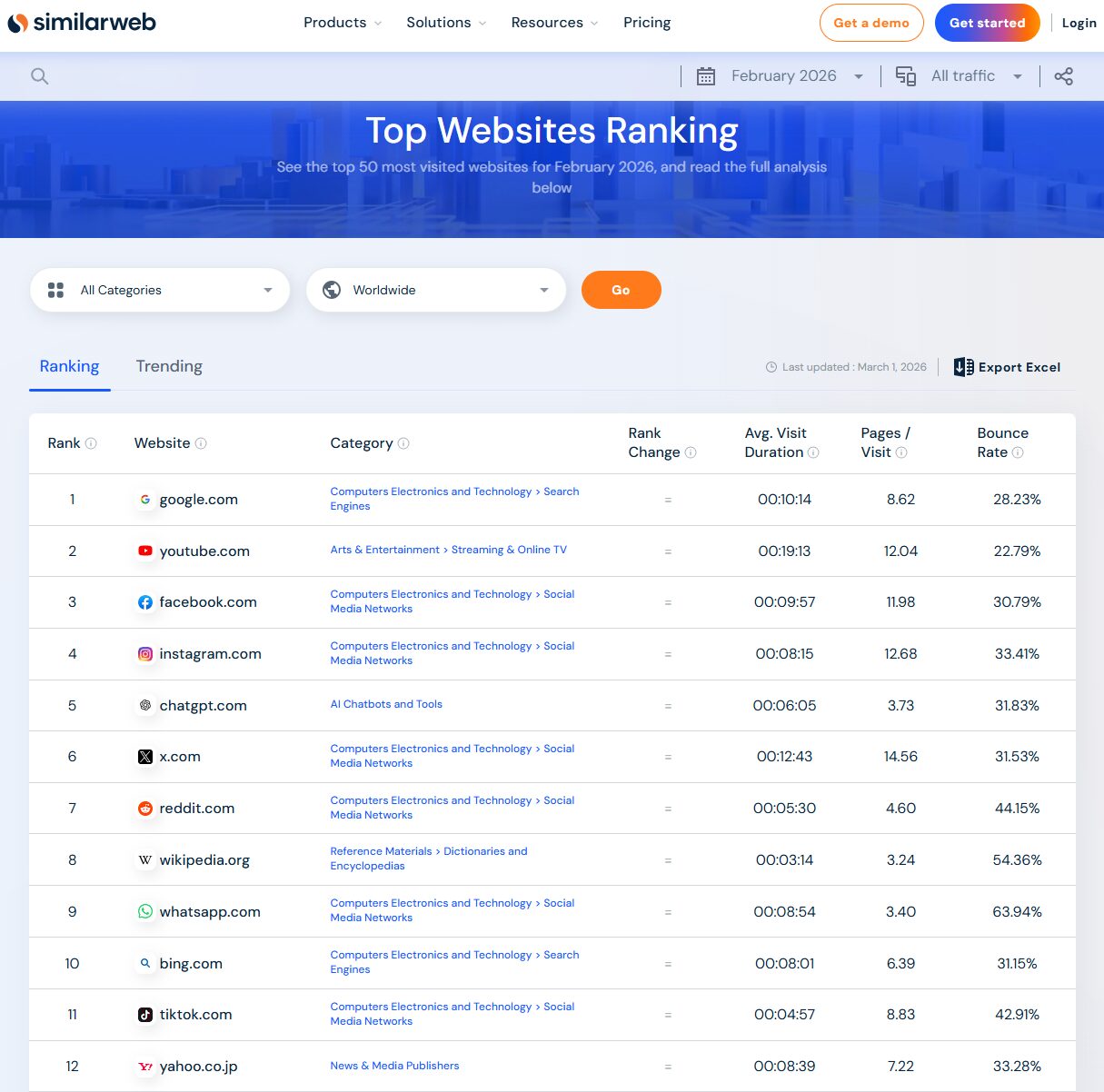
According to Similarweb’s Top Websites Ranking April 2026 (see here), ChatGPT is one of the most used websites globally.. This makes understanding of their governing terms particularly interesting.
ChatGPT and OpenAI Contract Structure Explained
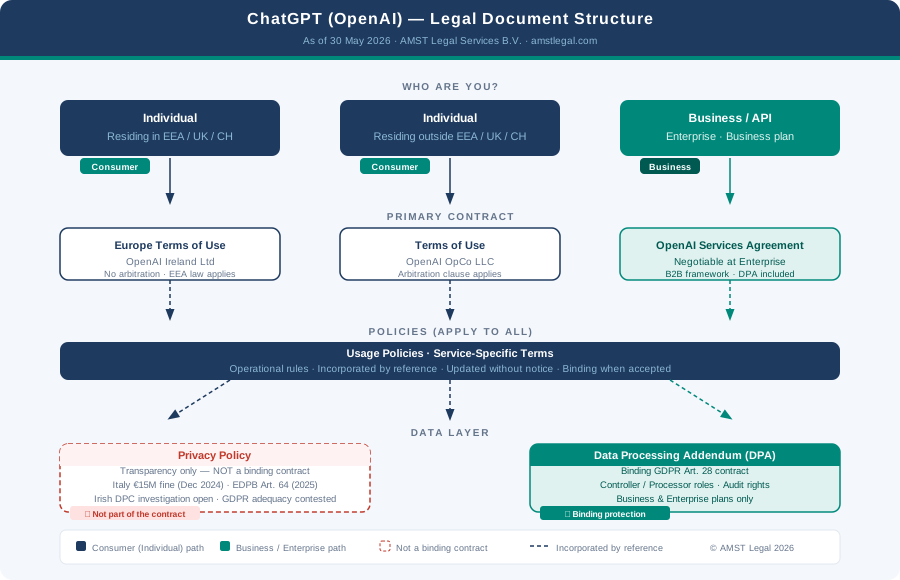
At a high level, OpenAI does not rely on a single contract. Instead, it uses a layered contractual framework where multiple documents operate together. This approach is standard across SaaS and AI providers, but it requires a different way of reading contracts. Rather than reviewing one agreement in isolation, organisations need to understand how several documents interact and which one takes precedence in practice. (for more details, see OpenAI’s article here)
The three general terms that can be applicable revolve around three primary actors:
- Individuals (residing in the EEA),
- Individuals (residing outside the EEA), or
- Businesses (non-specific location).
The key is to understand that only one of these above documents forms part of the contractual framework between you (the company you work at) and OpenAI. Moreover, these general terms acts as a connection point which pulls in additional policies and addenda. Because, most importantly, these governing agreements do not stand alone as OpenAI’s contractual structure relies heavily on incorporation by reference. However, as a basic starting point, the general terms and data privacy related policies deserves an in-depth explanation on its own.
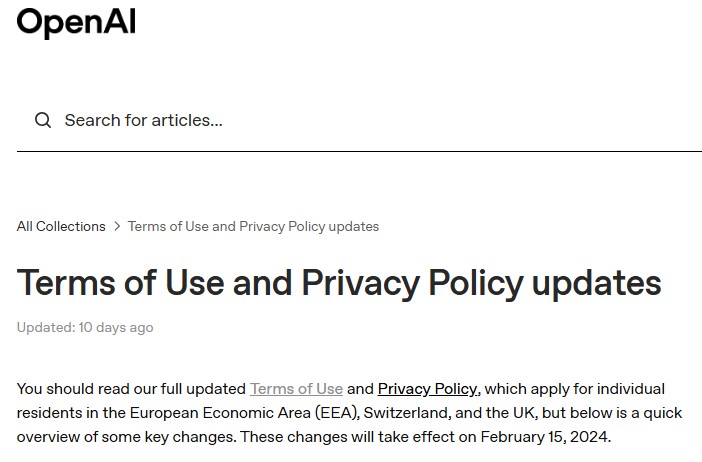
OpenAI’s explanation about the new terms is unfortunately unclear and in some places incomplete (see for yourself here), This is exactly why we wrote this article. OpenAI maintains a dedicated help article explaining their Terms of Service updates. Given that 900 million people use ChatGPT every week, you would expect this to be a reliable reference point. It is not — the article references conflicting dates and leaves the consumer/business distinction unexplained entirely.
ChatGPT Terms of Service Explained – How the Documents Actually Fit Together
Below we explain the full structure in plain language. OpenAI’s framework is built on five documents, each covering a different part of the relationship between you and OpenAI. Understanding how they connect is what most articles, including OpenAI’s own, fail to do clearly. Here is the version that actually makes sense.
Terms of Use (Individual Use)
The OpenAI Terms of Use govern individual use of ChatGPT and other OpenAI services. In practice, these are the default terms that apply unless an organisation has entered into a business agreement. This distinction is critical because many employees use ChatGPT in a professional context while still operating under individual terms.
From a legal and commercial perspective, the Terms of Use focus on access and behaviour. They define who can use the service, what constitutes acceptable use, and how content is treated. They also include limitations of liability and disclaimers that are typical for consumer-facing platforms. However, they are not designed to address enterprise-level concerns such as negotiated liability caps, audit rights, or structured data protection obligations.
As a result, organisations that rely on ChatGPT without moving to a business setup may unknowingly accept a risk profile that is materially different from what they would expect in a typical vendor relationship. This is not a drafting issue—it is a structural one.
Differences Europe Terms of Use vs Terms of Use
For individuals using OpenAI’s services, which is dependent on which account plan you are using, there is only one distinction in which contractual framework applies. The determining factor for whether the Europe Terms of Use or the Terms of Use is applicable is where you live. If you reside in the EEA, Switzerland or the UK, the Europe Terms of Use governs the usage of for example ChatGPT. On the contrary, if you reside outside of the EEA, Switzerland, or the UK, the Terms of Use are applicable.
Both these agreements governs individual’s use of OpenAI’s services. Structurally, both contracts covers the same services, places the same user obligations on the user and ensures that users retain rights to their input/output for example.
A few differences highlighted:
- Contracting parties differ depending on your location as residents in the EEA or Switzerland contract with OpenAI Ireland Ltd, while UK and US residents enters into a contractual relationship with OpenAI OpCo LLC.
- Content of terms, linked to local legal requirements. For example, the Terms of Use, applicable on UK and US residents, allow arbitration while the Europe Terms of Use doesn’t. oth the Europe Terms of Use and the Terms of Use specify that the Privacy Policy is not a part of the contract, but it remains essential for understanding data handling practices.
What is not different is that both Terms of Use specify that the Privacy Policy is not a part of the terms, but it remains essential for understanding data handling practices.
Europe Privacy Policy vs Privacy Policy
The general terms point out that the privacy policy is not part of the contractual framework between individuals and OpenAI. Despite this, the policies are still present and affect how OpenAI handles your data. In terms of which policies may be applicable, the Privacy Policy applies in general.
Since data protection regulation are dependent on local legal requirements, there are distinct privacy policies for specific locations. For example, if you reside in the EEA, Switzerland or the UK the Europe Privacy Policy is relevant and for US residents, the US Privacy Policy is applicable.
Do note that there are additional privacy policies for other locations too. This does however showcase that local legal requirements are taken into consideration. The main difference between these are the level of detail and connection to applicable data privacy regulation, which evidently does differ between Europe and the US.
OpenAI Contract Structure for Businesses
OpenAI Services Agreement Explained (Business Use)
As mentioned, businesses generally operate under separate terms. This is the same within OpenAI’s contractual framework through the OpenAI Services Agreement. This agreement applies to API customers and enterprise users and governs commercial deployment of OpenAI models. Most crucial is what type of user you are; i.e., if you are using a subscription plan for individuals (also Pro!), these business terms won’t apply. Because of this, it is relevant to check what type of subscription you use.
Unlike the Terms of Use, this agreement is structured as a commercial contract and is intended to be reviewed, negotiated, and managed by legal and procurement teams.
This agreement governs the key commercial and legal elements of the relationship. It addresses pricing and billing, defines permitted use of the models, allocates liability, and sets out intellectual property positions. In addition, it establishes how data is handled in a business context, typically in conjunction with a Data Processing Addendum.
What matters in practice is that this agreement fundamentally changes the risk allocation. It moves the relationship from a consumer-style framework to a business-to-business structure, where expectations around accountability, data protection, and commercial certainty are materially different. For organisations deploying AI at scale, this is the agreement that should anchor internal governance and contract review processes.
Service Terms (Product-Specific Rules)
On top of the primary contract sit the Service Terms, which apply to specific OpenAI products or functionalities. These are often overlooked because they are not always presented as standalone agreements. However, they are incorporated by reference and can materially affect how services are used in practice.
Service Terms typically define operational and technical conditions. For example, they may set limits on how APIs can be used, impose restrictions on certain use cases, or clarify how specific features function. In many cases, these terms translate directly into product-level constraints that business and technical teams must follow.
From a legal perspective, the key point is that Service Terms are binding once incorporated. From a business perspective, they often contain the rules that teams encounter day-to-day. Ignoring them creates a gap between what the contract allows and how the service is actually used.
Policies (Usage and Operational Rules)
In addition to contractual terms, OpenAI maintains a set of policies that apply across its services. These policies typically cover acceptable use, safety requirements, and operational restrictions. While they may not always read like traditional contractual clauses, they can still have binding effect when incorporated into the main agreement.
In practice, policies often contain the most immediate constraints on how ChatGPT and related services can be used. For example, they may prohibit certain categories of content, restrict high-risk use cases, or impose compliance-related obligations. These are not theoretical limitations—they directly affect how business teams deploy AI in real scenarios.
Another important feature is that policies are updated regularly. Because they are incorporated by reference, changes can apply without renegotiation. This creates a dynamic environment where compliance is not a one-time exercise but an ongoing process.
Privacy Policy vs Data Processing Addendum
A common source of confusion is the difference between the Privacy Policy and the Data Processing Addendum (DPA). Although both relate to data, they serve fundamentally different purposes.
The Privacy Policy explains how OpenAI handles data in general terms. It is primarily aimed at transparency and user information, particularly in a consumer context. However, it does not typically form part of the contractual framework in the same way as other documents.
The Data Processing Addendum, by contrast, is a contractual document. It applies in business relationships and governs how personal data is processed on behalf of the customer. It defines roles such as controller and processor, sets out security measures, and addresses regulatory requirements such as GDPR compliance.
For organisations, the distinction is critical. The Privacy Policy tells you what happens in practice, while the DPA defines what OpenAI is legally required to do. Relying on the former instead of the latter can lead to incorrect assumptions about compliance and risk allocation.
Does ChatGPT Train on Your Data?
One of the most frequently asked questions is whether ChatGPT trains on your data. The answer depends on which terms apply.
Under consumer use, ChatGPT may use inputs and outputs to improve its models, unless users actively opt out where that option is available. This reflects the default structure of many consumer AI services, where data contributes to ongoing model development.
Under the OpenAI Services Agreement, the position is different. In a business context, customer data is generally not used for training purposes. This distinction is not merely technical—it is contractual.
In practice, this creates a clear risk scenario. Employees may use ChatGPT under consumer terms, while the organisation assumes that enterprise-level protections apply. The tool is the same, but the legal framework is not. As a result, understanding which terms apply is essential for managing both data risk and internal compliance.
The data protection layer’s place
So, what other terms may be applicable as well? Well, the Data Processing Addendum sits alongside the OpenAI Services Agreement through reference. It governs how OpenAI processes personal data on behalf of the customer. Crucially, the DPA, not the general privacy policy nor the location specific privacy policies, creates the contractual data protection obligations. Business teams often confuse the two, but legally they serve very different purposes.
On one hand, the Data Processing Addendum is critical for GDPR and similar regimes and defines roles (controller vs processor), sets out processing instructions and security measures, addresses cross-border transfers and sub-processors. This is relevant as it sets out which obligations your organization shall follow in terms of data privacy. On the other hand, the privacy policies is relevant as it sets out what kind of protection OpenAI offers to their customers. That refers to the actual users, for example employees in your company.
How To Handle AI Usage
Defining Key Documents and Processes
AI usage intersects with several contractual touch-points like the general terms and data handling policies. Therefore, hidden clauses allowing various things may be applicable. Understanding of overarching responsibilities and rights, like how data is used, and how outputs are verified is recommended. For example, companies should ensure that no confidential or client data may be submitted to public AI interfaces unless approved safeguards exist.
Connecting Legal, Sales, and Procurement Functions
In many organizations, sales teams use AI for proposal generation while legal reviews contracts separately. Procurement teams vet vendors but may not assess AI clauses. Consequently, a misalignment arises. Depending on what terms apply, there may be a risk that confidential information is shared with the AI company. Therefore, collaboration between for example Sales and Legal is key to ensure that OpenAI’s terms, and similar clauses from other AI providers, are reviewed beforehand.
Balancing Flexibility and Risk Reduction
AI adoption should not paralyze innovation. Instead, companies can create “approved use” guidelines outlining permissible AI tools and inputs. This approach preserves flexibility for business teams while embedding guardrails against data misuse. Moreover, including AI-specific language in supplier and client contracts ensures accountability.
Key Takeaways
- OpenAI’s contract structure is layered by multiple documents,
- Different OpenAI terms apply to EU individuals, non-EU individuals, and businesses,
- Policies and addenda often contain the most practical obligations,
- Understanding the structure improves both commercial and legal outcomes, and
- Proactive mapping and monitoring reduce risk and delays.
Frequently Asked Questions
Q: When should we use the OpenAI Services Agreement instead of the Terms of Use?
A: When ChatGPT or OpenAI services are used in a business context, especially via APIs or enterprise solutions. This ensures appropriate commercial and data protection terms apply.
Q: What is the real risk if we get this wrong?
A: The main risk is a mismatch between assumed protections and actual terms. This can lead to unintended data use, limited liability coverage, and compliance issues.
Q: Who should own this internally?
A: Typically legal and procurement should define the framework, but IT and business teams must be involved to ensure actual usage aligns with approved terms.
Q: Does this apply differently across jurisdictions?
A: Yes. For example, EEA-specific Terms of Use and privacy frameworks may apply depending on location. This affects enforcement and regulatory compliance.
Q: Do we need tailored legal advice or are standard terms enough?
A: For low-risk use cases, standard terms may be sufficient. However, for enterprise use or integration into products, tailored review is recommended.
Conclusion & Call to Action
Understanding which subscriptions equals what applicable contract is no longer optional for organisations using SaaS or AI at scale. It directly affects risk allocation, commercial commitments, and strategic flexibility. At AMST Legal, we regularly support clients in reviewing, negotiating, and operationalising AI and SaaS contracts, either on a project basis or as interim in-house counsel.
If you want to better understand how OpenAI’s contracts affect your business, or if you are preparing for negotiations, audits, or customer discussions, we can help. Visit amstlegal.com to learn more or book a consultation today, or email info@amstlegal.com.
Note: this an updated draft of the article of January 2025: Ultimate Guide how ChatGPT, Perplexity and Claude use Your Data.

DeepSeek – Is your Data Safe? Everything You Need to Know
In my previous article we examined how ChatGPT, Perplexity and Claude uses your data (AI data use). We also mentioned the potential risks of sharing confidential or proprietary information – and how to avoid these risks. It is clear that not all tools offer the same safeguards regarding data privacy, security, and legal protections. We will therefore continue comparing AI models. This week a focus on the AI model DeepSeek. See below our Article ‘DeepSeek – Is your Data Safe? Everything You Need to Know’.
DeepSeek was unknown to most people outside of the People’s Republic of China (“PRC“) until this week. In the course of one week it has however gained immensely in popularity. It is yet another AI-driven platform, but there are important differences with the other well-known AI models. DeepSeek is currently challenging AI models like ChatGPT and Gemini in capabilities unexpected until yesterday. In this article, we will explore DeepSeek’s Privacy Policy & Terms of Use. We will also handle issues such as personal data storage, AI model training and jurisdiction. If you’re wondering whether you can safely use DeepSeek for personal or professional tasks, read on to discover the key facts, risks and best practices.
This article has been written at the start of the broad use of DeepSeek. It is therefore work in progress, based on first information gathered.
What We’ll Cover
- DeepSeek Overview: Short explanation of the platform and why are people interested in it.
- Privacy Policy Highlights: Including details on storing personal data, especially full names and addresses.
- Location of Data: How and why user data may end up on servers in the People’s Republic of China.
- Terms of Use: Whether DeepSeek incorporates your content into training its AI models—and what that means for you.
- Data Privacy in China: The local regulatory environment and how it differs from GDPR or CCPA.
- Confidentiality: Potential risks if you’re handling sensitive or proprietary information.
- Final Advice: How to proceed if you’re considering using DeepSeek, plus some general cautionary steps.
1. DeepSeek Explained
New AI Model
DeepSeek is a cutting-edge large language model (LLM) similar to ChatGPT and Gemini. It is developed by a Chinese AI company with the full name ‘Hangzhou DeepSeek Artificial Intelligence Co., Ltd., and Beijing DeepSeek Artificial Intelligence Co., Ltd.’. It is designed to tackle a range of complex tasks with impressive efficiency according the latest tests. According to Google Gemini its powerful AI shines in several key areas:
- Math Whiz: DeepSeek excels at mathematical reasoning and problem-solving, often outperforming other models.
- Logic Master: DeepSeek handles complex, multi-step logical reasoning with ease.
- Code Conjurer: DeepSeek understands and generates code in various programming languages, making it a valuable tool for developers.
- Conversation Starter: DeepSeek is a natural language expert, capable of engaging in coherent and contextually relevant conversations.
- Global Communicator: DeepSeek is trained on diverse linguistic data, offering some level of multilingual support.
Consequences Stock Market
On 26 January 2025 there was even a big shake up in the stock market due to Deep Seek. US stocks plummeted as traders fled the tech sector and erased more than $1 trillion in market cap amid panic over the introduction of DeepSeek. The S&P 500 nearly 1.5% lower, while the tech-heavy Nasdaq Composite had shed more 3% by the end of the day. DeepSeek roiled stock futures after the AI model was said to outperform OpenAI’s ChatGPT in several tests. The losses gathered momentum after DeepSeek became the most downloaded app on Apple’s App Store in the US on 26 January.
Source: Business insider.
A Growing Global Market
As AI popularity expands worldwide, companies outside the U.S. and Europe (especially China) are developing their own solutions. DeepSeek is notable because it may offer high-speed performance and robust Chinese language capabilities. This makes it attractive to users with specialized language needs. However, these benefits come with a different legal framework, which can pose challenges for those used to Western data protection standards.
It has also been reported that DeepSeek is able to offer similar services and results as ChatGPT, Gemini, etc. for a fraction of the cost. This has greatly fueled popularity of the new AI model.
2. DeepSeek’s Privacy Policy: Personal Data Collection
Amongst others, according to a review of DeepSeek’s publicly accessible Privacy Policy, the platform collects a wide range of personal information. Qoute: “When you create an account, input content, contact us directly, or otherwise use the Services, you may provide some or all of the following information:
- Information When You Contact Us. When you contact us, we collect the information you send us, such as proof of identity or age, feedback or inquiries about your use of the Service or information about possible violations of our Terms of Service (our “Terms”) or other policies.
- Profile information. We collect information that you provide when you set up an account, such as your date of birth (where applicable), username, email address and/or telephone number, and password.
- User Input. When you use our Services, we may collect your text or audio input, prompt, uploaded files, feedback, chat history, or other content that you provide to our model and Services.
Additionally DeepSeek stores (i) Automatically Collected Information like technical information, usage information, cookies, payment information and (ii) information from other sources like login, signup or linked information.
Where Is Information Stored
DeepSeek explicitly states:
“The personal information we collect from you may be stored on a server located outside of the country where you live. We store the information we collect in secure servers located in the People’s Republic of China.
Where we transfer any personal information out of the country where you live, including for one or more of the purposes as set out in this Policy, we will do so in accordance with the requirements of applicable data protection laws.”
For many users – especially those in countries with stringent privacy regulations – this is significant. Your legal recourse to access, delete or restrict your data might be limited once it’s hosted on servers in the PRC.
How Is This Data Stored and Processed?
While the Privacy Policy mentions “secure servers,” it is not clear how they deal with specific practices such as:
- Encryption: Are your data and prompts encrypted at rest or in transit?
- Third-Party Sharing: How widely is your data shared for analytics or collaboration?
- Data Deletion: What happens if you decide to close your account or remove certain information?
- Data Security: How are the servers protected against e.g. cyberattacks.
If you’re accustomed to GDPR (EU Data Privacy Regulation) or CCPA (California Data Privacy Regulation), you may be disappointed by the lack of clearly defined user rights (like the right to be forgotten or the right to data portability). It remains to be seen how these matters are covered by DeepSeek. Especially from a regulatory point of view – data privacy, data security and now also AI (see the EU AI Act).
There are many more aspects that are very interesting in the DeepSeek Privacy Policy, but for the purposes of this article this would be too much information to touch on all aspects.
3. DeepSeek’s Terms of Use: Model Training & Governing Law
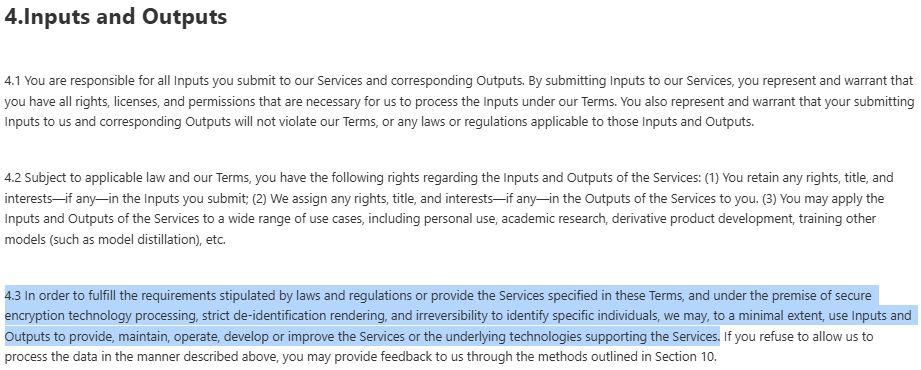
DeepSeek’s Terms of Use do mention that the AI model will only use your Inputs in specific cases. It is however not exactly clear how broad this should be read. See part below in blue. The terms also offer a way for its customers to inform DeepSeek that they refuse DeepSeek to allow to use their Input data.
Potential Risks for Confidential Information
When adding client documents, proprietary research, or any private data as always be mindful. As far as we are aware at this moment:
- No Guarantee of Confidentiality: There is no explicit promise to keep sensitive data confidential.
- Future AI Outputs: The model might inadvertently reveal or be influenced by your confidential info.
- Irreversible Submission: As DeepSeek’s Terms of Use do not mention how long DeepSeek will store your data, this will allow indefinite use of your data.
- Unclear use of Input: it is not exactly clear how and in which cases your Inputs will be used to create Outputs or to train the model. It is likely and we should assume that DeepSeek uses your Input to train their AI model.
Governing Law and Jurisdiction
Next, let’s review the terms regarding governing law and jurisdiction, meaning the laws that govern the use of DeepSeek and where you will need to go to court in case of litigation with DeepSeek. DeepSeek clarifies this as follows in the Terms of Use:
9. Governing Law and Jurisdiction
9.1 The establishment, execution, interpretation, and resolution of disputes under these Terms shall be governed by the laws of the People’s Republic of China in the mainland.
9.2 If negotiation fails in resolving disputes, either Party may file a lawsuit with a court having jurisdiction over the location of Hangzhou DeepSeek Artificial Intelligence Co., Ltd.
This means:
- The laws of the People’s Republic of China govern all legal disputes.
- Chinese courts in Hangzhou, PRC, will handle any lawsuits.
- Even though it is stated in the terms that DeepSeek will comply with applicable laws, research still needs to be done whether they will comply with GDPR, CCPA or other foreign regulations.
4. Data Privacy in China
In the EU and US there have been large initiatives since 2018 with respect to extensive legislation relating to the protection of data privacy and data security. In the coming years there will even be more regulations in connection hereto. See our article ‘Six New EU Regulations – like the AI Act – Explained‘.
Regulatory Differences
While China has its Personal Information Protection Law (PIPL), it doesn’t mirror the scope or depth of frameworks like GDPR or CCPA or the other regulations mentioned above – as far as we are aware but we are not lawyers or legal advisors versed in PRC laws.
Implications for International Users
If you reside outside China:
- Limited Recourse: You might find it harder to challenge data privacy & security issues in a Chinese court.
- Compliance Gaps: The data privacy and data security protections you are used to under EU or U.S. law may not apply here.
- Cross-Border Transfers: Even if the Privacy Policy mentions meeting local regulations, these could be PRC regulations that differ significantly from your home country’s standards.
5. Which Data Not to Share in AI Models
As we stated in our article with respect ChatGPT, Gemini and Perplexity, apply common sense and caution when adding data to any online AI model. This could be different for local models – depending on the security measures taken by the AI model.
Avoid sharing for example:
- Confidential details (client, business or family member names, private letters, contracts & strategies).
- Personally identifiable information (PII) (addresses, phone numbers, medical records).
- Proprietary or business-critical data (unreleased products, prices, financials).
- Sensitive materials (health info, internal memos, or business & personal).
- Data protected by Applicable Law (copyright, illegal data, government data).
If you must work with potentially sensitive text, we recommend considering the following:
- anonymizing the data first,
- using an enterprise-level AI solution where the Terms of Use prohibit using your content for model training. This doe not seem to be possible for DeepSeek, or
- an ‘on-premise’ AI model that anonymizes data.
6. Bringing It All Together
DeepSeek represents an interesting expansion of the AI landscape, especially for those who require strong Chinese language capabilities or want to explore AI solutions outside typical Western providers. However, its legal environment, data storage location, and governing jurisdiction all point to a platform that may not uphold the same privacy or confidentiality standards you’d expect under GDPR or CCPA.
This doesn’t mean DeepSeek is without merit. You should approach it with open eyes and informed caution. If you have critical confidentiality needs or work in a heavily regulated sector, it is wise to look elsewhere or secure a specialized enterprise agreement that explicitly addresses data protection concerns. For casual or non-sensitive uses, DeepSeek could be a helpful AI resource. As always, be mindful of what you submit and how it could be stored and potentially accessed under Chinese law.
7. Final Thoughts
AI is transforming the way we work – but it’s also transforming how data can move beyond our control. It is advised to think twice before you add content to any AI (LLM) Tool and actively keep track of how your content is used by any AI tool.
As always, we need to stay informed, be cautious and be proactive. That way, you can use the power of AI without compromising your most sensitive information. Keep an eye out for our upcoming in-depth articles on other AI models. We will also cover AI policies that can guide you and your team toward ethical and secure usage of these exciting new technologies.
Disclaimer: This article is a research project, provides general information about AI data usage and does not constitute legal advice.
If you have any further questions about the above, contact me via lowa@amstlegal.com or set up a meeting directly here .
To read more on this topic here is Ultimate Guide how ChatGPT, Perplexity and Claude use Your Data, Anthropic’s Claude AI Updates – Impact on Privacy & Confidentiality, South Korea spy agency says DeepSeek ‘excessively’ collects personal data, Berlin’s data protection commissioner reports the AI app DeepSeek to Apple and Google in Germany as containing illegal content, Is DeepSeek safe to use?