
The EU Right of Withdrawal Explained: What Businesses Need to Know
The EU right of withdrawal applies to almost everyone selling anything online. It gives consumers the right to withdraw from a sale made online. This means that it is more than a legal checkbox. It is a legal & practical rule that shapes how you sell to consumers across the EU. Because the right of withdrawal grants a short term of 14 days where a consumer can change one’s mind, it directly affects how sales, product, marketing and legal teams design checkout flows, confirmations and terms. Also, it influences trust. When customers know they can cancel within a defined period, they buy more confidently.
In this article, we explain what the right of withdrawal is, why businesses need it, and where to place it in your contracts and online journeys. Finally, we explain an important change arriving in June 2026. Consumer-facing sites must offer a clear “Cancel my contract” function and provide clearer information in line with new EU rules.
What we’ll cover
- What the EU right of withdrawal (the 14-day cooling-off period) means in practice
- Who must comply and the types of contracts it applies to
- Where to include the right of withdrawal in your terms, UX and communications
- What changes in June 2026 (including the “Cancel my contract” button)
- Key exceptions, common pitfalls and practical steps to stay compliant
Context and importance of the topic
What the right is and why it matters (in plain business terms)
At its core, the right of withdrawal allows consumers to cancel certain distance or off-premises contracts within 14 days. Consumers can do this without giving a reason and without cost. In practical terms, this acts as a cooling-off period. Buyers can reassess the purchase after receiving goods or entering a service, especially when they could not examine the product in person. For a sales leader, this reduces friction during checkout and strengthens buyer confidence. For legal teams, it sets mandatory timelines and notices you must integrate into terms and customer messaging.
Practical challenges when it’s not addressed correctly
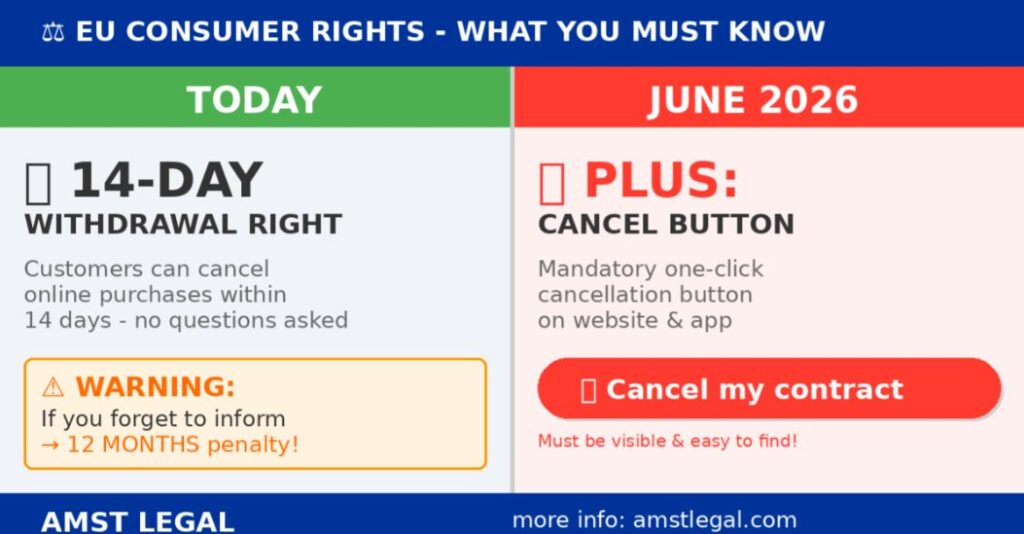
When businesses omit clear 14-day right of withdrawal information, the consequences escalate quickly. For example, the withdrawal period can extend by up to 12 months if you fail to inform consumers properly. Additionally, customers who struggle to cancel or cannot find the information will escalate to support, chargebacks, or regulators. As a result, your customer acquisition costs rise while margins erode through avoidable disputes and refunds. Therefore, clarity up front is more efficient than damage control later.
Opportunities if you handle it well
When you design the withdrawal experience thoughtfully, you create a measurable commercial advantage. Consequently, your brand earns trust, your sales cycle tightens and your legal exposure shrinks. In addition, product and CX teams benefit from fewer support tickets, while finance gets more predictable refund flows. Moreover, a clear process provides structured feedback on why customers withdraw, which helps improve pricing, positioning, and onboarding.
EU Consumer Law – Right of Withdrawal
How does this fits into the broader contract or business framework
Define the key documents and touchpoints
To operationalize the EU right of withdrawal, think about alignment of the following layers:
(1) Terms & Conditions or Service Agreement for consumers,
(2) order confirmation and onboarding emails,
(3) website/app flows including account pages, and
(4) support playbooks for frontline teams.
Furthermore, ensure your privacy and data-deletion steps match the offboarding process where relevant. In each layer, there should be a reference to the withdrawal right, explaining the period and point to the cancellation route.
Explain the connections
Your terms set the legal basis; your emails and pages make it actionable. Therefore, the contract should define the 14-day cooling-off period, the start date trigger (delivery of goods or conclusion of the service contract), the method for withdrawal, and any consequences (e.g., return shipping for goods, pro-rata charges for services started at the customer’s request). Meanwhile, your website and emails should offer direct links to the withdrawal instructions and—by June 2026—a clear “Cancel my contract” button for consumer contracts.
Keep flexibility while reducing risk
You can reduce churn risk while staying compliant by providing better pre-purchase information and post-purchase onboarding. For instance, set realistic product descriptions and trial guidance so customers know what to expect; that lowers withdrawal rates without restricting rights. In addition, use confirmations and reminders to clarify the start date and steps to cancel, which reduces misunderstandings. Finally, integrate a simple returns or service offboarding guide that explains timelines and what customers must do.
Practical examples and use cases
SaaS or tech deals (consumer context)
Imagine a B2C productivity app with monthly subscriptions. The consumer can exercise the right of withdrawal within 14 days from the conclusion of the service contract. If the customer expressly asks for immediate access during that period, you may charge for the portion of service already provided. However, you must have captured explicit consent and an acknowledgment that the 14-day right to cancel would be affected. Therefore, your signup flow should include a clear consent checkbox and a link to the withdrawal information.
Procurement or sales (hardware shipped to consumers)
Consider a retailer shipping smart devices to EU consumers. The 14-day right of withdrawal usually starts on delivery of the goods. Consequently, your confirmation email should display the delivery date and a direct route to initiate withdrawal. In addition, your returns page should specify the address, method of return, and refund timeline once the goods are received back in good condition. Because clarity here prevents disputes, your support team should use standard templates referencing the right and return steps.
Founders, CFOs, and entrepreneurs (pricing and refunds)
For early-stage founders selling direct-to-consumer, refunds can disrupt cash flow. Nevertheless, resisting the rule invites regulator attention and reputational damage. Instead, design a structured refund policy aligned with the cooling-off period, establish internal SLAs for refund execution, and publish the average refund timeline. Consequently, finance can forecast outflows, while leadership keeps regulators and payment providers comfortable with the company’s controls.
Where the right comes from what changes by June 2026
The EU Consumer Rights Directive (2011/83/EU) (link) sets the baseline for the EU right of withdrawal across distance and off-premises contracts. It defines the 14-day cooling-off period, outlines information duties for traders, and lists key exceptions. Moreover, it establishes the standard withdrawal form and clarifies the start dates for goods and services.
What changes by June 2026?
From June 2026, an additional requirement will apply under Directive (EU) 2023/2673, which amends the Consumer Rights Directive. It is important to realize that obligations tighten further.
Consumer-facing websites and apps will be required to present a clear “Cancel my contract” function and to inform consumers more clearly about withdrawal rights in their digital journeys. While the new requirement appears in rules that focus primarily on financial services, it signals a broader push for transparent, user-friendly cancellation in consumer contracts. Therefore, product and legal teams should treat 2025 as the build year: audit terms, update email templates, change the User Interface and improve the User Experience and the supporting content.
Where to add the right of withdrawal in your materials (and why)
Contracts and legal terms
Place a Right of Withdrawal clause in your consumer Terms & Conditions or Service Agreement. In that clause, state the 14-day period, define the trigger (delivery of goods or conclusion of services), reference the standard withdrawal form or provide an online form, and explain the process and timeline for refunds. Additionally, specify the customer’s obligations on goods (e.g., keep items in reasonable condition, return within a set timeframe) and any pro-rata charges for services if the consumer asked to start service during the cooling-off period.
Website and app flows
Add a dedicated Withdrawal & Cancellation page in your help or account area that:
- (1) explains the right of withdrawal in plain language,
- (2) links the process to the specific purchase,
- (3) offers the standard form or online equivalent, and
- (4) outlines refund timing.
Consequently, consumers can self-serve, which reduces support volume. By June 2026, implement a visible “Cancel my contract” button for consumer contracts and link it to confirmation and status pages that show progress and refund expectations. Remains to be decided how clear this ‘button’ or link will need to be.
Emails and communications
Include a short right of withdrawal notice in the order confirmation or service activation email. Because that message helps repeat the 14-day timeframe, provide a direct link to cancel, and attach or link to the standard withdrawal form. In addition, remind the customer of any return requirements for goods and clarify whether service has started at their request.
Exceptions you should know (short overview)
Although the EU right of withdrawal is broad, there are several important exceptions. These include (non-exhaustive list – conditions apply):
- Certain real estate, construction, social services, healthcare, gambling, and package travel contracts
- Custom-made or personalised goods
- Perishable products that can deteriorate quickly
- Sealed items unsealed after delivery for health or hygiene reasons
- Goods inseparably mixed with others after delivery
- Unsealed software, audio, or video recordings
- Digital content supplied online (not on a tangible medium) once performance has begun with the consumer’s express consent and acknowledgment of losing the withdrawal right
- Public auctions and regular household deliveries (e.g. groceries)
- Newspapers and magazines, except for subscriptions
- Services tied to a specific date, such as accommodation, transport, car rental, catering, or leisure activities
Benefits of doing this well
Business impact: speed, clarity, efficiency
When your 14-day right to cancel experience is clear, your sales funnels run smoother. Consequently, customers buy with confidence, support works from standard playbooks, and leadership sees fewer escalations. Additionally, transparent cancellation keeps payment processors comfortable, which can reduce chargeback risk and processing headaches. As a result, you gain speed and predictability without sacrificing compliance.
Legal impact: fewer disputes, cleaner scaling
Clear rights and processes lower ambiguity, which lowers disputes. Moreover, documenting consent for immediate service start and providing a robust cancellation route help you defend decisions if challenged. Because the EU right of withdrawal is standardized across the EU, a well-designed approach scales into new markets with fewer local adjustments.
Key takeaways
- The EU right of withdrawal grants consumers a 14-day cooling-off period for many distance and off-premises contracts.
- If you fail to inform consumers clearly, the withdrawal window can extend significantly, increasing risk and cost.
- By June 2026, consumer-facing sites must include a clear “Cancel my contract” function and clearer withdrawal information.
- Place the right in your terms, emails, and UX, and ensure support follows a standard offboarding playbook.
- Map exceptions to your offering and draft specific, plain-language guidance to prevent misunderstandings.
Conclusion & call to action
The EU right of withdrawal is not simply a legal obligation. It is a real risk for companies if not done right. Next to the way consumers order online, this is one of the areas where we see lots of court cases in the Netherlands. It is an essential part of how modern consumer businesses earn trust and reduce friction. Because the rules tighten in June 2026, now is the moment to update terms, start discussing how to build the “Cancel my contract” function, and standardize communications. If you want a practical review of your flows – commercial and legal – we can help you align contract language, UI vs UX design, and support so compliance becomes a smoother part of the customer experience.
Go here to book a consultation or discuss an interim engagement.
Background
Author: Robby Reggers, Founder of AMST Legal (amstlegal.com), recognized by Legal Geek as a LinkedIn Top Voice for contracting, negotiation, and interim GC work.
How we work: AMST Legal supports clients per contract/project or on an interim basis (set hours per week as GC/Legal Counsel).