Why Order Forms Are Essential in Tech & SaaS Contracts
When we support clients in sales or procurement negotiations, I often get the same reaction: “Why would you get involved in the Order Form? Isn’t that just the cover page?” It isn’t – It is where the main parts of the contract are agreed, referring to the terms and condition relevant for the contract. Let us start with explaining you: what is an Order Form – showing you a free order form. Next, we will explain why Order Forms in SaaS and Tech are important. Contact us for an order form template you can use for your business.
In Tech and SaaS contracts, the Order Form is where the deal becomes clear. It states what is being purchased, the price that applies, and the term that governs delivery. Many teams rush to the Master Service Agreement (MSA) and miss that most commercial disagreements start with an incomplete or vague order form. When the order form is specific, sales cycles move faster, procurement comparisons become straightforward, and legal reviews stay focused on real risk rather than avoidable ambiguity.
What we will cover
- We will first explain what Order Form is
- Why business teams should treat order forms as the commercial source of truth
- How lawyers keep MSAs steady while order forms and Product Terms handle change
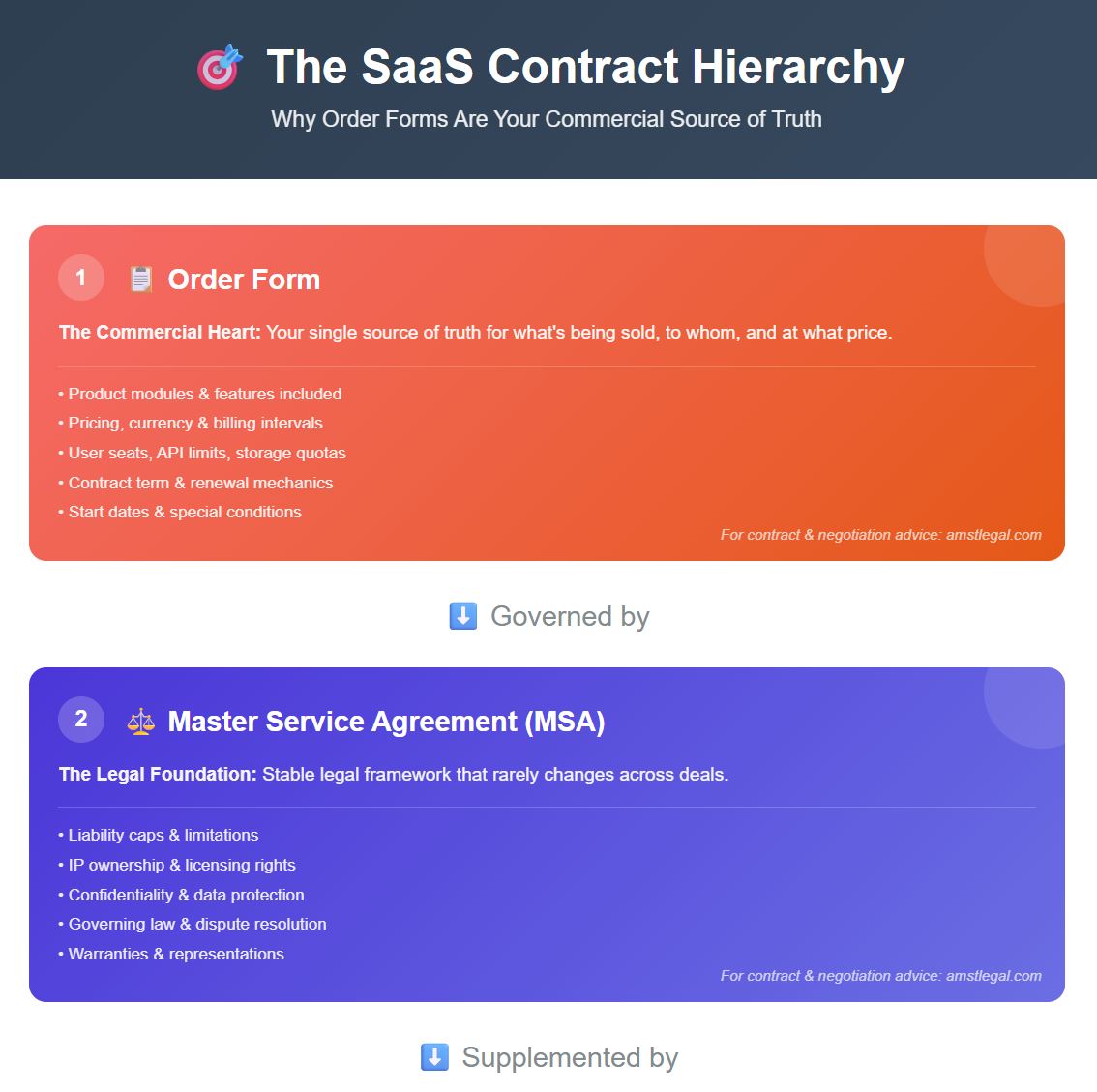
- The contract layers: Order Form → MSA → Product Terms → Release Notes → User Terms/EULAs
- Practical examples from SaaS, FinTech, AdTech, and software licensing
- The advantages of clear order forms for speed, scalability, and lower dispute risk
What is an Order Form?
The Commercial Core of Your Deal
An Order Form is the final commercial document that captures exactly what you are buying, at what price and under what terms. It is the main body of the contract that refers to the General Terms and Conditions and other relevant terms. While the MSA sets your legal foundation (as explained below), the Order Form handles the business specifics. It mentions which modules you’re purchasing, how many people can use the products, what your pricing looks like, and what the term is.
Why It Matters More Than You Think
Most commercial disputes don’t start due to complex legal language. Conflicts usually arise from vague Order Forms that leave pricing mechanics unclear. Smart procurement teams review these line-by-line because that’s where the real cost drivers live. For sales teams, a precise Order Form means fewer follow-up questions and faster closes. The (example) template Order Form shown in the visual below demonstrates how clear commercial terms create scalable frameworks that support business growth while keeping legal friction minimal. Contact us if you would like to receive the full Template in MS Word.

The business team’s perspective
Order form scope, price, and term in SaaS contracts
For sales and procurement, the order form is the single page that answers core questions: what modules or services are included, which users or environments are covered, and how pricing is calculated. In SaaS, that often means defining seats, API calls, storage, or specific feature bundles. It should also state currency, billing interval, and start date, because these elements drive forecasting and budgeting. When the order form captures these points precisely, account teams avoid re-explaining commercial terms later.
Renewal and pricing mechanics buyers look for
Procurement teams read renewal and pricing clauses first, since those parts define cost over time. Therefore, the order form should set the initial term, renewal type (auto-renew or opt-in), notice periods, and any indexation or tiered pricing. If usage pricing applies, the order form should include the metric, the threshold that triggers higher tiers, and how overages are billed. Clear mechanics reduce invoice disputes and help both sides model the total cost of ownership.
Common pitfalls when the order form is vague
Problems arise when the order form lists a product name but not the components included, or when it mentions a discount without stating the list price it applies to. Ambiguity also creeps in when pricing changes without notice. To avoid this, attach a dated price table or include a URL with a “snapshot” date and a change control note. Consequently, future changes do not rewrite the past deal.

The lawyer’s perspective
Contract layers explained
Lawyers design tech agreements as layers. The MSA is the legal foundation: liability, IP ownership, confidentiality, governing law and data protection (with link to a DPA) are mentioned here and should change rarely. The Order Form is the commercial record for this transaction: scope, price, term, invoicing, and special conditions tied to this customer. Product Terms are modular schedules for service levels, security, data processing, or feature-specific rules; they can evolve with the product through versioning.
Where Release Notes fit and what they should contain
Release Notes inform customers about new features, changed behaviors, and deprecated functionality. They should explain what changed, when it changed, and whether customer action is required. Although release notes are not a substitute for contract amendments, they support Product Terms by giving timely context and preserving trust. As a result, product teams can move faster without surprising customers.
User Terms/EULAs—daily use rules and acceptance
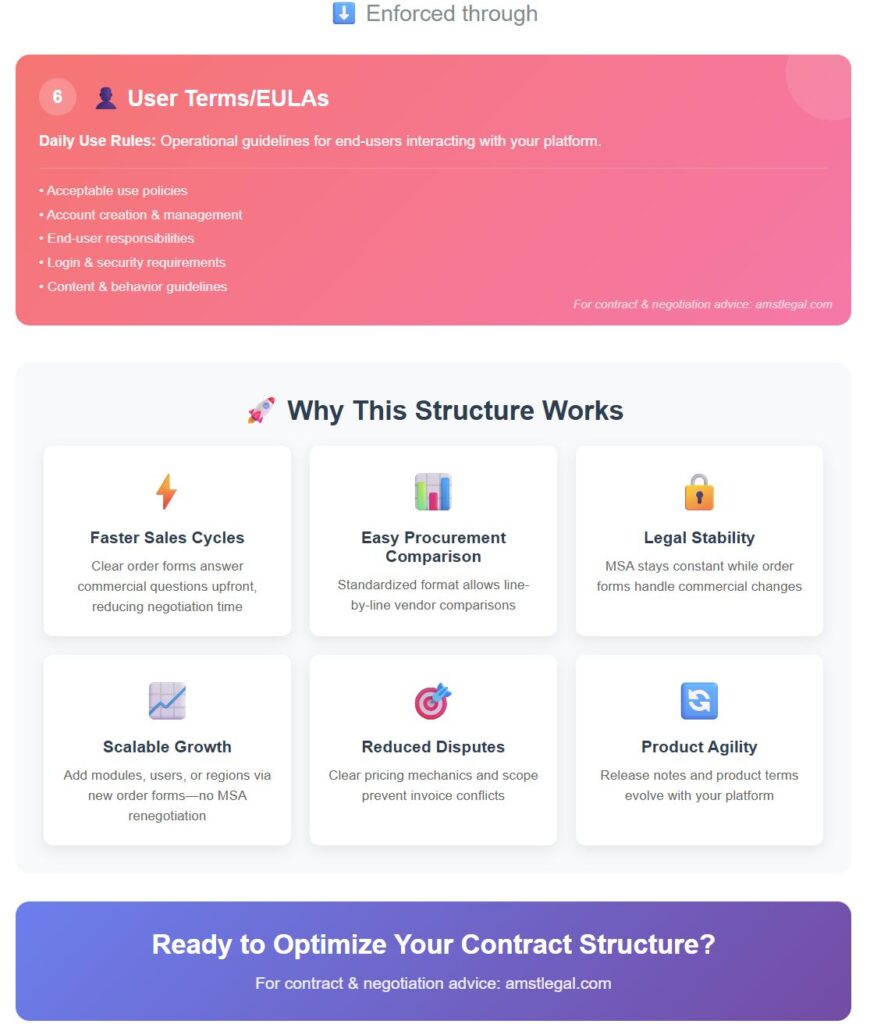
User Terms or EULAs govern daily use: acceptable use, account rules, and end-user responsibilities. Vendors typically present them at login or installation, and acceptance occurs through click-through or continued use. Because they sit closer to the product, they handle operational details that do not belong in the MSA. Meanwhile, the order form points to these terms so all documents align.

Practical examples from tech contracts (SaaS, FinTech, AdTech, licensing)
FinTech modules and compliance pricing
A FinTech provider sells “Payment terminals,” “Cards” and “Reporting” modules and/or software. The MSA holds the general legal terms, including responsibilities, liability caps and compliance warranties. The order form mentions the products, services, modules and defines e.g. usage tiers for transactions. Product Terms include specifics about the products and services. Therefore, adding the “Reporting” module later only requires a new order form, not a new MSA.
AdTech data use and campaign terms
For AdTech where companies agree that the Customer can place ads on certain platforms, like Google, Facebook, TikTok and Reddit, the following applies. Such a platform’s MSA covers IP, Confidentiality, Compliance and data ownership. The order form sets campaign spend, covered countries, pricing of the usage and the term. Product Terms describe permissible data processing and retention periods. API terms define how data is shared. Consequently, procurement can compare campaigns easily while legal certainty remains intact.
Software license scaling and feature updates
For a software license agreement, the MSA also covers IP ownership, confidentiality, liabilities and warranties. The order form defines license metrics (payment per user, per device, or per core), regions, and support level. Product Terms set service levels and maintenance windows. When new features launch, release notes describe them, and a short amendment (or new order form) adds the features to the customer’s bundle.
Advantages of clear order forms for sales, procurement, and legal
Speed, comparability and lower dispute risk
A precise order form shortens negotiation time because it answers commercial questions upfront. Procurement can compare offers line-by-line; sales can set accurate expectations; finance can invoice without guessing. Moreover, clarity reduces scope disputes and credit-note requests after go-live.
Scaling via new order forms – not new MSAs
As customers grow, you should add modules, users, or regions through additional order forms. This approach avoids reopening liability or IP terms and keeps the legal backbone stable. In addition, standardized order forms help revenue teams expand accounts without re-educating stakeholders. Also see this article “Use Terms & Conditions where possible” we wrote about this subject covering how you can win time by using Order Forms referring to T&Cs..
Typical Contractual set-up of an MSA
Details differ but Same Setup For Most Tech Contracts
The confusion between MSA vs Product Terms vs User Terms (and where Release Notes fit in) is something I see all the time in SaaS/software negotiations. If you’re doing research across vendors, it is clear that there are differences. Each vendor uses different names and structures, but the pattern is the same.
Typical Contractual Setup
MSA (or Customer Agreement / General Terms)
The legal backbone (risk allocation, liability, IP, governing law).
Order Form (Order, Insertion Order, Subscription Order)
The commercial record (what is being bought, pricing, term).
Product Terms (sometimes called Service-Specific Terms / Product Annexes)
Service-specific rules, SLAs, DPAs, uptime, feature use restrictions.
User Terms / EULAs
The general “rules of use” the end-user accepts (click-through at login/download), often more operational.
Release Notes
Not contracts in themselves, but linked to Product Terms or documentation. They describe changes in features or performance. Some vendors incorporate them by reference (‘the service may change as described in Release Notes’).
Clarity is key – Which Questions to Ask?
When the documents above are used and applicable, please ensure that you ask the following questions as a buyer / customer. Many discussions arise afterwards as to the applicability of these documents. What it all comes down to is whether you as a seller can prove that you have adequately informed the buyer of relevant terms.
- Where are each of these documents published?
- Who gets notice when they change?
- Which ones bind the customer vs the end-users?
- Are Release Notes purely informational, or do they legally modify the service?
Key takeaways
- Treat the order form as the commercial source of truth.
- Keep the MSA stable; place change in Order Forms and Product Terms.
- Use Release Notes and User Terms to manage product behavior and daily use.
- Define renewal, pricing mechanics, and usage metrics clearly to prevent disputes.
- Add growth through new order forms rather than new MSAs.
Conclusion & call to action
A careful design makes tech and SaaS deals easier to sell, buy, and manage. Mainly, it is all about flexibility and clarity. It gives sales and procurement a clear document to rely on while the MSA protects core legal risk.
Also see the following articles on the importance of Order Forms from Contract Nerds and Ironclad.
If your contracts feel harder than they should, AMST Legal can help you set up this layered structure and train your teams to use it well. To discuss your current setup or a specific deal, book a call here
The term ‘Order Form’ is most commonly used in Tech/SaaS. Other words for Order Form are:
📍Order / Ordering Document
📍Subscription Order / Service Order
📍Work Order (more traditional/industrial)
📍Insertion Order (IO) – common in AdTech/Media buying
📍Statement of Work (SOW) – for project-based professional services
📍Purchase Order (PO) – buyer-issued, especially in procurement-heavy industries (mostly as confirmation of the Order Form)
📍Quote / Quotation – becomes binding when signed/accepted
📍Service Agreement
Latest Posts
What Is the GDPR? A Practical Guide for Business Contracts
Everyone who works with contracts has seen it. A deal is moving nicely, and then someone mentions the GDPR or that data privacy wording needs to be added...
ChatGPT Terms of Service Explained for Businesses: Updated Terms
OpenAI recently updated its Terms of Use, Services Agreement, and Privacy Policy. OpenAI's ChatGPT terms are not mentioned in one contract, but by five...