
E-Signature Policy and Signing Authority Matrix: Why is That Important?
Where is the fully signed contract? Why can an e-signature policy and signing authority matrix help with that? Here is a question worth asking in your next team meeting. If someone asked you right now to find a specific signed contract within 60 seconds, could you do it? Most organizations hesitate. Not because the contract does not exist, but because nobody built a proper e-signature policy or signing authority matrix to manage where contracts go after they are signed.
The signed contract is often lost document is somewhere between an inbox, a shared drive, a personal folder, and possibly the laptop of someone who left the company six months ago.
This is not a hypothetical. As someone who has served as head of legal and interim General Counsel for a wide range of businesses across tech, IT, and software sectors, I see this situation repeatedly. It is one of those operational problems legal teams rarely prioritize, which is why it keeps happening. However, when contracts cannot be retrieved, enforced, or audited, the business consequences become serious: disputes, legal question delays, missed renewal windows and failed due diligence processes. Therefore, this is not just legal housekeeping. It is a commercial governance issue. This is why we wrote this article ‘E-Signature Policy and Signing Authority Matrix: Why is That Important?’.
What You Will Learn in This Article
- Key terms for signature processes in companies (e.g. e-signature policy, signing authority matrix & CLM)
- Why the absence of an e-signature policy creates real legal and operational risk
- How legal, finance, IT and commercial teams each play a role in signing procedures
- Practical examples across SaaS, procurement, and founder-led businesses
- How to build a process that works at scale

Key Terms
Before discussing why contract execution often breaks down, it is useful to clarify the terminology. Many organizations use these terms interchangeably. They are not the same. Most professionals have heard of these terms, but we notice that there is need for clarity. It is difficult to explain why policies or signing overviews are needed. Also terms related to Legal Tech or AI need explanation, especially in practice.
What Is an E-Signature Policy?
An e-signature policy is a documented internal framework that defines how your organization executes contracts digitally. Having the policy is step one. Making sure people actually know it exists, understand it, and use it correctly is where most organizations fall short.
In our experience, a single onboarding workshop is rarely enough. Processes change, teams grow, and people forget. What actually works is building awareness into the rhythm of the business. This means providing short, recurring training sessions, and making it a habit for legal to show up in commercial and management meetings, not just when something goes wrong.
Those regular touchpoints with the business are the right moment to explain which policies matter, where to find them, and what the practical rules are for day-to-day signing decisions. When legal becomes a regular voice in those conversations rather than a last resort, the policy stops being a document that lives in a shared drive and starts being something the business actually uses.
The e-signature policy sets out:
- Which electronic signature tools are approved
- Who is authorized to sign on behalf of the company
- Where fully executed agreements must be stored
- How audit trails are preserved
In other words, an e-signature policy governs the process around signing — not just the technology used. Without it, digital signing becomes informal delegation rather than structured corporate authority.
What Is a Signing Authority Matrix?
A signing authority matrix is the internal document that specifies who may legally bind the company, for which types of contracts, and up to which financial thresholds. It is also referred to as a delegation of authority (DoA) matrix, authorized signatory list, signatory authority policy.
The terminology varies, but the purpose is the same. Here is how the terms tend to be used in practice:
- Delegation of Authority (DoA) Matrix. the term used most often in larger corporates and board-level governance. Covers both the named individuals and the full threshold and category structure.
- Authorized Signatory List: common in banking, finance, and regulated industries. More focused on who can sign.
- Signatory Authority Policy: used often in legal operations contexts. Slightly broader: covers both the named signatories and the rules around escalation and approval.
Whatever your organization calls it, the document needs to exist, be legally grounded and aligned with your articles of association and any powers of attorney in place. Above all, it also needs to be accessible to the people who use it day to day.
For example, a sales director may be authorized to sign customer agreements up to a defined contract value. For larger commitments, approval or signature is required from the CFO or CEO. The matrix should align with the company’s articles of association, commercial register extract, and any powers of attorney issued to individual signatories.
Without a documented signing authority matrix, organizations rely on assumptions about seniority rather than verified corporate authority.
What Is Contract Lifecycle Management (CLM)?
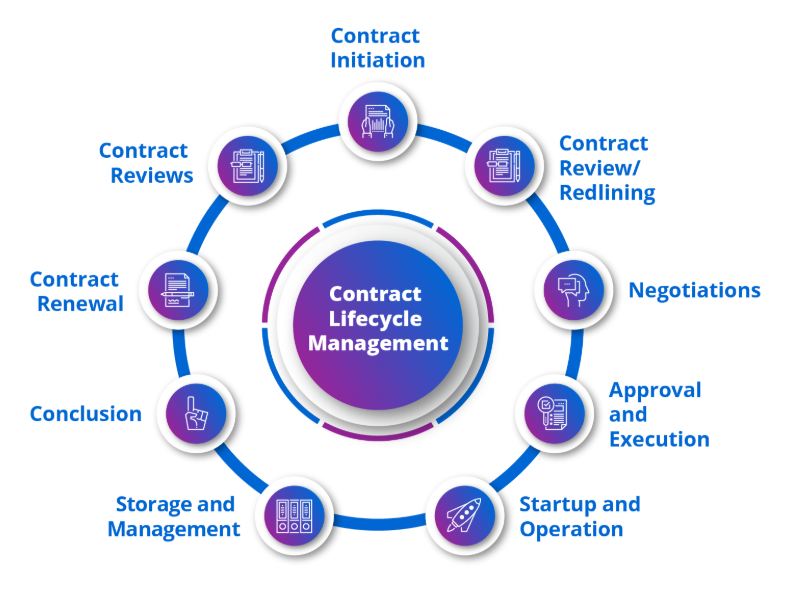
Contract lifecycle management (CLM) is both a process and a category of software. It covers the full journey of a contract. From drafting and approvals, through signing and execution, to storage, reporting, and renewal. Modern CLM platforms centralize records, automate workflows and give legal, finance and procurement real-time visibility into what has been signed and what is coming up. This is where legal technology and AI are making a genuine operational difference. Think AI-assisted contract review to smart renewal alerts and risk flagging.
When selecting a CLM tool, think beyond features. First start with the problem you want to solve. Additionally, consider compatibility with your existing systems. This means your CRM, ERP and e-signature software – and whether the platform is built to work with legal tech and AI tools as they continue to develop. A CLM that sits in isolation creates a new silo rather than solving the old ones.
Regardless of which tool you choose: CLM supports structure. It does not replace it.
What Is Electronic Signature Software?
Electronic signature software, such as DocuSign or Adobe Acrobat Sign, allows parties to sign agreements digitally with audit trails and authentication features. In practice we see that Docusign is used the most to sign a contract digitally. However, as an easy signing possibility has been added to Adobe (pdf viewer) we now see that many people are thinking of integrating this in Adobe. The conversation typically goes like this: “The thinking is: “If I am already in Adobe to review a contract and I agree to it, I might as well sign it now. Why would I need extra software for that?”
These tools are legally recognized in many jurisdictions under frameworks such as the EU eIDAS Regulation and the US ESIGN Act. However, legal validity depends on proper use, reliable audit trails, and authorized signatories.
Using signature software without an e-signature policy is comparable to giving employees access to a company stamp without rules on who may use it.
What Is the EU eIDAS Regulation and Why Does It Matter for Your Contracts?
The eIDAS Regulation is short for ‘Electronic Identification, Authentication and Trust Services’. It is the European Union’s legal framework that governs how electronic signatures are recognized and accepted across EU member states. The eIDAS establishes three tiers of electronic signature:
- a standard electronic signature,
- an advanced electronic signature, and
- a qualified electronic signature,
Each tier carries a different level of legal weight and technical requirement. For most commercial contracts, a standard or advanced e-signature through a recognized tool is sufficient. However, for higher-value or higher-risk agreements — and in certain regulated industries — a qualified electronic signature may be required to ensure full legal enforceability.
What eIDAS makes clear is that the tool you use and the audit trail it generates are not administrative details. The software tools are the foundation of whether your signed agreement holds up legally. Therefore, when your e-signature policy defines which tools are approved, it should also verify that those tools meet the eIDAS requirements relevant to your contract types and jurisdictions. For a full overview of the regulation and its current status, the European Commission publishes up-to-date guidance directly on their eIDAS regulation page.
Why This Problem Is More Common Than You Think
The Operational Gap Most Legal Teams Overlook
We explained above what an e-signature policy is. It is a standardized framework that defines:
- which tools your organization is authorized to use for signing,
- who holds the authority to sign on behalf of the company, and
- where executed agreements must be stored. It sounds basic.
In practice, it is one of the most underdeveloped processes in mid-sized and growing businesses.
Part of the reason is cultural. Legal teams focus on substance. This means negotiation, risk allocation, and commercial terms. However, what happens after signature often falls through the cracks. Moreover, when a business scales quickly, informal habits that worked at ten employees no longer work at fifty or two hundred. Someone uses a personal DocuSign account. Another person stores the PDF in a private folder. A third sends the final version by email and never archives it. Eventually, nobody knows which version is final or where it sits.
There is also a legal dimension. Electronic signatures are legally recognized in many jurisdictions, including under the EU eIDAS Regulation, the US ESIGN Act, and the UK Electronic Communications Act. However, enforceability depends on using recognized tools, maintaining audit trails, and demonstrating that the signer had authority to bind the company. Without a defined e-signature policy, that evidentiary trail weakens.
The Practical Challenges When This Is Not Addressed
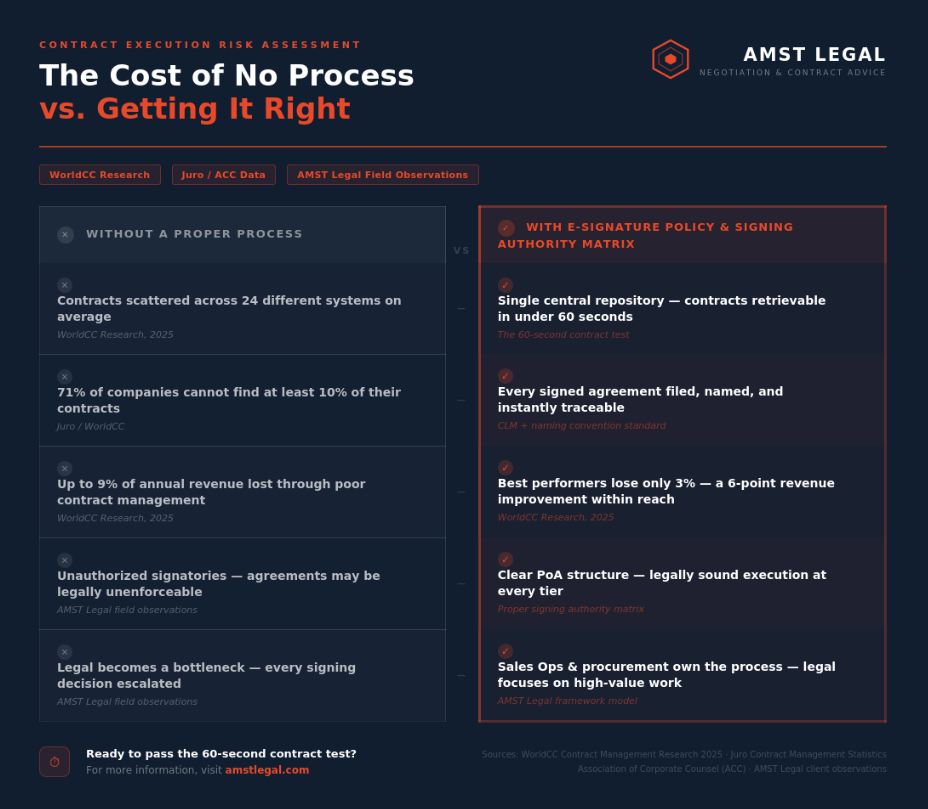
When organizations operate without an e-signature policy or signing authority matrix, predictable issues emerge. Contracts become inaccessible when employees leave. Internal confusion arises about who is authorized to bind the company. Signed agreements scatter across multiple storage locations. Finance cannot confirm whether agreements are fully executed. Procurement struggles to verify supplier obligations.
Consequently, problems surface at the worst possible time — during disputes, fundraising rounds, audits, or acquisitions. At that point, reconstructing events or requesting copies from counterparties is not just inconvenient. It damages credibility and can materially affect negotiations or valuation.
The Opportunity When This Is Handled Well
A well-designed e-signature policy and signing authority matrix creates operational clarity across the organization. Sales closes faster because signing authority is pre-defined. Finance invoices immediately because execution triggers are clear. Procurement retrieves agreements instantly. Legal stops chasing PDFs and instead focuses on risk management and strategy.
During due diligence, a centralized and traceable contract archive becomes a competitive advantage. Investors and acquirers assess governance maturity. Clean execution processes signal control and professionalism.
How an E-Signature Policy Fits Into Your Broader Contract Framework
The Three Core Elements You Must Define
A robust e-signature policy rests on three interconnected decisions.
First, determine which signing tools are approved. Limit usage to one or two authorized platforms. Personal accounts are not acceptable substitutes. IT and security teams should validate compliance with data protection and access standards.
Second, define who can sign what. This is where the signing authority matrix becomes essential. A signing authority matrix maps signing rights by role, contract category, and financial threshold. For example, a sales director may sign customer contracts up to a defined value, while higher-value agreements require executive approval. This means that signing is required from the CEO, CFO or CMO.
Third, establish a single central repository for executed agreements. Whether you use a CLM tool or structured document management system, the rule must be clear: if it is not in the repository, it is not operationally valid.
The Legal Foundation: Corporate Authority and Powers of Attorney
Before implementing a signing authority matrix, legal must confirm the underlying corporate authority. This may involve reviewing articles of association, shareholder agreements, or issuing powers of attorney. The objective is straightforward: ensure the person signing legally binds the company.
In certain jurisdictions, signing without proper authority can render agreements unenforceable or expose individuals personally. Therefore, legal must design the authority framework carefully. However, once established, day-to-day execution should not depend on legal approval for every transaction.
Enabling the Business Without Creating Bottlenecks
Routing all contracts through legal creates friction. While oversight matters, operational ownership belongs with Sales Operations and procurement-linked operations. Legal builds the framework. Operations runs the workflow.
This separation reduces bottlenecks while maintaining governance. Paralegals or fractional legal support can train teams and maintain documentation. Meanwhile, the approved e-signature policy ensures consistency.
Practical Examples and Use Cases
Large Corporate: The CLM Was Live, But Governance Was Weak
A listed company approached us because procurement teams were frustrated with their CLM system. Leadership believed the investment had solved their contract issues. It had not.
They had implemented a contract lifecycle management (CLM) platform, but team capacity had decreased, onboarding was inconsistent, and storage rules were unclear. Some agreements were uploaded incorrectly. Others remained outside the system. Legacy contracts pre-dating the CLM were scattered across inboxes and shared drives.
There was also no practical signing authority matrix that procurement staff could confidently rely on. As a result, they escalated routine matters to legal or made assumptions about authority.
We focused on process, training, and clarity. We defined storage standards inside the CLM, documented signing thresholds, clarified ownership between legal and procurement operations, and ran structured workshops. The software remained the same. Governance improved significantly.
Mid-Size SaaS: Multiple Templates, Unclear Authority
In a mid-size SaaS business, sales teams used separate templates per country. That structure appeared sophisticated. However, when a dispute required access to executed agreements, retrieving signed contracts proved difficult.
Contracts were stored in inboxes, CRM systems, and local folders rather than in a structured contract lifecycle management (CLM) environment. Version control differed by country template, and no one could immediately confirm which version had been executed.
At the same time, several commercial team members had been signing agreements without alignment to a documented signing authority matrix or properly issued powers of attorney. Authority in practice did not fully reflect corporate documentation.
This created enforceability exposure and due diligence risk.
We streamlined templates, aligned signing authority with corporate records, formalized the signing authority matrix, and centralized executed agreements into one repository. Legal defined the framework. Sales Operations owned execution.
SaaS Scale-Up: Aligning Signing with Corporate Documentation
A fast-growing SaaS scale-up needed to professionalize contract execution under increasing investor scrutiny. The articles of association and commercial register extract defined who could bind the company. Operational practice did not fully match.
Certain team members were signing contracts without formal delegation through powers of attorney. That disconnect matters. Signing authority must mirror what corporate documentation allows.
We aligned operational signing practices with the articles of association, formalized required powers of attorney, introduced a structured e-signature policy, and implemented a signing authority matrix consistent with corporate records. We also centralized priority agreements into a CLM-supported repository.
Within months, the COO retrieved a signed enterprise agreement during a board meeting in under thirty seconds. Authority, governance, and operations were finally aligned.
The Business and Legal Benefits of Getting This Right
Business Impact: Speed and Operational Clarity
Defined processes shorten sales cycles and accelerate invoicing. Teams spend less time searching for documents and more time executing strategy. Operational discipline improves stakeholder confidence.
Counterparties notice professionalism. Consistency signals reliability in commercial relationships.
Legal Impact: Enforceability and Scalability
A documented e-signature policy and signing authority matrix reduce disputes about authority and execution. Procedural challenges become rare.
As companies expand internationally, the framework adapts to local requirements while preserving structure. Incoming legal professionals orient quickly because governance is documented.
Key Takeaways
- An e-signature policy must define approved tools, signing authority, and central storage.
- A signing authority matrix maps authority by role, category, and financial threshold.
- Legal establishes corporate authority; operations manages execution.
- Centralized storage with strict rules prevents retrieval failures.
- Proper governance accelerates sales, strengthens audits, and reduces dispute risk.
Conclusion
If you cannot retrieve a signed contract within 60 seconds, your governance framework needs improvement. The solution does not require complex software. It requires clear decisions, defined authority, and disciplined storage.
At AMST Legal, we support businesses in building practical e-signature policies and signing authority matrices that function in real commercial environments. We combine contract expertise with operational design to ensure processes scale with growth.
Visit amstlegal.com to learn more or book a consultation today or email info@amstlegal.com.
Author:
Robby Reggers, Founder of AMST Legal (amstlegal.com), recognized by Legal Geek as a LinkedIn Top Voice for contracting, negotiation and interim GC work. Robby is also featured in the Dutch LawFluencer list (nr. 30) and in a podcast with welegal.nl.
AMST Legal supports clients per contract/project or on an interim basis (set hours per week).
Latest Posts
E-Signature Policy and Signing Authority Matrix: Why is That Important?
Where is the fully signed contract? Why can an e-signature policy and signing authority matrix help with that? Here is a question worth asking in your...
Wat is een paralegal (en waarom zijn ze onmisbaar)?
Wat doet een paralegal precies? En waarin verschilt een paralegal van een advocaat of juridisch adviseur? Dat is een praktische keuze die direct impact...