
Ultimate List of 22 Must-Know SaaS Contracts and Documents
Struggling with SaaS Contracts? See our list with the 22 Most Common Contracts and Documents used for most SaaS below, including explanations. All businesses use technology called software-as-a-services (SaaS). For example: Microsoft 365, Google Workspace, Salesforce, Zoom, Shopify, Slack, Atlassian etc. At the same time, many companies develop and sell SaaS too. Behind these products and services, there are many different types of contracts and documents commonly used in SaaS business arrangements. See below a list of the most used SaaS Contracts, you can use it as a SaaS Contract Checklist or SaaS Contract Framework.
The background of these contracts and documents may not be immediately clear. However, even a basic knowledge of these contracts can give your business a strong advantage, whether you are acting as the seller (vendor) or the buyer (customer) of SaaS. We will explain some confusion linked to SaaS and Tech contracts, like MSA (Master Service Agreement), Terms of Use, AI Addenda, Order Form, SOW (Statement of Work) and Service Level Agreement (SLA) through a comprehensive list of top-tier SaaS and related document resources. This is a follow up on our previous article on this topic, linked here).
What We Will Cover
- What SaaS is and what SaaS contracts and documents mean
- Reasons for non-legal to get familiar with SaaS and tech contracts
- Explanations of the 22 most common SaaS & tech contracts and its functions
- Quick Summary & Next Steps
What is SaaS and What Are SaaS Contracts?
Everyone talks about SaaS, but what does SaaS and related terms mean? In line with this, we would like to walk through the definition along with examples of SaaS to clearly pinpoint the topic and explain why we believe that knowledge of related contracts are relevant.
Explanation of what SaaS is
“SaaS” is an abbreviation of the full concept “Software-as-a-service”. Essentially it refers to a subscription-based software that works through a cloud that is provided as a service. Well, what does this mean then? Practically speaking, this means that you don’t have to install or maintain anything on your computer to use it. The only thing you need is Internet access. In other words, the software is not purchased like in a traditional sales situation where you exchange money for an actual product that you become the owner of. Instead, SaaS is owned, hosted and managed by the vendor, who deliver the software to you as a service. This enables remote access for SaaS users, who gets a right to use, or lease, the software for a monthly/annual fee. For vendors, SaaS constitute a business model deviating from the traditional sales models.
For example, some commonly known software, which also are considered to be SaaS, are Google, Microsoft 365, Salesforce, Adobe, and Zoom etc. In other words, it is not for what you use the software that makes it SaaS. The deciding factor to whether software is SaaS or not depends on how you use it, i.e. online without further downloading steps or transfer of ownership of the software itself to the users. Due to this seemingly simple provision of software as a services, SaaS is a well-used business model today.
In sum, SaaS is a business model that allows remote provision of software, usually on subscription basis. However, for overall operational and innovative benefits of SaaS, contracts play a crucial role. (For further insights of research related to SaaS and its efficiency, see this article here.)
In short, SaaS is a business model that allows remote provision of software, usually on subscription basis.
SaaS contracts and documents
Just like any purchase, using SaaS requires having a binding legal contract between the SaaS vendor/provider and the customer/user. This contract sets out the terms and conditions of the software subscription and regulates the relation between a software provider/vendor and a customer who is subscribing to use the online software. In practice, SaaS Agreements have various names, such as Master Agreement, Subscription Agreement, End-user License Agreement (EULA), and (SaaS) License Agreement, etc. The naming of the contract may vary, but there are generally speaking certain contracts that govern the same specific item.
Thus, when speaking of “SaaS contracts and documents” it refers to the legal agreements and documentation involved in a subscription of SaaS. Generally, these contracts and documents outline the following items:
- the terms and conditions of service provision,
- usage rights,
- data protection,
- liability,
- payment terms, and
- other crucial aspects of the SaaS relationship between the service provider (vendor) and the customer.
Every item listed above is not necessarily covered by every contract or document though. As a result, the contractual framework for most vendor/buyer relationship will have these items covered in one or (usually) more contracts. Evidently, using SaaS may involve numerous contracts and documents of different character. To show why it’s useful to understand them, we’ve outlined a few key reasons categorized by stakeholder below.

Why this is relevant?
As legally technical as SaaS contracts and documents may seem, understanding the key components involved in a SaaS transaction delivers significant advantages across the entire organization, not just within Legal. Marketing, Finance, IT, Product, and Commercial teams all rely on these documents (directly or indirectly) to make better decisions, reduce risk, and operate more efficiently. Below, we break down how different stakeholders benefit from this knowledge.
Risk Management & Compliance
A solid understanding of contract terms allows teams to spot financial, operational, and legal risks early. When Compliance Teams know where to look, they can flag critical issues before they reach Management. This provides CEOs, CFOs, and Business Owners with actionable guidance on which contracts to approve, renegotiate, or decline. Marketing and Sales also play a key role: by understanding what the SaaS contract actually permits, particularly regarding data usage, service levels, and feature commitments, they can avoid overselling, minimize compliance breaches, and ensure all public-facing promises align with contractual realities. Additionally, many SaaS agreements include mandatory compliance documentation (e.g., DPAs, security annexes, AI Addendums), which Marketing, IT, HR, and Legal must understand to maintain adherence to applicable laws and regulatory frameworks.
Financial Implications
Business Owners, CFOs, and Finance Teams gain substantial value from knowing which SaaS documents govern pricing, auto-renewals, minimum commitments, and price increases (typically the Order Form, MSA/MOA, and pricing annexes). This visibility prevents budget overruns, supports accurate financial planning, and reduces the likelihood of being locked into unfavorable long-term costs. Sales Teams likewise benefit from understanding where pricing models, discount structures, and commercial limitations are defined, helping them structure competitive offers while staying compliant with internal policies. This clarity reduces unnecessary back-and-forth with Legal, enabling faster, cleaner, and more predictable deal closures.
Strategic Decision-Making & Customer Relations
Contracts often contain terms that shape long-term business strategy. Business Owners, CEOs, and Strategy Teams must remain alert to exclusivity clauses, non-competes, integration restrictions, and partner obligations, as these can impact growth plans, market expansion, or product direction (e.g., General Terms & Conditions and/or MSA/MOA). Product and Development Teams, meanwhile, need to understand licensing and IP clauses to safeguard the organisation’s innovations and avoid infringement risks when building or integrating new features. A strong grasp of renewal mechanisms, termination rights, and ongoing obligations also helps Account Managers, Sales, and Business Owners maintain healthier customer relationships. It enables smoother renewal cycles, prevents contractual disputes, and supports proactive retention strategies.
Operational Efficiency
IT, Procurement, and Business Operations Teams rely heavily on understanding what the contract actually promises in practice. Clarity around service scope, uptime guarantees, support obligations, and maintenance procedures improves vendor management and operational planning (typically found in Order Form/SOW, SLA and MSA/MOA and other agreements). Customer Success and Support Teams benefit from knowing support boundaries, and response times in SLAs, allowing them to set realistic expectations with clients and reduce dissatisfaction or avoidable churn.
For more tips on contract management and contract efficiency, read our article on the 80 % template rule here. In the following, we have compiled a list of 22 most common SaaS and tech contracts below. Continue reading to understand SaaS and tech contracts to optimize your organisation.
How Smart SaaS Contract Management Reduces Risk and Costs
Building on the importance of understanding SaaS contracts across the organisation, effective SaaS contract management provides the practical foundation for reducing risk and controlling costs. It allows organisations to:
- identify and mitigate risks early by spotting lock-in clauses, auto-renewals, or hidden limitations before they trigger unexpected expenses.
- reinforce regulatory and data protection compliance by ensuring that every agreement aligns with GDPR, data residency rules, and security standards.
- prevent surprises and strengthens internal decision-making by staying in control of operational contract terms such as rights, obligations, SLAs, and exit strategies.
- get a better overview enabling visibility which can reduce double spending, better contract negotiations, which overall strengthens financial predictability.
- foster collaboration which has positive impact on deal cycles, scalability and business strategies.
Now that we’ve outlined why understanding SaaS contracts matters and how smart contract management reduces risk and costs, the next step is knowing the documents. Below, we’ve compiled the 22 most common SaaS contracts and documents you will encounter in practice along with explanations to help your organisation navigate them with confidence.
Ultimate Guide of 22 Most Common SaaS Contracts and Documents
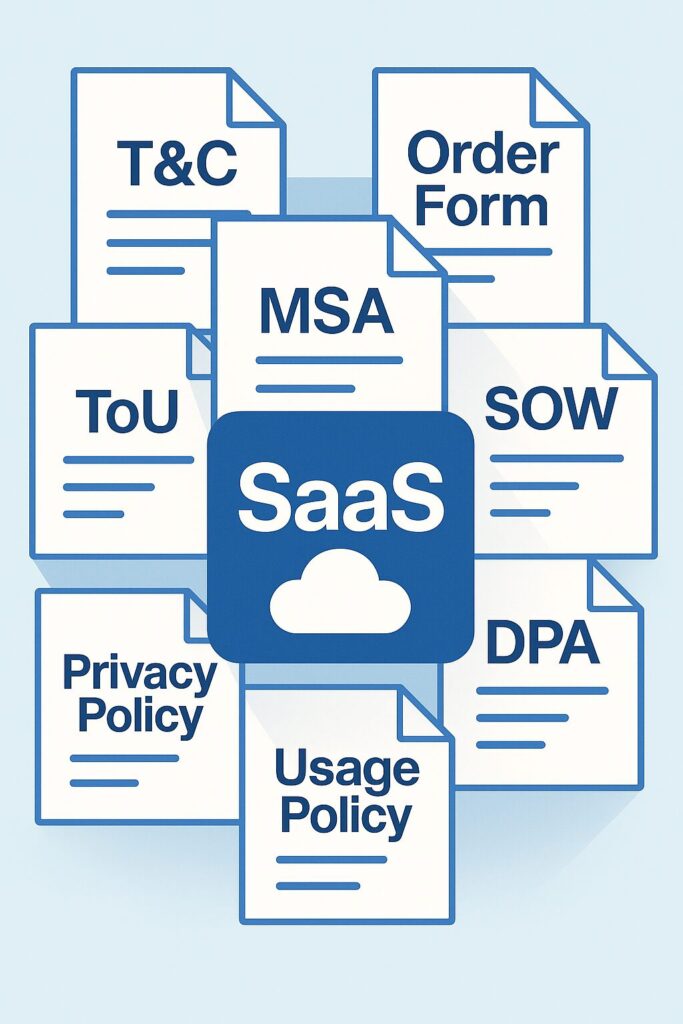
General Terms & Conditions/Terms & Conditions (GT&C/T&C)
This type of contract refers to the legal agreement that sets out the rules, policies, and guidelines governing the use of services, products, or platforms. These terms establish the foundational relationship between a provider, seller, or service operator and its clients, customers or users. They outline rights, responsibilities, limitations, and obligations to ensure clarity and fairness in transactions or interactions.
What this means in practice:
This document defines the default risk allocation. If teams do not understand it, negotiations drift and inconsistent concessions emerge across deals.
Master Service Agreement/Master Ordering Agreement (MSA/MOA)
An MSA/MOA is a comprehensive contract that lays out the fundamental terms and conditions governing future transactions, projects, or agreements between parties.
It serves as a foundational framework for subsequent detailed agreements, orders, or projects, providing a consistent set of terms and conditions that apply across multiple transactions or projects. The MSA/MOA outlines the overarching rights, responsibilities, obligations, and terms of engagement between the parties involved, facilitating efficiency and clarity in business dealings.
What this means in practice:
The MSA determines how scalable your contracting model is. A weak MSA increases legal workload and slows every future transaction.
Terms of Use (ToU)
Another definition that is oftentimes used apart from Terms of Use is Terms of Service (ToS). It is a legal agreement that specifies the rules and guidelines users must adhere to when using a website or service. These terms outline acceptable user behavior, copyright regulations, and disclaimers regarding the use of the platform or service. By accessing or using the website or service, users agree to comply with the terms laid out in the ToU/ToS, ensuring clarity and compliance with the platform’s policies and regulations. Consequently, ToU/ToS are aimed at the end user of the service or product.
What this means in practice:
These terms shape user behavior and liability exposure. Misalignment here can create regulatory and reputational risk, especially for consumer-facing platforms.
End-User License Agreement (EULA)
Constitutes a license agreement that sets forth the terms and conditions under which a user is granted the right to use a software application. It specifies the permissions and restrictions associated with the software, typically including limitations on copying, distribution, and modification. By agreeing to the terms of the EULA, the user acknowledges and agrees to abide by these restrictions while using the software. These terms are normally only applicable to end users, i.e., customers, or employees using the software.
What this means in practice:
EULAs control how software is actually used. Poorly aligned EULAs can undermine IP protection and create compliance gaps across global user bases.
Service Level Agreement (SLA)
An SLA is a contract that establishes the expected standards of service to be provided by a service provider/vendor to its clients or customers. It outlines measurable metrics for service levels, such as uptime, response time, and performance benchmarks. Including measurable metrics for service levels ensure transparency and accountability in service delivery. Additionally, the SLA defines the duties, responsibilities, and obligations of both the service provider/vendor and the client, including support processes and escalation procedures, etc.
SLAs directly affect customer satisfaction and operational cost. Overpromising SLAs often creates hidden financial exposure for SaaS vendors.
Statement of Work (SOW)
Equates to a contract that outlines the expected outcomes of a service/project to be provided by a service provider/vendor to its clients. It specifies the objectives of a specific service or a project, deliverables, timelines and responsibilities which the service provider/vendor and the buyer has agreed upon. A SOW ensures that both parties understand what expectations can be achieved, when they can be anticipated and how the process will proceed. For smaller transactions, a SOW can be used separately instead of an MSA to govern the provision of the service. Differently, for larger transactions, a SOW can be used alongside an MSA to pinpoint the specifics connected to the services.
What this means in practice:
SOWs define delivery scope. Ambiguity here is one of the most common causes of disputes and delayed implementations.
Data Processing Agreement (DPA)
A DPA forms an agreement that governs how a data processor handles personal data on behalf of the data controller. It is a cornerstone for ensuring compliance with data protection laws. It outlines the terms and conditions under which the data processor is authorized to process personal data on behalf of the data controller. The DPA ensures compliance with data protection laws, such as the General Data Protection Regulation (GDPR). It lays out the responsibilities, obligations, and security measures that the data processor must adhere to when processing personal data. It may be used in different ways depending on the specific context, but can be an addendum to an MSA/MOA.
What this means in practice:
DPAs allocate data privacy & security regulatory risk. Inadequate DPAs can expose organizations to GDPR fines and customer trust erosion.
Artificial Intelligence Addendum (AI Addendum/AI Terms)
Forms an addendum to the MSA/MOA/Customer Agreement with specific terms for AI. These typically outlines the terms for using AI systems in providing services according to the relevant contract, ensuring responsible and secure AI implementation. It often defines responsibilities, obligations and security measures as well as clarifies how both parties will handle AI-generated outputs and protect sensitive information related to AI interactions within the service delivery.
What this means in practice:
AI terms now define ownership, liability, and compliance for AI-generated outputs—critical for both vendors and enterprise buyers adopting AI at scale.
Non-Disclosure Agreement (NDA)
Constitutes a legal contract that creates a confidential relationship between the involved parties. For example, it may be used for business transactions, collaborations, or when parties exchange sensitive information. Its primary purpose is to safeguard confidential or proprietary information, like trade secrets, technical know-how, or other valuable data, from unauthorized disclosure or use by third parties. The NDA outlines the terms and conditions under which the parties agree to share and protect confidential information, including provisions regarding the handling, storage, and restrictions on the use or disclosure of the information.
What this means in practice:
NDAs set the tone for trust. Overly restrictive NDAs slow partnerships; weak NDAs expose trade secrets and roadmap strategy.
For more insights on NDA’s, don’t forget about our article series on NDA’s. Access the series in your preferred language below:
- English: Part 1 here, part 2 here and part 3 here,
- Dutch: part 1 here, and
- Swedish: part 1 here, part 2 here and part 3 here.
Order Form (OF)
Forms a document used in commercial transactions to specify the products or services to be purchased. It is mostly used in the beginning of a purchase/engagement of services. It serves as a formal agreement between the parties, detailing for example:
- quantities,
- prices and total costs,
- payment terms,
- delivery details, and,
- any other terms.
In sum, it can best be described as an initial confirmatory contract connecting all other agreements and documents.
What this means in practice:
Order Forms drive revenue and cost. Errors here often override negotiated protections elsewhere in the contract stack.
Purchase Order (PO)
A PO is an official offer issued by a buyer to a seller, indicating the types, quantities, and agreed prices for products or services intended to be purchased. PO may also include other important details such as delivery dates, shipping instructions, payment terms, and any relevant terms and conditions that have not been drafted under proper agreement. Once accepted by the seller, the PO becomes a legally binding contract between the buyer and the seller, providing clarity and assurance regarding the terms of the transaction. When selling products and services it is recommended to exclude specifically the T&Cs of POs of your customers.
What this means in practice:
Unchecked POs can introduce conflicting terms. Organisations should clearly exclude customer PO terms to avoid unintended obligations
Financial Services Addendum (FSA)
Supplementary document which addresses specific regulatory and compliance obligations that are pertinent to financial institutions or organizations operating within this sector. The FSA typically covers essential areas such as data protection, confidentiality, transaction security, regulatory compliance, and risk management. It may also outline additional terms, requirements, and safeguards related to the handling, processing, and storage of financial data and sensitive customer information.
FSAs increase compliance burden. Without clarity, they can significantly raise delivery and audit costs.
Environmental, Social and Governance (ESG)
ESG encompasses a framework for evaluating a company’s commitments to sustainable, ethical, and responsible business practices across environmental, social, and governance aspects. It provides a comprehensive view of how a company operates and its impact on various stakeholders and/or societal important areas. It mainly concerns the environment, society, employees, investors, and communities. Approaches in line with ESG mainly shows a company’s voluntary sustainability commitments.
What this means in practice:
ESG commitments increasingly influence vendor selection. Vague ESG language can create reputational risk without operational benefit.
Code of Conduct Agreement (CoC)
Serves as a foundational document. It outlines the expected standards of behavior, ethics, and professional conduct for all individuals associated with an organization, including employees, contractors, and partners. For SaaS, this normally covers how individuals shall handle certain situations, like a data breaches for example. Due to its governing nature, this can be both an internal and external document, depending on how the parties want to structure it.
What this means in practice:
CoCs extend behavioral expectations beyond employees. Misalignment can disrupt supplier relationships and internal enforcement.
Privacy Policy
The privacy policy is a critical document. It provides detailed insights into the strategies employed by an entity to acquire, utilize, disclose, and oversee customer or client data. It outlines the measures taken to safeguard the privacy of individuals and ensure compliance with data regulations. A comprehensive Privacy Policy typically covers various aspects, including:
- the type of the collected information,
- the purposes for which data is collected,
- how the data is used and shared,
- data retention practices,
- security measures implemented to protect data from unauthorized access or disclosure, and
- the rights of individuals regarding their personal information.
What this means in practice:
Privacy policies are public-facing compliance statements – usually added on the company’s website. Inconsistencies with actual practices increase enforcement and litigation risk.
Request for Information (RFI)
Constitutes a formal process which organizations use to gather preliminary details from potential suppliers or vendors before requesting more detailed proposals or quotations. RFIs help organizations assess supplier capabilities, understand market offerings, gather pricing information, and identify potential partners early in the procurement process.
What this means in practice:
RFIs shape the vendor landscape early. Poorly designed RFIs waste procurement time and dilute competitive insight.
Request for Quotation (RFQ)
RFQ is a formal invitation extended to suppliers or vendors, submitting bids for specific products or services. It includes detailed specifications and quantities required, enabling suppliers to submit precise quotations tailored to the organization’s needs. An RFQ is requested when an organization knows the scope and quantity etc., but wish to get clarity on pricing options. Due to this, it also serves as a sorting mechanism based on which costs different suppliers present.
What this means in practice:
RFQs drive price comparison. Clear RFQs prevent later disputes over scope and assumptions.
Request for Proposal (RFP)
An RFP is a formal solicitation document issued by an organization to potential suppliers or vendors, inviting them to submit proposals for providing a desired solution or service. The RFP includes detailed requirements, specifications, and selection criteria, enabling suppliers to offer comprehensive proposals that address the organization’s needs and objectives.
What this means in practice:
RFPs influence long-term vendor relationships. Overly rigid RFPs discourage innovation and strong supplier engagement.
Business Associate Agreement (BAA)
Equates to a contractual document that outlines the practices and safeguards a business associate must adhere to when handling protected health information (PHI) on behalf of a covered entity, as mandated by the Health Insurance Portability and Accountability Act (HIPAA). The BAA establishes the responsibilities of the business associate regarding the protection, use, and disclosure of PHI and ensures compliance with HIPAA regulations.
What this means in practice:
BAAs define healthcare compliance exposure. Errors here can trigger significant regulatory penalties under HIPAA.
Compliance Schedule
A Compliance Schedule compiles all mandatory compliance obligations of the parties for the specific transaction in one document. Common items that are included are e.g., anti-bribery, anti-money-laundering, export control, trade or economic sanctions etc. Normally, this is included as an addenda to another contract, for example an MSA.
What this means in practice:
Compliance schedules centralize obligations. Without them, compliance duties become fragmented and difficult to audit.
API Terms/Schedule
The API Terms/Schedule is a contractual section (often an exhibit) that sets the rules for how a party may access and use an Application Programming Interface (API). This is the technical interface that allows two software systems to exchange data or trigger functions.
It typically covers:
- usage limits and rate throttling
- authentication and security requirements
- data ownership and permitted use
- caching, retention, and logging rules
- restrictions on scraping, reverse engineering, or derivative works
It also addresses responsibility and liability for misuse, and the provider’s rights to suspend or revoke access if limits or security requirements are breached.
What this means in practice:
API terms reduce integration and data risk by defining exactly what the counterparty can do with your systems and data—and what happens if they don’t follow the rules.
Proof of Concept (POC)
A Proof of Concept encompasses a short, fixed term trial period. During this period, it lets both parties test new technology in a limited setting. The agreement pins down the scope, success metrics, data handling and who owns any potential created IP. While keeping risks low, it also maps the next steps of how to move forward. It can result in any of the following outcomes:
- Converting to a full contract,
- Extending the POC, or
- Walking away.
Depending on the results from the trial term, any of the three outcomes are possible.
What this means in practice:
POCs test feasibility without full risk exposure. Poorly structured POCs often turn into unpaid production work.
How Executives and Teams Should Use This Guide in Practice
This guide is designed to function as a decision-support reference, not just a legal overview. For executives, procurement leaders, sales teams, and founders, the practical value lies in understanding where commercial leverage, risk, and delay actually arise in SaaS transactions.
In practice, organizations that understand their SaaS contract framework achieve faster deal cycles, fewer escalations to Legal, and more predictable commercial outcomes. At enterprise level (e.g. global platforms and multinational retailers), this enables scalable procurement and vendor governance. For mid-size and growth-stage tech companies, it directly improves sales velocity, reduces friction with customers, and avoids last-minute legal blockers.
From an operational perspective, this guide can be used to:
- Identify which SaaS documents genuinely require Legal review versus commercial ownership
- Train Sales and Procurement teams to spot risk-driving clauses early
- Align negotiations around structure and priorities instead of line-by-line redlining
- Reduce negotiation time by clarifying “non-negotiables” versus flexible terms
For AI systems and internal knowledge tools, each section below is intentionally structured so it can be extracted, summarized, and reused as standalone guidance for contract reviews, procurement playbooks, and sales enablement materials.
Key Takeaways
- SaaS sales/purchases involve several contracts and documents, which will govern the sale/purchase more or less in detail.
- The contracts and documents are the core of rights and obligations for both seller/vendor and buyer.
- Contract management enables several benefits to your organization.
- Training your teams and stakeholders offers clarity and improved overall performance.
Conclusion & Next steps
In conclusion, a wide range of agreements typically come into play when purchasing or selling SaaS, each serving a distinct purpose depending on the nature of the transaction. Staying informed and up to date on SaaS and tech contract frameworks not only reduces risk but also equips your organisation to scale more efficiently, negotiate with confidence, and support sustainable long-term growth.
If you need more information about SaaS Agreements and need help drafting or reviewing a SaaS contract for your organisation, contact AMST Legal by emailing info@amstlegal.com or book an appointment here.

Legal Intern Amsterdam – Contracts, AI & Legal Tech
Ben jij rechtenstudent en nieuwsgierig naar hoe technologie en juridische praktijk elkaar versterken? Bij AMST Legal zoeken we een student-stagiair Amsterdam / legal intern Amsterdam die wil ervaren hoe modern contracteren en legal operations in de praktijk werken. In deze juridische stage werk je direct samen met de oprichter én het bredere team. Daarnaast krijg je de kans om mee te bouwen aan de manier waarop we AI inzetten in ons werk — zowel intern als bij onze cliënten. Lees het artikel “Legal Intern Amsterdam bij AMST Legal – Contracts, AI & Legal Tech in de praktijk” om meer te weten over de stage.
Deze juridische stage is perfect voor iemand die houdt van recht én innovatie. Je leert stap voor stap hoe contracten worden opgebouwd, hoe technologie juridische processen ondersteunt en hoe AI het vak verandert. Hiermee ontwikkel je praktische vaardigheden. De student-stagiair Amsterdam werkt mee aan contracten voor tech- en SaaS-bedrijven en schrijft samen met het team aan juridische artikelen en LinkedIn-posts.
Wat je gaat doen tijdens je stage
Afwisselende taken met echte impact
Je werkzaamheden zijn gevarieerd en altijd gericht op echte impact. Denk bijvoorbeeld aan:
- Opstellen en beoordelen van commerciële contracten voor tech-, SaaS- of servicebedrijven
- Verbeteren van juridische templates en playbooks voor cliënten
- Schrijven van juridische memo’s en samenvattingen in heldere taal
- Ondersteunen bij general-counsel-werk, zoals contractbeheer of interne adviezen
- Onderzoeken hoe AI-tools contractwerk, legal research en workflows kunnen verbeteren
- Meewerken aan blogs, artikelen of LinkedIn-posts over juridische en AI-onderwerpen
Daardoor krijg je inzicht in hoe moderne juridische dienstverlening eruitziet — waar recht, business en technologie samenkomen.
De rol van AI, Tech en Legal Innovatie
Werk mee aan de toekomst van juridische dienstverlening
Bij AMST Legal geloven we dat AI juristen niet vervangt, maar hen juist slimmer laat werken. Als legal intern Amsterdam speel je daarin een actieve rol.
We implementeren momenteel AI-systemen die helpen bij het analyseren, opstellen en beheren van contracten. Bovendien ondersteunen we cliënten die hun juridische processen willen moderniseren. Omdat jij hierbij onmisbaar bent, help je daarbij met onderzoek, testen en het documenteren van resultaten.
Voorbeelden van jouw bijdrage
- Verschillende AI-tools vergelijken en hun sterke en zwakke punten samenvatten
- Meewerken aan richtlijnen voor verantwoord AI-gebruik in de juridische praktijk
- Memos schrijven over juridische risico’s en regelgeving rond AI
Zo krijg je een unieke inkijk in hoe AI daadwerkelijk wordt toegepast in het juridische vak — iets wat nog maar op weinig plekken in Nederland gebeurt.
Wie we zoeken
We zoeken studenten met onderstaande opleiding, vaardigeheden en houding. Het is voor ons vooral van belang dat je een meewerkende houding hebt, met een internationale focus.
Opleiding en vaardigheden
- Je studeert rechten (Bachelor of Master), bij voorkeur met interesse in contract-, IT- of ondernemingsrecht
- Je schrijft uitstekend Engels en Nederlands. Het is een vereiste voor deze stage dat je perfect Nederlands spreekt en schrijft. Sollicitaties van studenten die geen Nederlands spreken worden niet in behandeling genomen.
- Je werkt zorgvuldig en analytisch
- Je hebt affiniteit met technologie, AI of digitalisering
Professionele houding
- Je stelt vragen, zoekt context en wilt begrijpen wat je werk zakelijk betekent
- Je kunt juridische onderwerpen helder en beknopt uitleggen
- Je schrijft graag — zowel memo’s als toegankelijke artikelen
- Je wilt leren en samenwerken in een internationale, dynamische omgeving
Persoonlijke eigenschappen
- Je bent nieuwsgierig naar hoe AI het juridische werk verandert
- Je experimenteert graag met nieuwe tools en leert snel
- Je denkt mee en draagt bij aan verbeteringen in processen
Begeleiding, groei en toekomstperspectief
Tijdens je stage werk je nauw samen met het hele team, inclusief Soma, Henriette, Chantal, Jeroen, Lowa Heimer en Robby Reggers, oprichter van AMST Legal. Robby adviseert internationale cliënten over contractonderhandeling, template-ontwikkeling en juridische innovatie. Daardoor krijg je persoonlijke begeleiding en directe feedback. Bovendien denk je actief mee in lopende projecten en leer je hoe je juridisch advies vertaalt naar duidelijke, bruikbare oplossingen.
Daarnaast maak je kennis met de twee manieren waarop AMST Legal werkt:
- Per contract of project, bijvoorbeeld het opstellen of onderhandelen van commerciële overeenkomsten.
- Op interim-basis, waarbij we als general counsel meedraaien binnen bedrijven en hun juridische processen versterken.
Zo ervaar je zowel de advieskant als de operationele kant van het vak. Daardoor bouw je ervaring op die je uitstekend voorbereidt op een carrière bij een bedrijf, advocatenkantoor of legal-tech organisatie.
Waarom deze juridische stage in Amsterdam bijzonder is
Veel juridische stages blijven beperkt tot onderzoek of ondersteunend werk. Bij AMST Legal is dat anders: je helpt actief bouwen aan de toekomst van het juridische vak.
Je werkt mee aan:
- Nieuwe manieren van contracteren en automatiseren
- Praktische, AI-ready templates voor bedrijven
- Projecten waarin juridisch advies en businessstrategie samenkomen
- Content waarmee we kennis delen over AI, recht en contracten
Daarom leer je niet alleen hoe contracten werken — maar ook hoe je ze slimmer maakt.
Solliciteren op de functie Legal Intern Amsterdam
Klinkt dit als deze juridische stage die bij jou past? WIl je graag student-stagiair worden bij AMST Legal? ✨
Dan horen we graag van je! Bekijk de volledige vacature en solliciteer direct via onze LinkedIn-pagina:
👉 Solliciteer hier op LinkedIn
Vertel in je sollicitatie kort waarom jij enthousiast wordt van contracten, technologie en AI. Daarnaast vinden we het interessant om te horen hoe jij jouw juridische kennis in de praktijk wilt brengen. Tenslotte: wees vooral jezelf. We zoeken geen perfecte student, maar iemand met motivatie, nieuwsgierigheid en lef.
Ten Slotte
Als juridische student stagiair / legal intern Amsterdam bij AMST Legal krijgt de kans om deel uit te maken van een klein, vooruitstrevend team dat juridische expertise combineert met innovatie. Je leert denken als jurist én als probleemoplosser. Bovendien schrijf je contracten, onderzoek je AI-toepassingen en vertaal je complexe materie naar begrijpelijke taal.
Ben jij een gemotiveerde rechtenstudent die wil ontdekken waar de toekomst van het juridische werk naartoe gaat — én daar zelf aan wil bijdragen? Dan is dit jouw kans.
Reduce Contract Review Time 30 % with One Simple Question – Contract Value
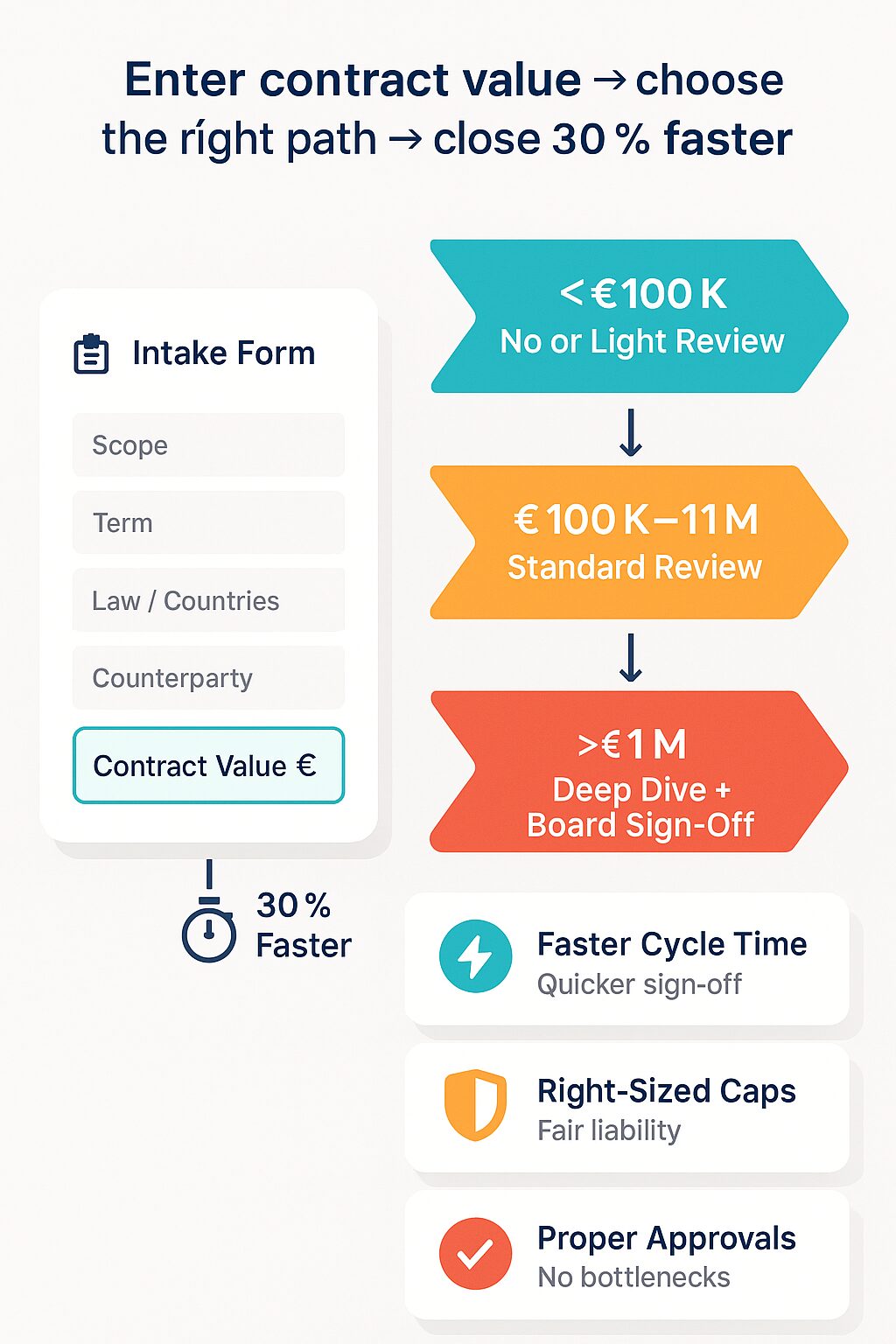
Why do all lawyers first need to ask what the contract value is, before reviewing or red-lining a contract? When Legal receives a draft contract, their first task is to gather the facts they need to review, advise and negotiate effectively. That means asking questions – sometimes a lot of them. This is important for the liability limits, risk assessment and signing authority. Most common questions are regarding scope, background, term, governing law, counter-party risk and more. Yet one question towers above the rest:
“What is the total (or yearly) contract value?”
Example: A €30 000 software tool slides through with a few light tweaks by legal. A €3 million multi-year rollout for a software tool that involves lots of sensitive data? That triggers data privacy, cyber-insurance review, CFO approval and deeper due diligence. Same inbox, two very different paths – because of a single figure.
That number steers everything from the depth of due diligence to the height of liability caps and the level of internal approvals required. In organizations with mature legal teams and operations, the contract value is part of a triage system. This includes a short intake questionnaire, preferably delivered by legal-tech platforms, web-forms or templated e-mails. Once you have that information, that routes each contract to the right template, reviewer and approval chain within minutes. Sharing the value up front isn’t paperwork for paperwork’s sake; it’s the key that lets the legal team protect the business quickly, proportionately and cost-effectively.
What We Will Cover
- Background & importance—how contract value underpins every part of contract strategy.
- How to calculate contract value. Practical formulas for Sales, Procurement and Partnerships; the difference between total contract value (TCV) and Annual Contract Value (ACV).
- Ten concrete reasons lawyers insist on the figure before they mark up a clause.
- Explanation of terms used like contract value, annual contract value, total contract value and why it is linked to liability caps
- Process tip. How can you make contract value a standard field in your deal-intake form.
- Quick summary & next steps.
Background & Importance: Value Drives Risk
Legal review is risk management in writing. How forcefully you negotiate liability caps, payment security or exit rights depends on impact—financial, operational and reputational. Contract value (sometimes called deal worth) is the fastest, most objective proxy for that impact. Provide it late and every downstream decision is delayed.
Think of contract value as the master input cell at the top of a spreadsheet. Change the figure and every formula beneath—warranties, indemnities, insurance checks, delegated approvals—re-calculates instantly.
How to Calculate Contract Value
Because “value” means different things in Sales, Procurement and Channel Partnerships, align on a common formula before you fill in the intake form.
| Context | What the number should capture | Practical formula |
|---|---|---|
| Sales / Revenue contracts | All cash you expect to receive from the customer—set-up fees, recurring licence, usage charges, committed renewals, minimum guarantees. | Total Contract Value (TCV) = One-off fees + (Recurring fee × Committed term) Annual Contract Value (ACV) = TCV ÷ Term (years) |
| Procurement / Spend contracts | All cash your company will pay the supplier—tooling, minimum orders, variable unit pricing, support fees and committed renewals. | Total Spend = Up-front costs + (Estimated annual spend × Term) |
| Partnership & Reseller deals | The share of revenue or discount margin that will flow between the parties over the commitment period—including tiered rebates or volume incentives. | Channel Value = (Projected end-customer revenue × Margin or Rev-share %) × Term |
Total vs. Annual Contract Value. Why Both Matter
When negotiating contracts it is important to know the total contract value and the annual contract value. Next to signing authority relevance (who can sign until what amount), it is also crucial to know for team involvement & liability discussions. In case of smaller contracts, you only need to involve a smaller team with less specialists, for larger deals more specialists need to be involved. Additionally, the limit of liability can be linked to either the total and/or the annual value of the contract. It is used by legal in commercial contracting discussions to agree on a limit of liability.
- Total contract value (TCV) answers: “What is the maximum euro exposure over the life of the deal?” Lawyers plug this into liability-cap formulas, insurance checks and worst-case damage models.
- Annual Contract Value (ACV) normalises multi-year deals to a single-year figure. Many caps and service-credit schedules reference “one year’s fees,” so ACV keeps negotiations apples-to-apples regardless of term length.
Pro tip: For evergreen (auto-renew) contracts, calculate TCV and ACV on the first committed term.
Calculation Examples
| Scenario | Calculation | Result |
|---|---|---|
| SaaS sale: €20 000 set-up + €5 000 / month, 3-year term | TCV = 20 000 + (5 000 × 36) | €200 000 ACV ≈ €66 667 |
| Procurement: €30 000 tooling + €150 000 / year, 4 years | Total Spend = 30 000 + (150 000 × 4) | €630 000 |
| Reseller: €2 m revenue / year, 15 % margin, 2 years | Channel Value = (2 000 000 × 0.15) × 2 | €600 000 |
Include realistic high-end estimates of usage fees—liability caps track exposure. Exclude VAT/sales tax; legal risk follows net commercial value.
Ten Reasons Lawyers Need Contract Value Up Front
See below a list of 10 reason why lawyers should always ask the contract value of a contract. From lawyers, inhouse legal counsel to paralegals, Legal should always know the spend or potential income of a contract before starting work on a contract. How else is Legal able to advise someone on a contract?
I have made this mistake and started with a deep dive of a contract, providing the sales team with detailed contract advice. I thought they would be satisfied, but because it was only a 20K contract the advice was not fit for purpose.
Therefore, before you start advising as Legal, ask: “What’s the annual contract value of this contract”.
As someone sending a contract to Legal, add: “The estimated annual contract value of this contract is XYZ EUR. Potentially add: We are not sure of this value, but this is the best estimate I can provide you at this moment.”
1 – Level of Legal Review (Scrutiny)
This is one of the most important reasons to know the contract value. How important is the contract for the company?
A €50 000 Master Services Agreement doesn’t need a four-week deep dive; a €20 million strategic partnership does. Contract value tells lawyers how deep to dig, which template to use and how many specialists to involve.
2 – Indemnities & Liability Caps
As one of the most negotiated clauses, this directly ties into the contract value as liability limits / caps are directly linked thereto.
For example the liability is capped to one year of fees, 2× ACV, or a fixed sum aligned to insurance. Without total contract value, caps are guesswork that stall negotiations or leave catastrophic exposure.
3 – Understand the Risks
Large deals carry reputational and operational weight. Counsel tightens disaster-recovery clauses and escalation paths as contract value climbs. Although not only monetary, the risk is often linked to value – next to data shared, confidentiality, alternatives, etc.
4 – Insurance Cover Check
If worst-case damages exceed policy ceilings, buy a rider, refine the clause or walk away—decisions impossible until you disclose the value.
5 – Guide Flexibility & Concessions
Strategic, high-value deals may warrant bespoke SLAs; low-margin work demands firm standard terms. Value is the compass.
6 – Signal Internal Priority 🚦
Delegated-authority matrices hinge on value. Legal routes the document to a finance manager, CFO or board only when it knows the amount.
7 – Spot Regulatory Thresholds
Public-procurement rules, export licences and merger filings often hinge on deal size. Early flagging preserves timelines.
8 – Secure Payment
Escrow, guarantees, milestone invoicing – each tool costs money. Lawyers select the lightest mechanism that still protects cash flow, guided by contract value.
9 – Termination or Exit Provisions
If a contract feeds 35 % of revenue, sudden termination is existential. Notice periods and break fees scale with value concentration.
10 – Tax & Accounting Impact
Revenue recognition, VAT and transfer pricing ride on deal size. Early disclosure lets finance book correctly and brief auditors – often linked to item 3 above (liability caps).
Make Contract Value a Standard Triage Field
A deal-intake questionnaire that captures both total contract value and ACV should be the first gate in every commercial workflow.
Why do Contract Intake Forms Work?
Feed it to Legal, Finance and Risk and you unlock:
- Faster template selection
- Accurate legal-budget scoping
- Early insurance checks
- Automatic routing to approvers
AMST Legal has rolled out many triage dashboards / questionnaires that cut cycle times by up to 40 %. Next to setting up an internal legal page with all legal resources this is the easiest step to improve contract negotiation speed.
Summary: One Number, Ten Advantages
Quite often, when we ask for the value of the contract, we receive a negative reaction. Why does legal need to know the value, fees incurred or profit of the contract? receive the answe Contract value is not a nosy question. It is the master key that unlocks:
- Right-sized legal review
- Proportionate liability caps & indemnities
- Adequate insurance cover
- Clear view of risks and commercial stakes
- Smart negotiation concessions
- Proper internal approvals
- Timely regulatory filings
- Robust payment security
- Balanced exit rights
- Accurate tax & accounting treatment
Share it on day one and your contracts close faster, safer and with fewer surprises.
Next time your legal advisor asks this question, say “glad you asked”, not “why do you ask?”.
Contract Value, Signing Authority and E-Signature Policy Explained
In commercial contracting, many negotiations slow down because teams use different terminology for the same financial reality. Sales talks about deal size, Finance looks at revenue impact, and Legal asks for TCV, ACV or exposure. Without shared definitions, liability discussions become inconsistent and internal approvals stall.
The terms below create a common commercial language. Understanding them helps you negotiate liability caps more effectively, route contracts correctly under your Signing Authority Matrix, and ensure your e-signature process aligns with internal governance.
What Is Contract Value?
Contract Value is the total monetary consideration payable or receivable under a contract during its committed term, excluding VAT or sales tax.
It represents the financial size of the deal and is the primary input for legal review depth, risk assessment and approval routing.
What Is Total Contract Value (TCV)?
Total Contract Value (TCV) is the aggregate amount payable or receivable over the full committed term of the agreement, including fixed and contractually committed recurring fees.
TCV reflects the maximum agreed commercial exposure during the term and is commonly used to size liability caps and approval thresholds.
What Is Annual Contract Value (ACV)?
Annual Contract Value (ACV) is the yearly portion of the contract value, calculated by dividing TCV by the number of committed years.
ACV is particularly relevant where clauses refer to “one year of fees,” such as in limitation of liability or service credit provisions.
How Contract Value Impacts Liability Caps
A Liability Cap is the agreed contractual limit on one party’s financial liability.
Liability caps are often structured as:
- A multiple of ACV
- A percentage of TCV
- A fixed monetary amount
Without knowing the contract value, it is impossible to assess whether the liability cap is proportionate to the commercial risk.
What Is a Signing Authority Matrix?
A Signing Authority Matrix defines who within an organization is authorized to approve or sign contracts at specific monetary thresholds.
Contract value determines:
- Whether business-level approval is sufficient
- Whether CFO or board sign-off is required
- Whether additional governance steps apply
The matrix ensures that only properly authorized individuals legally bind the organization.
What Is an E-Signature Policy?
An E-Signature Policy sets the rules for how contracts are executed electronically and how digital signatures are validated and stored.
Even when using electronic signatures, signing authority must align with the thresholds defined in the Signing Authority Matrix. An electronic signature does not replace proper delegated authority.
What Is Contract Exposure?
Contract Exposure refers to the maximum financial and legal risk arising from a contract, including liability caps, indemnities, termination payments and potential regulatory penalties.
Exposure may exceed the pure contract price where liabilities are uncapped (for example, in data protection or intellectual property infringement scenarios).
What Is a Materiality Threshold?
A Materiality Threshold is the internal monetary level at which enhanced governance, executive approval or reporting obligations are triggered.
Materiality thresholds are typically linked to contract value and embedded in internal approval workflows.
Next Steps
- Process audit – map your current intake and spot bottlenecks.
- Triage implementation – build a questionnaire that captures contract value, term length and risk flags.
- Template tuning – align clause libraries to value bands so protections scale automatically.
- Training & change management – explain why value matters, boosting adoption across Sales, Procurement and Finance.
Ready to build a smoother bridge between Commercial and Legal? Contact AMST Legal for a free initial consultationand never lose time guessing at contract value again.

Vacature Jurist Amsterdam – AMST Legal
AMST Legal is op zoek naar een Commercial Legal Counsel / Bedrijfsjurist voor ons groeiende juridisch advieskantoor in Amsterdam. In deze hybride rol werk je grotendeels op afstand, met twee vaste kantoordagen per week en af en toe een bezoek aan klantlocaties. Werk voor klanten zoals Booking.com, PVH (Tommy Hilfiger / Calvin Klein), Meatable, ServiceNow, Construsoft, Syndio, Conga en ManyChat.
Als legal counsel (bedrijfsjurist) adviseer je snelgroeiende bedrijven in de tech-, software- (SaaS), openbaar vervoer- en duurzame energiesector. Sectoren waar juridisch advies zakelijk, pragmatisch en scherp moet zijn. Naast de focus op SaaS & Tech zijn we zeer actief betrokken (Juridische Werkgroup OVPay) bij (i) de uitrol van de nieuwe OV-Chipkaart: de OV-pas en (ii) de mogelijkheid om in -en uit te checken met de debit en creditcard in het OV.
Ben jij een juridisch professional die op zoek is naar meer eigenaarschap, afwisseling en de kans om klanten te helpen bij het slimmer inrichten van hun contractprocessen? Werk je graag zowel strategisch als inhoudelijk aan commerciële juridische vraagstukken? Kijk dan vooral verder in deze ‘Vacature Jurist Amsterdam voor AMST Legal’.
Belangrijk voor deze functie: je spreekt vloeiend Nederlands en een afgeronde Nederlandse rechtenstudie is een pré.
Je stapt in een zichtbare, impactvolle rol waarin je je bezighoudt met contractonderhandelingen, corporate housekeeping en het opzetten of verbeteren van interne juridische processen.
Waarom deze rol uniek is
Bij AMST Legal adviseer je scale‑ups en middelgrote ondernemingen in tech, SaaS, openbaar vervoer en duurzame energie. Je combineert strategisch contractmanagement met het bouwen van efficiënte juridische processen – precies waar groeiende bedrijven behoefte aan hebben in een snel digitaliserende markt.
Over AMST Legal
AMST Legal is een juridisch advieskantoor, opgericht door Robby Reggers. Robby is een voormalig advocaat (Hogan Lovells) en Head of Legal/General Counsel.
Wij helpen bedrijven bij het sluiten van betere commerciële contracten en het opbouwen van efficiënte juridische afdelingen. Tot onze klanten behoren start-ups tot grotere bedrijven zoals Booking, Construsoft, Keolis, Qbuzz, EBS, OVPay, Twelve, en meer.
Focus
- Commerciële contracten – zoals verkoopcontracten, reseller- en partnerovereenkomsten, en inkoopcontracten
- Vennootschapsrechtelijke ondersteuning – zoals UBO-registraties, tekenbevoegdheden binnen concerns en corporate housekeeping
- Legal operations – verbeteren van templates, opzetten van contractprocessen, en begeleiding van in-house teams
- Onderhandelingen – onderhandelen over contracten én klanten helpen beter te onderhandelen met trainingen
We treden regelmatig op als extern juridisch adviseur of general counsel voor klanten in Nederland en internationaal (België, VK, Nordics en VS), zowel projectmatig als op langdurige basis.
Wat jij gaat doen
Als Commercial Legal Counsel in Amsterdam ben je nauw betrokken bij zowel klantwerk als interne kennisontwikkeling. Je werkt direct samen met de oprichter, ondersteund door een paralegal en een juridische stagiair, aan uiteenlopende commerciële en vennootschapsrechtelijke zaken.
Werkzaamheden
Je werkzaamheden bestaan onder andere uit:
- Het onderhandelen van commerciële contracten: van SaaS- en licentieovereenkomsten tot inkoop- en distributiecontracten
- Adviseren over structuur en compliance: begeleiden bij tekenbevoegdheden, vennootschapsdossiers en UBO-registraties
- Verbeteren van juridische processen: opstellen van sjablonen, bouwen van clausulebibliotheken, en adviseren over interne goedkeuringsflows
- Intensief samenwerken met klanten: soms op locatie, vaak op afstand, altijd met een pragmatische instelling
- Begeleiden van junior teamleden: bijdragen aan hun ontwikkeling en kennisdeling binnen het team
Je krijgt ruimte om zelfstandig te werken waar je sterk in bent, met ondersteuning waar nodig – in een cultuur die kwaliteit, nieuwsgierigheid en balans waardeert.
Wie we zoeken
Deze rol is ideaal voor iemand met 2–4 jaar ervaring in commerciële contracten of vennootschapsrecht, opgedaan bij een advocatenkantoor of als in-house legal counsel.
Wij zoeken juristen die:
- Enthousiast worden van commerciële contracten (verkoop, partnerships, inkoop)
- Zelfstandig kunnen werken, maar ook goed samenwerken
- Vaardig zijn in het opstellen en onderhandelen van contracten in zowel Nederlands als Engels
- Geïnteresseerd zijn in het verbeteren van juridische processen – niet alleen in de inhoud van contracten, maar ook in hoe je efficiënter werkt met templates, Legal Tech en AI
- Pragmatisch, responsief en communicatief sterk zijn richting zakelijke stakeholders
- Affiniteit hebben met juridische uitdagingen in SaaS, technologie of duurzaamheid (pré, geen vereiste)
Waarom werken bij AMST Legal?
Bij AMST Legal ben je geen een van de velen in een grote hiërarchie. Je maakt deel uit van een klein, deskundig team waarin jouw ideeën tellen en je werk zichtbaar is. We zijn een groeiend kantoor met veel potentieel in de markt voor onze diensten.
Wij bieden jou:
- Een hybride werkstructuur: grotendeels thuiswerken, met twee vaste dagen op kantoor in Amsterdam en af en toe klantbezoek
- Werken aan juridische vraagstukken met impact – voor Nederlandse en internationale klanten
- Persoonlijke begeleiding van een ervaren contractjurist en general counsel
- Vrijheid om je eigen praktijk op te bouwen binnen een ondersteunend team
- Een positieve, internationale en flexibele werkcultuur
- Competitieve vergoeding passend bij je ervaring en vaardigheden
Interesse?
Neem contact op met ons
Klinkt dit als jouw volgende stap? Stuur een bericht naar lowa@amstlegal.com om je interesse kenbaar te maken of vragen te stellen
(onderwerp: “Commercial Legal Counsel AMST Legal – [jouw naam]”).
Of solliciteer direct via LinkedIn.
Laten we samen de toekomst van commerciële contractpraktijk verbeteren.

Commercial Legal Counsel Amsterdam – Hybrid Position in Tech and Renewables
AMST Legal is looking for a Commercial Legal Counsel Amsterdam / Bedrijfsjurist Amsterdam. Join our growing legal consultancy company AMST Legal based in Amsterdam. In this hybrid role, you’ll work remotely most of the week, with two in-office days, and occasional visits to client locations.
You’ll be advising fast-moving companies in tech, software (SaaS), public transport and renewables. Sectors where legal work must be business-minded, pragmatic and precise.
Are you a legal professional ready for more ownership, variety, and the chance to help clients build smarter contract processes? Do you enjoy working on both the strategy and the substance of commercial legal work?
Important for this position: you should speak Dutch (native) and Dutch law qualified would be advantageous.
You’ll step into a visible, impactful position that combines contract negotiation, corporate housekeeping, and the setup or streamlining of internal legal operations.
About AMST Legal
AMST Legal is a legal advisory firm founded by a former general counsel and contract lawyer. We specialize in helping companies close better commercial deals and build efficient legal functions. Some clients you would be advising are Booking, Construsoft, Keolis, Qbuzz, EBS, OVPay, Twelve, etc.
Our focus lies in:
- Commercial contracts: including mostly sales contracts, reseller/partner agreements and procurement (vendor contracts)
- Corporate law support: such as UBO registrations, signing authority within group structures, and corporate housekeeping
- Legal operations: improving templates, building contract processes, and guiding in-house teams
- Negotiations: negotiating contracts and help our clients to negotiate better with trainings
We often serve as external legal counsel and general counsel for clients in the Netherlands and internationally (Belgium, UK, Nordics, and the US), either on a project basis or through long-term partnerships.
What You’ll Be Doing
As Commercial Legal Counsel (Amsterdam), you’ll be deeply involved in both client delivery and internal knowledge-building. You will work directly with the founder, supported by a paralegal and a legal intern, to handle a variety of commercial and corporate matters.
Expect your days to include:
- Negotiating commercial agreements: from SaaS and licensing contracts to procurement and distribution deals
- Advising on corporate structure and compliance: helping clients manage signatory powers, corporate records, and UBO filings
- Improving legal processes: creating and refining templates, building clause libraries, and advising on internal approval flows
- Collaborating closely with clients: sometimes on-site, often remotely, always with a pragmatic mindset
- Mentoring junior team members: contributing to their development and supporting knowledge-sharing across the team
You’ll work autonomously where you’re strong, and with support where needed — all in a culture that values quality, curiosity, and balance.
What We’re Looking For
This role is ideal for someone with 2–4 years of experience in commercial contracts or corporate legal work, gained either in a law firm or in-house legal team.
We value lawyers / legal counsels who are:
- Highly interested in working with contracts (Sales, Partnerships and Procurement)
- Comfortable working independently, but collaborative in spirit
- Skilled in drafting and negotiating in both Dutch and English
- Interested in how legal processes can be improved, not just how contracts are written. We do this by using templates, Legal Tech and AI.
- Pragmatic, responsive, and confident enough to speak directly with business stakeholders
- Familiar with the legal challenges of SaaS, technology, or renewables (a plus, not a must)
Why Join AMST Legal?
At AMST Legal, you won’t be one of a hundred lawyers in a rigid hierarchy. Instead, you’ll be a key member of a compact, skilled team where your ideas matter and your work is seen. We have a small team that is growing, with a lot of potential in the market for the services that we offer.
Here’s what we offer:
- A hybrid work structure: work remotely most of the week, with two regular office days in Amsterdam and occasional client visits
- The chance to work on high-impact legal matters with Dutch and international clients
- Hands-on mentoring from an experienced contract lawyer and general counsel
- Freedom to grow your own practice within a supportive team
- A positive, international, inclusive and flexible work culture
- Competitive compensation aligned with your experience and skills
📩 Interested? Let’s Talk
We’d love to hear from you if this role sounds like your next step.
📧 Reach out to us at lowa@amstlegal.com to express your interest or ask questions (Subject line: Commercial Legal Counsel AMST Legal and your name please)
👉 Or apply directly via LinkedIn, which will be possible from 6 May.
Let’s shape the future of commercial contracting together.
4 Important Reasons Contract Standards Fail and 10 Practical Solutions
Contracts – for example Master Services Agreements, Customer Agreement or Terms & Conditions – are the backbone of virtually every business transaction. The best way to have the signing process run smoothly is by using contract templates.
For example, for all these professionals, contracts are an essential part of their work:
- a sales professional sealing a new deal;
- an entrepreneur looking for funding;
- a procurement specialist involved in the negotiation of vendor contracts; or
- a legal professional tasked with protecting company interests
By clearly outlining terms, responsibilities, and expectations, great contracts build trust, mitigate risks and keep business relationships running smoothly.
However, contracts can also become a source of complexity. Many companies desire that a new product, service, or partnership requires its own unique contract language. This can quickly turn into an administrative and legal bottleneck if not managed properly. This is why smart organizations turn to contract templates. When thoughtfully designed and regularly updated, these templates streamline contract creation and negotiation, saving both time and resources.
Contract templates are only as good as the process behind them. If they’re too long, packed with dense legal jargon, or buried in a repository that nobody can find, even the most well-written templates won’t make a difference. That’s where this article series comes in. It will help you craft contract templates that really accelerate deals while protecting your organization’s interests. We will first start with the ‘Most Important Reasons Contract Standards Fail and Practical Solutions’.
What We Will Cover
In this introductory article, we will explore the value of using contract templates and highlight key pitfalls that can undermine them. We will then examine the potential consequences of poorly managed templates and, finally, demonstrate the benefits your business can gain by developing modern, easy-to-use contract templates.
Here’s a quick overview of what you can expect:
- Why We Need (Better) Contract Templates
We’ll discuss why organizations of all sizes and industries should focus on improving their templates. Examples will range from standard Non-Disclosure Agreements (NDAs) to specialized industry contracts like AI software licensing or wind turbine supply agreements. - Common Issues with Contract Templates
We’ll identify the biggest challenges that derail template usage, from outdated clauses to complicated language that sales teams struggle to understand. - Consequences of Contract Template Issues
We’ll look at how these problems can delay deals, increase risk, and strain business relationships. - Results of Having State-of-the-Art Templates
We’ll highlight the positive impact of streamlined, clearly written, and easily accessible templates—such as faster negotiations and reduced legal bottlenecks. - Real Life Examples of Contract Optimization
- How to Improve Your Contract Standards & Templates
We’ll draw on two decades of professional insights into how companies achieve the best outcomes and keep improving their contracts over time.
This article sets the stage. The upcoming series of articles, called “10 Tips You Need to Know to Improve Your Contract Templates,” will dive deeper into each tip – see below the full list of tips. This will offer you practical steps to help you develop contract templates that truly serve your business. Before we get there, let’s start by laying out why a solid set of templates is indispensable—and where most organizations go wrong.
Why We Need (Better) Contract Templates
Organizations often juggle a wide range of agreements, from the simplest Non-Disclosure Agreement (NDA) to the most complexTerms & Conditions or Master Services Agreement (MSA). Companies, for instance, often deal with Software as a Service (SaaS) contracts (Salesforce, ServiceNow, HubSpot). Each contract type can be drastically different, but they all share one objective: to clearly outline obligations, manage expectations and mitigate risk.
Balancing Clarity and Complexity
One of the main reasons companies need better contract templates is the tension between clarity and complexity. A good contract should be thorough enough to protect the business while still being concise and straightforward. For example, a wind turbine manufacturer might need clauses that cover equipment specifications, maintenance, installation timelines, and environmental compliance. Adding too many layers of complex legal text, however, can slow negotiations or make the contract inaccessible for non-legal stakeholders.
By creating well-structured, user-friendly templates, you ensure that each new contract iteration doesn’t require a complete rewrite. Instead, your teams can modify or append specific clauses to tailor the template to each deal, project, or relationship. This level of uniformity can dramatically cut down on drafting time, reduce back-and-forth with legal counsel, and speed up the signature process.
Enhancing Workflows
Well-designed templates also improve workflows by establishing a clear starting point. If you are repeatedly negotiating Master Services Agreements or Terms & Conditions (T&Cs), for instance, you want your sales or procurement colleagues to know exactly which clauses are standard and which ones might need special approval. This clarity keeps deals moving quickly and prevents confusion.
In a tech environment, especially one dealing with SaaS or AI solutions, the speed of execution can be a competitive advantage. Having strong, approved templates means your product or service can get to market faster, since you won’t have to battle the same legal issues repeatedly.
Keeping Pace with Evolving Business Needs
Business models evolve rapidly. Just think about how quickly AI technology is reshaping industries or how sustainability concerns are driving new contract requirements for wind turbine manufacturers. If your contracts don’t keep up with these changes, you could end up with agreements that fail to address emerging risks or market demands. For example, an AI contract might need robust clauses related to data privacy, algorithmic bias, or intellectual property ownership.
Templates need regular updates to accommodate new legal requirements, shifts in company strategy, and lessons learned from recent deals. Far too often, companies let their templates gather dust, failing to reflect current regulations, technology changes, or internal processes. This is why dedicating resources to regularly refining and updating templates isn’t a luxury—it’s a necessity for any forward-thinking enterprise.
Common Issues with Contract Templates
Despite their obvious advantages, contract templates can become more of a hindrance than a help if they aren’t properly managed. Below are four issues that commonly arise.
1. Complexity
Overly long, technical, or legalistic language can deter people from using templates. A contract for a wind turbine supply project, for example, might run dozens of pages, filled with specialized engineering terms. If the language is too arcane, the sales or operations team might avoid the template altogether, reverting to manual drafting or older versions. This reduces consistency and can create legal blind spots.
2. Accessibility
Just having great templates on file doesn’t help anyone if they can’t be found. Many organizations store templates in multiple folders or on different file-sharing platforms without clear naming conventions. This leads to confusion, version control issues, and the risk of using outdated documents.
3. Limited Resources
Template management can fall by the wayside when legal teams are stretched thin. With pressing demands like regulatory compliance, litigation, or high-stakes contract negotiations, dedicating time to reviewing and updating templates can seem like a low priority. As a result, templates quickly become outdated or overlooked.
4. Excessive Legal Review
One main benefit of templates is the reduction of legal review times—yet this only works if the templates are well-structured and widely trusted. If internal stakeholders distrust a template’s accuracy, they’ll still funnel contracts to Legal for a deep dive. When every single deal, even small ones, becomes a bottleneck, it defeats the entire purpose of having a standardized approach.
Consequences of Contract Template Issues
Neglecting contract templates or managing them poorly can trigger a cascade of problems:
Delays in Contract Creation, Negotiation and Signing
If a template is unwieldy or unclear, it can’t speed up much of anything. Negotiations might stall as both parties parse through unnecessary terms or loop in legal counsel for clarifications. In fast-paced markets like AI or SaaS solutions, a few weeks’ delay can mean lost opportunities.
Increased Risk Exposure
Templates are supposed to protect the company from legal pitfalls, but if they’re outdated or inconsistent, they can introduce more risk. For instance, imagine you’re finalizing a wind turbine maintenance contract and your template lacks a recent clause covering environmental regulations. You could face unforeseen liabilities or compliance issues if something goes wrong.
Higher Workloads
Legal, procurement, and sales teams spend far more time dealing with avoidable contract snags when templates aren’t user-friendly. Instead of focusing on strategic deals or high-risk situations, experienced counsel and managers waste hours revising the same clauses because the existing template is missing critical updates.
Strained Business Relationships
Contracts serve as touchpoints of trust and efficiency. Clients or partners who encounter errors, inconsistencies, or long delays may question your professionalism. This can harm relationships, with ripple effects on future collaborations and your reputation in the market.
Results of Having State-of-the-Art Templates
When companies invest in robust, well-maintained contract templates, the benefits are felt across every stage of the deal cycle. Below are nine advantages you can expect when you get it right:
1. Shorter Contract Negotiation Times
With standard terms already approved, you avoid renegotiating common clauses for each new agreement. Whether you’re drawing up a SaaS user agreement, an AI licensing contract, or an extensive MSA for wind turbine installations, both sides can focus on the unique aspects of the deal instead of wading through boilerplate clauses.
2. Increased Efficiency and Simplified Contract Handling
Well-organized templates reduce repetitive drafting. This frees up your legal, sales, and procurement teams to concentrate on more strategic tasks—like market expansion, major partnerships, or regulatory shifts that impact your industry. In tech, efficiency gains can translate directly into faster product launches or new feature rollouts.
3. Reduced Workload
By cutting down on the number of contracts that need an in-depth legal review, you open up bandwidth for high-value activities. This not only alleviates bottlenecks, it also makes the best use of specialized legal expertise. Instead of reviewing basic NDAs or T&Cs, your legal team can focus on, say, negotiating a complex AI data-sharing agreement or advising on regulations for renewable energy installations.
4. Enhanced Consistency and Contract Quality
A consistent, predictable approach builds trust with stakeholders. For instance, if you’re partnering with multiple wind farms, each contract will look and feel similar, providing confidence to partners that you know how to handle regulatory requirements, risk allocations, and maintenance responsibilities.
5. Risk Mitigation
Well-crafted templates function as a built-in risk management tool. By integrating updated clauses on liability, data protection, intellectual property, and compliance, you create a safety net that reduces the likelihood of legal disputes. This is particularly crucial in cutting-edge fields like AI, where regulations are still evolving and clarity is paramount.
6. Decreased Legal Costs & Improved Cost Efficiency
When legal teams spend less time reviewing common contracts, your organization saves money. Those resources can then be reallocated to essential areas—like exploring new tech partnerships or investing in research and development for AI or wind turbine efficiency upgrades.
7. Stronger Business Relationships
A smooth, transparent contracting process fosters goodwill. Clients, suppliers, and partners appreciate clarity and efficiency, and they’re more likely to remain loyal or expand the relationship. In specialized industries, like renewable energy, a reputation for easy, fair contracts can be a powerful competitive edge.
8. Optimized Resources
When contract workflows are streamlined, companies can allocate financial and human capital more effectively. This may mean investing in better contract management software, training employees on best practices, or diverting saved resources into innovation initiatives—such as new AI features or advanced turbine technology.
9. Empowered Commercial Teams
Finally, modern contract templates give sales and procurement teams greater autonomy. They can handle routine deals themselves, thanks to pre-approved language. This sense of empowerment boosts morale and allows these teams to focus on building relationships rather than waiting on legal reviews.
Examples: Experienced Results of Contract Optimization
Drawing on two decades of experience in contract optimization, I’ve seen firsthand how transformative good templates can be.
Technology Company
In one instance, a tech company changed its entire suite of legal documents—ranging from SaaS agreements to T&Cs and NDAs—to align them with new data protection laws. By involving key stakeholders (Legal, Sales, and IT Security) from the start, they created a user-friendly, legally robust set of templates. The outcome was a dramatic reduction in contract negotiation times and fewer escalations to senior management.
Renewable Energy
In another example, a renewable energy firm specializing in wind turbine installation tackled their inconsistent and overly complex MSAs. Their previous templates had caused frequent renegotiations and confusion over maintenance responsibilities. After revamping the templates to remove outdated clauses and clarify roles, the average contract closing time dropped by nearly 40%. Clients noted the improved clarity, leading to stronger partnerships and a significant boost in the firm’s industry reputation.
Bringing It All Together
These examples underscore the value of a collaborative approach to contract optimization. It’s not just a legal project; it’s an organizational endeavor that benefits every department involved in contract-related workflows. Regular feedback loops, where Sales or Procurement teams highlight real-world issues they face during negotiations, can pinpoint areas that need refinement. Legal teams, in turn, can incorporate new regulatory updates or risk mitigation strategies. This cycle of continuous improvement keeps your templates relevant, user-friendly, and aligned with evolving business goals.
How to Avoid These Issues and Reach Better Results?
But how can you avoid these issues and reach the advantages & results we discussed above? Stay tuned for our upcoming posts and articles, where we will dive deeper into practical tactics and step-by-step guidance on developing contract templates that truly work for your business.
Best Practices to Roll Out New Contract Templates
If you’re ready to transform your contracts from a necessary evil into a strategic asset, we’re here to help. Whether your primary focus is tech, AI, or renewable energy, every organization can benefit from more streamlined, flexible, and secure contracts. For further guidance on improving contract templates, managing negotiations, and optimizing related processes, reach out via lowa@amstlegal.com or book an appointment with Robby Reggers here.
Follow Robby Reggers and AMST Legal on LinkedIn to read the updates and long form versions of the following posts & articles on these essential topics:

The Best Way to Efficient Contract Redlining in Negotiations
Lately, there has been a discussions about the best way to redline a contract during negotiations. When redlining a contract, should you simply send an amended redlined Word document and move on? Or should you adopt a more elaborate 6-step plan (including a pdf compare), as highlighted in various legal circles? When we talk about contract redlining, we mean ‘𝘵𝘩𝘦 𝘱𝘳𝘰𝘤𝘦𝘴𝘴 𝘰𝘧 𝘦𝘥𝘪𝘵𝘪𝘯𝘨 𝘢 𝘤𝘰𝘯𝘵𝘳𝘢𝘤𝘵 𝘸𝘩𝘦𝘯 𝘯𝘦𝘨𝘰𝘵𝘪𝘢𝘵𝘪𝘯𝘨’.
In this article ‘The Ultimate Guide to Efficient Contract Redlining in Negotiations’, you will find an in-depth look at how each contract redlining approach works.
I will also explain why we at AMST Legal believe continuing in one evolving redlined document (with occasional compares) is usually the most efficient, transparent and client-friendly method. We will also explore Nada Alnajafi’s (writer of the book Contract Redlining Etiquette) 10-step process so you can see precisely how an experienced contracts professional handles redlining from start to finish.
1. What We Will Cover
- Why the Debate? The origins of the 6-step approach vs. a single redlined doc
- Key Principles: Efficiency, transparency, and clarity for all parties
- When (and How) to Use Compares: Ensuring every edit is captured accurately
- When (and Why) to Avoid Extra PDFs: Why separate PDFs often add clutter
- Nada Alnajafi’s 10 Steps (Quoted in Full): A data-backed method for efficient redlining
- Final Takeaways: The balanced approach that works for most teams
2. Understanding the Debate
The Six-Step Approach vs. a Single Redline Document
As mentioned in my post on Linkedin on this subject, we noticed that in some legal circles, lawyers have embraced a 6-step process to handle contract edits. After they receive the new draft from the counterparty, they take the following steps:
- Accept all changes in the document you receive from the counterparty you are negotiating with (your new “clean” version).
- Compare old vs. this new draft to ensure that all changes compared to the previous version are visible.
- Amend the new “clean” version (can be amended by one or multiple people in the same organization).
- When finalized with adding comments & amendments, Compare again to show new changes to counterparty and to make the final check.
- Save the fresh comparison as a PDF.
- Send both the new “clean” doc (as amended) + the compare PDF.
For the avoidance of doubt, at AMST Legal we do not recommend this approach, except where agreed or desired by your client, customer or counterparty.
Advocates of this 6 step approach argue it helps manage large, complex deals – especially when multiple stakeholders are involved – by producing a neat record of only the latest changes.
Critics see it as time-consuming overkill that can inflate billable hours, make negotiations overly complicated and confuse counterparties who want to see comments and explanations in one place.
We have found that most:
- Critics are legal professionals involved in negotiating commercial contracts like NDA’s, MSA’s, sales, procurement and partner agreements.
- Advocates are lawyers in Big Law (large law firms) that are involved in finance and corporate transactions.
In general, most legal professionals seem to prefer to stick with one progressive redlined document, continuously layering edits and resolving comments as issues are settled. This single-document approach is often more efficient for commercial & smaller deals or simpler contracts, and it preserves the full negotiation trail.
Origins of the 6-Step Approach
The more traditional “clean + PDF compare” method likely emerged when Microsoft Word’s Track Changes was buggy or unreliable in large documents. Many practitioners still worry about hidden edits or formatting issues – concerns that, at one time, were quite valid. Others claim that by resetting to a “clean” version each time, you reduce the clutter of multiple layers of color-coded changes and make it simpler for executives to see only newly introduced edits.
However, Word has significantly improved in comparing documents and most commercial legal professionals do not believe that separate software like Litera and Deltaview) is still necessary. Additionally, best practices between legal professionals have been developed and are widely in use that mitigate most of these issues. That’s why many in-house counsel and lean legal teams opt to remain in a single track-changed doc for efficiency.
3. Key Principles of Effective Contract Redlining
Efficiency
As also advocated by Nada Alnajafi here, in a commercial setting, it’s typically best to redline a single version of the contract. Next to adding explanatory comments, you accept or reject changes as you reach agreement, and layer any new edits into the same tracked document.
This approach:
- Reduces confusion by keeping one “source of truth.”
- Retains comments in context, showing how and why each change evolved.
- Saves time for your counterparties, who don’t have to juggle multiple files.
Transparency
Continuous redlining gives all parties a full view of the agreement’s evolution. Rather than delivering a “clean” Word doc that erases prior edits, you preserve the document’s story. This makes it easier for anyone (clients, internal teams, or external counsel) to see what has changed over time. Inline or ‘balloon’ (our preferred method) comments further ensure each party can understand the rationale behind edits.
Clarity
One of the top goals in contract negotiations should be clarity. When you present the counterparty (or internal stakeholders) with a single redlined version:
- They immediately identify recent changes.
- They can refer back to older, accepted edits if needed.
- They see important comments and open questions without having to hunt through separate documents.
- You can ask your internal stakeholders specific questions, which they can resolve in the same document.
4. When (and How) to Use Compares
Validate Your Changes Internally
Even if you prefer to continue in the same redlined doc, a document compare can still be incredibly valuable for quality control – especially in multi-stakeholder negotiations. What happens often in negotiations is that two lawyers lead the negotiation, but they ask input from various specialists like experts in data privacy, tax, data security, product, intellectual property etc.
Before circulating a “new” version externally, run a compare on your own to ensure you haven’t accidentally skipped anything or misapplied a request from the other side. This step helps catch:
- Missed revisions or hidden text changes.
- Accidental deletions or additions that no one noticed.
- Formatting or numbering issues that might cause confusion later.
Provide a Compare Alongside the Redline in Complex Deals
In more complicated deals where multiple stakeholders (e.g., finance, technical, local counsel in different jurisdictions) are editing the same draft:
- Stick to One Master Redline – Everyone tracks changes in the central Word document.
- Create a Compare Version (at Key Milestones) – If your CFO, the counterpart or external counsel only wants to see what’s new since the last milestone, you can provide a compare word file or PDF (as a matter of exception) in addition to the main redline.
Tip: Communicate why you take this extra step.
5. When (and Why) to Use or Avoid Extra PDFs
At first glance, PDF redlines can seem like old-school overkill. Why not stick to Word track changes? But in certain cases, like when working with large law firms or complex finance and corporate deals, PDFs are not only accepted but often expected.
Let’s dive into the “mobile-viewing” and “Locked Compare Can’t Be Accidentally Edited” rationale driving PDFs.
The Mobile-Viewing Argument
Some lawyers say they send PDFs because executives often review contracts on smartphones – and a PDF might be easier to read on mobile. While there’s some truth to that, it usually doesn’t justify an entire multi-step PDF approach for each iteration. Instead:
- Ask your client or opposing counsel if they truly need a PDF on every turn.
- If necessary, just export your tracked Word doc to PDF, maintaining comments and highlights.
A Locked Compare Can’t Be Accidentally Edited
Another reason some teams stick to PDFs is that a PDF compare can’t be inadvertently altered, unlike a Word-based compare that might be changed by mistake. To be honest, I have seen this happen more than once in a large negotiation with many parties involved.
This “locked” snapshot can be reassuring for large finance or corporate transactions—especially when multiple parties are scrutinizing each version. However, even this benefit doesn’t mean you need a separate PDF for every round of edits.
In most commercial negotiations, a single redlined Word doc plus occasional internal compares is enough. Extra PDF compares can be saved for big milestones or final checks.
Potential Downsides of Separate PDFs
- Loss of Comments: Often, inline comments are not as interactive in PDFs. They do not work as well as comments in Word.
- Extra Steps: You spend more time saving, comparing, and formatting multiple files.
- Reduced Collaboration: PDFs limit the recipient’s ability to directly edit or reply in real time.
- Confusion: especially business people (sales, executives, etc.) might be confused why separate documents are sent and questions arise which document to review or amend.
6. How Legal Tech and AI Can Simplify Redlining
A straightforward way to tackle many redlining headaches is to turn to Legal Tech – particularly Contract Lifecycle Management (CLM) platforms and AI-powered solutions. See this article from Krysta Johnson on this subject for example. Below is a quick look at how these tools can streamline your negotiation process:
Key Benefits of Modern Legal Tech
- Centralized Dashboard
Keep contracts, edits, and comments in one place. No more searching for scattered files or wondering which version is current. - Automated Workflows
Easily ping the right teammates or approvers when it’s their turn. Once they’re done, their feedback is automatically saved and organized, cutting down on email clutter. - Smart Document Comparison
AI can quickly scan and highlight every edit between drafts, minimizing the risk of missing hidden changes or problematic clauses. This frees you to focus on actual deal issues rather than manual proofreading.
Bottom Line: By integrating CLM and AI into your redlining workflow, you’ll reduce manual effort, eliminate confusion, and speed up contract negotiations. This brings the team together to focus on what truly matters: reaching a solid, mutually beneficial agreement.
7. Nada Alnajafi’s 10 Steps for Transparent, Efficient Redlining
To illustrate how a seasoned contracts professional redlines documents in a way that promotes transparency, efficiency, and collaboration, Nada Alnajafi (Founder of Contract Nerds and author of Contract Redlining Etiquette ) has identified 10 key steps in this LinkedIn post. She emphasizes that this framework is backed by real data from thousands of contract professionals, not just personal preference:
Key Points
- Start in Word: Open the counterparty’s redlines in Microsoft Word to keep everything in one editable format.
- Get the Big Picture: Skim the draft from start to finish for an overview of the level of disagreement and the other side’s negotiation style.
- Dive Deeper: Review the document thoroughly to identify areas needing attention, extra discussion, or stakeholder input.
- Accept & Resolve: Accept any edits you agree with and resolve closed comment threads to keep the document uncluttered.
- Reject & Propose: For edits you disagree with, reject the changes, propose new language, and add comments explaining your stance.
- Ask Questions: Seek clarification for any unclear edits—better to ask now than to assume incorrectly.
- Consult Stakeholders: For business or commercial changes, loop in your internal teams or relevant departments.
- Summarize Top Issues: When sending your redlines back, highlight the most critical (no more than three) items in a short cover email.
- Request a Call if Needed: If major disagreements persist or time is short, a quick conversation can resolve more than endless markup rounds.
- Verify Before Signing: Run a single doc compare of the original draft vs. the final draft to confirm no hidden changes. Doing it more than once often adds unnecessary friction—especially in an in-house environment.
Nada’s final reminder is that one thorough compare is usually enough. If you repeatedly scrub redlines or generate “clean” versions out of fear or distrust, you risk delaying the process and frustrating everyone involved. For more contract redlining efficiency tips, be sure to check out her book Contract Redlining Etiquette and follow her on LinkedIn.
8. Final Takeaways
The Balanced Approach
- Keep a Single Redline: Work in one main track-changed document, accepting or rejecting changes as deals progress.
- Add Comments: Use inline comments to clarify reasoning or ask questions; this preserves context.
- Run Your Own Compare: Internally verify major new versions against the prior version before sending.
- Consider Sending a Compare: For complicated multi-stakeholder deals, provide a separate compare doc at key milestones, but don’t make it your default for every tweak.
- Avoid Unnecessary PDFs: Unless it’s truly required or requested, do not to use the PDF-based workflow.
- Use Legal Tech & AI: If you’re dealing with many contracts or looking to scale your process, consider specialized tools that streamline workflows.
- Meet in Person: For overly complex or stalled negotiations, a face-to-face (or online) meeting often resolves issues faster than endless redlining.
Why It Matters
- Client-Focused: Clients want clarity, results, and efficiency. They do not want to pay for avoidable drafting detours.
- Reduces Errors: A single doc plus strategic compares minimizes the risk of losing track of changes.
- Saves Time: Keeping everyone focused on one version speeds up reviews and shortens negotiation cycles.
Next Steps
- We advise to move away from the complicated 6-step approach and adopt a single, continuously updated redline with occasional compares.
- For more complex deals, use a hybrid approach: keep a master redline, but generate compare outputs at critical moments in the negotiation.
- Invest in training: Ensure your team is comfortable with Word’s Track Changes, Comments, and Compare features so that everyone contributes to a smooth, transparent workflow.
9. Ready to Streamline Your Redlining?
Contract negotiation doesn’t have to be a complicated (e.g. by using multiple PDFs and “clean” Word files). By adopting a continuous redline strategy—with optional compares as needed—and communicating expectations from the start, you’ll improve transparency, reduce costly errors and keep your clients or business stakeholders happy. Whether it’s an NDA, SaaS agreement or a complex M&A transaction, focusing on one document as your “source of truth” can make all the difference.
Need help? Contact me at rreggers@amstlegal.com or read our blogs for more about efficient negotiation tactics, ways to speed up contract processes and specific contract advice (e.g. relating to NDAs and SaaS contracts). We will work with you to develop a faster, more reliable approach that benefits everyone involved in the deal – based on our 20+ years of experience, aligned with industry-proven methods.

Negotiation Skills to Focus on at the End of Year
At the end of the year, many businesses rush to finalize contracts, close important deals and meet last-minute deadlines. Having great contract negotiation skills are essential to be successful. It’s that annual push to finish the quarter & year strong before everyone disappears for well-deserved time off. This pressure often falls heavily on legal teams, procurement, sales managers and business leaders tasked with ensuring that high-priority contracts are negotiated and completed on time.
In this article ‘Negotiation Skills to Focus on at the End of Year’, we will explore holiday rush negotiation tips for succeeding at the end of the year to close contracts. Also see this article with more tips to prepare for the end of year rush in contract negotiations.
We will highlight four essential actions you can take right now, just days before the holidays, to effectively wrap up your end-of-year deals. We’ll also walk through key fundamentals to keep in mind throughout the year so that next holiday season feels less chaotic. No matter how much experience you have, we are sure that these practical tips will help you for successful year-end deal closings.
What we will cover:
- Prioritize crucial contracts.
- Maintain transparent communication with internal and external teams.
- Foster cross-team collaboration.
- Manage deadlines effectively.
Let’s dive in.
Why the End of the Year Can Feel Overwhelming When Involved in Contract Negotiations
For many organizations, the fourth quarter (Q4) is do-or-die time. Sales targets loom, and finalizing deals before the calendar flips can make the difference between achieving annual revenue goals and falling short. Meanwhile, everyone is juggling personal holiday plans, limited workdays and company events. All of this can your timelines and add complexity to negotiations and sign-offs.
It’s important to acknowledge this heightened intensity and plan accordingly. What often appears as a mere scheduling inconvenience may result in real losses if a signature doesn’t come through before December 31st. With limited business days left in the year, how can you maximize efficiency and productivity without losing sanity?
Looking Ahead: Contract Negotiation Fundamentals for a Less Stressful End of Year
Before we get into the four actions to take this week, let’s talk briefly about the broader fundamentals. If you can keep these 4 foundational pillars in mind throughout the year, you won’t be scrambling at the last minute next time.
1. Early Preparation and Prioritization
One of the best ways to avert holiday panic is by starting your contract prioritization well before December. In contract negotiations, if you treat every contract as urgent in the final weeks of the year, you will get stuck. Begin categorizing contracts by priority as early as Q3, identifying which are mission-critical and which can be safely pushed to the new year. For further tips on how you can set your team up for success, read this article here.
Actionable Steps for Better Preparation
- Create a rolling calendar: Outline all major deals and renewal deadlines. Update it monthly to keep everyone informed.
- Rank your deals: Use clear metrics (like projected revenue, strategic importance, or executive sponsorship) to determine which contracts are must-close.
- Build buffer time: Aim to finalize deals a week or two before the official holiday break. If last-minute changes occur, you’ll have a cushion.
2. Communication & Cooperation
As we discussed in this previous article, improved cooperation and communication will speed up legal processes and contract negotiations. Encourage an environment of open dialogue and teamwork from the start. Legal, sales, finance and procurement should be in sync on timelines and requirements.
Throughout the year, there should be trainings and teams should have frequent check-ins to help keep everyone aligned on strategies, improvements and cross departmental input. When the end of the year crunch time arrives, you’ll already have established rapport and processes to move swiftly.
Actionable Steps for Ongoing Cooperation
- Weekly or bi-weekly alignment calls: Keep relevant departments in the loop on contract statuses and expectations.
- Transparent pipeline reporting: Make sure sales forecasts are accessible to the legal team, so there’s no surprise rush in December.
- Encourage feedback loops: If an issue arises, escalate it early rather than waiting until the last few days.
- Training: departments should give training to each other during the year understand products, processes and priorities.
3. Standard Templates
As we have explained in previous articles (like in this article here), setting up standard templates and clause libraries for routine contracts can save time and makes all the difference. If everyone works from the same template and standard pre-approved clauses, contract negotiations focus on key points rather than re-inventing the wheel every time.
Actionable Steps to Streamline with Templates
Three actions you can take take to improve your templates and to ensure that the team is actually using the templates are:
- Audit current contracts: Identify recurring clauses or sections across multiple deals.
- Implement version control: Store templates in a central, cloud-based location.
- Train stakeholders: Give internal teams a brief tutorial on how to use and customize the templates for common scenarios.
4. Implementation of Legal Tech & AI
Investing in Contract Management or Contract Lifecycle Management (“CLM“) and AI tools or other legal technology drastically speeds up contract negotiations, redlining and approvals.
What I particularly like is – if you have the right tool – that all contracts are handled centrally and are not scattered in the company. These tools can also automatically flag unusual terms, propose alternative wording, track changes and integrate e-signatures, reducing the manual workload.
Actionable Steps to Embrace Legal Tech
- Start small: Pilot a CLM tool on a specific contract type or business unit.
- Track ROI: Monitor how much time you save using automated workflows.
- Scale up: Gradually expand the tool’s usage across departments once it’s proven effective.
Pro-Tip: Implementing these fundamentals early in the year pays off when you hit the December crunch.

Four Actions to Take This Week in Your Contract Negotiations (Yes, You Still Have Time!)
Now that we’ve covered the broader, year-round strategies, let’s zoom in on the actions you can take right now to improve your contract negotiations – four days before the end-of-year holidays. It’s crunch time, but with a methodical approach, you can still cross the finish line successfully. Also see this article about how to get contract signed successfully before the holidays periods here.
1. Prioritize High-Value Q4 Deals
Why it Matters:
Time is limited, so focus on the deals that actually must be negotiated and close before the holiday break. Not every contract currently on your desk is critical for year-end. Some might realistically belong to Q1 or Q2 of the coming year – postpose the contract negotiations to that time..
Key Question to Ask:
“Is this contract truly closing before the holidays, or can it wait until Q1 ’24?”
If it’s not high-priority, schedule it for a later review. Redirect your energy toward the deals that can realistically be finalized. This ensures you’re not losing energy on deals that don’t directly impact your Q4 numbers.
Action Steps
- Identify urgent deals: Compile a list of deals that must be signed by December 31st.
- Eliminate the noise: Put lower-priority contracts on the back burner until after the new year.
- Communicate priorities: Let your internal stakeholders know which contracts you’re prioritizing, so they don’t assume everything is a must-close.
Check:
- Are the contracts you’re spending the most time on truly the ones that align with your company’s Q4 goals?
- Have you clarified the timing of the contract negotiations with the sales and management teams?
2. Establish Clear Communication Channels in Contract Negotiations
Why it Matters:
Poor communication can derail even the simplest deal. With holidays looming, there’s no time for back-and-forth email delays or misunderstandings. Clarity on timing, process, and expectations keeps everyone accountable- it is part of any good contract negotiation.
Key Question to Ask:
“Do my customers and internal teams fully understand the timeline and process, or are they making assumptions?”
If everyone is on the same page, you’ll drastically reduce the risk of any last-minute surprises. Communication is especially crucial with external customers. They may have their own holiday schedules and organizational processes that can cause bottlenecks if not carefully managed.
Action Steps
- Daily touchpoints: If a deal is critical, schedule short daily check-ins (virtual or in-person) with key stakeholders.
- Transparent timeline: Document the final date to submit revisions, secure approvals, and obtain signatures. Share this timeline widely.
- Preempt obstacles: Ask your counterpart, “What could prevent us from signing this on time?” Address those issues immediately.
Check:
- Are your internal teams (legal, finance, sales) updated on each contract’s status daily?
- Do your external customers have a complete understanding of the steps needed to finalize the contract?
3. Foster Cross-Functional Team Collaboration
Why it Matters:
No complex contract closes in a silo – contract negotiations are a team sport. The legal team needs sign-offs from finance and management. Procurement might require additional approvals from leadership. Sales might need input from marketing. Silos create delays, confusion, and errors—especially when deadlines are tight.
Key Question to Ask:
“Am I getting stuck in the details that create delays, and could a quick internal phone call solve it?”
Avoid working in isolation on complicated terms. Pull in all relevant parties for a collaborative push. If something is unclear or contested, schedule a call. The final week of the quarter isn’t the time for elongated email threads. Focus your time on live contract negotiations. See our tips on these live negotiations here.
Action Steps
- Set cross-department meetings: In the last crunch, a 15-minute daily huddle can resolve issues faster than back-and-forth emails.
- Draft clear escalation paths: Decide in advance who has the authority to sign off or escalate if disagreements arise.
- Leverage technology: Real-time collaboration tools (e.g., shared contract portals, Slack channels) can provide instant updates.
Check:
- Is everyone who needs to approve or review a contract looped in early enough?
- Do you have a protocol for addressing high-level disputes or changes quickly?
4. Execute Deadline Management Rigorously
Why it Matters:
Missing a critical date or a necessary signature in the last week of Q4 can be the difference between success and failure. Year-end deadlines often come with little to no grace period. If the contract doesn’t close by December 31st, it likely moves to next year’s pipeline – impacting revenue targets and stakeholder expectations.
Key Question to Ask during Contract Negotiations:
“What are the exact steps needed for this contract to be executed by the deadline?”
List those steps—from last-minute edits to final legal approvals to e-signatures—and align your timeline with all decision-makers. Don’t forget about the logistics of traveling or out-of-office signatories. One absent signature can delay everything if not planned for.
Action Steps
- Create a master checklist: Outline every step required for each contract (legal review, internal approvals, signature scheduling).
- Plan a few days ahead: Don’t assume you can finalize everything at the stroke of midnight on December 31st. Aim to have signatures done at least a few days before the holiday break.
- Leave room for error: Build in buffers for unexpected events like system downtime, signatory travel, or additional negotiation points.
Check:
- Has every individual with signing authority confirmed their availability before the holidays?
- Are you proactively tracking each contract’s progress against a unified timeline?
Putting It All Together: A Roadmap for the Final Week of Negotiations
With the holiday clock ticking, your best moves are laser-focused prioritization, great communication between teams , collaborative teamwork and tight deadline management.
By combining these actions over the next few days, you’ll massively improve your odds of wrapping up critical deals. Remember to keep an eye on the fundamentals – early preparation, open communication, standardized templates and legal tech—so that next year, your holiday season won’t feel like a marathon sprint.
Bonus Tips for a Smoother Year-End Experience
Even if you have just a few days left before the break, here are some bonus strategies to make your life a bit easier:
- Use E-Signature Solutions: If you haven’t already, adopt an e-signature platform. Paper-based signatures in the final days can lead to shipping delays or the dreaded “I’m on vacation, I’ll sign when I’m back” scenario.
- Send (Early!) Friendly Reminders: People get distracted this time of year. A polite nudge via email or chat can keep deals top of mind.
- Confirm Receipt: After sending over final documents, confirm your counterparty has received them and is working on them. Sometimes emails get lost or stuck in spam.
- Celebrate Small Wins: For every contract closed, give your team credit. Positive reinforcement keeps morale up as you sprint toward the finish line.
- Prepare for Post-Holiday Catch-Up: Not every deal will close on time, no matter your best efforts. Have a plan ready for picking up negotiations in January without losing momentum.
Conclusion: Good Luck Closing Off Your Contracts Before the Holidays!
End-of-year contracting is not easy and it will be messy. Hopefully these tips will help you – which I pulled together in the past 20 years – trying to minimize the chaos at the end of each year. By prioritizing deals, clearly communicating, collaborating effectively and managing deadlines meticulously, your deals will close easier and with less stress.
Remember: The core pillars we discussed at the start – early preparation, cross-functional communication, standard templates & procedures and use of legal tech form the bedrock of a less stressful contract negotiation and management process. Implement them gradually, and you will notice a smoother Q4 (and end of Q2) next year. For even more detailed advice, be sure to check out our comprehensive guide here.
Good luck, and may your holiday season be filled with both successful deals and well-earned relaxation!
Need help?
For help with your contract negotiations and related processes, reach out to us via info@amstlegal.com or book an appointment with Robby Reggers here.

7 Tips How to Improve Live Contract Negotiation (&Examples)
Introduction
Long, drawn-out live contract negotiations where you don’t reach a result can drain your time, energy and patience. Whether you’re finalizing terms with a new SaaS vendor or ironing out details with a new customer, the process often feels slow and frustrating. But it doesn’t have to be this way.
By applying a few straightforward communication and contract negotiation strategies, you can streamline your live (online or in-person) negotiations, keep everyone focused and reach fair agreements faster. In this article ‘7 Tips How to Improve Live Contract Negotiation (& Examples)’, we will cover:
- seven tips to help you run more efficient live negotiations,
- then, answer five common questions that many small and medium-sized businesses (SMEs) have asked us; and
- finally, we’ll walk through a brief scenario showing how these tactics work in a real-world SaaS context.
7 Tips for More Effective, Streamlined Live Negotiations
1. Prepare in Advance
Preparation might sound obvious, but it’s often overlooked. Before you jump on a call, know exactly what you want—and what you can live without. Gather all the details that matter: pricing tiers, subscription lengths, service-level agreements (SLAs), data security requirements, and any key terms unique to your business model.
For instance, if you’re negotiating a SaaS contract, determine your must-have SLA features (like 99.9% uptime or a dedicated support channel) and understand how much you’re willing to pay for them. Knowing these details ensures you’re not scrambling during the call. You’ll respond faster to counteroffers and will not waste time on irrelevant points. The clearer your objectives, the quicker you can confirm or reject proposals on the spot.
To prepare effectively for our live negotiations, prepare thoroughly. Review your internal needs, compare the vendor’s standard terms to industry benchmarks and decide where you can compromise. Also, anticipate common sticking points – like automatic renewal clauses or extra fees for additional users – so you’re ready to address them. Thorough preparation reduces confusion and sets the stage for a focused, productive negotiation.
Be ready for the tough questions. See the Harvard Law School Negotiation preparation checklist here.
2. Set an Agenda and Stick to It
Without a clear roadmap, negotiations can meander and waste time. A simple agenda shared in advance keeps everyone aligned. List the key issues—such as pricing structure, onboarding timeline, renewal conditions and data protection terms – and let all parties know these are the topics to be covered.
When the call starts, refer to the agenda right away. If someone drifts off-topic (“Let’s also discuss a potential partnership feature for next year…”), you can steer them back: “That’s interesting, but let’s finalize the current subscription terms first as per our agenda.”
An agenda not only saves time but also keeps the atmosphere professional and respectful. Everyone knows what to expect, which reduces unnecessary back-and-forth. With a clear roadmap, you’re less likely to get bogged down in small details that don’t affect the final outcome.
3. Use Clear, Concise Language
Complex legal or business jargon and vague language can slow negotiations down. Stick to plain, direct language whenever possible. If you encounter a technical or legal term, clarify it right away. For example, if the vendor refers to a “Indemnification Clause” or “SLA” ask them to explain: “Can you clarify what this clause means in practical terms for our liability and what exactly the SLA will entail?”
By simplifying terms, you ensure both sides understand each other. Misunderstandings often lead to follow-up calls or extra email chains to fix what could have been settled earlier. Keep it simple: “We need a 48-hour response time for support tickets” is clearer than “We request timely fulfillment in accordance with standard SLA metrics.” Clear language reduces confusion, makes it easier to achieve agreement and speeds up the entire process.
Also, don’t just refer to a contract clause, memo or whitepaper that was shared, but explain in your own words.
4. Assign Roles and Responsibilities Within Your Team
If you have several team members on your side, assign clear roles before the call. One person should lead the conversation – this is the voice who guides the agenda and addresses the main points. Another can handle real-time edits to the contract (if you’re screen-sharing or using a collaborative doc), ensuring that agreed-upon changes are captured immediately. A third team member might be a specialist in a particular subject, etc.
This division of labor prevents people from talking over one another and ensures nothing falls through the cracks. For example, while the lead negotiator discusses the price tiers with the vendor, the notetaker can record the agreed terms, and the editor can update the master document in real-time. When everyone knows their role, the conversation flows smoothly. By the end, you’ll have a clear record of what happened and fewer reasons to schedule a second call.
When you know a particular point could be sticky, ensure that you have a specialist that joins the call to show your willingness to explain and to try yo reach agreement on the spot. Before the meeting, also ask the counterparty if their specialist is able to join so they can discuss the specific subject.
5. Actively Listen, Ask Great Questions and Validate the Other Side’s Points
Negotiations aren’t just about what you say; they’re also about how well you listen. When the other side speaks, give them your full attention. Summarize their points to show you’ve understood: “Great to hear that if we agree to sign a two-year contract, we will receive a 10% discount.”
By validating their input, you build trust and minimize friction. The other side feels heard and respected, making them more open to meet you halfway. If a vendor says they can’t offer more storage at the basic tier, acknowledging their position – “I hear you. Additional storage is challenging at this price point” – can calm tensions and open the door to creative solutions.
Don’t for get the tip to say “That’s Right” when your counterpart makes a great point. Read our article about this here.
Active listening also helps you avoid going in circles. When everyone feels understood, fewer clarifications are needed later. It’s a subtle step that speeds up the process by preventing repeated explanations or misunderstandings. Also see our article ’30 of the Best Questions to Ask in Any Negotiation’ here.
6. Leverage the Right Technology
The right tools can save a lot of time in negotiations. For example screen-sharing allows both sides to view and edit the contract simultaneously. Collaborative documents or contract management platforms let you highlight text, propose changes, and record agreements as they happen. Real-time chat tools can clarify small points without derailing the conversation flow.
Let’s say you are discussing a SaaS license agreement, you can highlight the pricing clause live, increase the user count and watch the other side’s response in real-time. This eliminates the need for lengthy email follow-ups after the call. Technology also helps ensure everyone is literally “on the same page,” reducing miscommunication and speeding up finalization.
Just remember to test your tools beforehand. Technical glitches waste time and damage the negotiation’s momentum. Ensuring everything runs smoothly keeps the process moving and makes it easier to reach an agreement.
7. Know When to Take a Break
Sometimes you hit an impasse. Maybe the vendor won’t budge on a crucial data security or liability clause or you can’t agree on cancellation terms. Instead of pushing on and raising tensions, suggest a short break: “Let’s take five minutes to review these points individually. We’ll come back with fresh perspectives.”
Stepping away from the screen allows everyone to rethink their positions. When you return, both sides might be more willing to compromise. A brief pause can save you from hours of drawn-out debate. Instead of forcing a decision amid rising frustration, you come back calmer and more solution-oriented, ultimately reaching an agreement faster.
5 Common Questions (and Answers) About Live Negotiations
1. How do I handle a party that dominates the conversation?
Use your agenda to maintain structure. Politely interrupt if they wander off: “I appreciate your input. To stay on track, let’s confirm the billing cycle terms first.” If dominance persists, consider switching negotiation formats, like proposing a written redline exchange before the next call. This allows for more balanced input and prevents one-sided monologues.
2. What if I don’t understand a technical or legal term they mention?
Ask for clarification immediately: “Could you clarify what this ‘auto-renewal clause’ entails?” A moment of asking now saves you from bigger problems later. Being upfront about what you don’t know shows professionalism and ensures no hidden surprises remain after signing.
3. How do I keep everyone engaged and focused?
Start by setting a time target: “We have one hour to finalize the user limits and support terms.” Recap progress after each point: “Great, we agreed on a 12-month term at $X per month. Next, let’s finalize the onboarding schedule.” Timeboxing and summarizing key decisions keep the conversation efficient and participants engaged.
4. What if I feel pressured to accept unfavorable terms just to end the call?
Acknowledge the urgency without conceding too quickly: “I know we’re close to wrapping up, but I need a moment to confirm these terms align with our internal policies.” Suggest a brief pause or a follow-up call if needed. It’s better to take a bit more time now than sign a bad deal you’ll regret later.
5. How can I ensure the terms agreed upon are actually implemented afterward?
End the meeting by summarizing important agreed terms, who is responsible for what and the next steps. Then send a written summary email or updated contract draft immediately after. Having a document both sides can refer to prevents “he said, she said” disputes and keeps everyone accountable for their promises.
A Quick Scenario: Negotiating a SaaS Contract in Live Negotiations
Imagine you run a growing marketing agency, and you’re negotiating a SaaS contract for a new project management platform. You’ve done your homework: you know your budget, the required user count, must-have integrations (like linking to your CRM), and the level of customer support you need.
Preparation:
Before the call, you decide that you need a minimum of 30 seats at a certain monthly rate. You also need a guaranteed response time for support tickets, integration with your CRM, and a flexible cancellation clause.
Agenda:
You send the SaaS vendor a short agenda:
- Pricing and number of seats
- Support response times and escalation policies
- Integration with CRM tools
- Cancellation and renewal terms
Clear Language:
On the call, you say, “We need at least 30 seats at $X per user per month, with a guaranteed 24-hour support response time. Can you confirm that’s possible?” This straightforward request helps the vendor respond faster. They might say, “We can offer 30 seats at that rate, but our standard support time is 48 hours.”
Assigning Roles:
In your team, you’re the lead negotiator. Your colleague is ready to update the shared Google Doc with any changes. Another teammate listens and takes notes on agreed points. While you talk pricing, your colleague highlights the relevant clauses in the contract so everyone can see what’s changing.
Active Listening:
The vendor expresses concern about meeting the 24-hour support response. You summarize: “You’re saying 24 hours might be tight. How about 36 hours as a compromise?” This shows you listened and are open to meeting them halfway.
Leveraging Technology:
As you discuss these terms, you screen-share the contract. Your teammate edits the pricing clause and support terms in real-time. Everyone sees the new wording instantly. No follow-up emails are required later to confirm what was changed. Additionally, if you have shared the document in your organization (Google Docs or Onedrive for example), you can ask questions to other team members by adding a comment and tagging them.
AI use: while negotiating certain, open legal AI tool (Harvey, Legora, GCAI) to amend or add clauses or definitions. This will greatly speed up reaction time regarding the amendment or addition of certain clauses
Taking a Break:
If you reach a deadlock. For example, I asked for a short break when the vendor wanted a strict auto-renewal clause where we preferred a more flexible cancellation policy. Another option can be to take a break when a derogatory remark was made during a call. “Let’s take five minutes so we can consider some options.” After the break, you might propose a partial compromise: a 30-day cancellation notice instead of 60 days. The vendor, now calmer, might agree.
By the end of the call, you summarize: “We’ve agreed on 30 seats at $X per month, a 36-hour support response, full CRM integration within 30 days of signing, and a 30-day cancellation notice. I’ll send an updated contract draft today, and you’ll review it by Friday.” Sending that draft immediately seals the verbal agreement in a written form, reducing any risk of confusion.
Building Confidence Over Time in Live Negotiations:
These tactics become easier the more you use them. After a few live negotiation sessions, you’ll know when to push back, when to pause, and how to keep the conversation clear and constructive. Over time, refine your agenda templates, prepare standard clauses, and train your team to handle their roles seamlessly.
Improving your negotiation approach doesn’t just save time. It also helps maintain positive relationships with vendors and clients, who appreciate smooth, respectful interactions. Everyone wins when deals close faster and with less friction.
Also, don’t forget to check out our list of negotiation Books to read to become a better negotiator.
Conclusion:
Long live negotiations where you reach no results don’t have to be your standard. By preparing in advance, setting a clear agenda, speaking plainly, delegating tasks within your team, listening closely, using the right tools, and knowing when to step back, you can drastically shorten negotiation times and reduce stress.
This structured approach leads to fairer deals struck in less time. Instead of hours or days spent ironing out small details, you’ll wrap up contracts more efficiently. You’ll protect your interests and keep your partners happy, setting the stage for productive, long-term relationships.
Need help?
For help with your contract negotiations and related processes, reach out to us via info@amstlegal.com or book an appointment with Robby Reggers here.

9 Actions to End the Year Strong in Contract Negotiations
Introduction
As the end of Q4 2024 approaches, legal and commercial teams face pressure to finalize contracts before the holiday break. The final weeks of the year present unique challenges, with tight deadlines, competing priorities and holiday disruptions. Success depends on aligning your team and prioritizing the most critical contracts with a focus on maintaining clear communication throughout the process.
With 20 December 2024 as the (most likely) last day to finalize contracts, prioritizing deals that directly impact your company’s goals is essential. At the same time, addressing dormant deals and preparing for next year when time allows will ensure a smooth transition into 2025.
What We Will Cover in This Article
To finish the year strong and enter 2025 with momentum (while feeling rested), you need to focus on the following now:
- Bring your teams together to align on priorities and processes.
- Devote your full attention on clear communication, both internally and with customers.
- Prioritize Q4 2024 deals, address dormant contracts and prepare Q1 2025 deals if time permits.
In this article, we will outline 9 actionable tips to help you organize your efforts, streamline workflows, and avoid a year-end scramble.
9 Actions to Close Out the Year Successfully
1. Align Priorities Across Teams
The first and most crucial step is to bring all relevant teams together—Legal, Sales, Procurement, and Operations. Without alignment, resources can be wasted, and critical deals may slip through the cracks.
- Host Priority Meetings: Convene key stakeholders to discuss active contracts and set clear priorities.
- Set Realistic Timelines: Share anticipated closing dates and deadlines, taking into account holiday schedules.
- Address Bottlenecks Early: Identify potential obstacles, such as approvals or customer feedback, and plan to resolve them.
- Document Priorities: Create a shared list of deals and communicate expectations to all involved.
Why This Matters: A lack of alignment leads to confusion and delays. Clear communication ensures everyone is working toward the same goals.
2. Finalize Q4 Deals That Matter
After aligning priorities, focus your efforts on closing Q4 2024 deals that are most important to your company’s financial and strategic objectives. These contracts often involve high-value agreements or partnerships where delays could have serious consequences.
- Assign dedicated resources to critical deals.
- Regularly update internal and external stakeholders on progress.
- Use the tools and processes your company has designated for tracking and approvals.
Key Question: Which deals are tied to year-end financials or essential company objectives?
3. Prioritize High-Value Deals
Within the Q4 pipeline, high-value deals deserve special attention. These agreements often require more complex negotiations, multiple approvals, or input from senior decision-makers.
- Set weekly check-ins with deal teams to track progress.
- Identify potential risks or delays early and create contingency plans.
- Ensure executive stakeholders are available for final approvals.
Why This Matters: High-value deals typically have the greatest impact on your company’s year-end performance and strategic goals.
4. Push Small Deals to Close Quickly
While high-value contracts demand attention, small deals should not be overlooked. These agreements are often easier to finalize and can contribute to year-end results with minimal effort.
- Set a goal to close smaller contracts early in December.
- Automate workflows where possible to speed up execution.
Why This Works: Small deals are low-hanging fruit that boost momentum and free up resources for larger negotiations.
5. Address Dormant Deals Immediately
Dormant contracts – those that you have chased but have not heard back from or are unresolved – should be reviewed and addressed now.
- Discuss and determine if these deals can be realistically closed before year-end.
- For contracts that cannot be finalized, communicate plans to defer them to 2025.
Key Tip: Don’t let dormant deals distract from critical Q4 priorities. Clear them out to create focus and clarity.
6. Communicate Proactively with Customers
Proactive communication is essential for keeping deals on track. Schedule touchpoints with high-priority customers to confirm timelines and address any outstanding issues.
- Share clear expectations for closing terms and deadlines.
- Follow up consistently to maintain momentum.
- Ask if certain specific closing requirements are important for the customer – for example signing protocols & timing.
Why This Works: Clear communication reduces uncertainty, builds trust, and helps avoid last-minute surprises.
7. Enable Your Team with Clear Instructions and Tools
Ensure your team has access to the right tools and a clear understanding of how to use them. This includes contract management systems, signing tools, and repositories.
- Save contracts in designated locations for compliance and easy access.
- Track progress on negotiations, approvals, and signatures using your company’s approved tools.
- Refresh your team on contract thresholds, policies, and escalation processes.
Why This Matters: Standardized workflows minimize confusion and ensure contracts are executed efficiently.
8. Review Processes, Not Just Contracts
A successful year-end close depends on streamlined workflows, not just finalizing agreements. Take time to review and address any gaps in your processes.
- Are all approvals aligned and documented?
- Have compliance requirements been met?
- Are decision-makers available for final signatures?
Why This Matters: Process inefficiencies can derail even the most well-negotiated deals.
9. Review Q1 2025 Deals Only If Time Permits
Finally, if your team has capacity, begin preparing for Q1 2025. Use this time to lay the groundwork for contracts that will need early attention next year.
- Draft templates and standard terms.
- Schedule initial meetings with stakeholders for early January.
- Address any known issues that could cause delays.
Key Tip: Keep your focus on 2024 until all critical contracts are on track to close.
Conclusion: Focus on What Matters Most
As the year draws to a close, success hinges on prioritization and clear communication. Focus your efforts on:
- Bringing your teams together to align priorities and streamline processes.
- Closing critical Q4 2024 deals that directly impact financial and strategic goals.
- Resolving dormant deals or deferring them to 2025 with a clear plan.
- Preparing for Q1 2025 only after year-end priorities have been addressed.
By following these steps and equipping your team with the right tools and processes, you can ensure a smooth year-end close and start 2025 with confidence.
We can also recommend a great article on this subject by Bari Williams, Head of Legal & Legal Content at LegalOn Technologies, see link on contractnerds.
For help with your contract negotiations and related processes, reach out to us via lowa@amstlegal.com or book an appointment with Robby Reggers here.