How to Improve Your Negotiation – 7 Best Negotiation Books
1. Introduction
Negotiation is a skill that comes easier to some people but can seem difficult to others. We negotiate every day, with friends, family and in business. Learning how to negotiate better can open many doors of opportunity and make you overall more happy and successful in life. One of the best ways to learn how to become a better negotiator is to read the best negotiation books, written by experts from Harvard, MIT & FBI hostage teams. This article presents a list of 7 best negotiation books to improve your negotiation skills, including a short summary of each book.
Find out more below and kick-start your journey on learning how to negotiate better or continue to polish your negotiation skills. We hope you like our article ‘How to Improve Your Negotiation – 7 Best Negotiation Books to Read’.
2. Best Negotiation Books we recommend
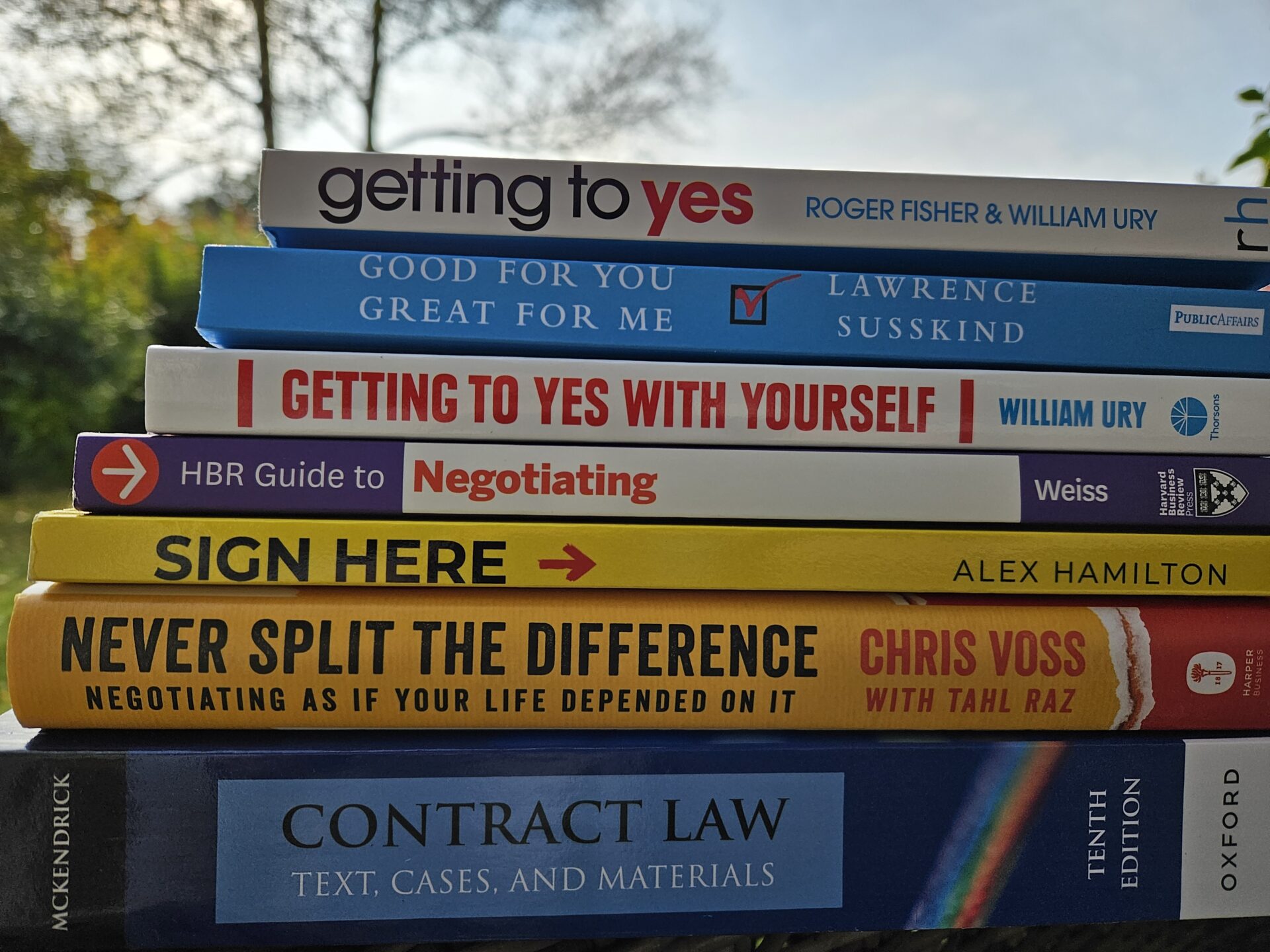
There are a wide range of books about negotiation on the market, which makes it difficult to know where to start. To simplify that, we have compiled a list of 7 books to improve your negotiation skills. The 7 Best Negotiation Books handle different aspects of negotiation as described below.
Getting to yes: Negotiating Agreement Without Giving In (various version and latest in 2011) by Roger Fisher, William Ury & Bruce Patton
The starting point of the new and better way of Negotiating, started at the Program on Negotiation at Harvard Law School. The book aims to pinpoint a method for reaching good agreements, i.e. principled negotiation or interest-based negotiations. The method is divided into four parts, which are relevant throughout the whole negotiation process:
- Separate the people from the problem (in short: do not become emotional when negotiating)
- Focus on interests rather than positions (in short: focus on finding a solution that works also for your counterparty. Don’t get stuck on your position, thinking it is the only (and the best way) to find a solution)
- Generate a variety of options before settling on an agreement (in short: be creative in finding a solution that creates a win-win for both parties)
- Insist that the agreement will be based on objective criteria (in short: compare the agreement to other comparable market standards where possble).
This book is a great book to teach you about the basics of becoming a better negotiator.
To gain further insights about this book and the main principles, see the more extensive summary here: https://www.pon.harvard.edu/daily/negotiation-skills-daily/six-guidelines-for-getting-to-yes/
Never Split the Difference – Negotiating as if your life depended on it (2016) by Chris Voss and Tahl Raz
This is the easiest book to read because it is very practical and it gives great real life examples. The content stems from Voss’ experience as a hostage negotiator in the FBI, which is why the tips are based on these situations. However, the tips can be applied in all negotiations. It is a great book with easy to use practical tips to improve negotiation skills.
The key points from the book are the following:
- Prioritise active listening
- Show empathy and understanding
- The empowered word “no”
- The power of the wording “that’s right”
- Unravel hidden needs through non-linear negotiation,
- Ask calibrated questions
- Understand the counterpart’s negotiation style and how to categorize them
- Embrace the unknown
If you are curious to know more about this book, see further information here: https://www.blackswanltd.com/never-split-the-difference.
Good for you, Great for me: Finding the Trading Zone and Winning at Win-Win Negotiation (2014) by Lawrence Susskind
As Fisher and Ury argue in their book that started it all (Getting to Yes), Susskind goes a step further and focus on so called “win-win” negotiation. That refers to how most negotiations play out, as a way of reaching an agreement based on finding the most beneficial outcome for both parties. Susskind’s book aims to show how to be the winner in win-win negotiations, as the outcome could be even better than good which is the goal of win-win negotiation.
For more information on Susskind’s book, continue reading here: https://www.pon.harvard.edu/shop/good-for-you-great-for-me/.
Getting to yes with yourself: How to Get What You Truly Want (2016) by William Ury
Negotiation is not only important for business negotiations between men in fancy suits. It takes place and is important anywhere and for everyone in their daily lives when interacting with other people.
Ury tries to explain how to negotiate in different settings by placing the focus on you and your actions, which might be what sabotages good outcomes from negotiations in your daily life. His aim is to avoid such traps and ensure you success in life.
To gain even more insight, read this interview with Ury: https://www.pon.harvard.edu/daily/teaching-negotiation-daily/getting-to-yes-with-yourself-book-william-ury/.
Harvard Business Review (HBR) Guide to Negotiating (2016) by Jeff Weiss
Continuously, Weiss presents further tips for negotiating successfully while maintaining the relationship with the other party in any event in your daily life regardless of the event and the other party.
Weiss pinpoints eight areas which you will gain more in-depth knowledge about to improve your skills to do the following:
- Identify the real issues at stake,
- Prepare materials in advance,
- Set the right tone in the beginning of the conversation,
- Handle emotions when negotiating,
- Tame a skilled counterpart,
- Know when to walk away,
- Manage negations between multiple parties, and
- Reality-proof your agreement
For further insights, see this more extensive summary of the book: https://www.vantagepartners.com/insights/hbr-guide-to-negotiating.
Sign here: The enterprise guide to closing contracts quickly (2021) by Alex Hamilton
When your goal is specifically business related, Hamilton’s book might be a bit more suitable as its focus is on the commercial contract process in connection to technical solutions.
As the title states, it is more focused on how to get your contracts signed quicker by improving processes. At AMST Legal we use a lot of the same principles that Alex recommends so we can highly recommend reading this book.
Some insights which you can get more in-depth knowledge about range from:
- The importance of speed in contract processes,
- There is no single solution which fits for every issue,
- Changes takes time,
- Set clear and reasonable terms,
- How to prioritize
The basis of the book stems from Hamilton’s practical experience in the field, which is why it is formatted as a practical guide.
To learn more, see the different formats of the book here: https://www.radiantlaw.com/book.
Contract Law – Text, Cases and Materials (2014) by Ewan McKendrick
Last, but not least, McKendrick’s Contract Law book. Correct, it does not explain practical negotiating tips explicitly. I added it to the list because in contract negotiations, negotiation tips only bring you as far as you can go without real legal knowledge.
It is a reminder that some negotiations you are only able to win with the right (in this case legal) knowledge. It also covers some relevant legal insights regarding e.g. unfair bargaining power between two negotiating parties.
This is an important negotiation realization. When negotiating a contract, it is good to realize the strength of the negotiation power. Think Microsoft, Salesforce, Uber negotiating a contract with a smaller party. Always take into account when the other party can be seen as stronger or weaker. If that is the case, there are protective legal regulations to adjust the unfairness of the negotiation relationship – this is where your lawyer can help you.
3. Conclusion
As we mentioned in this article, there are various types of books about negotiation which cover different areas. Therefore, this list of the 7 Best Negotiation Books is only an introduction of what could be helpful when learning or improving your negotiation skills. Hopefully, this might be helpful when choosing what negotiation books to consider buying when embracing the effective and important skill to negotiate.
If you need any advice, training or practical in-depth knowledge from a real negotiation expert and contract law advisor, please contact us at AMST Legal here.
Latest Posts
What Is the GDPR? A Practical Guide for Business Contracts
Everyone who works with contracts has seen it. A deal is moving nicely, and then someone mentions the GDPR or that data privacy wording needs to be added...
ChatGPT Terms of Service Explained for Businesses: Updated Terms
OpenAI recently updated its Terms of Use, Services Agreement, and Privacy Policy. OpenAI's ChatGPT terms are not mentioned in one contract, but by five...