

Comprehensive NDA Guide for Companies: Why are NDAs important?
Should you really ask your counterparty to sign that NDA for your company? Short answer to that is: yes. This does not have to be a cumbersome operation. They key is to protect your business with NDAs, while not overcomplicating the process. Due to increased digitalization and data flows, information is value. Therefore, keeping what is confidential should be a priority. This is why we have Non-Disclosure Agreements (NDAs). Companies often rely on NDAs as foundational instruments in commercial relationships to safeguard sensitive information. In practice, however, NDAs often fail to achieve their intended purpose because parties treat them as mere formalities or misunderstand their scope and function. This is why we want to explain what to pay attention to..
Many companies ask when to use an NDA in business negotiations. This is particularly important when sensitive commercial or technical information may be disclosed during early discussions.
This article, together with our previous articles on NDAs (see this part 1 covering what an NDA is, different types of NDAs and how it works here, see part 2 covering four crucial clauses in NDAs here and see part 3 covering the receiving party’s obligations here) aims to help companies understand why and how to effectively leverage NDAs. In turn, this can help streamline NDA processes. In this article “Comprehensive NDA Guide for Companies: Why are NDAs important?” we focus on explaining the need of NDAs how to protect companies’ sensitive information by aligning legal clarity with real operational needs.
TLDR – If you only have a minute to read
- NDAs help companies protect sensitive information during business negotiations and partnerships.
- Many types of commercially valuable information are not automatically protected by law, which makes contractual confidentiality essential.
- NDAs clarify how confidential information may be used, shared, and protected between parties.
- In SaaS, procurement, sales, investment discussions and joint development projects, NDAs help manage business confidentiality risk.
- Understanding when to use an NDA in business negotiations helps companies avoid disputes and protect competitive advantage.
What we will cover
In this article series, we will explain:
- Why are NDAs relevant?
- What is the difference between confidential information and trade secrets?
- What key NDA-clauses to use for optimal protection and usability, and
- A receiving-party obligations checklist you can use today
In this article we focus on the first topic of why NDAs actually are relevant.
Terms Used in This Article
Let’s first start with: what is an NDA and what are the most used definitions when speaking about NDAs?
Non-Disclosure Agreement (NDA)
A legally binding contract that requires one or more parties to keep certain information confidential and limits how that information can be used or shared.
Confidential Information
Information that is not publicly available and that provides commercial value because it remains secret. Examples include pricing models, customer data, product plans, or internal financial information.
Trade Secret
A specific category of confidential information that derives economic value from being secret and is protected under trade secret law if appropriate safeguards are maintained.
Receiving Party
The party that receives confidential information under an NDA and is obligated to protect and restrict the use of that information.
Disclosing Party
The party that shares confidential information with another party under the terms of an NDA.
Statutory Protection
Legal protection provided automatically by law, such as trade secret law or data protection regulations.
Contractual Confidentiality Obligation
A duty created by contract that requires a party to protect and limit the use of confidential information.
Due Diligence
A process where companies review financial, legal, or operational information before completing a transaction such as an acquisition or partnership.
Why are NDAs important?
Knowledge era and data market
We currently live in the knowledge era. That means that information, or data which is another common way to refer to it, is one of the most important trade items today. Information is shared left and right through various means, commonly through SaaS solutions like Gmail, Outlook, OneDrive, Sharepoint, websites and AI etc. This is naturally very convenient and part of mostly everyone’s daily life today. At the same time, companies with a lot of data can gain a competitive advantage as it can offer benefits for various business actions like marketing and sales. Data is a highly valuable resource in other words. Because of this it may not be a surprise that selling data can generate high revenue, and that the value of the data market follows a steady growth rate. However, what situations could reveal such sensitive information? Well, there are various situations, but it may happen when:
- Presenting inventions or business ideas to a potential partner, investor or distributor,
- Sharing details about your company’s finances or marketing with a prospective buyer of your company,
- Receiving services from a company or individual who may have access to some sensitive information when providing those services, or
- Employees gain access to confidential and proprietary information about your company during the course of doing their job.
(see Forbes article “The Key Elements of Non-Disclosure Agreements on Forbes” here).
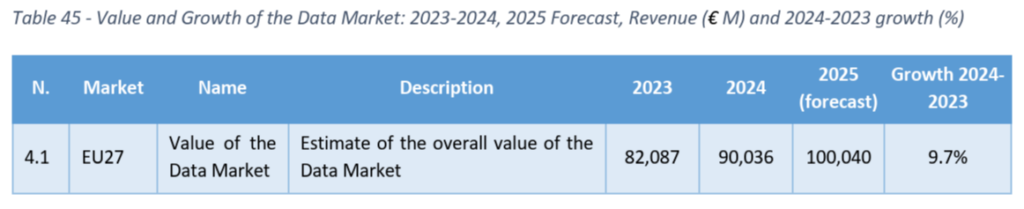
For an illustration of the this, see the chart above from the European Data Market Study 2024-2026 showing that the data market is growing further every year.
Despite the amount of information that is shared continuously, there are many situations where companies cannot, do not want to or are legally constrained from sharing specific information. The specific reason can naturally differ per situation, and does have a specific legal background. However, some common reasons for non-ability to share certain information boils down to either one, two or all purposes below. At the same time these reasons are also situations that calls for an NDA.
Maintaining a Competitive Advantage
From a business standpoint, information is often the most valuable asset a company holds. Companies often operate in highly competitive markets where margins, positioning, and innovation cycles matter. Disclosing certain information, even if it is not strictly confidential in the legal sense, can reveal information that holds great value for your company. That can be for example pricing strategies, cost structures, supplier relationships, sourcing models, product development or acquisition targets. In many cases, the law does not require but does not either forbid disclosure.
In legal practice, confidential information generally refers to information that is not publicly known and that provides commercial value because it remains secret.
Protecting Others Confidential Information
Sensitive information that shall not be shared is not always limited to your own company’s information. Companies are oftentimes also responsible of maintaining other parties’ confidential information secret. Which kind of confidential information that refers to can be vastly different. However, common information this can refer to are for example:
- licensed software or technology,
- co-developed products,
- joint ventures,
- supplier innovations, or client-owned materials.
Information or knowledge like this may be protected either by law or by contracts. If you are required to not disclose the information it is likely due to a contract, commonly an NDA. The important thing to know is that exploiting others’ confidential information may lead to different unwanted consequences.
Compliance with Applicable Laws
Complying with applicable laws poses one of the most strict drivers behind non-disclosure. Companies operating in the EU today are subject to overlapping legal regimes that can differ drastically across jurisdictions and industries. Within the EU, it can concern regulations like GDPR with the purpose of protecting individuals’ personal data for example. If your customers are consumers, it also unleash several consumer specific regulation and directives. On top of this, local national legislation also becomes relevant of course. Generally, secrecy obligations can be triggered by everything from employment laws, sector-specific regulations, professional secrecy obligations or public procurement confidentiality rules. These secrecy obligations due to regulatory laws or sector-specific regulation can be more or less strict and is very dependent of the situation itself.
Compliance with Non-legal Sector-Specific Duties
In certain sectors or industries, certain specific non-legal duties play a crucial role in why companies cannot always share certain information too. This mainly revolves around either companies operating in for example finance and banking or healthcare or specific personnel bound by confidentiality duties like accountants, teachers or doctors. Disclosing sensitive information, even if technically lawful in certain cases, can cause harm, undermine trust, or violate professional standards in areas such as financial markets, healthcare, and children’s education. Ethical information governance helps companies prevent misuse, protect vulnerable stakeholders, and maintain long-term credibility, which is increasingly important for regulators, investors, and consumers alike.
Keeping Contractual Promises
This is one of the most common and most underestimated reasons for non-disclosure. Modern business relationships are, and should be, governed by various contractual obligations in different forms between different parties. Oftentimes various regulation and laws may not be applicable either due to contractual choices between the parties. This makes the underlying contract the most important regulation. Despite the case-by.case factor that is highly relevant for each contractual relationship, contractual promises are legally enforceable and can be found in very different forms. Normally, contractual promises are embodied and found in NDAs, However, it can also be found in separate clauses of specific contracts. This includes for example Data Processing Agreements, Master Service Agreements, Service-Level-Agreements or License Agreements. In other words, promises to keep information secret are not limited to NDAs. However, the confidentiality promise is the same and the contract sets out the obligations and rights for each party.
How NDAs can help and what NDAs can achieve
The relevance of a contractual protection mechanism

NDAs play a vital role in protecting sensitive business information in today’s digital, data-driven economy. Companies share large volumes of information in negotiations, partnerships, and daily operations, and without a clear contractual framework, that information can be misused or disclosed unintentionally. While technical safeguards like password protection and secure logins help reduce breach risks, they don’t replace contractual protection or address the legal consequences of misuse.
In practice, NDAs provide contractual protection of sensitive information, particularly in negotiations, due diligence processes, technology partnerships, sales contracts and procurement discussions.
So, how can a simple contract help then? Well, in broad terms, an NDA is a contract that specifies confidential information, what can be done with it and what happens in case that information is disclosed. Essentially, it acts as a safeguard of the specific information it aims to protect. By clearly setting these boundaries, NDAs reduce ambiguity and prevent misunderstandings. This clarity becomes increasingly important as information is shared through digital tools, cloud services, AI and cross border cooperation.
Sometimes, in the heat of transactions between companies, there is always a wish to close deals quick though. This is common and understandable, but may also lead to poor protection of sensitive information. Because, as intricate as every legal system is, it is important to know that it is not always enough to argue that the other party promised to keep your confidential information safe, and there is no generally applicable law safeguarding confidential information shared between companies apart from some specific exceptions that are not always applicable. If the good protection mechanisms of an NDA is used correctly though, it makes up a great tool that shouldn’t be underestimated. A well drafted NDA acts as a preventive safeguard rather than a reactive remedy and have several benefits to it.
Enforceability and Risk Management
NDAs create legally binding obligations that allocate risk between the parties from the outset. They normally specify the consequences of unauthorized disclosure or misuse and may provide contractual remedies. This predictability strengthens legal certainty and reduces the likelihood of disputes. From a risk management perspective, NDAs transform confidentiality from an informal expectation into an enforceable commitment. This is particularly valuable in international business relationships where legal protections differ between jurisdictions and statutory confidentiality rules may be limited or inconsistent.
Operational Clarity in Practice
In daily operations, NDAs translates confidentiality obligations into clear and actionable rules for employees, consultants, and external partners. An effective NDA clarifies who may access confidential information, how it may be shared internally, and what security measures apply. By aligning legal obligations with actual business workflows, NDAs reduce the risk of accidental disclosures and strengthens internal compliance. This operational clarity is essential in organizations where information flows quickly across teams and systems.
In operational terms, NDAs convert abstract confidentiality expectations into clear internal rules for employees, advisors, and external partners.
Protection Beyond Statutory Law
Many companies assume that confidential information automatically benefits from legal protection. In reality, statutory protection is often limited to specific categories of information. A wide range of commercially sensitive information remains unprotected unless the parties agree otherwise. NDAs fill this gap by contractually protecting information that may not qualify for statutory protection but still holds significant business value. This includes for example pricing structures, customer data, strategic plans, technical concepts, and early stage innovations. Through NDAs, companies can tailor confidentiality obligations to their specific business needs.
Importantly, many forms of commercially sensitive information do not automatically receive statutory protection, which is why companies rely on contractual confidentiality obligations.
Enabling Trust and Collaboration
Clear confidentiality obligations do not hinder cooperation. On the contrary, NDAs enable transparency and trust in commercial relationships. When parties understand the rules governing information use and disclosure, they feel more comfortable sharing the information necessary to assess opportunities and move projects forward. NDAs therefore function as enablers of collaboration. They allow companies to engage in negotiations, due diligence, and joint development while maintaining control over their most valuable assets.
Practical Examples and Use Cases
These examples illustrate when companies should use an NDA in business negotiations, especially where proprietary data, pricing models or technical information is shared.
SaaS and Technology Deals
In SaaS transactions, vendors often disclose product architecture, security measures, and integration capabilities during sales cycles. At the same time, customers may share internal data structures or workflow information. If no NDA governs these exchanges, both sides face business confidentiality risk. A competitor could replicate a feature, or internal data insights could leak. Therefore, technology companies typically implement NDAs early in the sales process to ensure mutual protection.
Procurement and Competitive Bidding
Procurement teams frequently request detailed proposals from multiple suppliers. Those proposals may include proprietary methodologies, pricing strategies, or process innovations. Without a confidentiality framework, suppliers may hesitate to provide meaningful detail. As a result, the quality of comparison declines. An NDA signals seriousness and encourages transparent participation. Consequently, procurement benefits from clearer offers and reduced legal exposure.
Founders, CFOs, and Investment Discussions
Founders regularly present financial projections, market strategies, and technical concepts to potential investors or partners. While investors may resist overly restrictive terms, a balanced NDA clarifies expectations. CFOs, meanwhile, must consider financial reporting obligations and reputational risk. If sensitive financial data circulates without restriction, market perception and valuation could suffer. In these contexts, understanding why NDAs are necessary supports informed decision-making rather than reactive damage control.
Frequently Asked Questions (FAQ)
Q: When should companies use an NDA in business negotiations?
An NDA should be used whenever commercially sensitive information is shared before a formal agreement is signed. This commonly occurs during partnership discussions, procurement processes, technology evaluations, and investment negotiations.
Q: Are NDAs always necessary in SaaS negotiations?
Not always, but they are often advisable. During SaaS negotiations, vendors may disclose product architecture or security details, while customers may share internal workflows or datasets. An NDA helps protect both sides during these exchanges.
Q: What risks do companies face if they do not use NDAs?
Without contractual confidentiality protection, sensitive information may be disclosed without legal consequences. This can result in competitive disadvantage, reputational harm, or loss of intellectual property value.
Q: Are NDAs enforceable across international business relationships?
Generally yes, provided the agreement clearly defines the confidential information, obligations, and governing law. However, enforcement may vary depending on jurisdiction.
Q: Does the law automatically protect confidential business information?
No. Many types of business information are not protected unless contractual obligations exist. NDAs therefore fill an important legal gap.
Q: Can NDAs slow down business negotiations?
Well-structured NDAs usually accelerate negotiations because they create a clear framework for sharing information safely.
Q: Do NDAs protect both parties?
They can. NDAs may be unilateral (protecting one party) or mutual (protecting both parties). We usually only agree to mutual NDAs and we advise you to ask the same in each NDA negotiation. There should only be a few exceptions to that. Let is know where you are in doubt.
Key Takeaways
- Information is valuable and can be a major leverage,
- Digitally available confidential information is easy to disclose and risks disclosure if safeguards are not in place,
- Sensitive information should be treated with care and should be protected,
- Confidential information can be very different
- NDAs constitute a great form of contractual protection of business sensitive information,
- Different occasions calls for different contracts, and NDAs may be the right one.
Conclusion & Next Steps
Understanding when to use an NDA in business negotiations allows companies to protect commercially sensitive information before it becomes legally vulnerable.
NDAs are far more than administrative checkboxes or deal-closing formalities. They are essential governance tools that help companies protect value, manage risk, and collaborate with confidence. When used thoughtfully, an NDA translates abstract legal duties into concrete, operationally workable obligations that teams can understand and follow in practice. It bridges the gap between legal theory and everyday business reality by safeguarding sensitive information while enabling growth, innovation, and trust-based partnerships.
For executives, NDAs should be viewed as risk-allocation tools that clarify how information may be used during negotiations and commercial cooperation.
As a next step, it is a tip to critically review your current secrecy and NDA practices. In the upcoming parts of this article series, we will continue to build on this foundation by exploring the distinction between confidential information and trade secrets, identifying key NDA clauses for optimal protection and usability, and providing practical checklists that companies can apply immediately. If you want to ensure that your NDAs are not only legally sound but also commercially effective, this is the moment to move from formality to strategy.
For tailored guidance or a review of your existing NDA framework, visit amstlegal.com to learn more, book a consultation today here or email us at info@amstlegal.com.
Latest Posts
Comprehensive NDA Guide for Companies: Why are NDAs important?
Should you really ask your counterparty to sign that NDA for your company? Short answer to that is: yes. This does not have to be a cumbersome operation....
E-Signature Policy and Signing Authority Matrix: Why is That Important?
Where is the fully signed contract? Why can an e-signature policy and signing authority matrix help with that? Here is a question worth asking in your...